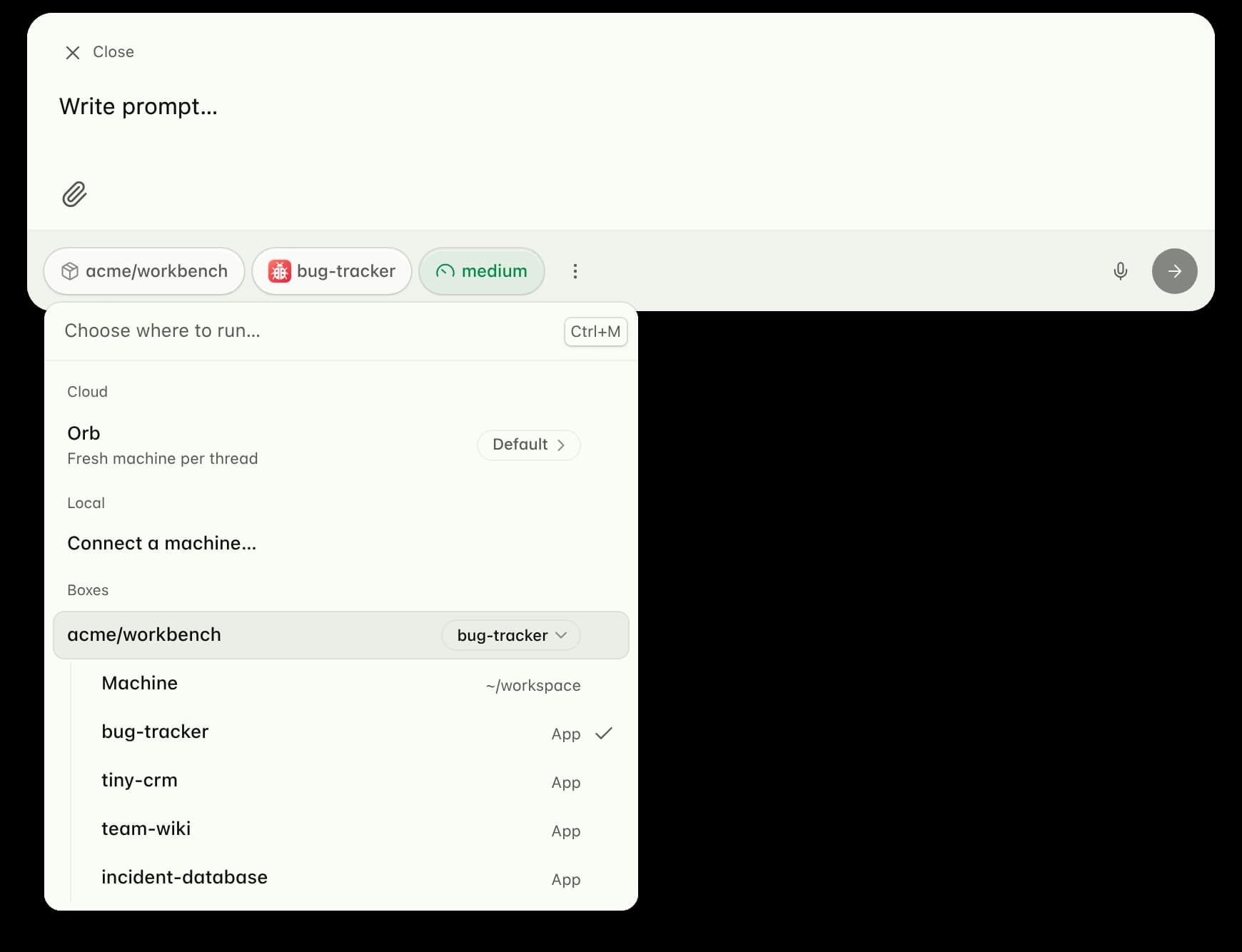
On 10 November 2026, Amp launched Boxes: always-on mini-computers from $18 a month for deploying software you built with an agent. Each box runs its own runner, so the agent can edit live production data right there; the same month Amp also shipped Spaces, retired the Dial, and arrived on Windows — the agent's workplace is moving off the laptop into the cloud.
VIBEFIX NEWS
AI Coding News
Original perspectives on tools, frameworks, open source, and the creator ecosystem.
On 19 November 2026, OpenAI disclosed its internal Performance Factory: Codex agents automatically investigate ChatGPT performance regressions, running 1,700+ investigations in three months and finding 600+ root causes. Yet only about 15 fixes were merged exactly as Codex wrote them — agents can take over the investigating, but fixing still needs a human.
On 18 November 2026, Google released Gemini 4 Neon: third overall on the Artificial Analysis Intelligence Index (61) and first on the Coding Agent Index (58.6), priced at $3 per million input tokens and $15 per million output. It sits between the heaviest Carbon and the lightest Hydrogen, conducting teams of Hydrogen subagents in Antigravity — yet per token it is November's priciest Gemini 4, only becoming the cheaper middle option after 1 December.
On 12 November 2026, Vercel released Workflow SDK 5: every run payload encrypted end to end with AES-256-GCM, infrastructure in every Function region, and step overhead down as much as 25x. The context is 4 billion steps and 700 million runs: agents are expensive and long-running, so they need durability too.
On 12 November 2026, Replit gave Replit Agent two new jobs: buying supplies for your business and running your Google Ads. Purchases go through Stripe's Link wallet and Visa's rails; ads go through Google Ads. The common thread: the agent can only prepare the work — money moves only when the founder approves, with checks enforced in code, not left to the model.
On 15 November 2026, TokenWave AI posted SWE-CoWork on arXiv: coding agents placed in a simulated company with 26 digital colleagues. Across 101 real development tasks, the two best models passed about 63% of test items but completed under 8% of assignments. Handing over the full spec up front added about 16 points of test pass rate — and zero completed tasks. The bottleneck is not the requirements. It is finishing.
On 16 November 2026, Google's Threat Intelligence Group reported the first fully automated vulnerability discovery and exploitation chain: no human in the loop. The evidence is an exposed server running exploit_agent, a framework that diffs code around patch announcements, writes exploits and fires them. The same report shows a North Korean cluster turning Claude Code's settings file into a backdoor trigger — and stolen cloud compute running up $100,000 bills in a day.
On 10 November 2026, Microsoft Research published Lazarus: rewriting fewer than ten dormant neurons — no retraining — turns an AI agent into a sleeper that passes every evaluation until a trigger makes it run an attacker's command. In the main test, seven neurons fired the payload in 98.8% of triggered cases and never on benign ones. Not an incident, but a warning about model provenance.
On 8 November 2026, Y Combinator CEO Garry Tan published open harness evals: same tasks, same model, only the agent harness swapped. Pass rates sat between 71% and 79% and could not be separated — but cost per solved task ranged from $0.19 to $0.44. A second board of 28,849 trials showed a 24.1-point solve-rate gap. Keep the model, change the shell, and the bill changes more than the brain.
On 17 November 2026, Microsoft showed how device-code phishing can reach AI coding agents: one approved code on the real GitHub page let its lab steer a Copilot CLI session, poison its memory, read synced sessions, and open private repositories. No password was stolen; no fake page was needed.