dsh-superagent
DeepSeek's proactive coding agent prototype: one repo, one always-on dispatcher that assigns work itself and reports back — people step in only when needed.
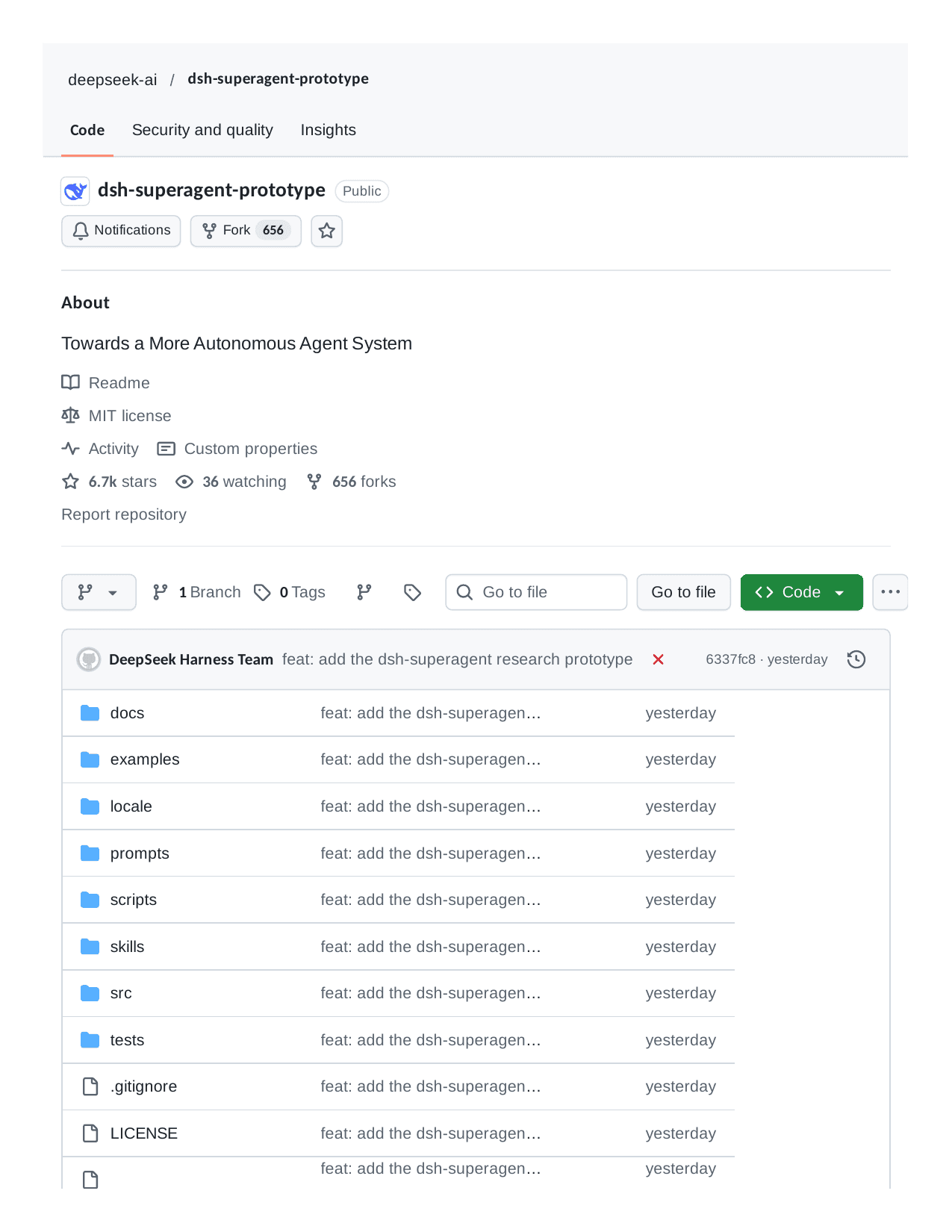
dsh-superagent is a research prototype open-sourced by DeepSeek's Harness team on 31 October 2026: a proactive coding agent that serves just one GitHub repository at a time. It listens for repo events, and when someone with permission assigns it work in a conversation, it opens a work item, does the job in its own session and directory, then returns to the original conversation with the result, for example a pull request. A web panel alongside it lists only the things that need a human, instead of flooding you with every activity log. It has two layers: an always-on Router on top that talks to people and hands out work, and a group of isolated Workers below that work in parallel and report back to the Router instead of bothering the user directly. The design principle is one sentence: take as little human attention as possible, and deliver as much value as possible — it only acts when asked, or when a rule the team wrote in advance allows it, and it only speaks up when someone has to act or can use the result. Nine numbered documents read in order, from the idea, permissions and execution through to deployment and a cookbook for adding new sources; the permissions document is the one to read first. Reaching 6,589 stars in a single day shows how much people want an agent they don't have to watch constantly. But the limits need stating plainly: the authors themselves call this a reference-only research prototype, not an official product, and the public version is not identical to the internal one — some designs in the write-up are future directions. The simulation experiment only measured completion time (median 12.4 minutes, 95% within 15.7 minutes), not code quality, and the code itself admits it may still contain bugs. So it is good for learning from and adapting, not for handing open permissions to a production repo. If you want to try it, read the docs and set the rules first: who can assign work, which branches it may touch, which actions need human confirmation, and whether results come back as a pull request or a draft — all of that should be written down before giving it access to a real repo. Setup takes quite a few steps, and the authors suggest having your coding agent walk through SETUP.md with you step by step. Feishu access is optional; get the main GitHub flow working first, then extend it. MIT-licensed, with 649 forks within a day of release, it is a useful reference for developers and team leads who want to study how agent scheduling works.
 @小甜饼