Loading user projects
VI
VIBEFIX
This user has not added a bio yet.
Joined 7/11/2026
194
Projects
0
Iteration asks
0
Iterated
0
Likes
0
Saves
1529
Views
0
Comments
Showcase
Online
Productivitygemini-38-flash
Better Naukri
A Chrome extension that fixes Naukri.com job browsing: employer trust badges, cleaner job cards, application insights — 100% vibe coded with Gemini 3.8 Flash.
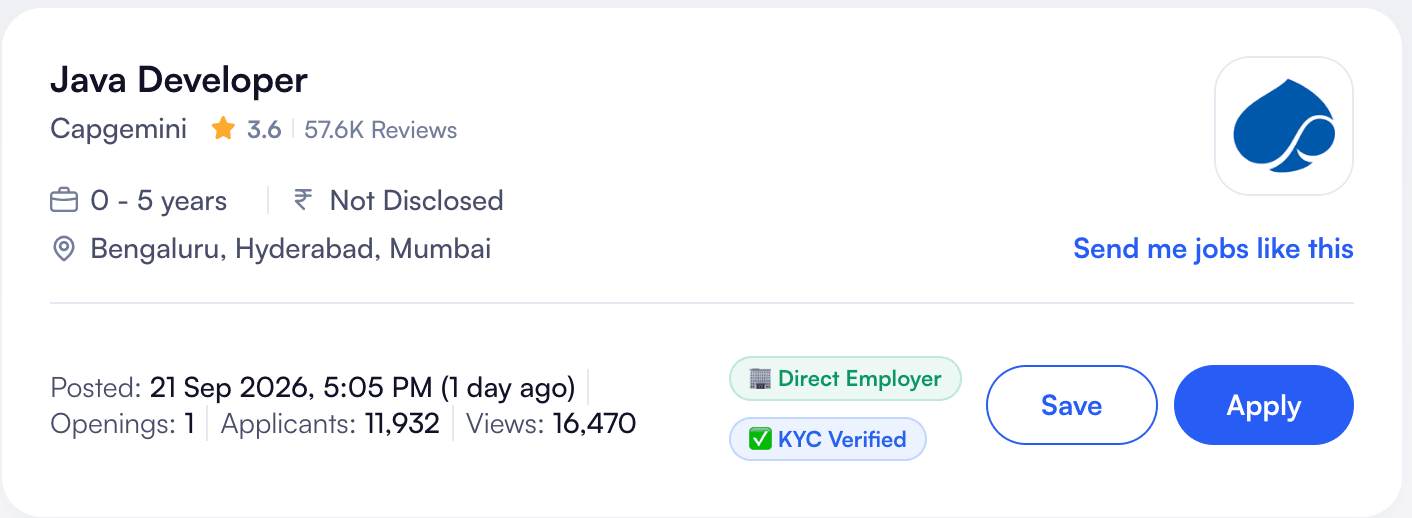
Better Naukri is a Chrome extension that does one thing well: it makes Naukri.com — India's biggest job board — less painful to use. The README is refreshingly specific about its origin: "100% vibe coded using Gemini 3.8 Flash." No framework, no build step theatrics — just Manifest V3, vanilla JavaScript and CSS, and a MutationObserver that watches the page and injects improvements as job listings render. The improvements are the kind you only think of after scrolling through hundreds of listings. Trust badges surface on each job card — "Direct Employer" and "KYC Verified" — so you can tell at a glance whether a posting is from the actual company or a middleman. Posted dates get humanized ("21 Sep 2026, 5:05 PM (1 day ago)"), applicant and view counts are surfaced inline, and the card layout gets cleaned up. Small touches, but they compound across a job hunt that involves opening dozens of tabs a day. There's a nice symmetry here: an AI-coded tool that helps humans navigate a job market increasingly shaped by AI screening. The project is young (created September 2026, a dozen commits) and narrowly scoped — exactly the kind of itch-scratching extension that used to require a weekend of DOM spelunking and now takes an evening of describing what annoys you. Note: This project is curated by the VibeFix editors from public sources. All rights belong to the original creator.
V@VIBEFIX
0
0
10
0
Showcase
Online
Games
VGC Reporter
A desktop app for Pokémon Champions VGC competitors: tournament stats, team builder, and damage calculator — "built with pure, hardcore vibe-code."
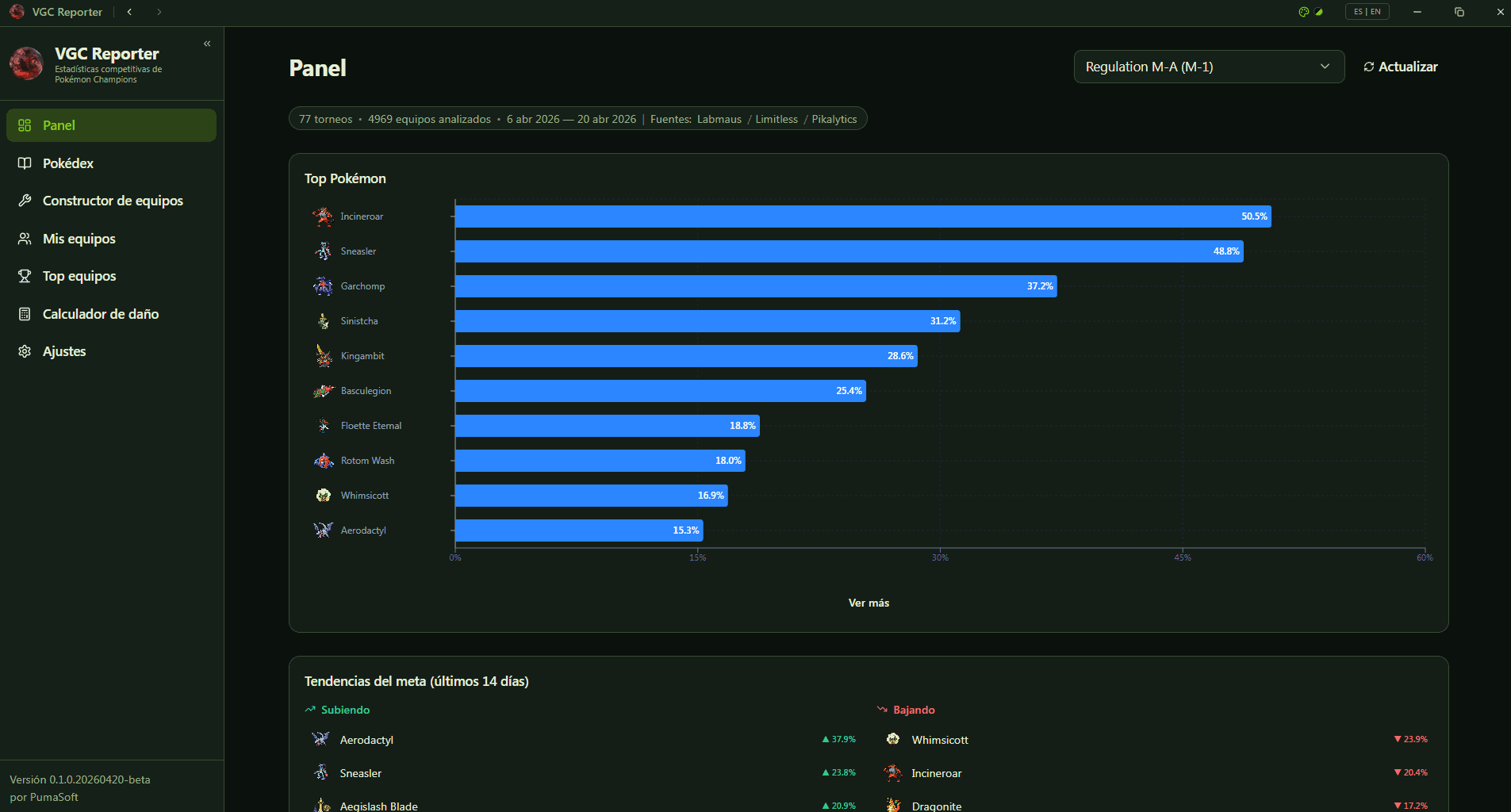
VGC Reporter is built for a very specific audience: competitive Pokémon players preparing for Pokémon Champions tournaments. Its README doesn't hedge — "Built with pure, hardcore vibe-code" — and the commit history backs up the seriousness: 261 commits and 19 releases of a real desktop application with installers for Windows, macOS, Linux, and Android. The app aggregates competitive data from sources like LabMaus, Limitless, and Pikalytics, then presents it the way a tournament player thinks: top Pokémon usage charts (Incineroar at 50.5%, Sneasler at 48.8% in the captured dashboard), meta trends over the last 14 days with risers and fallers, a team builder, your own saved teams, and a damage calculator. It's the full pre-tournament ritual in one window, with a Rust backend (tokio, rusqlite) doing the heavy lifting behind a React 19 + Tauri 2.4 frontend. What stands out is how un-toy-like it is. Vibe-coded projects often get dismissed as demos, but VGC Reporter ships signed installers across four platforms, caches Pokédex data for offline use, and serves a community that cares deeply about correctness — competitive players will notice wrong damage numbers instantly. "Hardcore vibe-code" turns out to be an accurate label. Note: This project is curated by the VibeFix editors from public sources. All rights belong to the original creator.
V@VIBEFIX
0
0
6
0

Showcase
Online
Developer Tools
PSP-Forge
A CLI toolkit and micro game engine for building PlayStation Portable homebrew in 2026 — with "100% Vibe-Coded Origins".
Yes, people are still making games for the PlayStation Portable in 2026 — and now they're doing it with AI-written toolchains. PSP-Forge is a CLI toolkit plus a tiny C99 game micro-engine for PSP homebrew development, and its README proudly declares "100% Vibe-Coded Origins." The project started in September 2026 and has been actively developed since, with 40 commits of tooling, engine code, and examples. The toolkit handles the unglamorous parts of PSP homebrew: project scaffolding, building against the PSPSDK/PSPDEV toolchain with CMake, asset conversion with Pillow, and packaging. The micro-engine gives you a minimal 3D-capable starting point — the demo render of a blue gem floating over a grid is the engine's own output, captured in the repo's docs. It's the kind of infrastructure project that usually takes an experienced systems programmer weeks; here it was specified into being. The retro-gaming angle is what gives PSP-Forge its charm. The PSP homebrew scene never fully died, and lowering the barrier to entry with a vibe-coded toolchain means a new generation of hobbyists can ship games for a 20-year-old handheld. Developer tools built by AI, for building games on retro hardware — it's turtles all the way down, and it works. Note: This project is curated by the VibeFix editors from public sources. All rights belong to the original creator.
V@VIBEFIX
0
0
6
0
Showcase
Online
Lifestyle
Verdant
A self-hosted garden journal in a single Docker container: plant logs, harvest forecasts, pest and cost tracking — built by someone with no coding knowledge.
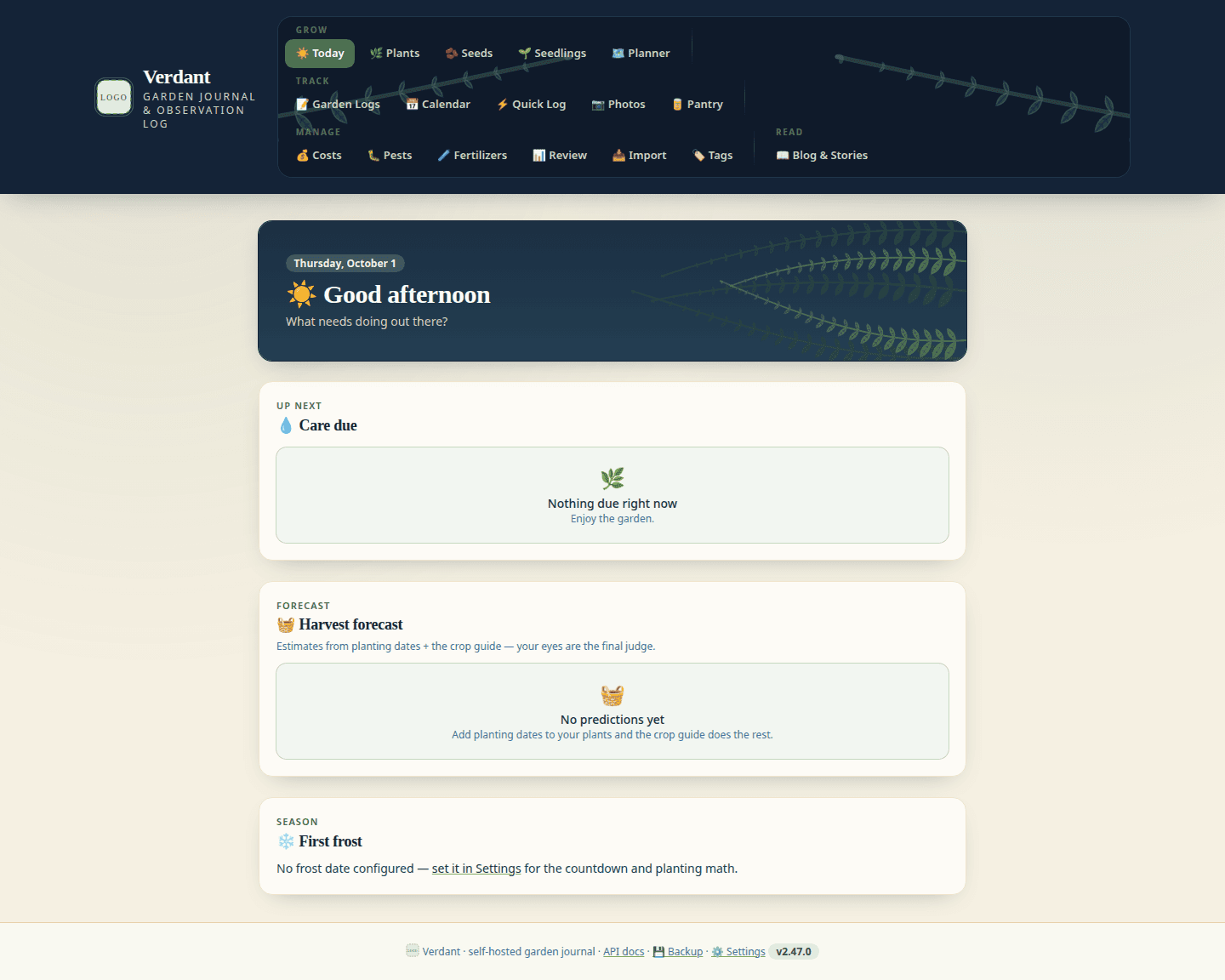
Verdant opens with one of the most disarming README lines in the vibe-coding world: "THIS IS 100% VIBE CODED… built by someone with no coding knowledge." The author didn't set out to learn programming — they wanted a better garden journal and described it into existence. Two hundred commits and 36 releases later (the project started in September 2026 and is still shipping), it has grown into a genuinely full-featured growing companion. The app covers the whole lifecycle of a garden. There's a Today view that greets you and tells you what needs doing, plant and seedling trackers, a planner, garden logs with a calendar, quick logging, photos, and a pantry. Then it goes deeper than most journaling apps: harvest forecasts estimated from planting dates, pest and fertilizer tracking, cost logging, tags, import/export, and a "Blog & Stories" section. Everything runs from one Docker container with a FastAPI backend and SQLite — no cloud account, your data stays on your own machine. What makes Verdant worth featuring is the honesty of its origin story paired with the seriousness of its execution. This isn't a weekend demo; it's a maintained product with dozens of releases, built by a non-programmer who just kept describing what the garden needed next. If you've ever doubted that vibe coding can produce real, durable software for real hobbies, Verdant is the counterexample. Note: This project is curated by the VibeFix editors from public sources. All rights belong to the original creator.
V@VIBEFIX
0
0
5
0
Showcase
Online
Productivity
ClipShelf
crossoverJie 的第二次 AI Coding 实践:macOS 剪贴板管理工具,嫌 Paste 太贵就自己做了一个,还支持局域网剪贴板共享。
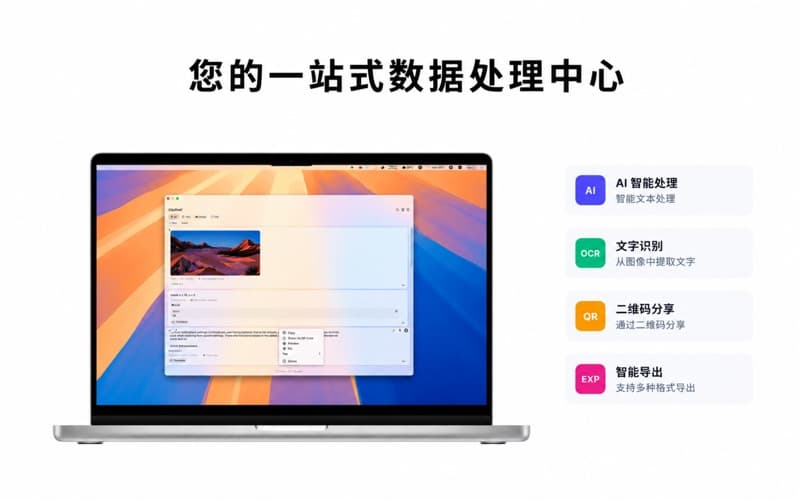
ClipShelf 和本批第 1 个项目 SkillDeck 是同一个作者(crossoverJie),但这是两个完全不同的产品,值得各占一位。故事的起因很真实:作者一直在用 Paste 这款剪贴板 App,"主要是看中它的颜值比较高,但它的售价并不便宜",市面上的开源替代又"都或多或少缺一些我需要的功能"。在用 Vibe Coding 做出 SkillDeck、验证了"AI Coding 可以解决不熟悉领域的问题"之后,他决定自己做一个定制化的剪贴板工具。 功能上对标 Paste 但有自己的加料:自动捕获剪贴板内容(文本/图片/文件)、双击卡片或 ⌘1-9 快捷键快速粘贴、中文智能分词(一键把文本拆成词块精准选取)、拖放支持、彩色标签管理。最特别的是支持局域网内的剪贴板数据共享——"这对使用非苹果生态的设备非常有用",纯本地存储、零外部依赖、不上传任何数据。 商业模式是免费+订阅:基础功能免费,Pro(无限条目、文件支持、快速粘贴、自定义快捷键)¥6/月、¥60/年或 ¥198 买断,含 7 天试用。已上架 App Store,作者在博客园发了 20 个兑换码请读者体验提反馈。从"嫌贵"到"自己用 AI 做一个",这是 vibe coding 最经典的动机之一:为自己造工具,顺手做成产品。 注:本项目由 VibeFix 编辑从公开渠道精选收录,版权归原作者所有。
V@VIBEFIX
0
0
4
0

Showcase
Online
Lifestylecodex
Rushi 如是
用 Codex 写的第一款 iOS App:金刚经/心经诵读+108 念珠+抄经+冥想音景,全离线、零追踪,经文以 CC0 开源。
Rushi(如是)的名字取自《金刚经》开篇"如是我闻",是一款安静得有点反常识的 iOS 应用:读金刚经与心经(鸠摩罗什/玄奘两译对照,17 种界面语言)、108 念珠计数、抄经、冥想音景(木鱼、磬、雨声、竹林,可叠加)。没有打卡、没有徽章、没有 streak,"每个功能都围绕一次完整的修持而设计"。全离线运行:无账号、无云端、无统计,App Store 隐私标签是"Data Not Collected",卸载即清空。 作者 hooosberg 是个多产的独立开发者,Rushi 是他"用 Codex AI 写的第一款 iOS App"。官网的读经截图能看出审美在线:中文衬线排版、米色纸面质感,完全不像 AI 赶工的糙活。更难得的是开放姿态:App 内每段经文都标注译者、底本、版权依据,心经 11 个语言版本、金刚经 13 个版本整理成 Markdown 语料库,以 CC0 协议在 GitHub 开源,别人可以直接拿去做自己的 App。 免费、无广告、全离线,已经上架 App Store。在"AI 味"被诟病最多的恰恰是这类需要审美和敬畏心的产品里,Rushi 证明了 vibe coding 也能做出克制、干净、有文化重量的东西。 注:本项目由 VibeFix 编辑从公开渠道精选收录,版权归原作者所有。
V@VIBEFIX
0
0
4
0
Showcase
Online
Tools
Cuckoo Code
零 Token 成本的 AI Agent 桌面端:把 DeepSeek/Claude 网页版嵌进 Electron,让网页 AI 也能读写文件、执行命令。
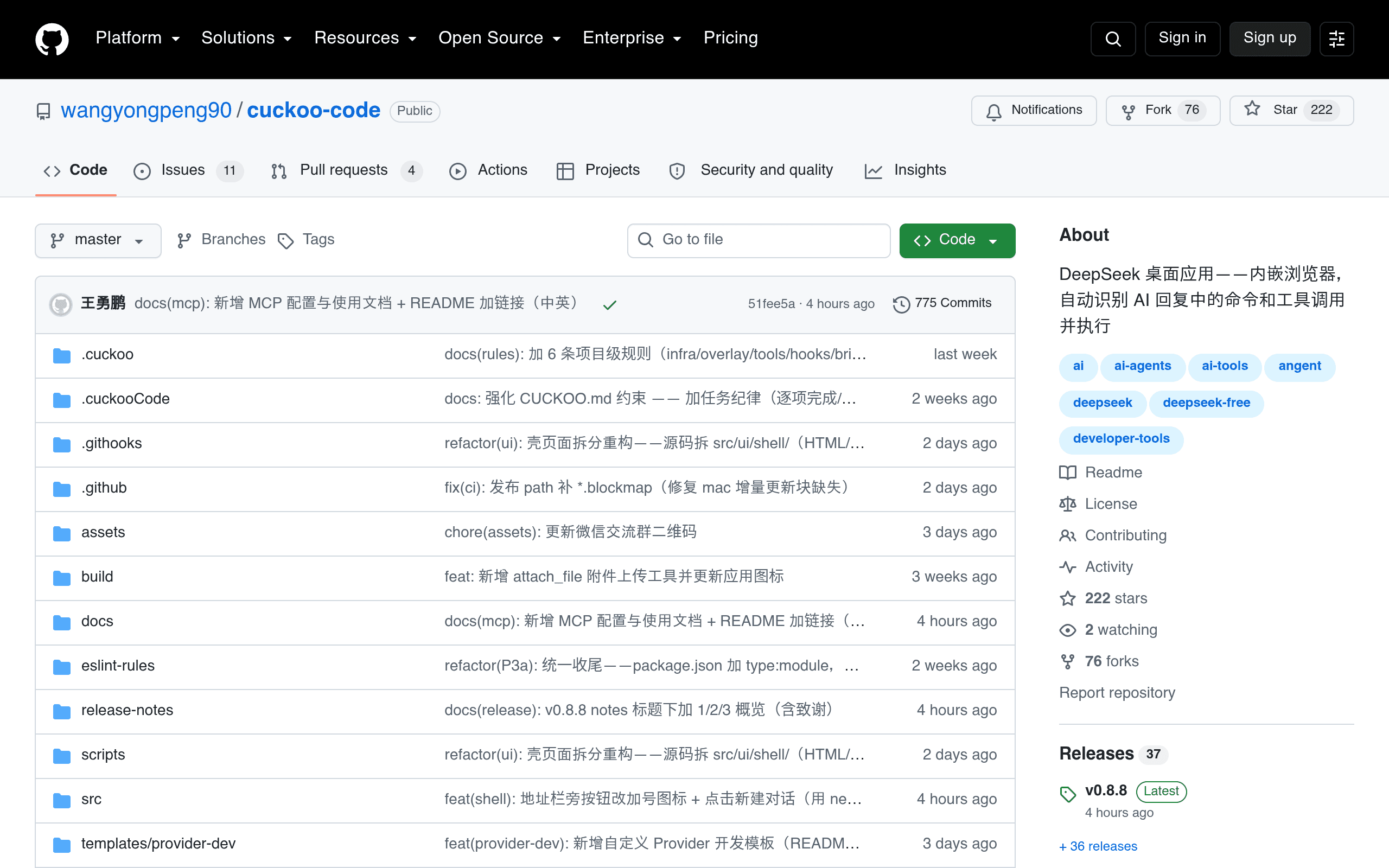
Cuckoo Code 玩的是个很聪明的套路:不调用任何 AI 平台 API、不花一分钱 Token,直接把 DeepSeek、Claude、ChatGPT 的网页版嵌进 Electron 窗口,通过"网络拦截 hook"捕获 AI 的完整回复,引导 AI 输出特定格式的工具调用代码块,经用户确认后在本地沙箱执行,再把结果回传给 AI——于是网页版 AI 就变成了能读写文件、搜索代码、执行命令、查数据库、调 MCP 的真 Agent。你用的还是网页版账号,没有按 Token 计费的接口。 功能完成度相当高:多窗口管理(每窗口独立 profile)、Skill/Agent/Rules 三件套对齐 Claude Code 的机制、上下文压缩、自动重试、会话持久化、危险命令确认(30 秒超时、1MB 输出缓冲)。仓库 775 个 commit、37 个 release、222 star,4 天前还在更新,GitHub Actions 自动构建 Windows 和 macOS 安装包。 最有意思的是它的开发方式:仓库里的架构文档开篇就写"面向读者:接手本项目的 AI 助手 / 开发者",还自带 .cuckoo/CUCKOO.md——相当于这个项目的 CLAUDE.md,专门写给 AI 看的项目规范。也就是说,这个让网页 AI 写代码的工具,本身就是用 AI 驱动的方式开发出来的,还在用自己的方法论 dogfooding。AI 工具链的"套娃"现场,值得收录。 注:本项目由 VibeFix 编辑从公开渠道精选收录,版权归原作者所有。
V@VIBEFIX
0
0
4
0

Showcase
Online
Lifestyle
在乎
一次完整的 vibe coding 实践:以人为中心的关系记录 App,iOS 17 原生+自建后端,作者复盘了哪些事不能交给 AI。
「在乎」的作者在 V2EX 的帖子标题就写明"用 vibe coding 做了「在乎」",并在正文里补了一句关键的自我定位:"我有一些开发基础,开发中大量使用了 AI coding 工具,也算一次完整的 vibe coding 实践。想借上线介绍产品,也聊聊它真正帮到什么、哪些事不能交给 AI。"——这后半句让这个项目比一般的"求体验"帖子有价值得多。 产品本身是个"以人为中心"的关系记录工具,解决的是通讯录、日历、备忘录三不管地带:先打开某个人,再看到关于 Ta 的喜好、忌口、生日(支持农历)、关系日记、人情账本(红包礼物往来)、礼物灵感 AI 推荐、待办 AI 拆解,还有桌面与锁屏小组件。作者刻意没做"关系打分""多久没联系扣分"这类设计:"App 不知道一个人是否在乎谁,也不应该替用户判断感情。"这种克制很难得。 技术实现是完整的前后端:iOS 17+ 原生(SwiftUI、SwiftData、WidgetKit、StoreKit 2,零第三方依赖),后端 Node.js + Express + MySQL 负责账号、云同步、媒体存储和 AI 服务。作者复盘的 vibe coding 经验很实在:AI 把"想到功能"到"跑起来"的距离压得很短,但提审被打回两次(内购没跟版本一起提交、订阅元数据缺用户协议链接),"需求、边界、数据模型、真机测试、异常恢复、隐私和审核,仍然要自己负责"。免费版可记 10 人,Pro 月付 8 元/年付 58 元/永久 128 元。 注:本项目由 VibeFix 编辑从公开渠道精选收录,版权归原作者所有。
V@VIBEFIX
0
0
2
0

Showcase
Online
Entertainmentclaude-codecursor
AI ASMR Video Generator
Built with 90% Claude Code + 10% Cursor: turn text prompts into 4K ASMR videos via VEO3, already serving 1.3K+ generated videos.
AI ASMR is one of those "right place, right time" vibe coding stories. The author spotted ASMR videos going viral on TikTok and YouTube, and built a full AI video generation site around it: type a text prompt (or upload an image / reference video) and get a 4K looped ASMR video back in 1-2 minutes, powered by Google's VEO3 API. The site is live and working — 1.3K+ videos generated, 850+ active creators, 45K+ total views, with a gallery of tapping, whispering, rain and ocean-sound videos to browse. What makes it a great VibeFix entry is how openly the author documented the build: "90% Claude Code + 10% Cursor", on a stack of Next.js + TypeScript + Tailwind CSS, NextAuth with Google OAuth, Supabase for data, Creem.io for payments, all shipped in Docker. That's a complete indie SaaS blueprint — auth, database, payments, AI API integration — assembled almost entirely by AI pair programmers. The original V2EX post is from September 2025, but the site is still live and the stats keep ticking, so it passes the freshness bar. For anyone wondering "can vibe coding actually ship a real SaaS with payments?", this is a concrete yes: a one-person AI video product, monetized, still running a year later. Note: This project is curated by the VibeFix editors from public sources. All rights belong to the original creator.
V@VIBEFIX
0
0
4
0
Showcase
Online
Educationcodexclaude
Readori
非程序员用 Codex+Claude 手搓的第一个 iOS App:无广告的公版书阅读器,代码 UI 全由 AI 生成。
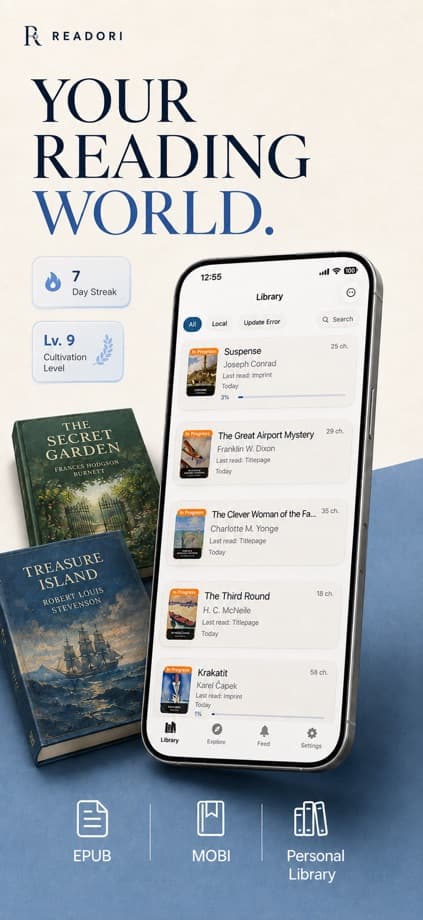
Readori 的作者在 V2EX 的帖子里"坦白"得非常彻底:"代码和 UI 设计全是 Codex、Claude 生成的。我不是专业开发者,只是给了它一个安卓开源项目应用做参考,它自动全程设计规划完工。"起因也很生活化:想看电子书,App Store 一搜"大部分里面都是广告加持,越看越烦",于是自己用 AI 手搓了一个看中英文电子书的应用。 产品定位是经典公版作品的浏览与阅读:内容全部来自公开可访问、允许商业使用的公版书籍资源站,涵盖进入公有领域或版权保护期届满的文学、历史、哲学及人文类作品,版权说明写得相当谨慎(还注明了不同国家/地区版权期限差异可能导致展示调整)。这种"公版书+无广告"的组合,精准切中了被广告版阅读器折磨的用户。 App 已上架除中国区以外的 App Store,作者当时还放了 100 个内购 Pro 兑换码请 V 友体验。从"给 AI 一个安卓开源项目做参考"到"全程设计规划完工",这是 vibe coding 里很典型的工作流:非程序员用参考实现+AI 完成跨平台复刻。对想"用 AI 做第一个上架 App"的人来说,这个帖子本身就是一份行动指南。 注:本项目由 VibeFix 编辑从公开渠道精选收录,版权归原作者所有。
V@VIBEFIX
0
0
2
0
Showcase
Online
Tools
Owl 猫头鹰
自媒体人 vibe coding 的小红书敏感词检测工具:6 万+词库、命中高亮,免费免注册,已累计检测 8,110 篇内容。
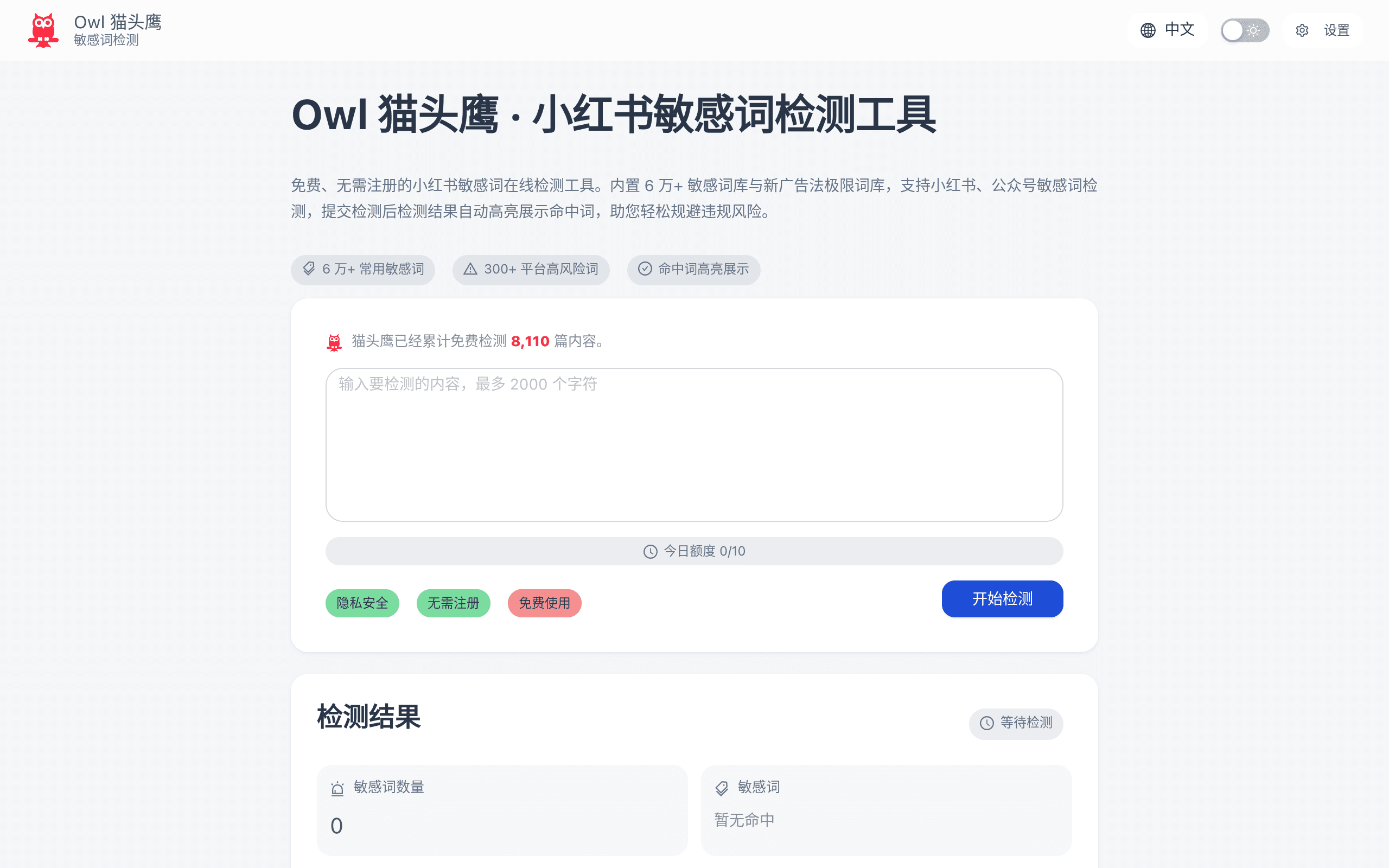
Owl 猫头鹰的作者做了半年自媒体后发现一个真痛点:发小红书、公众号最怕踩中敏感词被限流,之前用的检测工具停服了,市面上的要么要登录、要么要关注公众号。于是他"vibe coding 了一个敏感词检测工具"——词库从网上找来精简到 6 万多个,加上新广告法极限词库,支持小红书和公众号双平台检测,命中词自动高亮展示。 这是个典型的"为自己解决问题顺手分享"的 vibe coding 作品,技术路线也很独立开发者:跑在 Cloudflare 的免费套餐上,所以每人每天限 10 次——作者说得很实在,"主要是防止第三方调接口把额度耗完大家都没得用,应该对于大多数创作者都是足够的"。网站实测可用,界面干净:输入框、今日额度、检测结果高亮,无需注册,打开即用。截图时显示已累计免费检测 8,110 篇内容,说明一直在被真实使用。 这类小而美的工具正是 vibe coding 最擅长的:需求来自作者自己的真实 workflow,范围克制到一周能做完,上线后持续有人用。对做新媒体、短视频、种草文案的读者来说,收藏一个不亏。 注:本项目由 VibeFix 编辑从公开渠道精选收录,版权归原作者所有。
V@VIBEFIX
0
0
6
0
Showcase
Online
Productivity
产品魔方 Product Cube
专为一人公司打造的本地桌面 AI 工具:从需求诊断、ASO 优化到软文生成,把 vibe coder 最缺的产品和运营能力补上。
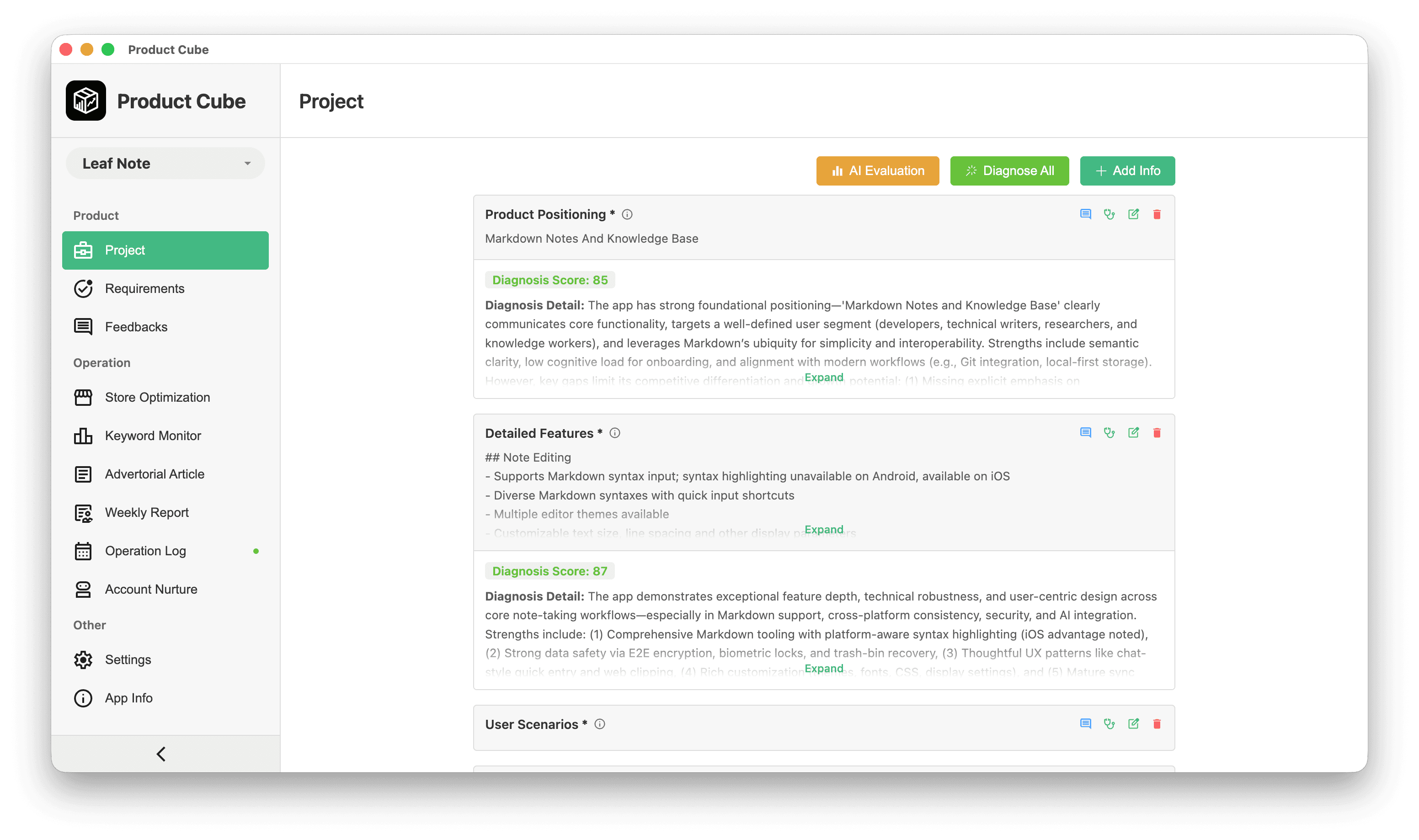
产品魔方的立意很妙:它不帮你写代码,而是替 vibe coder 干那些"写完代码之后"最头疼的活。作者在 V2EX 的帖子标题就开门见山——"Vibe Code 了产品却无人下载?我写了个工具来帮你"。他的判断是:Cursor、Copilot 让"一个周末 Vibe 出一个 MVP"成为常态,但决定产品成败的不再是技术,而是产品规划和运营——而这恰恰是独立开发者和一人公司最缺的。 于是有了产品魔方,一个 Electron 写的本地桌面程序,分产品和运营两大模块。产品篇相当于配了个 AI 产品总监:输入定位、功能、场景和商业模式,AI 帮你做可行性诊断、给需求打分排期(一套"四象限法则")、把用户反馈转成需求、按模板生成专业的用户回复。运营篇是重头戏:ASO 诊断与优化(支持谷歌和苹果商店信息逐条录入或网页抓取)、关键词排名监控、一键生成各平台软文并追踪社交数据、基于 Git 提交记录生成 Build in Public 周报。 隐私设计是加分项:纯本地桌面程序,所有数据存本地 SQLite,可一键导出;AI 部分自带 API Key,支持 OpenAI、Claude 或本地 Ollama,数据不经过第三方中转。目前免费使用,Mac App Store 送审中,GitHub 有 5 个 release 可直接下载。README 里"All Features Are Live"的截图能看出这是个完成度很高的作品,不是概念 demo。 注:本项目由 VibeFix 编辑从公开渠道精选收录,版权归原作者所有。
V@VIBEFIX
0
0
2
0
Showcase
Online
Toolscursorcodex
图切助手 PicSlicer
从被抖音带火的微信小程序,到作者用 Codex 一周搓出来的 iOS App:图片九宫格切割+旅行票根制作,v4.6.0 昨天刚更新。
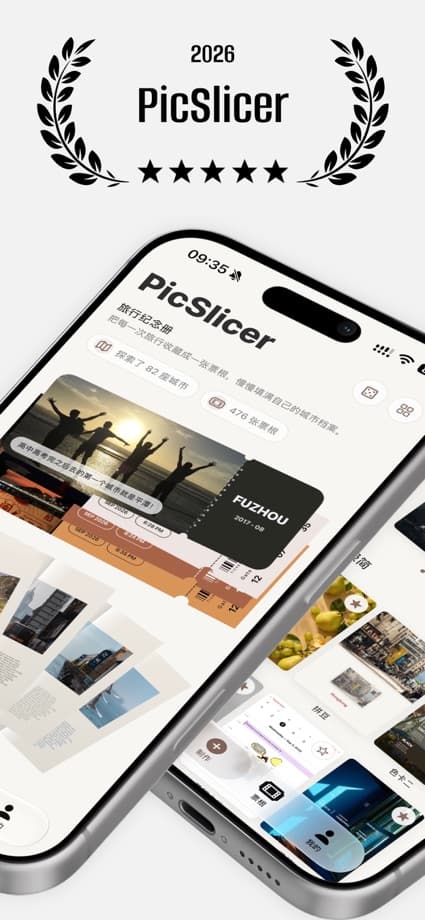
图切助手的故事是 2026 年中文独立开发圈最励志的 vibe coding 案例之一。作者原本在小红书看到"切图九宫格发朋友圈"的教程,找不到好用的工具,就让 Cursor 帮他 Vibe 了一个微信小程序。一年时间里他坚持更新了约 100 个版本,从单纯的图片切分扩展成图片拼接、分辨率修改、转 GIF 的图片工具箱,不温不火地每天只有五六个人用。转机出现在今年 6 月:他给小程序加了个"旅行票根"功能(把照片做成精美票根收藏),发到抖音后一周用户从每天四五十暴涨到 2000,巅峰一天 6000 人在用。 趁热打铁,对 iOS"一窍不通"的他直接用 Codex 开发了一周,做了同名 iOS App PicSlicer,经历四五个内测版、拉了 200 个用户一起测试,7 月 2 日正式上架 App Store。App 聚焦票根制作、展示、分享:五款横版+一款竖版票根模板,可编辑城市/日期/编号/备注,自动提取照片主色统一风格,支持桌面小组件,本地优先无需登录。目前 App Store 在架 v4.6.0,2026-10-04 昨天刚更新,迭代非常活跃。 作者在 V2EX 的原帖里有一句很出圈的话:"AI 除了帮我写代码还能帮我上传包到苹果开发者后台、处理 TestFlight 群组、编辑 APP 审核信息。甚至连我的 APP 下架需要 ICP 豁免,豁免的 PDF 都是让 GPT 帮我生成的。除了不让他付钱,其余都让 AI 帮我处理。"这几乎是 vibe coding 独立开发者的标准工作流写照。定价 3 元买断,前两周限时 1 元。 注:本项目由 VibeFix 编辑从公开渠道精选收录,版权归原作者所有。
V@VIBEFIX
0
0
9
0
Showcase
Online
Tools
SkillDeck
crossoverJie 用 Vibe Coding 写的 macOS 原生 App:12 种 AI 编程 Agent 的 Skills 统一管理,一键安装、更新、分配。
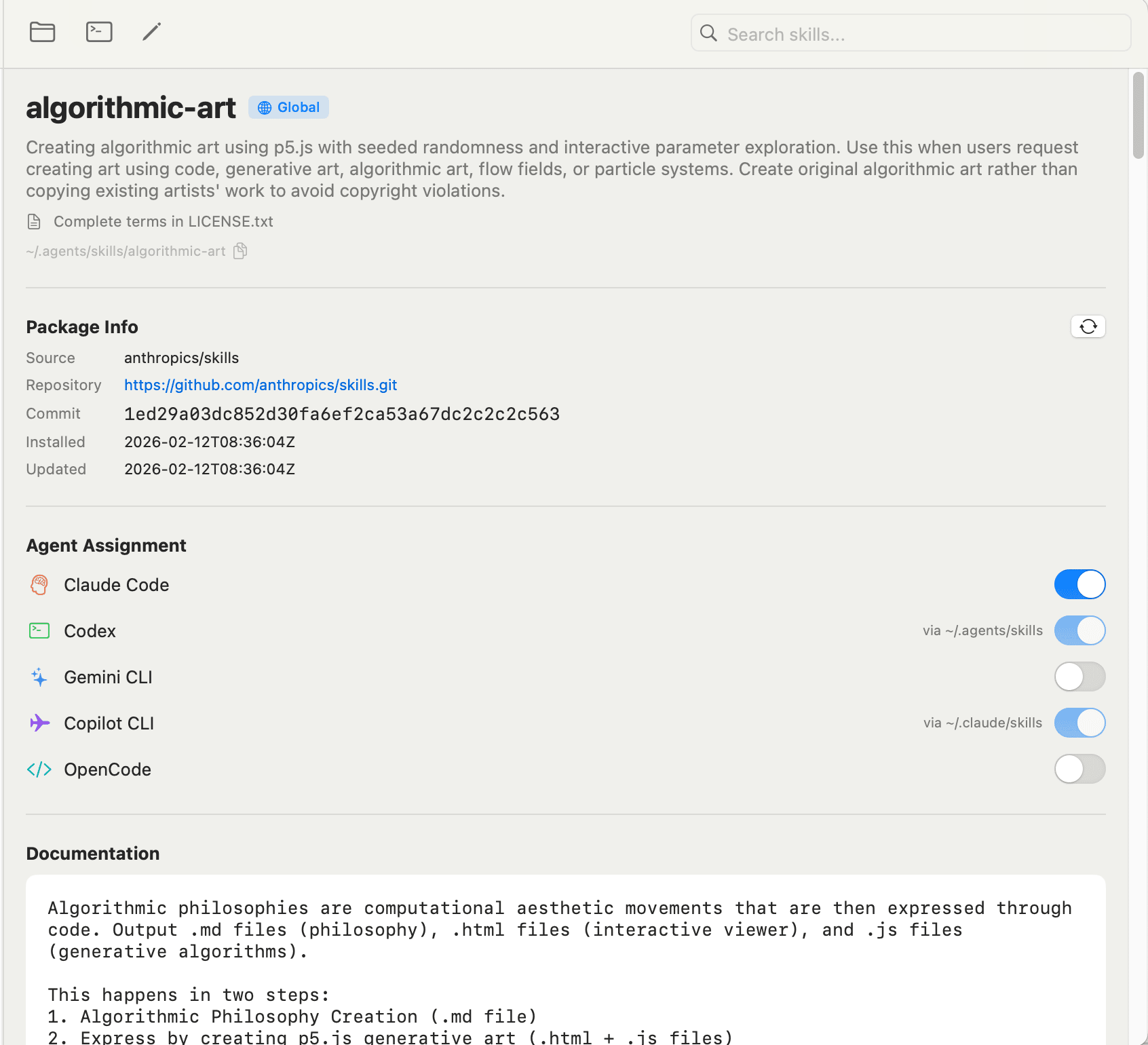
SkillDeck 的作者 crossoverJie 是博客园的老牌博主,他在 2026 年 5 月的文章里写得很坦白:相信 AI Coding 已经占据了工作中大部分代码,于是他"用 Vibe Coding 写了一个 macOS 原生的 APP,以此来判断 Vibe Coding 是否能让我在一个完全不熟悉的领域解决一个特定的问题"——他之前没做过 macOS 开发。验证的方式很硬核:直接做一个真产品,看能不能跑起来、能不能解决真问题。 产品本身切的是 AI 编程时代的新痛点:Claude Code、Codex、Cursor、Gemini CLI 等十几种 Agent 各自把 Skills 散放在不同目录(~/.claude/skills、~/.codex/skills……),手动管理就是一场符号链接和 YAML 的噩梦。SkillDeck 给了它们一个统一的 macOS 原生三栏仪表盘:浏览 skills.sh 排行榜和 ClawHub 市场、一键从 GitHub 安装或本地导入、检测远程更新、开关决定某个 Skill 装给哪些 Agent、可视化编辑 SKILL.md。它甚至自带一个 skilldeck Skill,让你在终端里用自然语言管理 Skills。 这个项目在 GitHub 拿了 570+ star、27 个 release,MIT 开源,架构是 MVVM + @Observable,文件系统即数据库。作者后来又用同样的方式做了剪贴板工具 ClipShelf 并上架 App Store,还在博客里复盘了"AI 时代产品经理能力比编码能力更重要"的体会。对每天跟多个 AI Agent 打交道的开发者来说,这是个"AI 工具太多反而需要工具来管工具"的典型 vibe coding 样本。 注:本项目由 VibeFix 编辑从公开渠道精选收录,版权归原作者所有。
V@VIBEFIX
0
0
4
0
Showcase
Online
Lifestyleclaude-code
inventree-pantry
A phone-sized pantry app on top of InvenTree — book in, use up, count — written almost entirely by Claude Code.
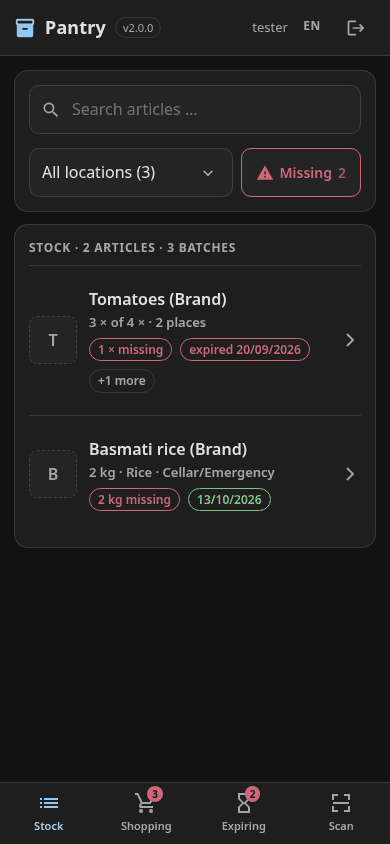
inventree-pantry's README is disarmingly honest: "This app is vibe-coded. It was written almost entirely by an AI coding agent (Claude Code), directed by one person, for one household's pantry and emergency supply. It is in daily use and every change was checked against a real InvenTree, but no human has reviewed the code line by line the way hand-written software would be reviewed." The problem it solves is real: InvenTree is excellent warehouse software, but in a kitchen its official app buries everyday actions several screens deep. This app covers the three things a household actually does — book in, use up, count — each as one button. Scan a supermarket barcode and Open Food Facts fills in the product; the shopping list knows what's missing; an expiry watchdog pushes "3 expired, 2 expiring soon" to ntfy or Matrix. InvenTree stays the single source of truth — the app stores nothing itself. Four languages: German, English, Russian, Chinese. My favorite detail: "The installation guide is written for an AI agent to carry out." Point your agent at INSTALL.md and let it do the work — software written by AI, installed by AI, with the human just directing. One star on GitHub, used every day in the author's own kitchen. Sometimes that's the better metric. Note: This project is curated by the VibeFix editors from public sources. All rights belong to the original creator.
V@VIBEFIX
0
0
5
0
Showcase
Online
Education
MyRA
A local-first AI assistant for academic work — meetings, research, paper drafting, peer review — that is "100% vibe coded."
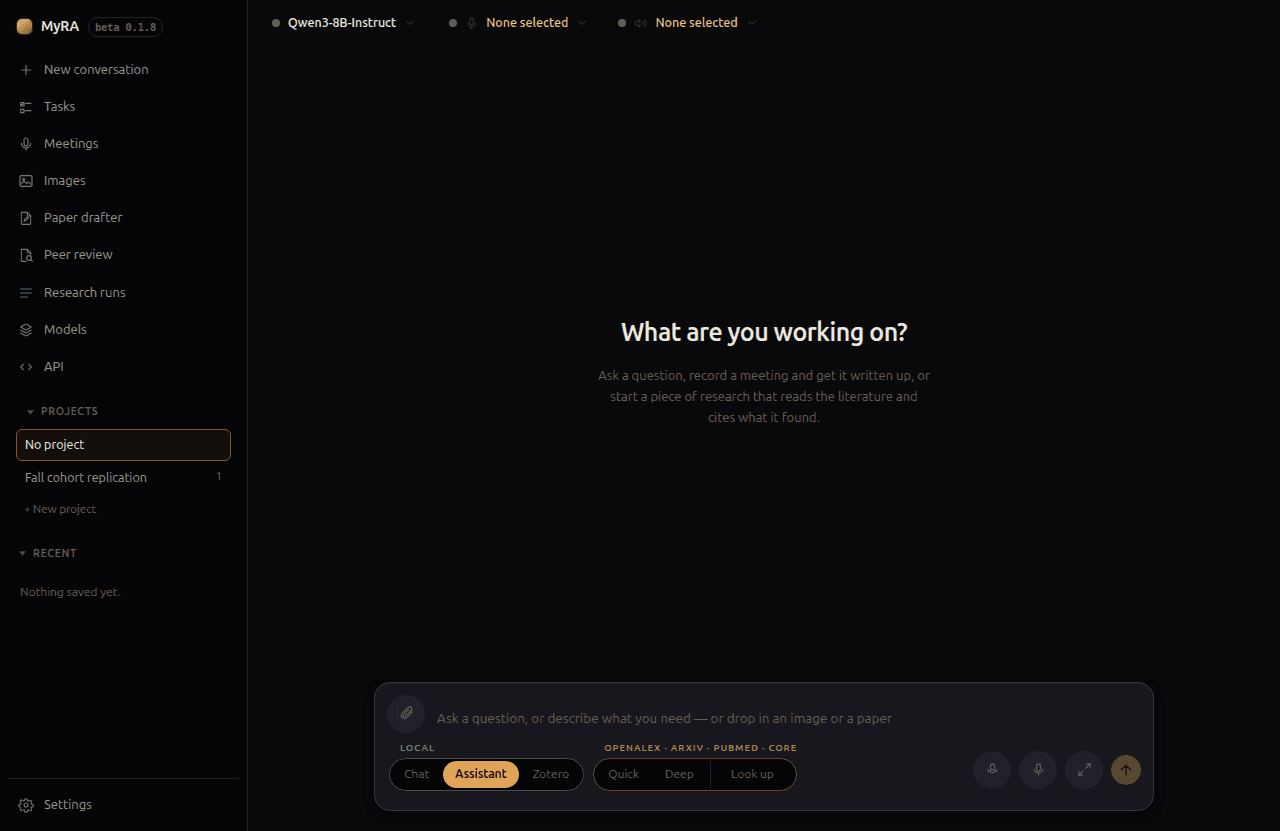
MyRA's README carries my favorite disclaimer in this whole batch: "Note: This app is 100% vibe coded. Don't use it if you're not comfortable with that." It's an all-in-one AI assistant for academic work, aimed at non-technical users: voice-to-voice, meeting notes, research synthesis, deep research, document drafting, AI-assisted peer review — with Zotero library integration. The architecture thesis is local-first. MyRA is built on Lemonade Server and bundles llama.cpp, whisper and kokoro, so you can download models from HuggingFace inside the app and keep private data on your own machine. The meeting feature records two tracks (mic + system output) to separate speakers, transcribes both, and writes a report where every claim is checked against the transcript — anything it can't source goes under "## Unverified" instead of being stated. Research searches OpenAlex, arXiv, PubMed and CORE directly and produces cited reports; the model can even draw flowcharts and PRISMA 2020 diagrams in Journal/Poster styles and export them as SVG. An AI assistant for academics, built entirely by AI, that keeps your unpublished work off other people's servers — there's a neat symmetry to it. The docs site has a full walkthrough; the repo was updated 2026-09-30 and is GPL-3.0. Note: This project is curated by the VibeFix editors from public sources. All rights belong to the original creator.
V@VIBEFIX
0
0
6
0
Showcase
Online
Gamescursorclaude
Cowboy Shooter
A free 3D Wild West runner-shooter, 100% AI-generated from assets to code — playable right in the browser.
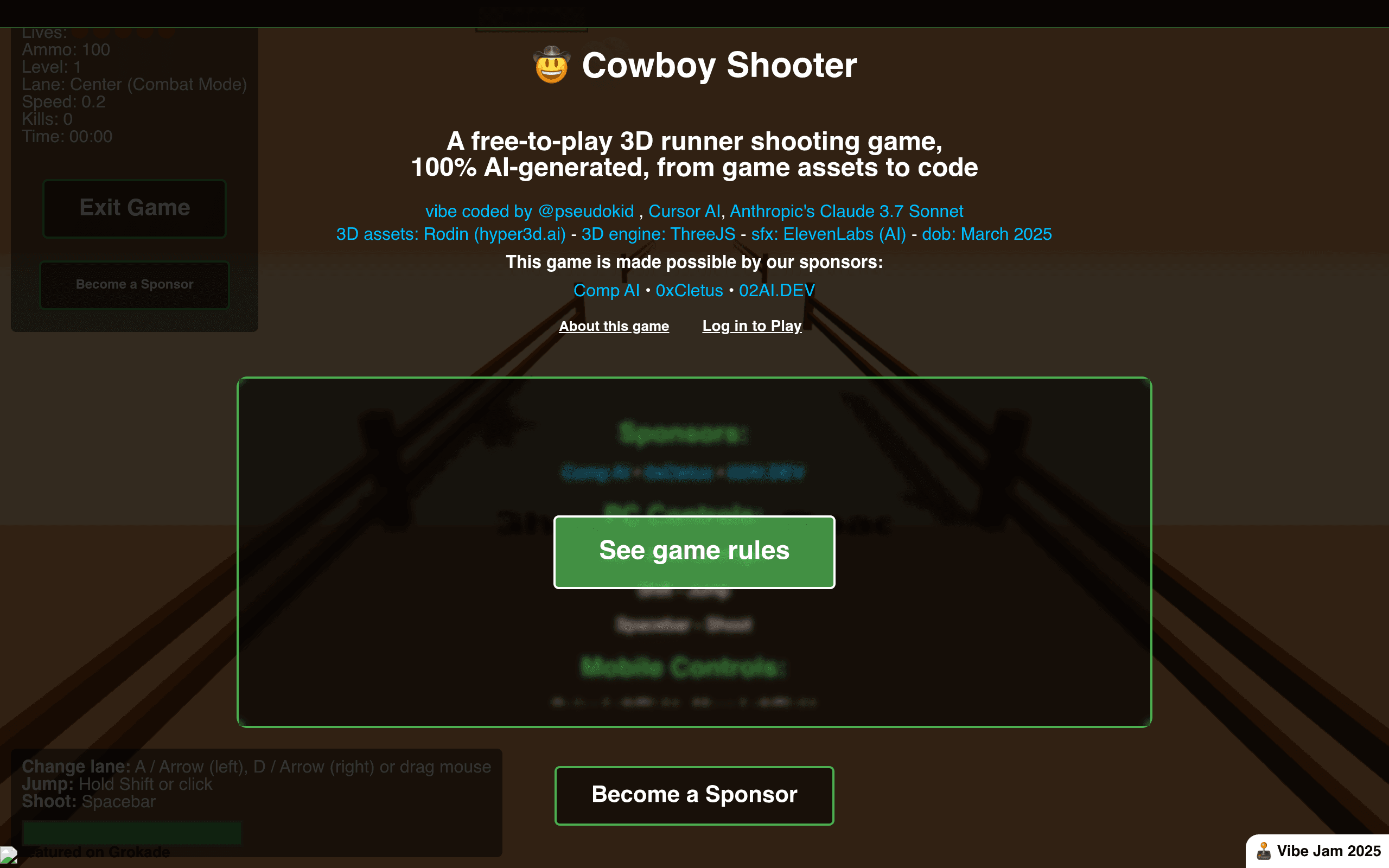
Cowboy Shooter wears its origin on its homepage: "A free-to-play 3D runner shooting game, 100% AI-generated, from game assets to code — vibe coded by @pseudokid, Cursor AI, Anthropic's Claude 3.7 Sonnet." Even the 3D assets were AI-made (Rodin/hyper3d.ai), the sound effects too (ElevenLabs). It was an entry in Vibe Jam 2025, and it's still live and playable. The game itself is a three-lane Western runner-shooter: switch lanes, jump, shoot with the spacebar, with a full HUD (lives, ammo, level, kills, time) and a global leaderboard. PC and mobile controls both work, no install — it runs in the browser. Games are the most legible demo of vibe coding, and this one is unusually transparent about the whole pipeline: which model wrote the code, which tool made the assets, which service synthesized the audio. "dob: March 2025" is even printed on the page like a birth certificate. If you want a single link that answers "so what can vibe coding actually ship," this is a good one. Note: This project is curated by the VibeFix editors from public sources. All rights belong to the original creator.
V@VIBEFIX
0
0
7
0
Showcase
Online
Travel & Localopencode
Ninety
A Schengen 90/180 day accountant that names the exact day you went over — and admits when it doesn't know.
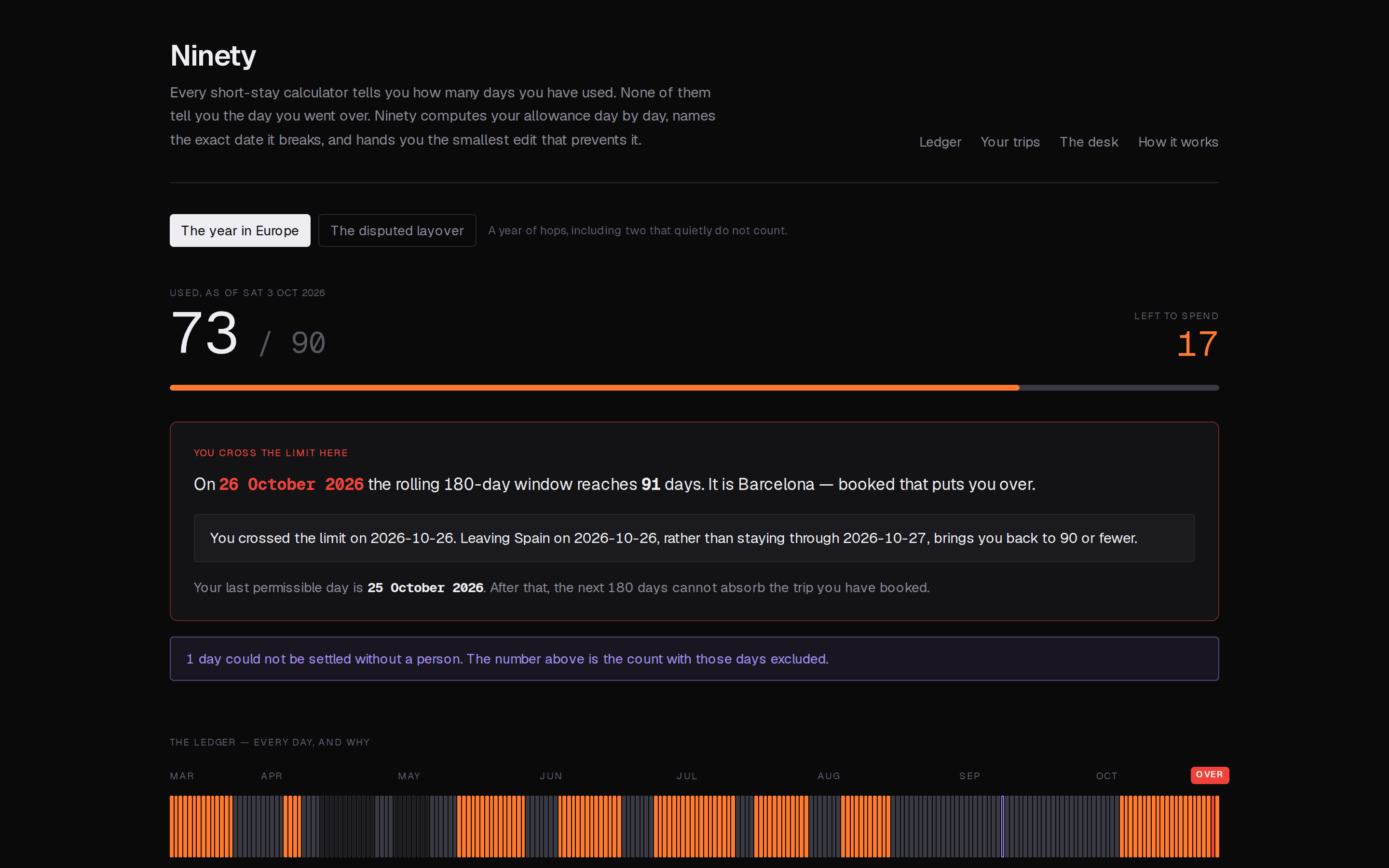
Ninety is a day accountant for the Schengen 90-in-any-180 rule, vibe-coded by kiter in about a day with OpenCode (documented in a dev.to post on 2026-10-04). Every Schengen calculator tells you *how many* days you've used. Ninety tells you *which day* you crossed the line, *why* that day counted, and *what to change*: "73 of 90 days used — on 26 October the window reaches 91 days. It is Barcelona — booked that puts you over. Leave on the 26th, not the 27th." Three things make it different from a calculator. First, it names the day, not just the number — an attribution algorithm finds the rolling window and maps the breach back to the trips that caused it. Second, it classifies instead of adding: three weeks in the Canary Islands is 0 days, a month in Dublin is 0, a week in Reykjavík is 0 (Iceland is EEA, not Schengen), an airside transit is 0 — and the same trip into Sofia counts overland but not by air in February 2025, because Bulgaria's land borders opened months before its air borders did. Third, and most important, it refuses visibly: hand it a passport it doesn't know and you get "Ninety declined to answer" instead of a confident wrong number. "A confident wrong number here costs someone money." The technical thesis is worth stealing: the verdict engine is pure TypeScript with no model and no network calls — the agent may retrieve, classify and explain, but it may never produce a number. The build log is unusually honest: the author's own evaluation caught six of his hand-written expectations being wrong (the engine was right every time), plus a real corpus bug where Iceland was modeled as a full Schengen member. 56 tests, all committed. For anyone who's ever squinted at a Schengen calculator before a Europe trip, this is the one that respects you enough to say "I don't know." Note: This project is curated by the VibeFix editors from public sources. All rights belong to the original creator.
V@VIBEFIX
0
0
5
0
Showcase
Online
Productivity
Mom Clock
治拖延的"强制执行"闹钟:到点不止提醒,会持续催你,甚至直接锁掉你正在刷的 App。
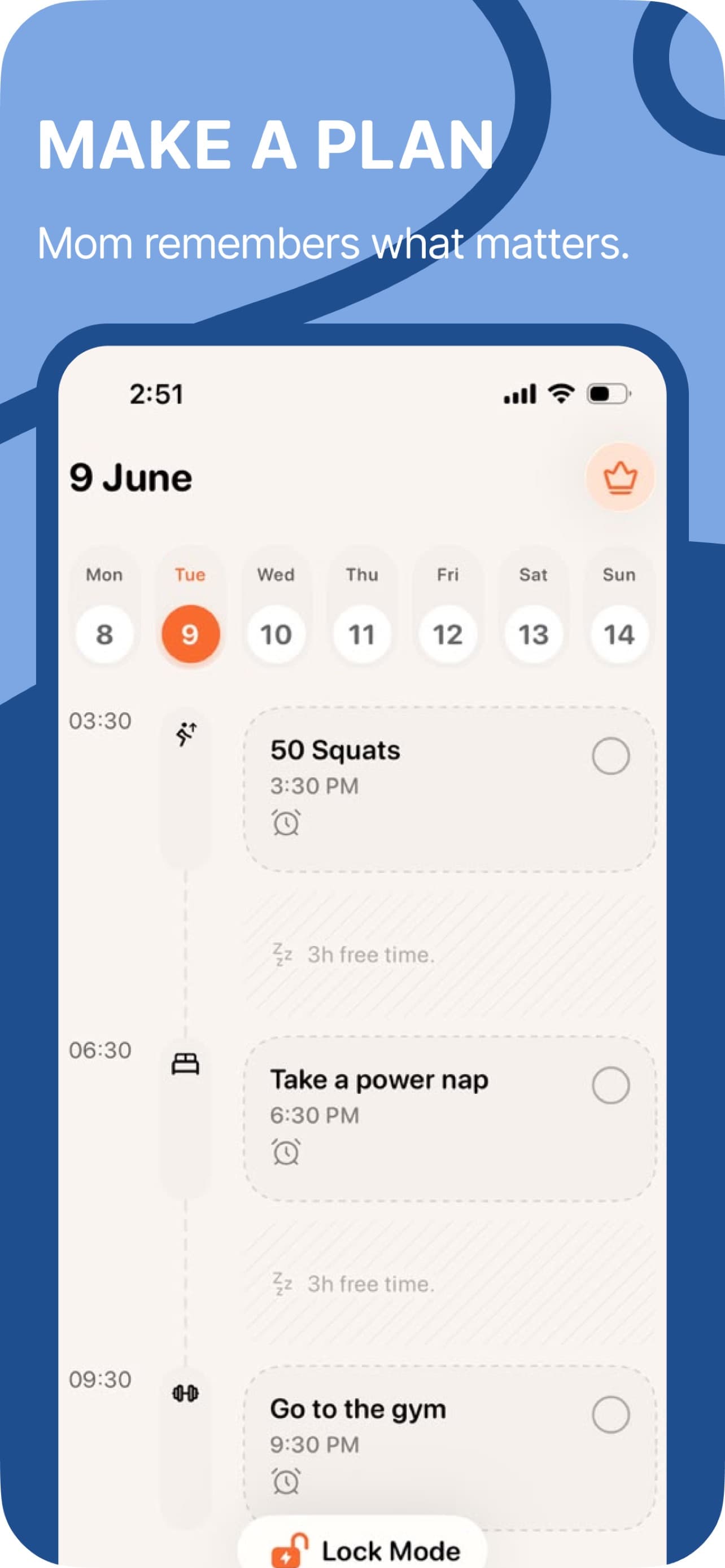
Mom Clock 的作者在 V2EX 开篇就自报家门:"我自己是一个长期拖延型选手。"他试过 Todo、提醒、专注、时间管理 App,"它们都很温柔。问题是:我不需要被温柔对待。我需要的是——像小时候我妈一样,到点了,不讲道理,直接催你去做。" 所以 Mom Clock 的核心不是"提醒你",而是"逼你执行"。为某件事设定时间后,到点不会只是一个通知——你不去做,它会持续出现;甚至可以在指定时段直接限制你使用某些 App。设计理念就三句话:没有"等一下",没有"稍后提醒",到点了就是现在。作者刻意避开了一切"看起来很高级"的东西:没有复杂任务系统、没有打卡积分、没有情绪安抚文案,"它更像是一个行为约束工具,而不是情绪陪伴工具"。做产品时他反复问自己一句话:"如果这是我妈,她会让我点「稍后」吗?" 这种反常识的哲学恰恰是它的差异化:当所有效率 App 都在比谁更温柔,强制反而成了稀缺品。作者自己验证"睡觉、开始工作明显比以前准时多了"。App 已在 App Store 上线(iOS),还在 Product Hunt 拿过日榜和周榜第一——说明"不讲道理"打中了很多拖延症患者。如果你也是对提醒已经免疫、明知道该做什么但就是拖的人,这个"妈妈"值得一试。 注:本项目由 VibeFix 编辑从公开渠道精选收录,版权归原作者所有。
V@VIBEFIX
0
0
5
0

Showcase
Online
Financeclaudecodex
Coast(为自由记账)
围绕 FIRE 理念的记账 App:把"距离财务自由还有多久"放最显眼,每笔消费都换算成"晚退休 X 天"。
Coast 的作者非技术出身,但记了 10 年账。动笔前他问 AI 要不要做,AI 明确劝退:记账赛道"红到发黑",用户迁移成本巨大。但他还是做了,因为 10 年记账让他发现了一个现有 App 都没解决的问题——不是功能缺失,而是"记了这么多数据,然后呢"。数据没用起来、没有目标、预算坚持不下去,说到底是"记账缺一个终点"。于是他 Vibe Coding 了 Coast,一款围绕 FIRE 理念设计的记账 App,名字取自 FIRE 的变体 Coast FIRE。 整个 App 的框架都长在 FIRE 上:专门的 FIRE 页面把"距离财务自由还有多久"放在最显眼的位置;敏感度滑块可以拖动"每月少花 1000 元"实时看退休时间提前多少;大额消费模拟相当于"冷静期",先看看这笔支出让退休晚几天再决定买不买;首页每记一笔消费,FIRE 日期即时变化——把"晚退休 X 天"这种可感知的代价摆在眼前。预算也不再是拍脑袋:从历史数据自动算,用中位数不用平均数,全年预算参考去年同月,还能在基准上再收紧一个百分比。另外还有同类商品价格追踪(作者发现同一家店的霸王茶姬能差出 7 块钱)、附属消费(小费/税费灵活配置)这些从真实记账痛点里长出来的功能。 开发过程本身也值得一说:作者用 Claude 写代码、Codex 出图,Claude 下任务、Codex 执行、Claude 读结果,多 AI 协作省掉反复沟通。他在少数派长文里总结的踩坑(别只甩截图骂 AI、先定设计规范、学 Git、一个功能模块开一个新对话、一次别丢超过 10 个 bug)本身就是一份 vibe coding 实战手册。这是他第二款上架的 App,上一款 EON 订阅管理纯免费也有 0.3% 的打赏率。Coast 目前 App Store 在架(v1.0.7,10 月初刚更新),免费下载,部分分析功能会员制。 注:本项目由 VibeFix 编辑从公开渠道精选收录,版权归原作者所有。
V@VIBEFIX
0
0
4
0