AI 项目展示 / 灵感交流 / 共创迭代

做出来的灵感,值得被看见。

发作品、看灵感、贴卡点、找帮手。跑起来的值得被看见,还差一步的也可以被讨论、被接力完成。

晒作品
作品大赏
找思路
灵感交流
接上话
共创迭代

项目广场

先扫热门方向,再按类别或热度继续找灵感。
jpm
大赏
已上线
开发工具claude-code

jpm

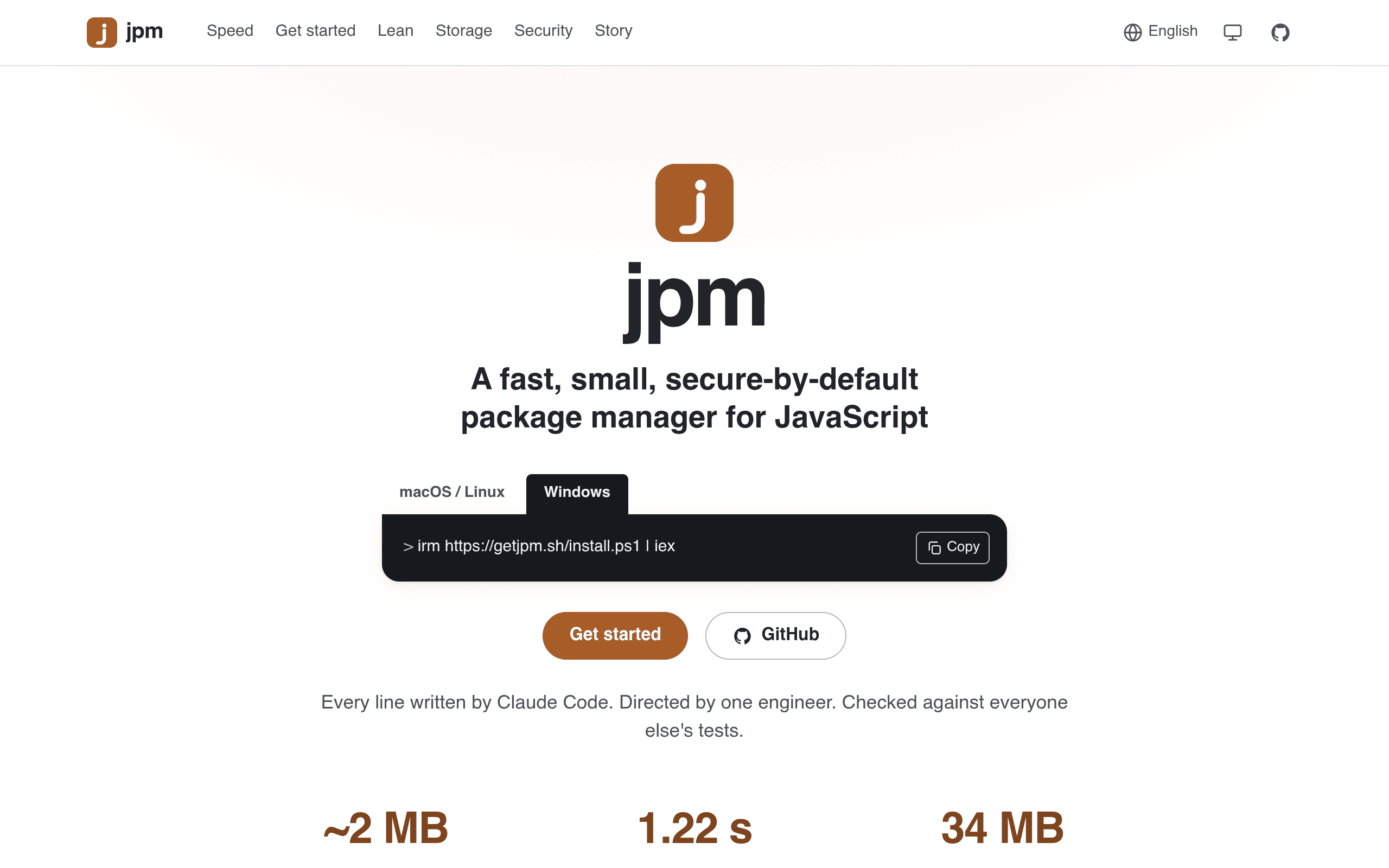
A fast, small, secure-by-default JavaScript package manager written in Rust — every line coded by Claude Code.

jpm is a JavaScript package manager written in Rust, and it makes a bold claim: up to 15x faster than npm, a ~2 MB binary, and security by default. Install scripts need explicit approval, and fresh versions of a package get a one-day cooling-off period before you can pull them. The story behind it is the real hook. The author directed Claude Code, running Claude Opus 5.5, to write every line — its own TLS and crypto included — then spent five days with the agent installing popular packages and hardening the implementation against real-world breakage. The site is brand new (the repo landed 2026-09-28), and the homepage leads with the honesty the genre needs: 'Every line written by Claude Code. Directed by one engineer. Checked against everyone else's tests.' curated by the VibeFix editors

Incident War Room
大赏
已上线
开发工具claude-code

Incident War Room

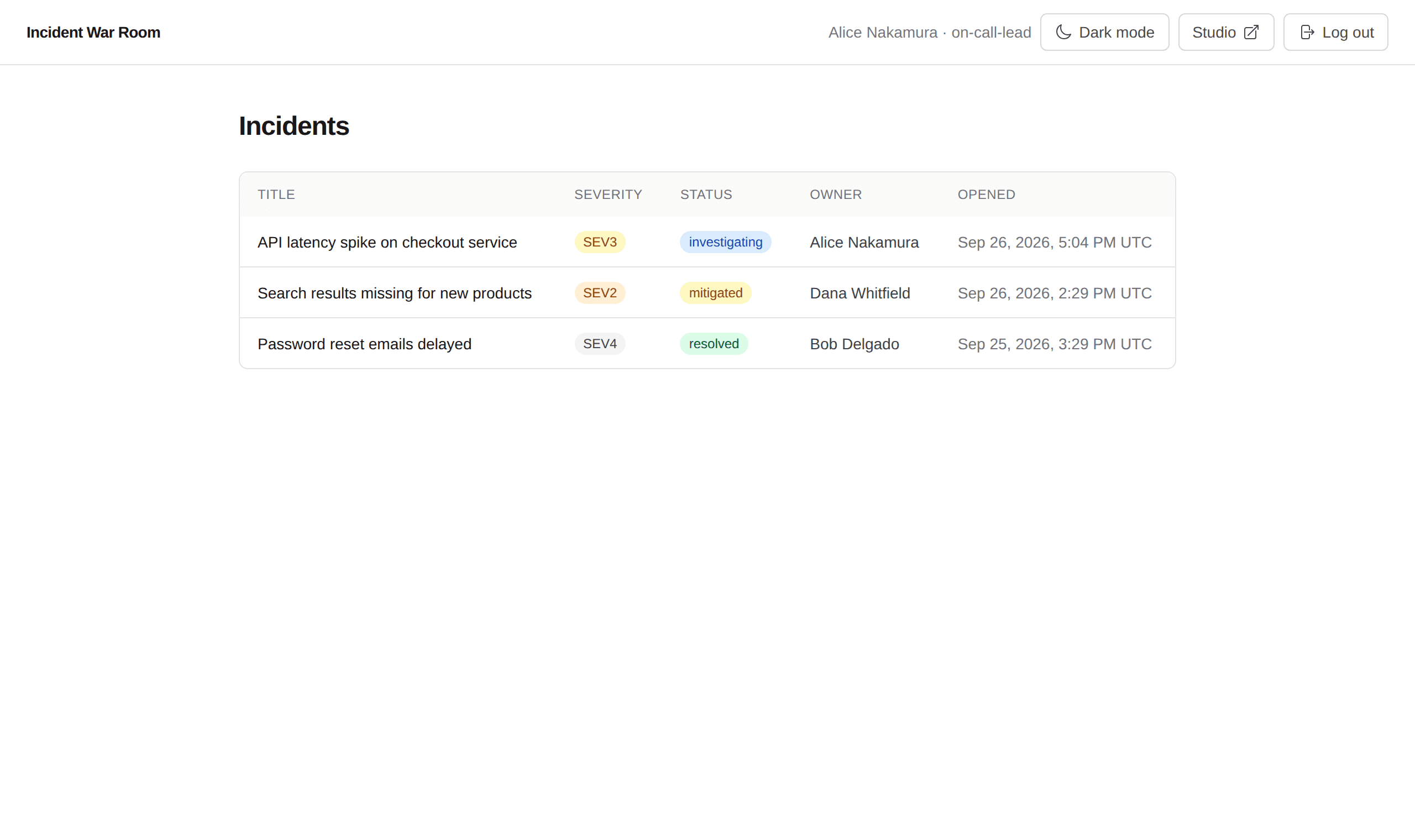
Real-time incident response for on-call teams: a live timeline, a SEV1 gate needing two on-call leads' approval server-side, and an AI-drafted postmortem.

Incident War Room is what you wish you had open at 2 AM when something breaks: everything about the incident lives on one page — a live timeline every responder sees update in real time (Sanity's `listen()`, no polling), a status page entry that publishes itself once an escalation is approved, runbooks for the incident's severity right on the page, and an AI-drafted postmortem when you mark it resolved. The centerpiece is the SEV1 escalation gate, and the author designed it specifically so a judge couldn't fake it. Raising an incident to SEV1 needs sign-off from two different on-call leads, enforced server-side in an `approveEscalation` Server Action — the approver is whoever the signed session says is logged in, must be an on-call lead, and can't approve twice. A Sanity Workflow tracks `escalationApproval` as `pending → approved / rejected` on a Kanban board in Studio. The build diary is the best part: the first version of the gate took the approver id from a hidden form field, so Alice could "Approve as" herself and Dana and push a SEV1 through alone — Claude Code caught that itself during a status check and it got fixed. Built for the DEV × Sanity challenge "Path Two: Vibe-Code Something Strange" with Claude Code, from an empty directory to a working demo — and the author is honest about where the model got stuck: Next.js 16 was newer than the model, so the repo's `AGENTS.md` points the agent at the docs bundled in `node_modules/next`; the `listen()` API ignored GROQ projections and two clocks (UTC vs local) disagreed, both found by driving the live site with Playwright. Resolving an incident freezes the timeline and sends it to Groq (`openai/gpt-oss-120b`) for a root cause and action items — told to say "unknown" rather than guess. Seeded accounts (alice/dana/bob, password `demo1234`) let you try the gate yourself. Note: This project is curated by the VibeFix editors from public sources. All rights belong to the original creator.

Seahelm
大赏
已上线
开发工具claude-codecodex

Seahelm

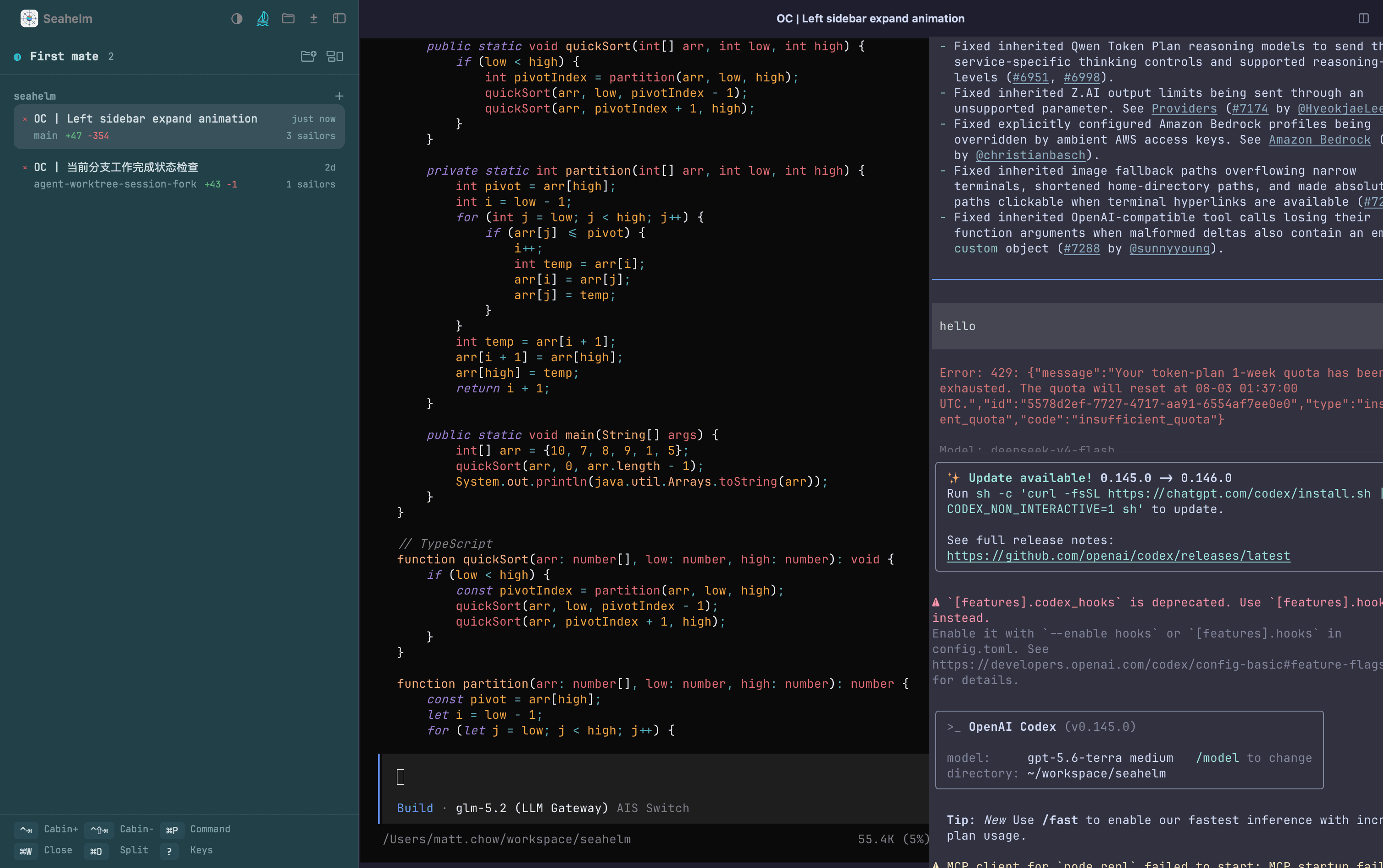
A native macOS workspace for coding agents: every git worktree a row, one agent per pane, built on Ghostty. Vibe-coded by Claude Code and Codex — inside itself.

Seahelm is a native macOS workspace for people who run coding agents the way air-traffic controllers run runways: every git worktree gets a row on one roster, each agent gets its own split pane, and an "Island" status pill sits at the edge of your screen staying quiet until a worktree actually needs you. Blocked agents raise real system notifications — answerable from your phone over iMessage — and Claude/Codex token usage is summarized in-app so you see budget burn before idea burn. The differentiator is philosophical: Seahelm is built around the decision, not the display. It reads each agent's final response from the Stop hook and turns inline next-step markers into clickable cards; a "First Mate" watches state transitions and either handles them or queues them for your approval. Under the hood it is Swift + AppKit on the Ghostty terminal engine (not Electron), with sessions that survive reboots via zmx and status detection for 12 agents out of the box. And then there is the provenance, stated plainly in the README: "Seahelm is vibe-coded. Nearly every line was written by coding agents — Claude Code and Codex — directed at the level of what should happen, not reviewed diff by diff. It was also built inside itself." 812 commits, 60 releases, around 1,900 unit tests. The dogfooding is the feature. Note: This project is curated by the VibeFix editors from public sources. All rights belong to the original creator.

bemtvi
大赏
已上线
开发工具claude-code

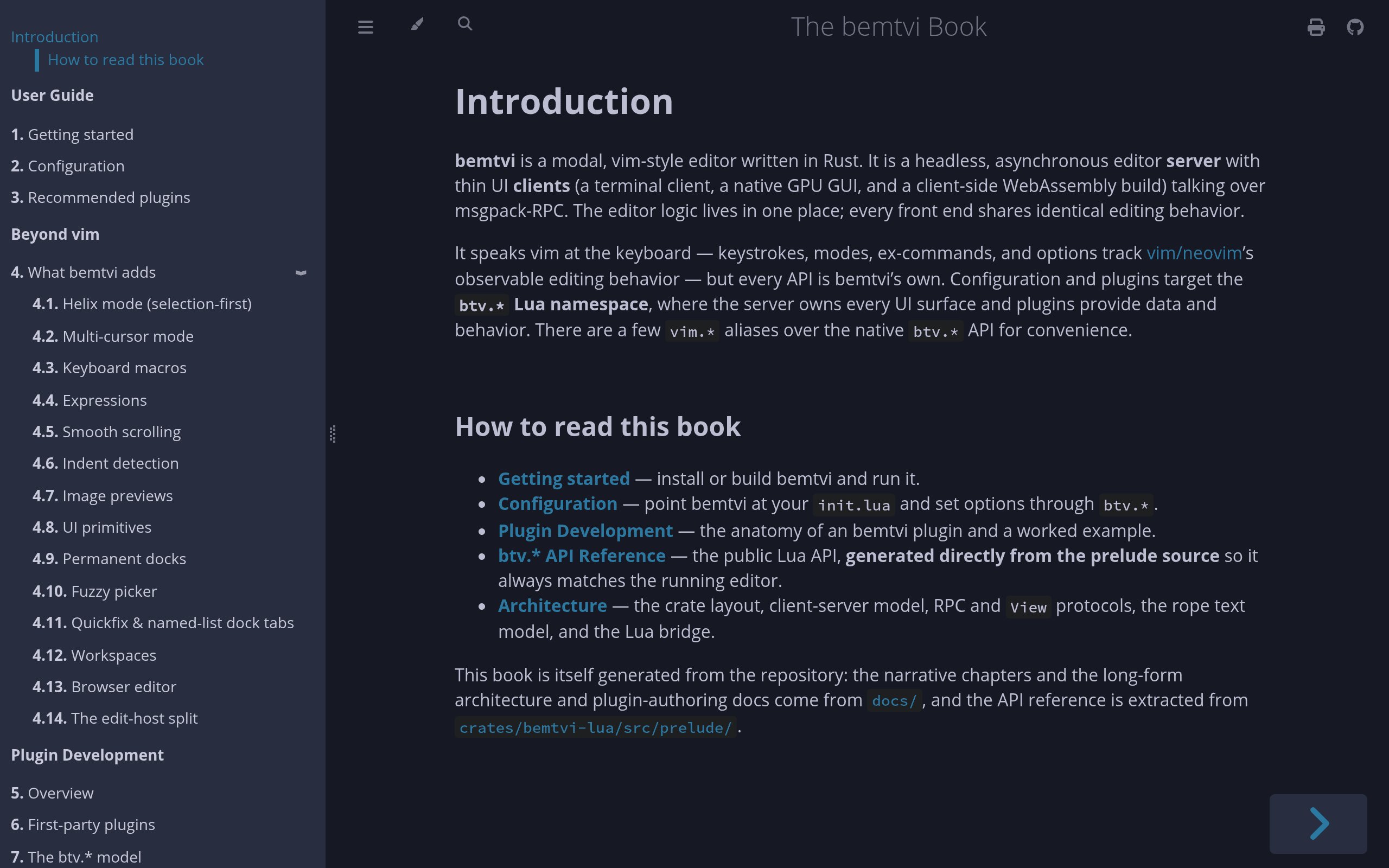
bemtvi

A vim-style editor 100% vibe-coded with Claude Code: real vim keystrokes, Lua plugins, tree-sitter and LSP — terminal, native GUI, or browser via WebAssembly.

Writing a text editor is a rite of passage. Writing a vim-compatible one with modal editing, Lua plugins, tree-sitter highlighting, and LSP support — entirely through Claude Code, across 1,253 commits — is something else. bemtvi (pronounced "ben-tee-vee") is a headless, asynchronous editor server with thin UI clients talking over msgpack-RPC: the terminal UI and the native GPU GUI are just two clients of the same protocol. It speaks vim at the keyboard for real: keystrokes, modes, ex-commands, and options track vim/neovim's observable behavior. But everything else is bemtvi's own — configuration and plugins target its native btv.* Lua API, colorschemes are pure-Lua modules, and there's even a branching undo tree you can walk with :earlier 10m. LSP servers are configured from Lua with 407 ready-made language server configs shipped. The README documents intentional deviations from vim with unusual candor ("these will not change"). The wildest part is the web build: bemtvi-edithost compiles the entire editor — core, the Lua 5.4 VM, the full server tick — to WebAssembly and runs it in a Web Worker, fully client-side. You really edit local files through the File System Access API; a static host is enough to put it online. There's a live demo, pre-built binaries for five targets with SLSA provenance, and a full Book generated from the repo so the docs can't drift from the code. A 100% vibe-coded editor that takes vim seriously enough to argue with it. The AGENTS.md in the repo is worth reading on its own. Note: This project is curated by the VibeFix editors from public sources. All rights belong to the original creator. --- ---

Proof of Shipping
大赏
已上线
开发工具

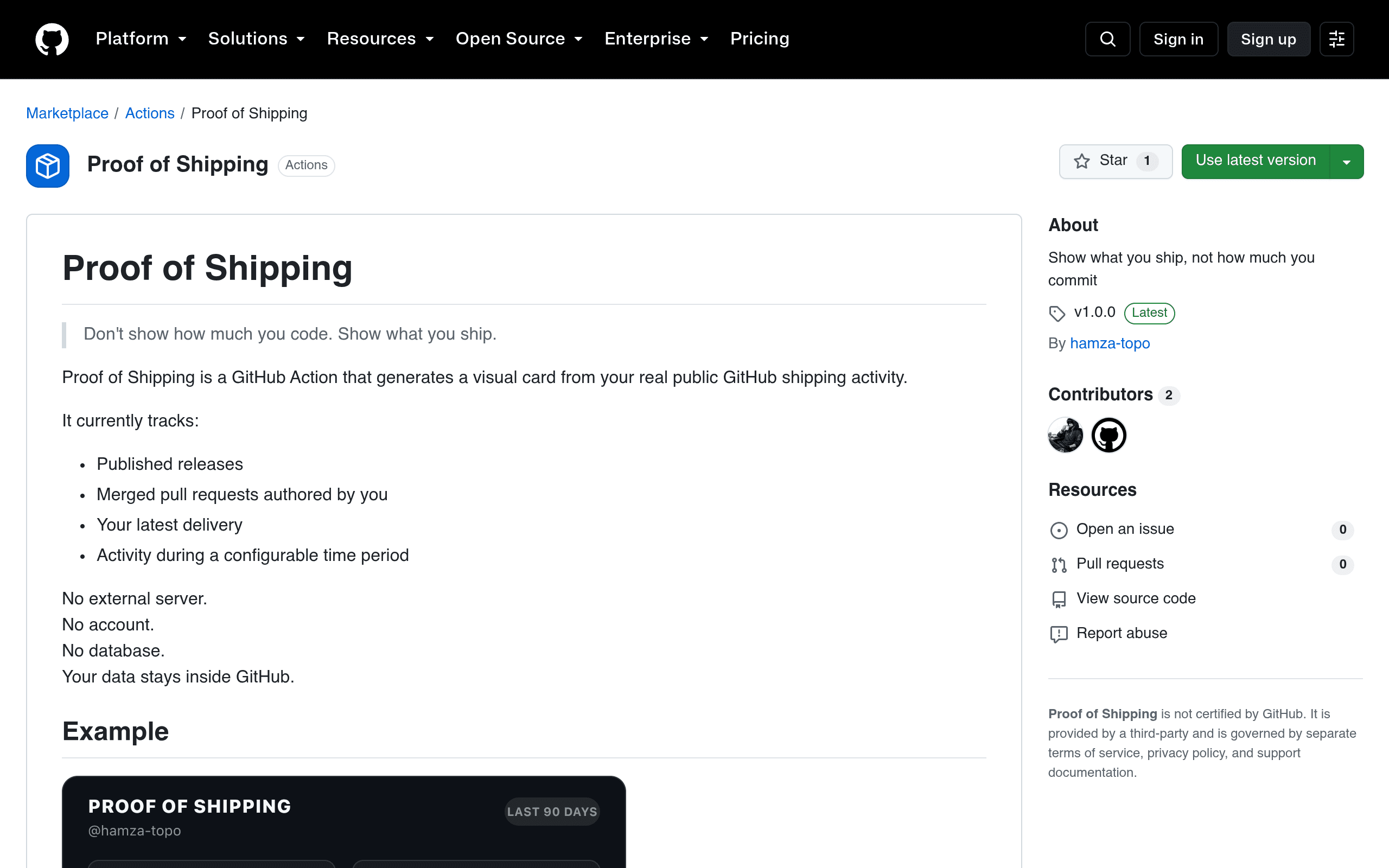
Proof of Shipping

A GitHub Action that turns your real shipping activity — releases, merged PRs, latest delivery — into a live profile card. No server, no account.

GitHub profiles are full of contribution graphs, streaks and commit counters. They answer how much you code. Proof of Shipping answers a different question: what did you actually ship? It's a GitHub Action that analyzes your real public GitHub activity and generates a visual card showing published releases, merged pull requests, your latest delivery, and activity over a configurable period. The workflow runs inside GitHub Actions itself and updates an SVG stored in your profile repository. The card running on the author's own profile shows 7 merged PRs and the latest delivery from a real repository — and it's no mockup: "This isn't a mockup. The card is generated by the GitHub Action itself from my public activity." The origin story is the point. The author started with a simple thought — developers show how much they code, but what if they showed what they actually ship? — and the whole thing went "Idea → AI-assisted coding → tests → real integration → release → GitHub Marketplace," with, in his own words, "a large part of the coding process" involving AI. Somewhere along the way, he writes, it stopped feeling like simple vibe coding and started requiring actual software engineering. MIT licensed, no external server, no account, no database — your data stays inside GitHub. Note: This project is curated by the VibeFix editors from public sources. All rights belong to the original creator.

video-lens
大赏
已上线
开发工具claude-code

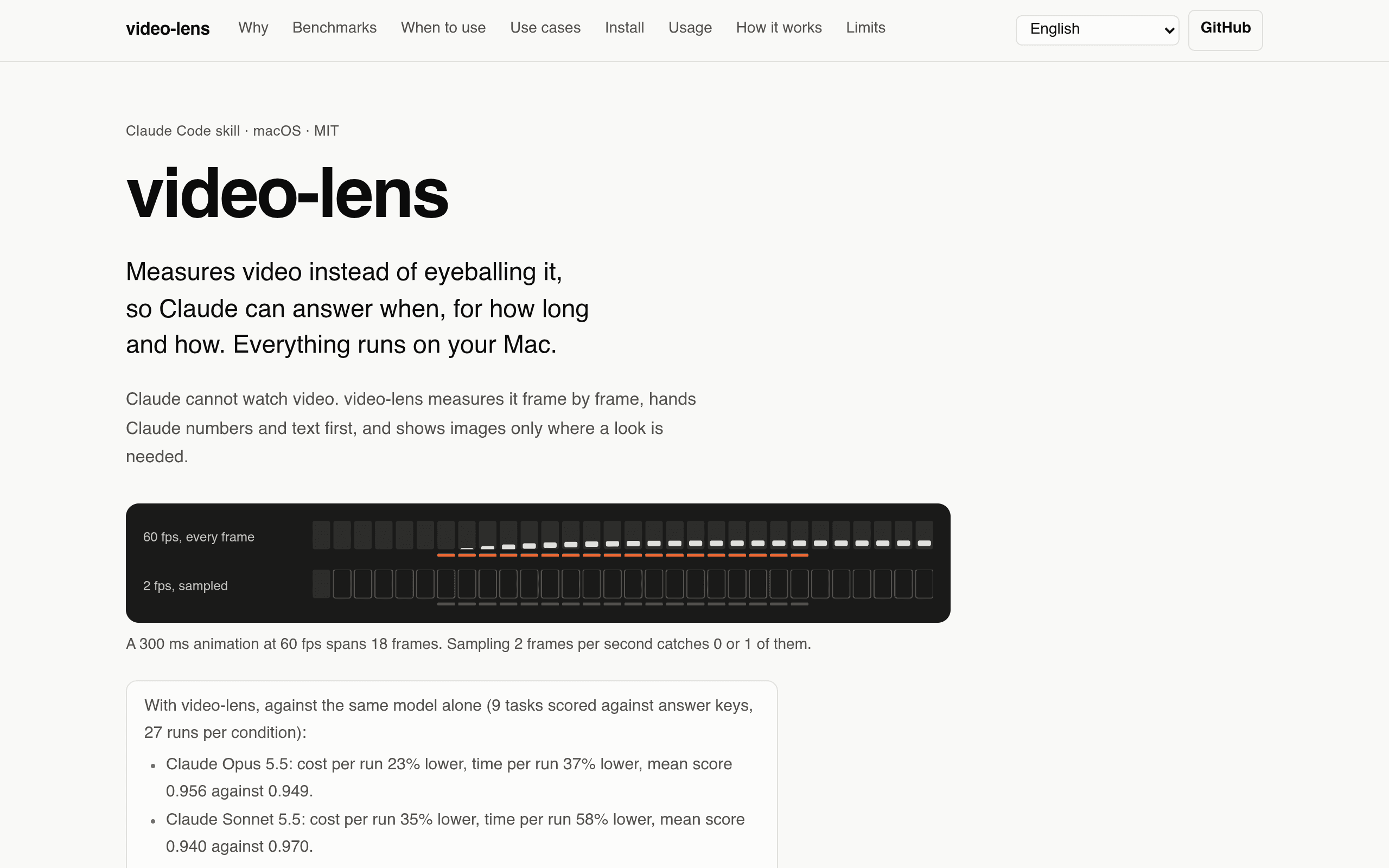
video-lens

A Claude Code skill that measures video frame-by-frame on your Mac — animation timing as CSS, scene cuts, transcripts — nothing uploaded.

Claude cannot watch video. That single limitation spawns a whole category of hacks — sampling frames, uploading to transcription APIs, eyeballing timestamps. video-lens takes the opposite approach: it measures the video on your Mac, frame by frame, and hands Claude numbers and text first, images only where a look is actually needed. Ask it to analyze a screen recording and you get UI motion as data: start time, duration, easing curve (named or cubic-bezier), stagger and travel of each animated element — measured to the frame and written out as CSS you can paste. Ask about a talk and you get scene cuts, keyframes, Korean and English on-screen text via macOS Vision, and a speech transcript with audio/video sync, all timestamped. Everything runs locally — ffmpeg, OpenCV, Apple on-device speech, whisper.cpp — nothing is uploaded, which also makes it the right tool for private meetings. What elevates this above a weekend script is the author's testing discipline: 9 tasks scored against answer keys, 27 runs per condition, published with raw data. A 300 ms toast animation rendered from real CSS measured 298 ms with the exact cubic-bezier curve. Against the model alone, Claude Opus 5.5 runs cost 23% less and finished 37% faster; Sonnet 5.5 saved 35% cost and 58% time. And the build story is the site's thesis in miniature — spec, Python analysis, Swift helpers, 60 synthetic test clips and the whole benchmark harness written with Claude Code on Opus 5.5, the human choosing what to track and verifying against answer keys. Install is two commands in Claude Code (/plugin marketplace add Junhan2/video-lens), macOS only, MIT licensed, with a nine-language docs site carrying interactive benchmark charts. Note: This project is curated by the VibeFix editors from public sources. All rights belong to the original creator. ---
LogPhase
大赏
已上线
开发工具cursorclaude

LogPhase

A multi-agent swarm harness that turns sprawling codebases into evidence-linked executive summaries.

AI now writes code at machine speed, and LogPhase's homepage opens with the thesis of our era: "The code is a byproduct. The real program lives in the people who understand it." LogPhase is a desktop app — macOS and Windows — that helps you build that understanding just as fast. It orchestrates dozens of AI agents, context analyzers, and deep-search workers as a multi-agent "swarm", then lets you point workspaces at a codebase and get back an executive summary of every pull request, with evidence links into the actual code. The visual signature is the city map: your repository rendered as districts and towers — services are districts, files are towers, user journeys are trails. A pull request stops being a wall of diffs and becomes three user journeys drawn step by step, with the affected steps popping up with code attached. Drill down into methods, call graphs, go-to-definition, all generated inside the app. The most human detail: it is built by a solo developer in Berlin who is dogfooding the AI-coding era in the most literal way — the site says it was "made by a solo dev with Cursor + Claude", written "in a cave of prompts, caffeine, and GPU fans". Pricing is indie-friendly: a free tier with 5 chats a month, $9/user/month Pro, $29/user/month Expert, one month free from first launch with no signup and no card. Note: This project is curated by the VibeFix editors from public sources. All rights belong to the original creator. ---
PSP-Forge
大赏
已上线
开发工具

PSP-Forge

A CLI toolkit and micro game engine for building PlayStation Portable homebrew in 2026 — with "100% Vibe-Coded Origins".

Yes, people are still making games for the PlayStation Portable in 2026 — and now they're doing it with AI-written toolchains. PSP-Forge is a CLI toolkit plus a tiny C99 game micro-engine for PSP homebrew development, and its README proudly declares "100% Vibe-Coded Origins." The project started in September 2026 and has been actively developed since, with 40 commits of tooling, engine code, and examples. The toolkit handles the unglamorous parts of PSP homebrew: project scaffolding, building against the PSPSDK/PSPDEV toolchain with CMake, asset conversion with Pillow, and packaging. The micro-engine gives you a minimal 3D-capable starting point — the demo render of a blue gem floating over a grid is the engine's own output, captured in the repo's docs. It's the kind of infrastructure project that usually takes an experienced systems programmer weeks; here it was specified into being. The retro-gaming angle is what gives PSP-Forge its charm. The PSP homebrew scene never fully died, and lowering the barrier to entry with a vibe-coded toolchain means a new generation of hobbyists can ship games for a 20-year-old handheld. Developer tools built by AI, for building games on retro hardware — it's turtles all the way down, and it works. Note: This project is curated by the VibeFix editors from public sources. All rights belong to the original creator.

myFlowForge
大赏
已上线
开发工具

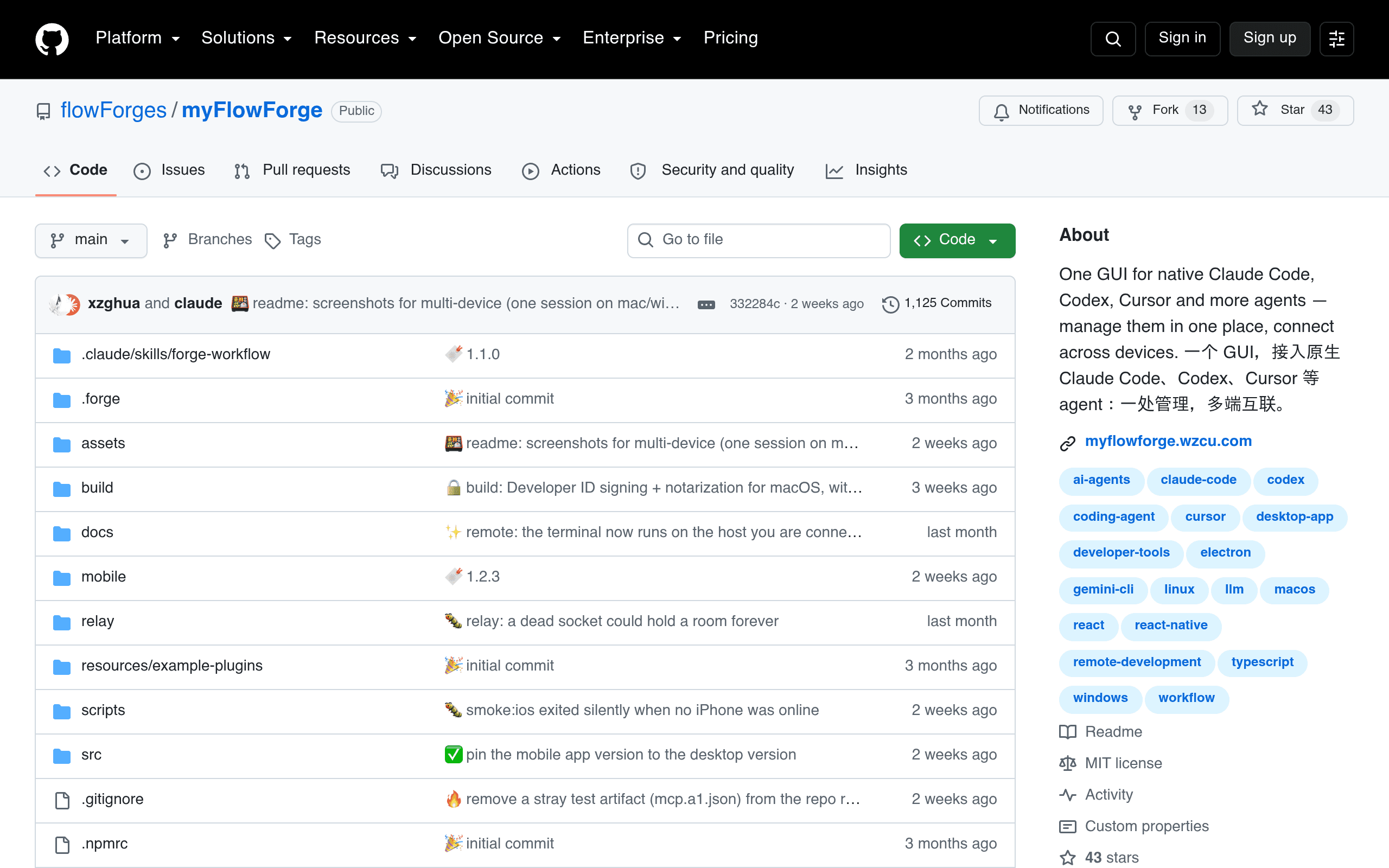
myFlowForge

一个 GUI 接入原生 Claude Code、Codex、Cursor 等 14 个编码 agent:一处管理、多端互联,还能编排"方案→开发→测试→评审"多模型工作流。

同时买了 Cursor、Claude、Codex 好几家套餐,每家量都不多——这个 2026 年程序员特有的烦恼,就是 myFlowForge 的起点。作者 xzgua 的想法很直接:方案设计用 Claude、代码开发用 Codex、代码 CR 用 Claude、单测用 qoder 和 Cursor,能不能有一个 GUI 把这些原生 agent 统一管起来?于是他 vibe 了 myFlowForge 出来。 它的定位是各家 CLI 之上的 GUI 层,坚持"原生接入":直接调用本机已安装的官方 CLI,不 fork、不修改 agent 本身,不保存 API key,也不代理请求。支持同一会话内切换 agent 与模型(某家额度耗尽直接换另一家续聊,上下文不断)、导入原生会话、阶段式工作流(需求→方案→审批→开发→测试→评审,每个阶段可指定不同的 agent 和模型,开发阶段还能按项目扇出到多个 git worktree 并行)。多端互联是另一大卖点:桌面端、无头 Linux daemon、iOS/Android 客户端共用同一套工作区,局域网直连、SSH 或端到端加密中转,手机上能实时看对话、处理权限确认、审批方案。 有意思的细节不少:兼容 Codex 原生宠物,还做了个随 token 消耗成长的桌面宠物;内置 Forge MCP 服务器供 agent 回调;额度与用量统计告诉你每家还剩多少;机器人桥接到钉钉、Telegram、飞书处理审批。仓库 1,125 次提交、32 个 release,提供 macOS(含签名公证)、Windows、Linux、安卓 APK 与 iOS TestFlight 安装包,MIT 开源,43 star 且两周前还在提交。 这是 vibe coding 生态的一个标志性时刻:AI 编程工具多到需要另一个 AI 做的工具来管理它们。对同时开好几个 agent 订阅的人来说,myFlowForge 就是那个"遥控器抽屉"。 注:本项目由 VibeFix 编辑从公开渠道精选收录,版权归原作者所有。