China Issues New Productive Forces Guidelines: Full-Scale "AI Plus" Rollout With Anti-Bubble Red Lines
On Oct 9, China issued the Opinions on Developing New Quality Productive Forces. Article X of its 19 measures mandates "full implementation of the AI Plus initiative": transforming traditional industries, building AI pilot bases, strengthening compute/algorithm/data supply, and enforcing safety controls. It also draws red lines against bubblification, holding officials accountable for blind investment. For vibe coders, the narrative has shifted from models to applications.
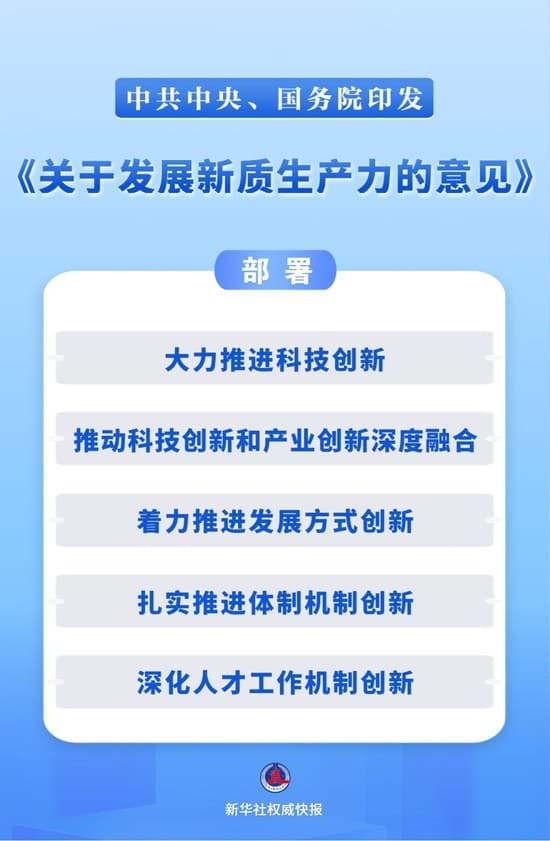
On October 9 at 18:08, Xinhua issued a dispatch: the CPC Central Committee and the State Council have released the "Opinions on Developing New Quality Productive Forces", laying out 19 key measures across five areas — sci-tech innovation, deep integration of technological and industrial innovation, new development models, institutional reforms, and talent mechanisms. The weight of this document starts with its rank: jointly issued by the Party Central Committee and the State Council, it is the master blueprint for China's tech and industrial policy for the period ahead. For those of us who write code and build AI products, only one article deserves a line-by-line read: Article X, "fully implementing the 'AI Plus' initiative."
Note the wording. "AI Plus" first appeared in the 2024 Government Work Report; two years later, the formulation has been upgraded to "full implementation." From "proposed" to "fully implemented," the policy center of gravity has moved past "whether to do AI" into "how to embed AI into every industry." For indie developers and vibe coders, this is a demand-side confirmation at the national level: the biggest AI increment in the coming years will not be in foundation models, but in the application layer.
The six AI-relevant articles out of nineteen
Of the 19 measures, six deserve every AI developer's attention (see figure below):
 Figure: 19 measures × 5 areas; the six AI-relevant articles highlighted.
- Article X: Fully implement the "AI Plus" initiative. Advance AI-driven transformation of traditional industries; accelerate scenario applications of new-generation intelligent terminals including intelligent connected new-energy vehicles, AI phones and computers, and humanoid robots; accelerate AI and digital-intelligence innovation, break through basic theories and core technologies, and strengthen efficient supply of computing power, algorithms, and data; establish national AI industry-application pilot bases and high-value application scenarios according to local conditions and sector-specific policies; build technology monitoring, risk early-warning, and emergency response systems to ensure AI is safe, reliable, and controllable. The densest article in the whole document.
- Article IX: Integrate the real and digital economies. Build a national integrated computing network and a national blockchain network; keep pushing the "East Data, West Computing" project and optimize the national data infrastructure.
- Article XIV: A national integrated data market. Build an open, shared, and secure national integrated data market; improve systems for data property-rights認定, market trading, rights distribution, and interest protection.
- Article XV: Stronger governance of AI. Under improved market regulation, "strengthen governance in AI, biotech and related fields" is listed on its own.
- Article XVII: Cross-border data flows. Establish an efficient, convenient, and secure mechanism for cross-border data flows.
- Article IV: Enterprises as innovation principals. Support capable private enterprises in leading major national technology programs; raise the extra R&D expense deduction ratio for enterprises.
And one red line everyone should read in the implementation section: "no detaching from the real economy for vanity projects, no grandiose overreach, no bubblification," and "it is strictly forbidden to abuse policies in the name of developing new quality productive forces; officials responsible for major losses caused by herd-like rushes and blind investment will be held seriously accountable." Reuters' October 9 coverage seized on exactly this point, describing a document that steps up support with one hand while warning against "blind investment" and "swarm-like" rushes into high-tech sectors with the other.
What Reuters saw: three keywords from the Western read
The same document, read through Reuters' lens, yields three points Western readers care about most — worth reading side by side. First, "original and disruptive" innovation: the document demands breakthroughs from 0 to 1 in core technologies and deploys the "new nationwide system" to accelerate the R&D and deployment of landmark products — an old instrument of Chinese tech policy, re-sharpened in an AI context. The signal: critical technologies will be conquered at home, not bought. Second, official accountability: holding officials "seriously accountable" for major losses from blind investment turns bubble-prevention from an exhortation into a personnel evaluation. Third, the low-altitude economy is named for "healthy and orderly development" — drones, air taxis, general aviation. "Healthy and orderly" means the green light stays on for this track, but the wild-growth phase is over. The developer translation: airspace management, dispatch, and inspection AI for the low-altitude economy is one of the few tracks the policy explicitly encourages while explicitly demanding order — compliance barriers will come first, suiting teams with industry resources.
Five signals: what this means for people building AI
 Figure: the logic chain of Article X's "AI Plus" initiative, decomposed into supply, application, and safety layers.
Signal 1: The national narrative shifts from "large models" to "AI Plus" — the application layer is the main battlefield. Read Article X's verbs: "transform," "establish," "promote application." Intelligent connected NEVs, AI phones and computers, humanoid robots are the terminals; traditional industries are the transformation targets; "national AI industry-application pilot bases" and "high-value application scenarios" are the vehicles. Not a single sentence is about training bigger foundation models. In developer language: policy dividends lie not in chasing parameter counts but in "vertical industry know-how + AI engineering." If you build QA agents for factories, medical-record assistants for hospitals, or planting advisors for farms, you are standing exactly where the document points; if you are building the Nth generic chat wrapper, you are standing exactly where it warns against "herd-like rushes."
Signal 2: Compute, algorithms, and data are named as "efficient supply" targets — falling inference costs are the long trend. Article X demands "efficient supply of computing power, algorithms, and data," with Article IX's national integrated computing network as backup. Combined with the industry datapoint from the recent SiliconFlow Series C news — inference costs falling 10x in a year — policy and market are pushing in the same direction: the commoditization of compute. For small teams this is a concrete tailwind: you don't need to build your own compute; you wait for cheaper, more stable inference supply.
Signal 3: Data-factor marketization accelerates — the missing piece for AI applications may get filled. Article XIV's national integrated data market and Article XVII's cross-border data flow mechanism target AI builders' shared pain: compliant, high-quality data is too hard to obtain. Once data property rights, trading, rights distribution, and cross-border rules are clarified, compliance costs for data businesses and AI apps going global will fall. This is a medium-to-long-term tailwind, though — the detailed rules aren't out yet, so don't go all in prematurely.
Signal 4: Small teams are written into the "eligible to lead" list for the first time. Article IV's "support capable private enterprises in leading major national technology programs" and Article V's guidance for universities and institutes to license research outcomes to SMEs on a "use first, pay later" basis. The bar remains high — "capable" is a hard qualifier — but writing "private firms may lead" into a central document is an unambiguous directional signal: small teams have a place in the innovation-principal narrative.
Signal 5: Safety and governance tighten in parallel — compliance is a ticket, not a cost. Article X requires technology monitoring, risk early-warning, and emergency response systems to ensure AI is "safe, reliable, and controllable"; Article XV lists "strengthen governance in AI" on its own. Existing compliance requirements — filing for generative AI services, labeling AI-generated content — will only continue and be refined. For teams operating both domestically and abroad: front-load compliance; don't wait for a regulatory call to patch it up.
Four things worth questioning
First, this is a framework document with no quantified KPIs. "Full implementation" sounds firm, but none of the 19 articles carries a numeric target; the details await ministries and local governments. It took two years to go from "AI Plus" being proposed in 2024 to "fully implemented" in 2026 — policy tempo is not market tempo. Don't mistake the document for orders arriving next week.
Second, the document itself admits the biggest risk: distorted execution. "No detaching from the real economy, no grandiose overreach, no bubblification" and "strictly forbidden to abuse policies in the name of new quality productive forces" — when a central document warns this heavily against "herd-like rushes," it is evidence those rushes are already happening. KPI-driven local AI projects and duplicative computing-center construction are exactly what this document is trying to prevent. A policy shouting about bubble prevention is itself proof that bubble anxiety is real.
Third, read against the US path: China is taking a different road. The US is capital-driven — Anthropic's upgraded anti-distillation defenses naming Z.ai a few days ago is a footnote to how white-hot US–China AI competition has become. China runs a dual engine of the "new nationwide system" plus capital: "leveraging the new nationwide system" and "high-quality development actions for key manufacturing chains" in this document continue that lineage. The takeaway for indie developers: the intersection of the two roads is "applications going global" — domestic policy offers scenarios, compute, and data rules; overseas markets offer willingness to pay. Those who eat dividends on both ends sit most comfortably.
Fourth, what the document doesn't say matters as much as what it says. Read all 19 articles and you'll notice three absences. One: no mention of open source — "strengthening supply of compute, algorithms, data" is about supply capacity, not open ecosystems; community-driven open models and toolchains are not in this narrative. Two: no subsidy numbers — "raise the R&D deduction ratio" and "grow patient capital" are directional; the actual ratios and amounts await fiscal rulemaking. Three: no word on private-compute access — the "national integrated computing network" is a state project, and the document doesn't spell out what role private cloud vendors and intelligent-computing centers play in it. The practical meaning: don't treat this document as a checklist of cashed benefits; it's a direction confirmation. The real dividends hide in the implementing rules to come — the配套 moves from MIIT, NDRC, and CAC are the ones worth tracking.
An action checklist for vibe coders
- Pick scenarios, not models. Manufacturing, healthcare, agriculture, government services, the low-altitude economy (Article VII also names it for "healthy and orderly development") — "transforming traditional industries" is your customer list.
- Watch local "AI industry-application pilot bases" and scenario-opening lists. They are small teams' low-cost tickets to real scenarios and real data — more reliable than building behind closed doors.
- Compliance first. Generative-AI service filing and AI-generated-content labeling: do them before launch, not after you've scaled.
- Don't build the Nth generic chat wrapper. The document explicitly guards against "bubblification" and "herd-like rushes"; generic consumer AI apps are the easiest category to fall into. Differentiation lives in scenario and delivery, not in the model.
- Mind the other side of talent policy. Articles XVIII and XIX cover cultivating "urgently needed talent for new quality productive forces" and talent mobility. The blunt translation: applied AI talent will be in stronger demand and better supply in the coming years. For indie developers that's double-edged — hiring gets easier, but the scarcity premium on "AI engineering ability" gets diluted. Turn scenario know-how into product moats during the window, rather than hoarding people who "can tune models."
One-line verdict: this document turns "AI Plus" from a slogan into a national construction drawing — the application layer, vertical scenarios, and compute/data supply are the certainty for the next few years; but the red lines are equally clear, and the chasers of vanity narratives will be called out by the eight characters "seriously held accountable." For indie developers, the opportunity is not in bolder narratives but in more concrete scenarios. Embedding AI into a real, existing industry matches every character of this document better than telling another grand AI story. One last note on timing: the document was issued October 9; the real test is the implementing rules from ministries over the next 6 to 12 months — whether "full implementation" lands depends on the rules, not the document.
Editor's note: Top-level documents settle direction; implementation details will tell. For indie developers and vibe coders, this document's signal is concrete: policy tailwinds in the coming years will flow to real "AI+" application scenarios — smart manufacturing, connected new-energy vehicles, humanoid robots, AI devices — not to yet another foundation model. Treat this document as a topic guide: if your product can explain which industry it makes more efficient, you'll have more leverage when applying for subsidies, entering industrial parks, or talking to customers than if you just talk about how strong your model is. The flip side is written in the document too: bubble-chasing and blind investment will be "held seriously accountable," so hype-driven projects should weigh the risk.
Primary source: Xinhua, "CPC Central Committee and State Council Issue the Opinions on Developing New Quality Productive Forces" (dispatch 2026-10-09 18:08). Cross-checked: Reuters 2026-10-09 report, Digital Watch Observatory 2026-10-10 analysis.
Comments (0)
Sources
Related articles

Chainguard launched Harness on October 14: Claude Mythos 5.1 hunts vulnerabilities in running applications inside isolated microVMs, delivering only reproducible findings with merge-ready fixes. A day earlier, its first public trophy was disclosed — a cross-request contamination bug in vLLM.

Google Cloud announced on October 7 that the MCP Toolbox Java SDK has reached v1.0, bringing type-safe agent database access to enterprise Java apps on Spring Boot, Quarkus, and Jakarta EE. The core design keeps the LLM away from the database: tools.yaml maps intents to parameterized SQL, with sensitive bound params pinned server-side. But the 'stable' claim clashes with a breaking change in the release notes, and Java still trails the Python/Go SDKs in features.

Anthropic's new anti-distillation safeguards cut distillation harvests by ~90%–99%, reasoning-token extraction to 1/10–1/100, banned tens of thousands of accounts, and named Z.ai over GLM-5.3. The model security war goes public — and quantified.