Software Developer Job Postings Rise 15% Even as AI Writes More Code — but Juniors Get Squeezed
CNBC reported Oct 11: US software-developer postings rose nearly 15% since late Feb 2025 while overall postings fell 7%. But seniors drove 71% of the gain and AI-titled roles 37%; totals remain 27.5% below pre-pandemic. Stanford's 2026 AI Index shows early-career developer employment down nearly 20%. What's growing isn't code-writing jobs — it's machine-driving jobs.
The numbers first: a 15% rise hiding two contrasts
On October 11, CNBC published a piece that makes the "AI will replace programmers" narrative very uncomfortable (original timed October 11, 1:30 PM; the fact chain here follows WhatJobs' full restatement and Scoopfeeds' cross-annotation — the CNBC original sits behind a paywall that our scouting couldn't get through directly, stated here honestly). The core data comes from Indeed Hiring Lab: U.S. software-development job postings have risen nearly 15% since late February 2025. Over the same stretch, overall U.S. job postings fell about 7%.
Late February 2025 wasn't picked at random — it brackets the launch of Anthropic's Claude Code and the visible acceleration of AI coding assistants. Since then, AI has written more and more code, "programmers are finished" has grown louder, and yet developer job ads kept climbing. CNBC's headline put the contradiction front and center: AI automates coding — so why are software developer job postings on the rise?
GitHub's October pull-request report supplies the other half of the contradiction: one in three pull requests now involves an AI agent, up from fewer than one in ten a year earlier. GitHub's own words: if that pace holds, within two years most code pushed to GitHub could be written by an agent, and "much of it may never be fully read by a human." Agents write the code; humans get hired in greater numbers — that is the software industry's real cross-section in the fall of 2026.
Eric Kutcher, McKinsey's North America chair, answered the "extinction" thesis on CNBC's "Squawk on the Street": "It wasn't that long ago that we were reading the headline that there will be no more need for software developers." His read is that reality went the other way — companies produce more code than ever, and developers who work with AI remain in high demand: "We're seeing much more growth in the places we thought we were gonna see the biggest displacement." That line became the most-quoted sentence of the whole piece.
A familiar script: every "programmers are finished" prophecy ended with more programmers
This "stronger tools, more practitioners" plot has played several times in software history. When ATMs arrived, bank tellers were supposed to vanish; instead tellers became wealth-management sellers and branches multiplied. When Excel arrived, accountants were supposed to be done; instead they became "analysts who use Excel," and their ranks grew. When cloud arrived, ops was supposed to die; instead it became SRE, managing a hundred times the machines. Every time, automation ate "repetitive execution" and grew "judgment and design."
AI coding agents are replaying that script, except this time what's being eaten is "writing code" itself. GitHub said as far back as 2023 that on projects where AI was available, it was close to writing half of all code; now some AI experts claim AI-written code across the entire GitHub platform has passed the halfway mark (GitHub hasn't confirmed that platform-wide figure — noted as a claim). The "production" of code got automated, but the "consumption" of code — review, integration, shipping, owning the fallout — is still human. The more that's produced, the busier the consumption side gets. That's the underlying logic of Kutcher's line: multiply output tenfold, and the people who supervise the output become ten times as valuable.
But the historical parallel has its limits. In previous automation waves, a decade or two of buffer separated the eaten execution layer from the newly grown judgment layer — enough for a generation to retrain. This time, Claude Code's launch to "one-third of PRs involve an agent" took under two years. The buffer compressed to something measured in years, and whether personal reinvention can keep pace is the biggest open variable of this round. The BLS ten-year projection (+10%) and Stanford's youth-employment decline (-20%) being true at once says exactly this: the aggregate story is for the patient; the structural story is for those who can't wait.
Who's actually rising: 71% senior, 37% with AI in the title
The 15% figure misleads on its own; split it open and it means something. Indeed's data shows that between May 2025 and May 2026, senior roles accounted for 71% of the gain in software-development postings, and job titles mentioning AI accounted for 37%. What's rising isn't "programmers" as a blob — it's "experienced, AI-fluent" programmers.
Two more numbers play cold water. First, even after the 15% climb, software-development postings remain about 27.5% below their pre-pandemic level — this is a rebound, not a new high. Second, the McKinsey Global Institute cautions that the earlier decline wasn't solely an AI story: after the pandemic-era over-hiring peak of 2022, tech companies pulled back hard, and a big chunk of the postings drop was frozen budgets and shrinking roadmaps, unrelated to AI replacement. Read today's rebound the same way in reverse: product roadmaps reopened, plus "someone needs to supervise the code-writing machines" — the two forces pushing together. Reading the 15% as pure "AI created jobs" is as oversimplified as reading it as "AI didn't replace humans."
Sneha Puri, an economist at Indeed Hiring Lab, offered the more grounded explanation: companies are realizing that even if AI handles some of the technical coding work, they still need developers to oversee it, refine products, and help clients integrate technology into day-to-day operations. Her example: part of the growing demand is for people who help businesses apply AI tools, not just build them. The former is integration and landing; the latter is R&D — and the labor market is rewarding the former.
Pricing power moves: why seniors get paid differently now
There's a rarely discussed angle: in this rebound, the source of senior pricing power changed. Seniors used to be expensive because "ten years of experience" was itself scarce — they'd seen enough pitfalls to know where the mines are. Now there's a second layer: they're "the people who can underwrite the agent." A company hiring a senior isn't buying hand-written code speed (AI is already faster there); it's buying the ability to review agent output, sign off on architecture, and take the 3 AM production-incident call.
That shift is good news for independent developers. In the traditional job market, "senior" is a title you simmer toward with years and big-company endorsements; under the new "can you drive the code-writing machine" standard, senior becomes a verifiable capability: can you get an agent to stably ship production-ready work? Can you catch it when it fails? Vibe coders who nail those two things are seeing market pricing converge toward traditional senior levels — regardless of what's on the résumé. The 37% of the gain carrying AI titles shows the market is already pricing that capability separately.
Conversely, the mid-level may be the most awkward layer next. Junior work got eaten by AI, senior judgment got repriced upward, and the cohort in the middle — "can write code but can't make architectural calls" — gets squeezed from both sides. GitHub's line about "better automated testing plus fewer human reviewers" names exactly that layer. The old career advice was "move up"; the 2026 version is "move toward judgment, away from execution" — the execution layer is being lifted out whole by agents.
The other side: the ladder's bottom rungs are thinning

The flip side of the 15% is a set of numbers from Stanford's 2026 AI Index: in AI-exposed fields, employment for ages 22 to 25 has fallen 16% since the rise of generative AI; for early-career software developers the drop is nearly 20%, even as older-developer roles expand. The ladder is still there, but its bottom rungs narrowed.
CNBC's piece explains the mechanism well: AI keeps getting better at research, drafting, coding, and administrative work — tasks traditionally handed to junior employees. Seniors and AI-titled roles dominate the posting rebound while early-career paths tighten. The piece's neat framing — "AI expands what experienced teams can ship" (glass half full) versus "the bottom rung of the ladder is sawed thinner" (glass half empty) — describes the same thing. What's being squeezed isn't just "lack of experience" but the opportunity cost of "trading experience for growth": writing CRUD used to be boring, but every line taught the codebase; now CRUD belongs to the agent, and juniors don't even get the chance to learn the system through the boring parts.
The Bureau of Labor Statistics' August report adds the third perspective: the official projection has software-developer employment growing 10% from 2025 to 2035, from about 1.72 million to 1.89 million jobs — roughly 174,700 new positions. All three datasets can be true at once: BLS sees decade-scale aggregate growth, Indeed sees a senior-led one-year rebound, Stanford sees the narrowing entry ramp for the young. The industry is getting bigger while the door gets narrower — that's the software labor market of 2026.
The thesis: what's growing isn't "code-writing jobs" but "machine-driving jobs"
Put the three datasets together and the conclusion is clean: the market no longer rewards the act of writing code; it rewards the ability to judge how code should be written, whether it's right, and whether it can ship. Seniors taking 71% of the gain means experience is what's being bought; 37% of postings carrying AI titles means "can drive AI" is the skill being bought. Combined, that's the 2026 developer-job portrait: people who can evaluate AI output, set architecture, and wire new tools into enterprise systems.
GitHub's PR report hides the other half of this logic: more code means more work to police. GitHub's words: "As the amount of code grows, we must prevent more exposures and reduce the human effort required by those that remain, or else the volume of vulnerabilities introduced will become untenable." Security is the hard constraint — if agents write most of the code and humans read less and less of it, vulnerability growth outruns review capacity. People who can set guardrails, design review pipelines, and own production risk only gain pricing power. That's fully consistent with Indeed's senior-led growth.
Anthropic's researchers poured their own cold water: even with automation, humans are still needed to oversee it and provide input — but it is "by no means certain that this pattern will persist into the future." GitHub put it more bluntly: if oversight can't scale with code volume, firms may pivot to "better automated testing and fewer human reviewers" — the next wave of pressure lands on mid-level review roles first. Today's senior premium rests on the assumption that human oversight is irreplaceable, and that assumption itself has a shelf life.
The pipeline warning: skip juniors today, no seniors in ten years

Puri said the thing employers least want to hear: "Today's entry-level talent becomes tomorrow's senior experts. If employers don't build those pipelines now, they're not going to have senior talent they need 10 years down the line." Mentorship, code-review apprenticeship, ownership starting from small features — that's the old road from junior to senior. Skipping junior hiring saves a few budget cycles and mortgages the talent pool a decade out.
That lands precisely on the "AI drafts the first pass, juniors have nothing to do" strategy: companies replace junior grunt work with AI, save headcount cost short-term, but juniors lose the chance to "make mistakes and grow on small tasks." Someone who never debugged production by hand — how do they review agent-written architecture in ten years? Seniors aren't born; juniors are trained into them. Sawing the ladder and then complaining that no seniors can be hired is the honest portrait of many 2026 companies.
For policymakers, the BLS 10% aggregate projection is a trap: a pretty total masking a split market — seniors and AI roles up, 22-to-25-year-old developers down nearly a fifth on Stanford's measure. Deciding by the total misses the real structural problem.
One cold detail hides in economist Steve Rattner's analysis of the BLS data: from May 2023 to May 2025, software developers were indeed among the occupations with positive growth — but merely in line with the all-occupation average, and well below the pace of traditionally blue-collar jobs tied to building AI data centers. The AI boom's employment dividend flowed first to the physical layer — the people pouring concrete, pulling cable, racking servers — and only then to the people driving code-writing machines. Virtual-world automation raising physical-world wages first: a very 2026 irony.
How Chinese developers should read this American data
The disclaimer first: Indeed, Stanford, and BLS are all U.S. data; transplanting them to China needs care. But the structural direction is global: Chinese big tech spent the last two years shrinking junior headcount too, and "hands-on experience with AI coding tools" moved from nice-to-have to must-have on job posts faster in China than in the U.S. A narrowing ladder isn't an American specialty; it's the agent era's global default.
For Chinese vibe coders, the takeaway is arguably more direct. The U.S. market's 15% proved one thing: "people who can drive AI" have pricing power. And the independent developer's edge is that you don't need a company's title system to certify you as senior — you price with shipped work. Someone who can independently ship production-grade products with agents is already seeing freelance and contract pricing converge toward traditional big-tech P6/P7 hourly rates in China. The market doesn't read your rank; it reads your delivery.
The other side deserves honesty too: AI-coding-tool penetration in China is still climbing, and enterprise "AI readiness" is uneven — the "help businesses apply AI tools" demand (the growth Puri described) may be even larger in China than in the U.S., with plenty of traditional enterprises still at the "heard of AI coding" stage. People who understand business and can wield agents are a scarcer middle layer in China than in America. The U.S. data is "the future"; China is "in progress" — the window hasn't closed.
Three takeaways for vibe coders
1. The "one person + AI" team is perfectly positioned for this dividend. The market pays for "people who can drive code-writing machines," and the indie-developer-plus-agent combo is essentially "one senior-grade judgment plus infinite junior execution." You don't need a traditional big-company senior title; you need the two capabilities: the eye to review AI output, and the ownership to ship and answer for production. Part of that 15% is buying exactly this "small team, big leverage" possibility.
2. If you're junior, don't just grind "AI tool fluency." Puri's advice to students is dual-track: being good with AI is the starting point, but communication, collaboration, and leadership — the things models don't replace — matter equally. In vibe-coder language: don't just learn to write longer prompts; learn to judge whether agent output is right, to explain technical decisions to humans, to own a launch. The junior squeeze is deleting the "only writes code" part and leaving the "makes judgments" part — walk toward what's left.
3. Beware survivor-bias optimism. This story is easy to read as "AI replacing programmers is a myth," but the data doesn't support that sunny reading: totals still sit 27.5% below pre-pandemic, the youth entry ramp narrowed nearly 20%, and the senior premium's premise (irreplaceable human oversight) is something even Anthropic won't guarantee. The correct reading: the profession didn't vanish, but its shape changed — writing code moved from "the main work" to "the supervised step," while judgment, integration, and ownership became the main work. Those who fit the new shape get raises; those clinging to the old shape get squeezed. That simple, that brutal. Most VibeFix readers are in the shape-fitting camp — but remember, the shape is still morphing, and the next version may look even less like a "programmer."
One final honesty note: the CNBC original is paywalled; this piece cites WhatJobs' full restatement (attributed to CNBC) and Scoopfeeds' dating of the original (October 11, 2026), with the fact chain cross-verified between the two. The "over half of code is AI-written" platform claim comes from some AI experts; GitHub itself hasn't confirmed it, and that qualification is preserved as in the original. Indeed's 15% counts job postings, not employed heads — rising ads don't equal rising headcount, a point the original didn't spell out, added here. Data is cold, interpretation is hot — but the base numbers have to be right first.
Comments (0)
Sources
Related articles

Stack Overflow's engineering blog (Oct 7) argues the agent is the model plus its harness - and the model is maybe a tenth. Evidence: LangChain's agent jumped 52.8% to 66.5% on Terminal-Bench 2.0, from outside the top 30 to the top 5, changing only the harness. The essay prescribes six artifacts - constitution, autonomy boundary, tiered CONTEXT.md, durable memory, a multi-lens review panel, a PostToolUse hook - plus multi-agent coordination via shared state and an append-only decision log.
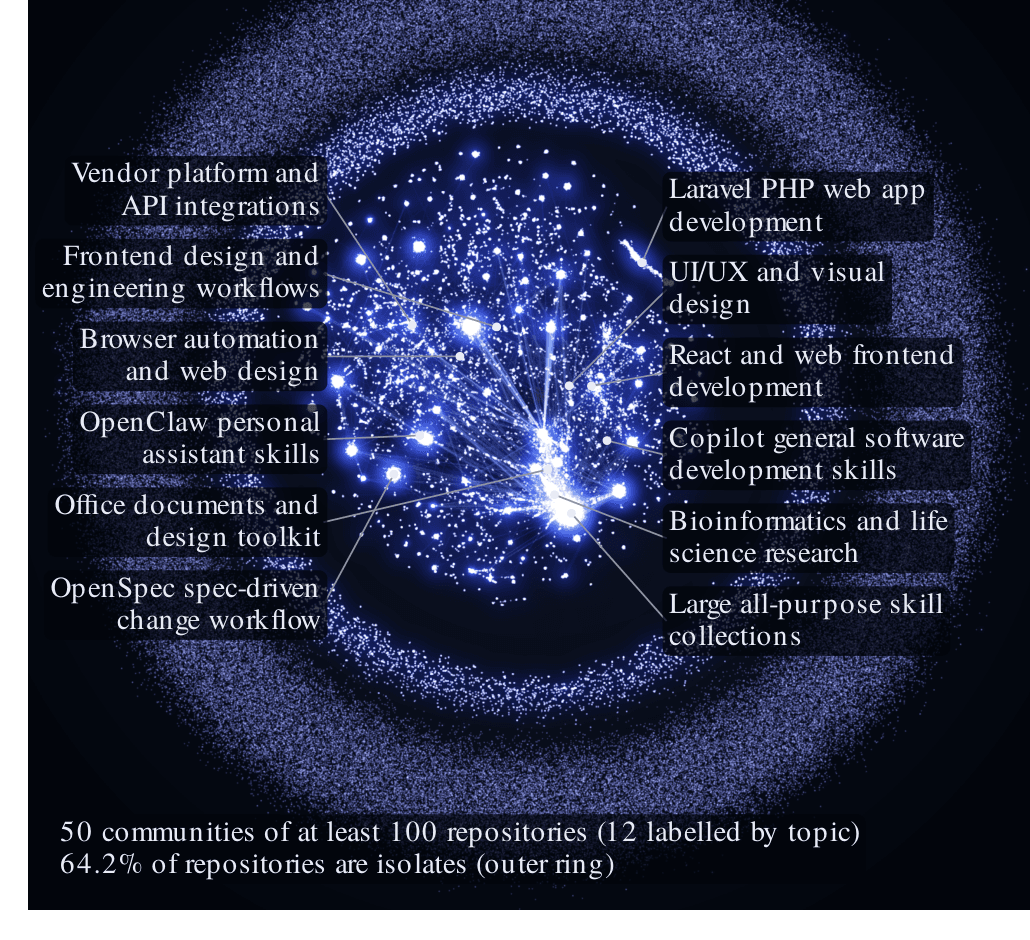
The Oct 8 arXiv paper 'Skill Constellations' rebuilt agent-skill copy networks from git history: of 2.19M adoptions, half of SKILL.md files are verbatim copies; the top 1% of repos drive 94.7% of transmissions; upstream fixes never reach installed copies. Auditing the network-ranked top 100 repos would intercept 14.9% of later high-risk adoptions vs 0.5% for the top 100 by stars. Stars can't find hubs; the missing update channel is the structural risk.

On October 8, Chinese team MirroS published the paper 'AgentGarten: Code Worlds for Evolving Agents' and open-sourced the repository (Apache-2.0). Its thesis: code handles physics, a neural renderer handles light, and agents accumulate experience in playbooks — one short skill file per lesson. In a reenactment of OpenAI's 2019 hide-and-seek, skills that took ~100M episodes of self-play RL now emerge within 10 rounds of play-review-write cycles across five code worlds.