"Programming Is Hard": Epic Admits Its Rewritten Launcher Is Vibe Coded, 5.47s Cold Start Takes on Steam
On October 14, Epic Games launched a rewritten Launcher preview and admitted it was vibe coded: 5.47s cold start vs Steam's 10.07s, tested by third-party Keywords Studios, with first-ever native Linux support. A landmark moment for vibe coding going to production.
"Programming is hard, so we vibe coded one"
On October 14, 2026, Epic Games launched a rewritten Epic Games Launcher preview and admitted through official channels: the new version was vibe coded. The official blog put it bluntly — roughly, "programming is hard, so instead of doing that, we vibe coded a new Launcher that is way faster, more responsive, and has a new look." The official X account's post that day (October 14) was even more provocative: "we vibe coded the Epic Games Launcher to be faster than the other guy" — "the other guy" clearly meaning Valve's Steam.
This may be the first time a gaming giant has written the words "vibe coding" into official product marketing. The vibe-coding stories we've covered before mostly starred indie developers and small teams; this time, Epic stamped "AI-written code" on the launch announcement of its flagship distribution platform — and attached a set of benchmark numbers calling out Steam.
A sourcing note first: Epic's official preview page (launcher.epicgames.com) could not be opened directly due to access policy, so the official quotes and figures in this article come from the official X post and blog text, cross-cited by WhaleAgent (Oct 15), Eurogamer (Oct 14), and Ars Technica (Oct 14). Every cited claim is labeled as such.
The numbers: 5.47 seconds vs 10.07 seconds
Epic's published comparison is specific, down to two decimal places:
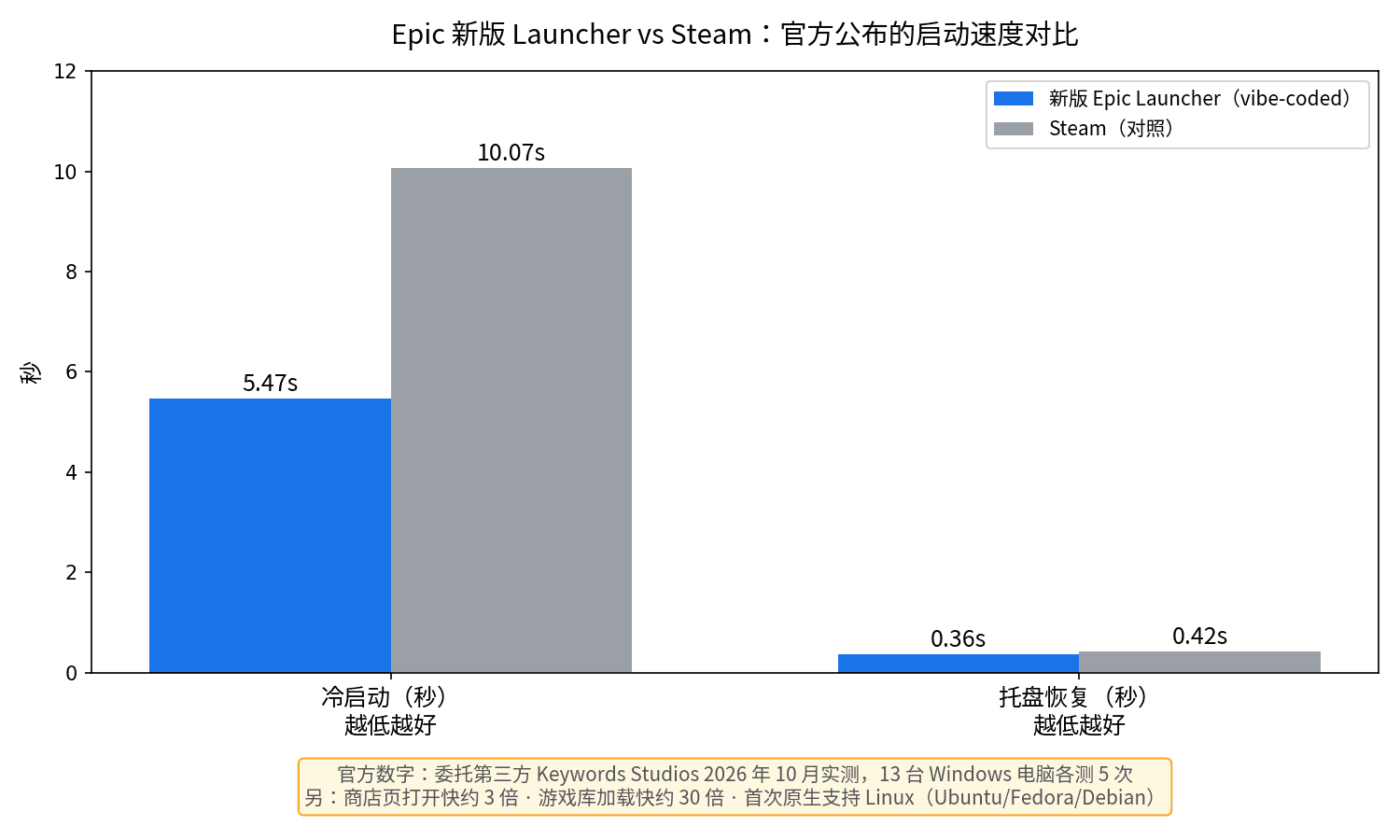
- Cold start: new build 5.47s vs Steam 10.07s — about 1.8× faster, 46% less time;
- Restore from system tray: 0.36s vs 0.42s;
- Store page open: about 3× faster;
- Library loading: about 30× faster.
 Figure 1: Epic's published new-Launcher vs Steam speed comparison. Source: independent testing by Keywords Studios commissioned by Epic in October 2026 — 13 Windows PCs, 5 runs each. Per Epic: store pages open ~3× faster, library loads ~30× faster.
What deserves study here is the testing methodology, not the numbers themselves. Epic didn't just run a benchmark on one maxed-out machine; it commissioned third-party Keywords Studios to test in October across 13 Windows PCs, 5 runs each. That's a "reproducible and challengeable" benchmarking posture: sample size disclosed, tester independent, skeptics can attack the methodology. The takeaway for vibe coders is direct — when you claim "my AI-rewritten version is 3× faster," the first question should be "how did you measure it." Epic just handed us a textbook answer template: third party, sample size, repetition count. All three are required.
A bucket of cold water is also due: these are Epic-commissioned, Epic-published numbers. The hardware distribution of the 13 machines, the Steam version tested, whether background updates were disabled — none of that is public. Treat the 1.8× figure as a vendor claim for now, pending independent review.
Three platforms, with Linux supported natively for the first time
The preview supports Windows, macOS (Apple Silicon only), and Linux. The Linux build officially supports Ubuntu, Fedora, and Debian — the first native Linux support in Epic Games Launcher history. Epic also preempted complaints: many games are Windows-only and may need a compatibility layer on Linux.
This detail's significance is underrated. Linux gamers have waited years for a native Epic Launcher; beyond Proton there's finally an official path. More importantly, it shows this rewrite isn't a reskin: shipping three platforms (Linux included) in one go is exactly the kind of work AI-assisted rewrites excel at — platform adaptation layers are voluminous, repetitive boilerplate, precisely where agents are least likely to blunder. Epic VP and Epic Games Store GM Steve Allison's comment to IGN confirms it: agents wrote and reviewed all of the code, while the development team "managed and supervised the entire process." Note the division of labor: AI is the execution layer, humans are the management layer. That sentence may be 2026's most standard-issue description of big-tech AI programming posture.
macOS being Apple-Silicon-only is an honest tradeoff: the Intel Mac baggage was simply dropped. One of the logics of a vibe rewrite is "don't carry historical baggage," and Epic just demonstrated it.
"Think of it as a speedboat, not a yacht"
Epic is candid about the preview's scope: the first version has fewer features — "think of it as a speedboat, not a yacht"; some social features and account-management options are missing for now; installing the preview removes the old Launcher. And the widely quoted disclaimer: "Will there be bugs? Yes. Do we want to know about them? Of course."
Each line of that messaging deserves a close read. First, "speedboat, not yacht" is classic MVP philosophy — make the core loop (launch, load, purchase) fast first, backfill social and account features later. Second, pre-admitting bugs is a new kind of honesty for the AI-generated-code era. Traditional software launches also say "bug reports welcome," but Epic's tone is different: it assumes you will hit bugs, because it assumes the code was batch-written by agents. That expectation management is itself a marker of vibe coding going to production: no more pretending AI-written code is as reliable as human-written code — instead, "iterate fast and fix bugs" is written into the launch strategy.
 Figure 2: Event timeline. On October 13 Bloomberg first reported Epic's company-wide shift to "AI-first" development; on October 14 the official X post announced the rewrite and the preview went live. This isn't an isolated product update — it's the product footnote of an organizational pivot.
Context: this isn't an isolated product update
Rewind one day. On October 13, Bloomberg reported Epic's full pivot to an "AI-first" development process, with a Marvel/Star Wars shooter delayed internally. CEO Tim Sweeney then posted online: the goal is "not to do the same thing with fewer people, but to let everyone make more and better things," with the results coming to all teams using Unreal Engine.
Put the two stories together and the shape is clear: the Launcher rewrite is the first public deliverable of Epic's org-level AI pivot. Practice on your own distribution platform first — huge user base, short feedback loops, problems fixable with fast preview pushes; then copy the methodology to game projects and the Unreal ecosystem. Sweeney's "bring it to all Unreal Engine teams" isn't politeness: if Epic distills an "agent-rewrites-legacy-codebase" SOP, tens of thousands of Unreal teams can copy the homework.
My judgment: the symbolism here outweighs the product. A 1.8× faster Launcher is nice for players, but the real industry shock is — a company famous for being hardcore-technical publicly admitted its flagship product is vibe coded, and marketed it as a selling point. That changes the "can AI-written code go to production" debate inside many teams: with Epic shipping agent-written code to tens of millions of users, the red line of "AI code must not ship" downgrades from a principle to an engineering problem — no longer "whether," but "how to manage it" (review, testing, gradual rollout, rollback).
Three takeaways for vibe coders
First, rewriting legacy codebases may be vibe coding's next main battlefield. Allison said the rewrite let "a small team rewrite the entire codebase and ship across platforms faster." Everyone has seen AI's advantage in 0-to-1 greenfield work; but tearing down and rebuilding a legacy codebase — clear requirements, clear boundaries, comparable tests — may be the higher-ROI scenario for agents. Your next side project doesn't have to be a new idea; AI-rewriting that old project of yours that barely runs might be the better investment.
Second, the benchmarking methodology is directly copyable. Third party, 13 machines, 5 runs each — the next time your README claims "N× faster after rewrite," write your test notes to this template and credibility doubles. VibeFix values verifiable claims above all when featuring projects; this methodology is pure bonus points.
Third, learn Epic-style expectation management. "Speedboat, not yacht," "there will be bugs, and we want to know" — stating the limits of AI-generated code upfront wins trust instead of losing it. For indie developers shipping vibe-coded products, that's a more effective strategy than any marketing copy: honesty is the scarcest marketing asset of the vibe-coding era.
Unanswered questions: how does the Linux build hold up in real compatibility? What's the crash rate of agent-written code in real users' hands? Will Epic publish follow-up iteration data? The answers will decide whether this "we vibe coded it" announcement was a marketing event or the start of a paradigm shift in engineering. Stay tuned.
What "agents wrote all the code" actually means
Allison's line — agents wrote and reviewed all of the code while the dev team managed and supervised the entire process — deserves three readings. It doesn't describe "programmers are unemployed"; it describes a new division of labor: humans graduate from "people who write code" to "people who manage code-writing."
Note he deliberately added "and reviewed." In the traditional flow, code review is humans checking humans; here, agents both write and review, with humans one level up doing "supervision." A key question hides in that chain: who reviews the reviewer? If agent-written code has systematic blind spots, agent self-review will likely reproduce the same blind spots. Epic's answer is "the dev team supervised the entire process" — humans didn't leave, they stepped back one level, from "review every line" to "spot-check, set rules, watch metrics." That "supervisor" role demands a new skill model from programmers: no longer earning a living on typing speed and memory, but on defining acceptance criteria, designing test suites, and spotting systemic risk.
It also explains why Epic dared to start with the Launcher: a distribution platform's business logic is relatively standardized — UI layer, downloads, payments, library management — each with mature patterns, compressing the agent's "hallucination space" to a minimum. For a 3A game's innovative core systems, Epic likely wouldn't dare. Vibe coding's production debut will always land first on code that is "highly patterned with clear acceptance criteria." That's directly actionable guidance for indie developers: let agents rewrite the "boring but important" parts first — admin panels, data import/export, settings pages — and save the blade for core logic that truly needs human judgment.
One industry-history footnote: the Epic–Steam feud has run nearly a decade, from the revenue-cut wars to the exclusives wars. Epic's two chosen attack vectors are telling — startup speed and Linux support, precisely Steam's long-mocked weak spots. The Steam client's bloat is a community meme; on Linux, Valve has Proton, but that's a compatibility layer, not native. Using a vibe-coded rewrite for an encirclement-style differentiation play is a shrewd move: AI rewriting collapses the cost of "tear it down and rebuild," so architectural debt that was too expensive to fix can now be resolved with one preview release.
So this story really has three layers: the surface is "Epic's Launcher got faster"; the middle is "a major studio publicly admits vibe coding in production"; the deep layer is "AI is rewriting software competition's cost structure" — when rewriting a product with tens of millions of users costs "a small team plus agents," much of what was once "too expensive to touch" gets put back on the table. Will Steam follow with a client rewrite? Will GOG or itch.io? The coming year may bring an "AI rewrite wave" across game distribution platforms. And that wave starts with a post on October 14, 2026 that said, in effect, "programming is hard."
Comments (0)
Sources
Related articles
On Oct 13, Shopify opened its billion-plus product catalog to any personal AI agent: the agent finds and compares, the human approves every order, and checkout always runs through Shop Pay. 65% of shoppers use AI for shopping tasks, yet only a third trust it to buy — the data behind the per-order approval design, and a new craft for vibe coders: legibility, product copy written for machines.

On October 3, The Atlantic published OpenAI safety lead David Robinson's resignation essay, "I Quit OpenAI Because Its Culture Is Broken." A 3.5-year insider who drafted the Preparedness Framework and wrote safety reports for 12 frontier launches, Robinson turns his fire on Silicon Valley's release philosophy: iterative deployment guarantees periodic failures in the agentic era. His four-incident evidence chain, OpenAI's rebuttal, and what it means for vibe coders.

On October 15, Ant Ling officially open-sourced Ling-3.1-flash: ~560B total parameters with ~25B activated per token, 1M context, a Hybrid-linear MoE architecture, benchmarks aimed at Terminal-Bench 4.0 and SWE-bench Pro, plus a long-horizon task harness called LingCode.