Google Bakes Antigravity Into the Gemini Mac App, Powered by Gemini 4 Argon
Google has embedded the full Antigravity experience into the Gemini Mac app via a Liquid Glass pill button, alongside the Gemini 4 Argon rollout. Gemini 4 Argon reaches AI Pro and above, but Antigravity access reportedly requires Ultra — the coding agent as top-tier moat, colliding with Cursor's IDE-orchestration route.
What happened: a coding entry point inside the chat app
On October 13, alongside the Gemini 4 Argon rollout, Google gave the Gemini app for macOS a major redesign: a new Antigravity entry button in the top-right corner — described by 9to5Google as a "Liquid Glass pill." Tap it to enter, tap the same button to exit.
The key point: what opens isn't a stripped-down version, but "the full experience found in the dedicated application." Google moved its entire agent-first development platform into the chat app — you can be mid-conversation and just start building an app.
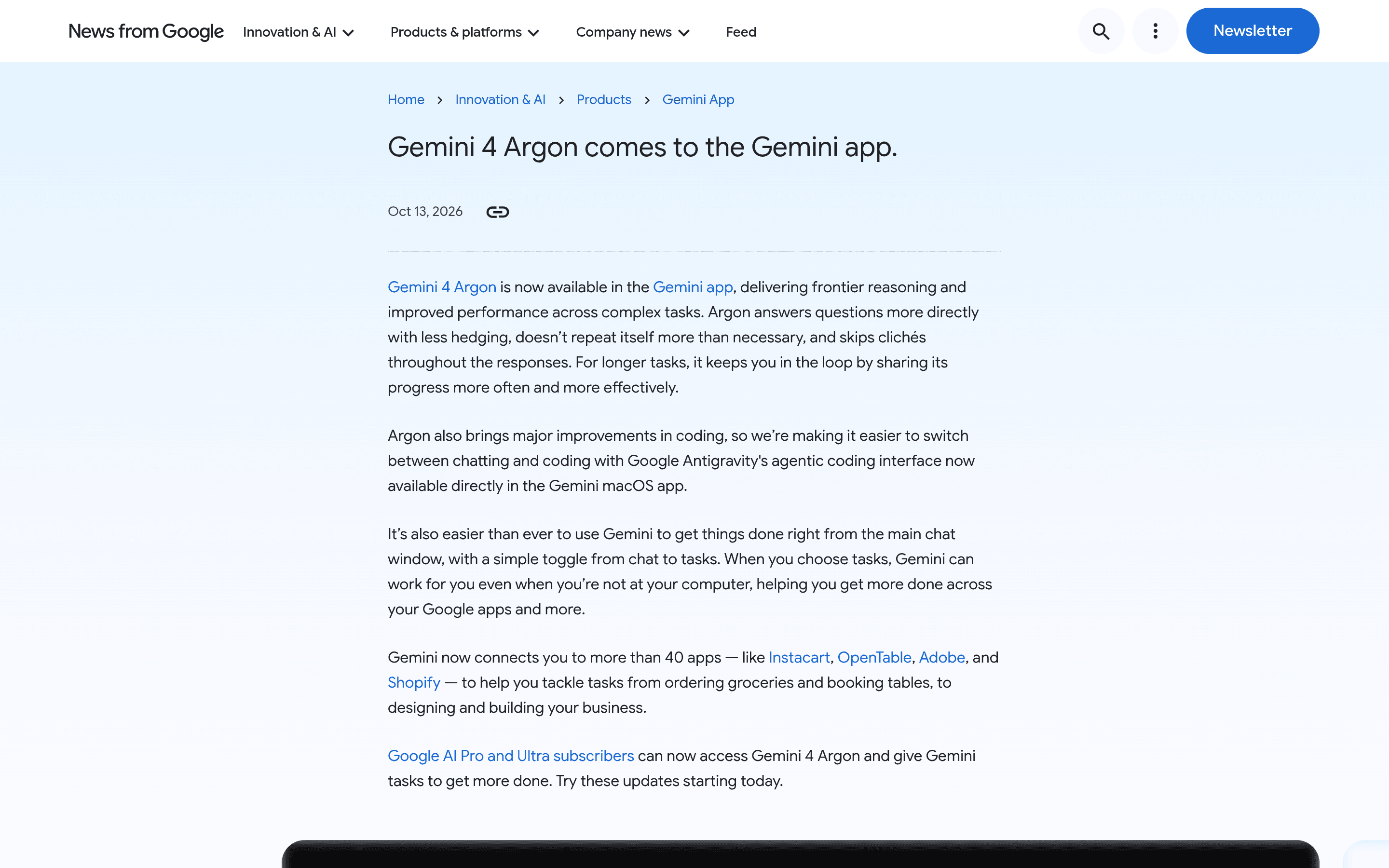
Google's official blog confirmed the integration the same day in "Gemini 4 Argon is now available in the Gemini app": "Argon also brings major improvements in coding, so we're making it easier to switch between chatting and coding with Google Antigravity's agentic coding interface now available directly in the Gemini macOS app." The company explicitly credits Gemini 4 Argon's upgraded coding capabilities as the reason for the move.
What else changed in the Mac app: more than one button
The Antigravity entry is the most visible item, but the Mac Gemini app's overall interaction model is shifting toward "agent-first" too:
- Chat / Task switcher: a new switcher below the prompt box, with Task being the renamed Gemini Spark — "task mode" now sits as a first-class citizen next to chat;
- Scheduled view: shows both Spark tasks and Scheduled actions in one place — agents keep working while you're away, and you review everything on return;
- @ to invoke Skills: Skills are now triggered with
@(mention-style) instead of/, matching chat conventions; - Customize manages Skills and Connectors: the side panel's Customize entry governs both Skills and Connectors, the latter being the renamed Connected Apps;
- Search moves top-right: the navigation drawer got a major update, with search relocated to the panel's top-right corner.
Google's blog also notes that Gemini now connects to 40+ apps (Instacart, OpenTable, Adobe, Shopify, and more), and paired with the chat-to-tasks toggle, Gemini can keep working across your apps after you walk away. The direction is clear: this chat app is becoming an agent workbench — and coding is one block of it, the block that got its own dedicated entry point.
The gate: the model goes to Pro, the agent stays with Ultra
The most telling part of this update is the subscription tiering. Google's official blog states that both Google AI Pro and Ultra subscribers get Gemini 4 Argon. But the Antigravity entry, according to 9to5Google's reporting, requires an AI Ultra subscription.
An honest annotation is needed here: Google's own blog post does not separately specify a subscription tier for the Antigravity entry — the Ultra requirement comes from 9to5Google's reporting (third-party outlet iGeeksBlog has flagged this distinction too). Still, the tiering is credible — it matches Google's pricing logic: per third-party reporting from outlets like Engadget, AI Pro runs about $20/month in the US while Ultra starts around $100/month, and parking an expensive capability like agentic coding at the top tier is exactly what you'd expect.
The signal matters more than the price: Google treats the coding agent as the moat for its highest-ARPU tier, not as a user-acquisition freebie. The model can trickle down to Pro for reach, but the compute-hungry agentic coding capability is reserved for Ultra subscribers. That's the opposite of the "free coding agent for growth" playbook — Google is betting the coding agent's value is solid enough to anchor the $100 tier.
Background: Antigravity didn't come out of nowhere
Antigravity is Google's agent-first development platform, with version 2.0 unveiled at I/O this May. Before this, it was a standalone app for Mac, Windows, and Linux, and most recently landed on Googlebook (Android tablets). Per 9to5Google, Google has kept up a pace of "major updates weekly, or even every few days" since May — a product line receiving serious investment and fast iteration.
One necessary delineation: this site previously covered Google's sunset of Gemini Code Assist and its full consolidation behind Antigravity. That was the restructuring; this is what comes after — with consolidation done, the next step is embedding Antigravity into the much larger Gemini chat app. A different event from the earlier story, so no repetition here.

The real story: two colliding answers to where coding agents belong
What deserves writing down isn't "the Mac app got a button" — it's the strategic choice it reveals. Connect the last month's news and two completely different answers emerge to the question of where coding agents should live:
- Google's answer: agents go to people. People stop opening IDEs; the agent moves into the chat app they already open every day. The "Claude Code inside Slack/Teams" story this site covered in cycle61 is another data point in the same direction — agents show up where people already are, instead of waiting to be visited.
- Cursor's answer: the IDE becomes the agent orchestration platform. Just three days later (October 16), Cursor's changelog announced shareable canvases from cloud agents and a beta Environments API — the editor is no longer where you write code, it's the agents' "HQ": code hosting (Origin), work decomposition (Projects), runtimes (Environments API), deliverable review (Canvas), ship monitoring (Rollouts), all inside the IDE's orbit.
The two routes bet on opposite user habits. Google bets most people — including future vibe coders — don't want to "open a development tool"; they want to "get things done inside a chat app." Cursor bets that people doing serious development will always need an IDE rebuilt for agents, and that a chat app can't carry real engineering workflows.
In the near term both routes will find their users — they don't even serve the same audience. But long-term, only one question matters: when agents get good enough, will "writing code" remain a standalone activity at all? If the answer is no, Google's route wins; if engineering complexity forever needs its own venue, Cursor's wins. This Mac Gemini redesign is Google putting another weight on its side of the scale.
What it means for vibe coders
If you're a Mac user on Ultra, the immediate value is concrete: no more hopping between two apps to "discuss the requirements" and "write the code" — talk it through in Gemini, tap the pill in the top-right corner, and you're straight into Antigravity with Gemini 4 Argon's coding capabilities behind it. For vibe coding's "ideas first, agents implement" style, that frictionless switching is genuine productivity.
If you're not on Ultra, no rush. Agents moving into chat apps is the macro trend, and Google isn't the only carrier: Claude Code is already inside Slack and Teams, and everyone is pushing agents to where people spend time. What's worth watching isn't any single button, but what the trend does to tool selection — the question may soon be "does the app you open every day have an agent in it," not "which IDE autocompletes better."
And back to the tiering point: Google daring to lock the coding agent behind its top tier says it believes the capability is valuable enough to carry pricing. For vibe-coding practitioners that's both good news (serious money is going into agent coding) and a warning — the strongest agent capabilities are becoming paywalled goods; free lunches are getting scarcer.
One-line summary: Google embedded the full Antigravity into the Gemini Mac app, announcing with a pill button in the top-right corner that "coding agents don't need standalone apps anymore." It's colliding head-on with Cursor's "IDE as orchestration platform" route: one side bets agents go to people, the other bets the IDE becomes the agents' HQ. And the Ultra gate shows Google treats the coding agent as its top-tier subscription moat.
Comments (0)
Sources
Related articles

On October 17, The Verge reported that major websites are shutting out AI agents: JPMorgan Chase and Charles Schwab confirmed blocking agents from customer accounts, Yelp only admits agents that pay for data licensing, and Delta has no third-party agent partnership. We map who is closing the door and why, revisit Amazon's year-long war with Perplexity, and give vibe coders four judgments on building in the age of the 'right-of-way war.'

Buried in Claude Code's October 14 changelog: two quiet fixes for a bug that sent your third-party gateway API key to Anthropic on six request types — feature flag, startup, fast mode, profile, feedback, and server-managed settings. The model traffic was fine; the side requests were not. No CVE, no advisory. If you use ANTHROPIC_BASE_URL, upgrade, rotate your key, and audit your managed settings.
Anthropic's Claude Code team moved review from a human gate to continuous AI pre-review: six layers of checks, risk-tiered approvals, a three-round cap on agent-vs-agent review loops, and deterministic pre-commit hooks. What solo vibe teams can copy directly.