Meta Ordered to Pay $25 Billion in New Mexico Privacy Case Rooted in Cambridge Analytica Scandal
A New Mexico judge ordered Meta to pay $25 billion over the Cambridge Analytica privacy case after a jury found 43.9 million violations of state consumer-protection law. Single-state litigation dwarfs federal settlements — and state AGs have a new playbook.

Eight and a half years after the Cambridge Analytica scandal broke in March 2018, it has produced the largest single-state penalty in American history against one company. On October 21, Judge Francis Mathew of New Mexico's First Judicial District Court ordered Meta to pay $25 billion in civil penalties, finding that Facebook had spent years systematically misleading the state's residents: its public promises about privacy protection, third-party data access, and content moderation did not match what was actually happening inside its systems.
This is not the first bill Meta has paid for Cambridge Analytica, but the number makes every previous settlement look like pocket change. The figure itself is less interesting than the structural signal underneath it: when a single state decides not to join the pack settlement and instead takes its case to a jury, the per-violation penalty clauses in consumer-protection law can push even a two-trillion-dollar company into uncharted territory.

How the Math Works: From $219.5 Billion to $25 Billion
The arithmetic matters, because it determines how much deterrent power this case actually carries for other platforms.
On September 25, a Santa Fe jury first established the facts: of 29 public statements Meta and its leadership had made — about who could access user data and how the company handled hate speech and misinformation — 26 were found misleading. The jury further found those statements added up to 43,899,720 violations of New Mexico's Unfair Practices Act. The counting logic is blunt: each misleading statement, multiplied by the number of New Mexico residents who could have seen it.
The state statute allows up to $5,000 per violation. In a 20-page judgment, Judge Mathew wrote that "the extraordinary number of willful violations found by the jury, the duration and repetition of the conduct," the involvement of senior Facebook leadership, the size of the New Mexico audiences reached, and "the clearly intentional and systematic nature of Facebook's repeated misstatements" supported the maximum per-violation penalty the law allows. 43,899,720 × $5,000 = $219.5 billion — more than Meta's roughly $201 billion in revenue for all of 2025.
The judge then exercised his discretion and cut the number to $25 billion. Even after the cut, it remains the largest penalty Meta has ever been ordered to pay. The judgment carries one more clause that rarely makes the headlines but carries real weight: the penalty accrues interest at 15% per year until paid in full. With Meta vowing to appeal — a process likely to take years — the interest clock adds $3.75 billion for every year the case drags on.
The trial revealed both sides' hands. State lawyers asked for $35 billion to $40 billion, arguing the court should "speak to Meta in the only language it understands, which is money, and the value of its stock price." Meta urged the penalty be capped at $3.45 billion, warning a larger figure would scare businesses out of the state, and argued it does not sell user data and the state never proved any consumer was actually misled. The judge adopted neither position.
Not the First Bill: An Eight-Year Timeline
Straightened out, the timeline shows New Mexico's victory as a case of the last one standing:
- Around 2016: Cambridge Analytica obtained personal data from as many as 87 million Facebook users, without their knowledge, through a personality-quiz app deployed by a researcher Facebook had allowed onto its platform — data used for voter profiling and targeted political advertising.
- March 2018: the scandal broke. Zuckerberg called it "a breach of trust between Facebook and the people who share their data with us and expect us to protect it."
- 2019: the U.S. Federal Trade Commission settled with Facebook for $5 billion — then the largest privacy penalty in FTC history.
- 2021: New Mexico sued Meta under then-Attorney General Hector Balderas, accusing it of lying to the state's Facebook users about data access, hate-speech handling, and other internal policies.
- March 2026: a separate New Mexico suit concluded first — a jury found Meta misled users about young users' safety, awarding $375 million; a second phase added $567 million into a teen mental-health fund and ordered protective measures.
- August 2026: Meta reached a $17.1 billion multistate settlement with 48 states (paid over a decade, including $9.89 billion tied to youth-safety claims), in which six states' Cambridge Analytica suits were wrapped up for $459.2 million. New Mexico did not join.
- September 25, 2026: the jury found 26 of 29 statements misleading and 43.9 million violations.
- October 21, 2026: the judge ordered the $25 billion payment.
Note the August inflection point: 48 states negotiating together produced a diluted wholesale price; New Mexico litigating alone extracted a retail price more than five times the federal record. That is the case's biggest institutional lesson.

Take One: A Single State's Leverage Dwarfs the Federal Settlement
The $25 billion only lands with full force against the coordinates of U.S. privacy enforcement. The FTC's $5 billion in 2019 was treated as the heaviest weapon the federal government could deploy; the ceiling for multistate enforcement was this August's $17.1 billion package — but that was 48 states, ten years of installments, covering a bundle of claims including teen mental health, with only $459.2 million attributable to Cambridge Analytica itself.
One state, one case, one statute produced five times the federal record. The leverage comes from three stacked factors. First, per-violation counting — violations tallied as misleading statements times audience size, a formula tailor-made to terrify platforms at scale: the bigger the user base, the more punishing the multiplier. Second, a jury rather than a regulator's negotiating table, where narrative and sympathy sit with ordinary people who were systematically deceived. Third, refusing the multistate settlement, sidestepping the lowest-common-denominator number every participating state can accept.
For every giant platform beyond Meta, this is now a ready-made arithmetic template: if your product reaches tens of millions of users in a given state, and a provable gap exists between your privacy promises and your systems' behavior, that state's attorney general holds a solved equation. The more detailed Judge Mathew's opinion — willfulness, duration, senior-leadership involvement, systematic conduct — the easier it is to copy.
Take Two: State Attorneys General Have a New Playbook
Attorney General Raúl Torrez called the judgment "one of the largest, if not the single largest, state verdicts against a company in American history," adding: "I think today's judgment is a clear break with that past and a very clear warning to those in this space and beyond that we intend to protect our people and protect our consumers."
The sentence deserves a close read. For a decade, the default script of U.S. tech privacy enforcement ran: federal agency investigates for years → issues a record-but-survivable fine → company books a provision, stock wobbles briefly, business as usual. The FTC's $5 billion was digested exactly that way. Torrez is performing a different play: no negotiation, no bundle, no installments — take the per-violation-times-jury combination all the way.
The demonstration effect already has transmission conditions. Every U.S. state has its own version of an unfair-practices act, most with per-violation clauses; attorneys general are elected officials, and a $25 billion win is prime political capital. Balderas filed the case in 2021; Torrez harvested it in 2026 — a handoff that proves this litigation no longer depends on one star prosecutor's will but is becoming standard operating procedure for state justice systems. The next emulator doesn't need to prove from scratch that a gap between privacy promises and code can be a crime; New Mexico has written both the precedent and the formula.
Meta chief legal officer C.J. Mahoney's response confirms the hit landed where it hurts: "This ruling, and the Attorney General's approach to this enforcement, makes it all but impossible to do business in the state of New Mexico... this lawsuit seeks to impose a tax on speech." Reframing a privacy case as a "speech tax" is appellate narrative strategy; but the "all but impossible" outburst concedes the deterrent is real — when one state can make business "all but impossible," the other 49 suddenly hold leverage no negotiating table ever gave them.
Same-Day Earnings: Why the Market Shrugged
Theatrically, hours after the ruling, Meta reported third-quarter 2026 earnings: revenue of $64.6 billion, up 26% year over year and above the ~$63.3 billion consensus; operating income of about $13 billion; net income of $9.86 billion (weighed down by a $9.89 billion legal-charge provision — $7.40 per share excluding it, also above expectations). Shares jumped roughly 4%–5% after hours.
A $25 billion penalty on one side, a rising stock on the other — the market's vote says three things. First, a judgment under appeal is a contingent liability, not a cash outflow, and Meta sits on $82.5 billion in cash and marketable securities. Second, Gil Luria of D.A. Davidson spoke for the consensus: Meta is worth nearly two trillion dollars and "will likely continue to appeal these cases and drag them out," so the current cases are unlikely to materially impair its value. Third, the ad business is strong enough to drown out the noise — ad impressions up 10%, average price per ad up 14%, AI recommendations converting directly into revenue.
But "the market shrugged" is not "this doesn't matter." Quite the opposite: precisely because Meta can afford to pay and afford to stall, state attorneys general need each individual strike priced at a level even giants feel. The $5 billion FTC settlement proved to be a cost of doing business; the $25 billion state-court judgment is the first number that meets the definition of deterrence. The next round of this game won't be cheaper settlements — it will be more states picking up the same formula.

Three Lessons for Vibe Coding and Indie Developers
$25 billion is a distant number for an indie developer, but the legal logic behind it sits close to anyone who writes a privacy policy. The Torrez office's theory of the case distills to one sentence: a public privacy promise, once proven false against how the systems actually behave, is itself a violation — no need to prove any user was concretely harmed. Meta argued in court that the state never proved anyone had actually been misled; the judge didn't buy it. The anchor of liability is the gap between promise and reality, not the damage the gap caused.
That is a direct warning for small teams, whose privacy policies are usually adapted from big-tech templates:
First, don't promise what you can't deliver. Template staples like "we will never share your data with third parties" or "your data is encrypted at rest end to end" are each a future litigation landmine. Vibe coding's speed advantage is precisely the risk here: an AI-generated privacy policy produced in an hour can contain ten promises you never verified. Before shipping, walk through it line by line — for each sentence, ask: does my code actually do this?
Second, consent records and data lineage are evidence, not decoration. The core evidentiary logic of this case was "the policy said one thing, the systems did another." For a small team, the low-cost version is a queryable audit trail at the key junctions of data flow: when a user consented, through which screen, to which data use; which fields a third-party SDK or OAuth app actually pulled. A team that can produce records and a team that can only produce a policy document are in two entirely different positions when questioned.
Third, third-party access is the highest-risk surface. Cambridge Analytica didn't start with a leaked database — it started with a third-party app that was allowed on. Indie products depend on the same sprawl: login SDKs, analytics tools, ad networks, AI APIs. Every third party that touches user data must be disclosed accurately in the privacy policy with its actual data permissions, and re-audited periodically — permission drift (it only read email at first, now it reads contacts) is the most common source of the promise-reality gap in privacy litigation.
In the end, New Mexico's $25 billion buys a precedent: the battleground of privacy compliance has moved from "did you write a policy" to "does your policy match your code." For giants, that's a staggering tuition bill; for small teams, it's a chance to do the homework while it's still cheap — by the time your user base is big enough to be worth suing, retrofitting an audit trail is too late.
A Global Comparison: U.S. Per-Violation Penalties vs. EU Revenue-Based Fines
Placed on the global map of privacy enforcement, New Mexico's formula runs on a completely different pricing curve than the EU's GDPR. The GDPR caps fines at 4% of global annual turnover — roughly $8 billion against Meta's ~$201 billion in 2025 revenue. A single U.S. state's statute, via "43,899,720 × $5,000" multiplication, produced a theoretical $219.5 billion: 27 times the GDPR ceiling.
The two formulas deter different things. Revenue-based fines hit "the bigger the company, the bigger the fine," but the total is decoupled from how many times the company broke the rules. New Mexico's model — misleading statements times audience reached — hits "the more users you have, the more each false sentence costs." For social platforms and AI apps whose user scale is itself the moat, the latter is the more precise weapon: your scale advantage gets converted, one for one, into a fine multiplier in court.
It also explains why the 26-of-29 ratio matters so much. The jury wasn't ruling on "whether Meta is a bad company" — it was auditing public statements for truthfulness one by one. Twenty-six of 29 found misleading means the company's entire external-messaging apparatus failed as a system. The lesson for any platform: every lovingly crafted "we take your privacy very seriously," polished by legal and PR, becomes an independent billing unit in a per-violation courtroom. The prettier the messaging, the higher the unit price.
What to Watch Next
Three dates matter. First, Meta's appeal: the fight will center on whether the 43.9-million-violation counting method holds up and whether $25 billion, even reduced, satisfies proportionality — appeals of per-violation penalties of this kind usually end in settlement or further reduction; full payment has almost no precedent. Second, the 15% annual interest clock is already ticking — every year of delay eats $3.75 billion out of Meta's settlement bargaining room, a card in the state's hand that grows the longer it's held. Third, the court deferred its decision on injunctive relief pending further briefing — if data-practice injunctions are ultimately issued, their constraint on Meta's business could run deeper than the fine itself.
And every state attorney general's office is now working through the same arithmetic. The verdict's biggest legacy may not be the $25 billion figure, but the proof that the equation is solvable.
Primary sources: TechCrunch (2026-10-21), Reuters via Devdiscourse (2026-10-21), shattered.io background analysis; judgment details drawn from court filings and press-conference transcripts cited in the above reporting.
Comments (0)
Sources
Related articles
Bloomberg reported on Oct 22 that DeepSeek is closing a ~¥100B ($14.98B) round led by CATL and Tencent at a ~¥500B pre-money valuation — two days after the US DHS ordered federal agencies to remove DeepSeek. We unpack the investor map, the two capital logics of China vs. the US, and what it means for the open-source vibe coding ecosystem.

Microsoft's Oct 19 Security blog declares AI agents an "insider risk": not malicious, but error-prone, manipulable, running at machine speed. Nadella: separate intelligence supply from authority. The stack — Entra Agent ID, Dynamic Agent Risk, Conditional Access, Dynamic Permissions, MXC sandbox, Guardian Agents, Playbooks — plus Defender naming Claude Code, Codex, Copilot. Five copyable practices for solo developers; availability labeled: Limited Preview, E7-only, more at Ignite Nov 17–20.
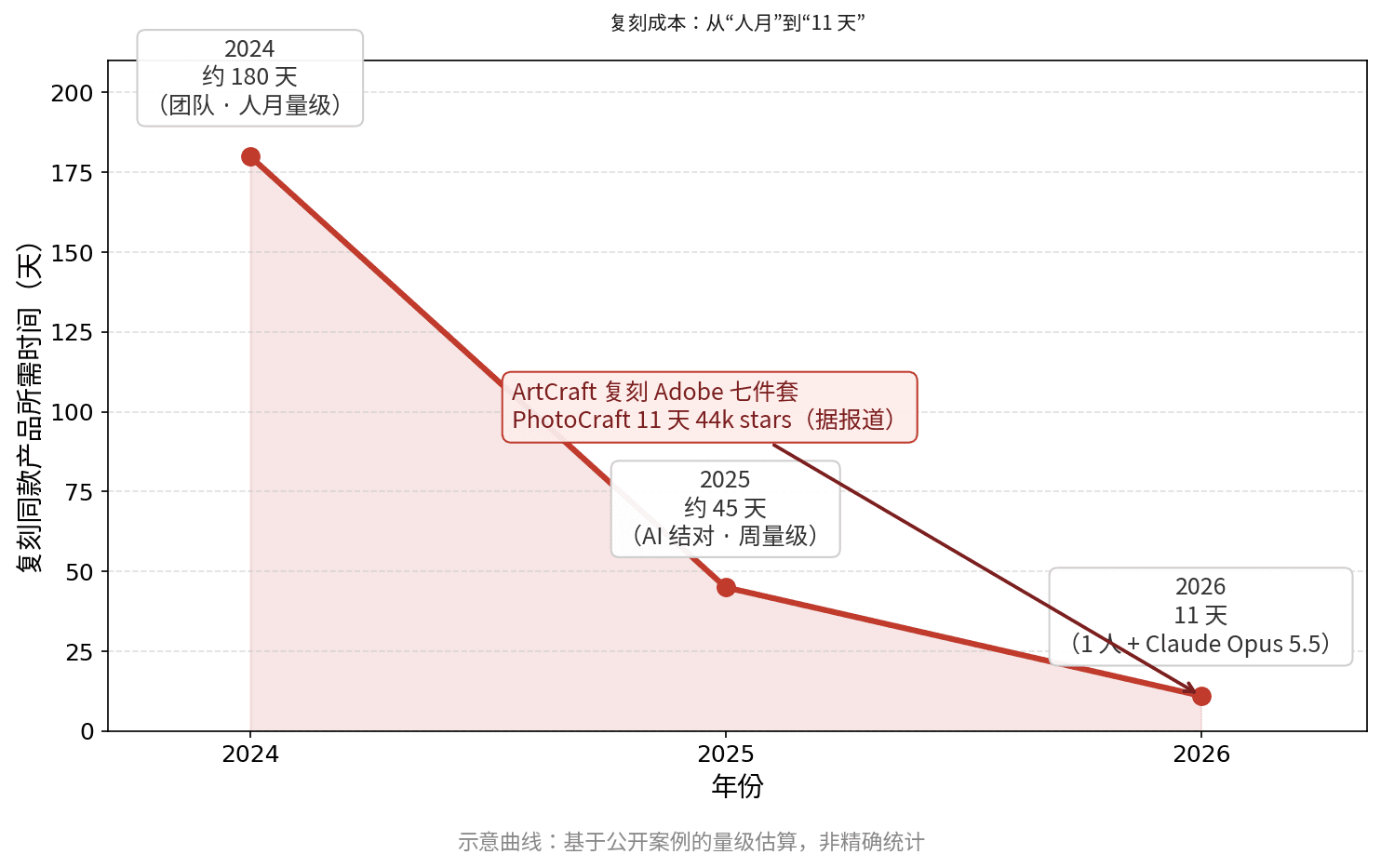
In 2026 AI drove clone costs near zero: Steam Next Fest submissions reportedly fell 18% YoY while one developer rebuilt Adobe's suite in eleven days with Claude Opus 5.5 for 44k stars. Features are no longer a moat. This guide is the anti-clone playbook for vibe projects: a data/network/identity moat framework, speed and community lock-in, layered defense (copyable free tier, server-side core), a 72-hour response checklist, and 8 moat-health self-checks.