Microsoft Turns Windows Into an Agent OS: MXC Sandbox GA, 137B On-Device Coding Model, HydraFusion Comes Local
Microsoft's October 7 'hybrid intelligence' play: Microsoft Execution Containers GA on Windows 11 with policies enforced outside agent control; MAI-Code-1.1-Flash (137B/6.8B) quantized to 3-bit for devices; GitHub HydraFusion extended to Windows, routing tasks between local and cloud models. We break down the trio, the cost controversy, and what it means for indie developers.
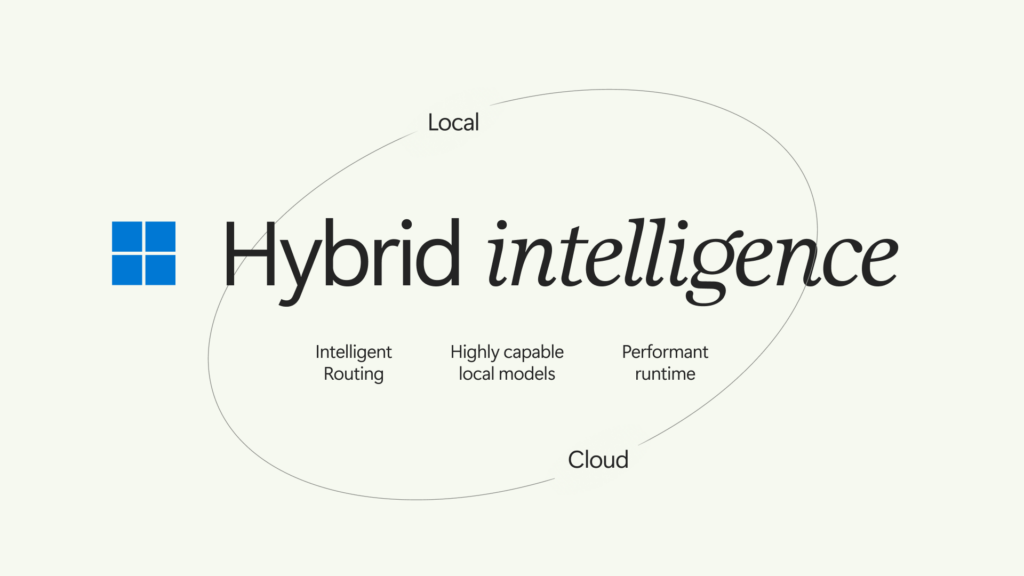
On October 7, Microsoft dropped a bombshell: Microsoft Execution Containers (MXC) went generally available on Windows 11, the MAI-Code-1.1-Flash coding model came down to devices, and GitHub's HydraFusion router is being extended to Windows to intelligently route each task between on-device and cloud models. Windows chief Pavan Davuluri gave the whole playbook a name in the official blog post — "hybrid intelligence."
If you've spent the past year building AI apps on cloud APIs, this blog post deserves a careful read. It signals that the giants' answer to the fundamental question of "where does AI compute happen" is shifting from "all in the cloud" to "cloud plus device." And an operating system's stance often shapes developers' next three years more than any model release.
A note on dating: the official Microsoft blog page carries no explicit date stamp in its body text. The October 7 date comes from the /2026/10/07/ path in the URL, corroborated by the official author page listing "October 7, 2026." Every "October 7" reference below follows this dating basis.
This is not a routine Windows feature update. For two years, the AI coding battlefield has been in the cloud: ever-larger models, ever-growing token bills, agents running in remote data centers while your PC was just a terminal firing off requests. Microsoft's announcement amounts to an admission that this model has run its course. Davuluri's logic is blunt — if an agent can run locally, run it locally; escalate to the cloud only for what the device can't handle. It sounds like common sense, but this is the first time an OS vendor has officially endorsed "local-first."
MXC: Handcuffs for Agents — and the Agent Doesn't Hold the Key
Start with the biggest piece: Microsoft Execution Containers going GA on Windows 11.
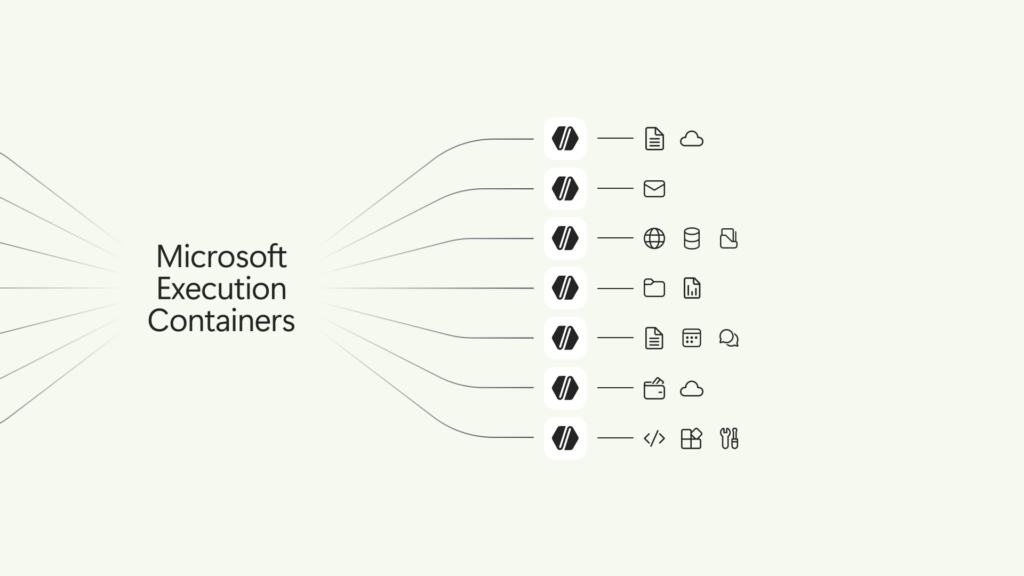
Simply put, MXC is an execution sandbox where organizations define exactly which files and networks an agent may touch. Policies are enforced at runtime, and the critical line from the official post is worth isolating: policies sit "outside of the agent's control" — an agent cannot grant itself more permissions. That sentence deserves attention because it answers the past year's biggest nightmare in agent security: prompt injection breaking agents out of their boundaries to read files they shouldn't and run commands they mustn't.
The GA launch partner list is telling: OpenAI Codex, GitHub Copilot, OpenClaw, Replit, LM Studio, NVIDIA OpenShell. Note the composition — Microsoft's own (Copilot, plus partner OpenAI's Codex) alongside pure third parties (OpenClaw, LM Studio). The "coming soon" list is even more interesting: Anthropic Claude Code, Box, Manus, Perplexity. Putting Claude Code on the roadmap is Microsoft's public admission that in the agent era, Windows can't serve only its own ecosystem — it has to be the landlord for every agent.
Microsoft frames the governance model on three pillars: containment, identity, manageability. In plain language: agents run in cages, every agent has an auditable identity, and IT admins stay in charge. It reads like marketing, but in enterprise settings each word is money — CIOs' biggest resistance to agents over the past year has been "this thing runs wild inside my network and I can't govern it." MXC is the key Microsoft is handing them.
The timing is notable: GitLab announced its "governed software factory" on October 6, one day earlier, with Dependency Firewall and Artifact Central built on the same "keep agents on a leash" logic. Two giants chanting "agent governance" within 24 hours tells you the industry has moved past "can agents do the work" into "who is accountable when they do."
On-Device Model Lineup: 137B Parameters Stuffed Into a Laptop
The second piece is models. MAI-Code-1.1-Flash from the Build conference (137B total parameters, 6.8B active, designed for real-world coding workloads) is coming to devices: 3-bit quantization shrinks it by nearly 80% while, Microsoft claims, preserving coding quality, with a 256K context window. Joining it are NVIDIA's new Nemotron model (70B+ parameters, about 20GB of memory after 2-bit quantization) and DeepSeek V4 Flash (284B parameters), all targeting RTX Spark hardware.
These numbers need 2026 hardware context. A 137B model, even at 3-bit, doesn't run on just any laptop — Microsoft's own reference configuration is the Surface Laptop Ultra: RTX Spark chip, up to 128GB of unified memory, able to run 120B+ parameter models, starting at $2,599, shipping October 16. The RTX Spark Dev Box ships in the US in November, and ASUS, Dell, HP, Lenovo, and MSI are all shipping RTX Spark machines.
Windows ML also announced llama.cpp support — a clear signal to the open-model crowd that Microsoft won't lock the device to its own models; the thousands of GGUF models in the llama.cpp ecosystem should theoretically all run.
One judgment worth writing down: Microsoft's on-device model strategy is "take everything." Its own MAI family leads, NVIDIA and DeepSeek fill out the ecosystem, llama.cpp covers the long tail. The bet is that the future of on-device inference isn't winner-take-all but a large local model market — and Windows wants to be that market's operating system, literally.
HydraFusion Comes Down: Routing Happens on Your PC
The third piece is the easiest to overlook and possibly the most important: GitHub's cloud HydraFusion router is being extended to Windows.
HydraFusion is GitHub's model router, previously cloud-only, dispatching tasks across models. Now it descends to the device: for the first time, the routing decision includes "on-device model" as an option alongside cloud models. Simple completions and renames go to the small local model — zero latency, zero token cost, nothing leaves the device; complex refactors and cross-file reasoning go to the big cloud model. The GitHub Copilot app, CLI, and VS Code get experimental preview "later in October."
The design's real merit is its admission of reality: no single model rules everything. Over the past year, developers had already formed the folk habit of tiering — fast models for easy tasks, strong models for hard ones. HydraFusion productizes and automates that folk wisdom. The router itself becomes the new competitive dimension: whoever routes most accurately wins on total cost.
Read alongside Copilot's local trio, Microsoft's on-device blueprint is complete: local context (reading your PC's files and recent activity with your permission), local actions (acting across Windows on your behalf — organizing files, diagnostics, troubleshooting, coding, workflows), local models (local compute plus cloud intelligence combined). Official word is rollout to Copilot+ PCs "in the coming months."
One overlooked detail: Windows ML's llama.cpp support. It's a single sentence in the official post, but it carries weight. llama.cpp is the de facto standard for running large models in the open-source world, with thousands of GGUF models from 1B minis to 400B monsters. Native Windows ML support is Microsoft handing the entire open-model ecosystem an admission ticket: your models run on Windows unmodified.
The clever part is how it hedges Microsoft's own model risk. However strong MAI-Code-1.1-Flash is, it's one company's model; what if developers prefer Qwen, Llama, or DeepSeek's open versions? llama.cpp support makes Windows "model-neutral" — run whatever you like, the OS just paves the road. That neutrality is exactly what a platform player should do: don't choose for users, just make choosing easy.
For indie developers, this drops the on-device experimentation threshold to zero. Tonight you can download a GGUF model, run it on Windows with llama.cpp, and validate whether your agent scenario even needs the cloud. No procurement, no API keys, no bill anxiety. That kind of zero-cost trial and error is something the cloud-API era of the past two years never offered.
The Pushback: The 120GB RAM Bar and a "Synthetic" Benchmark
Good news delivered; now the uncomfortable part. Third-party criticism of this launch centers on the cost math.
The suggested configuration for local models is 120GB+ of unified memory — the Surface Laptop Ultra tops out at 128GB and starts at $2,599. eWeek, Reddit, and HN threads are all doing the same arithmetic: how many years of saved inference tokens does it take to pay back that one-time hardware purchase? For the vast majority of developers, the answer is "the math doesn't work." Microsoft's vision of "free local inference" currently holds for exactly two groups: people who were buying high-end machines anyway, and those with hard data-residency requirements (finance, healthcare, government).
The second dispute is more technical: Microsoft claims 70.8% on SWE-bench Verified for local models versus 72.6% in the cloud — a slim gap. But third-party reporting (rdworldonline.com) notes the comparison used synthetic workloads, and the baseline was a quantized build of the open-source gpt-oss-120b — not a frontier model. The official blog discloses none of this context. The 70.8% vs 72.6% figure may be true, but it answers "a quantized open model didn't lose by much on specific synthetic tasks," not "local models caught up with the frontier." Those two claims differ by an order of magnitude in significance.
Recorded faithfully: the above criticisms come from third-party reporting and community discussion; the official Microsoft blog has not responded. Readers deserve both the official narrative and the community's arithmetic.
The Open List's Gambit: Why Microsoft Put Rivals on the Support Roster
Back to the MXC launch list — one detail deserves an extra beat. OpenAI Codex and GitHub Copilot leading is no surprise, but pure third parties like OpenClaw, LM Studio, and NVIDIA OpenShell made the day-one roster while Claude Code, Manus, and Perplexity sit in "coming soon." That ordering isn't random.
Microsoft is playing the platform game. Windows' moat was never any single app — it was "I'm where all apps run." The same logic holds in the agent era: if every agent has to solve sandboxing, permissions, and auditing alone, developers drown; if Windows provides it natively, agent developers will prioritize Windows. Putting third parties on the launch list tells every agent startup: come to Windows, and we'll solve half your security-compliance problem.
Contrast Apple's approach: macOS tightens entitlements and notarization — "thou shalt not touch"; Microsoft's philosophy is "here's your cage, go wild inside it." Neither is absolutely better, but for agents — a species that inherently touches files and drives systems — Microsoft's cage philosophy is plainly friendlier. That's why system-heavy agents like OpenClaw showed up on Microsoft's list first.
Don't miss the backdrop either: a week before this launch, Docker open-sourced Docker Agent ("one YAML file defines an agent, run it like a container," which we covered on October 8). The boundary between containers and agent runtimes is blurring. MXC and Docker Agent walk the same road: treat the agent as a new kind of "process" to manage — quotas, isolation, auditing, all mandatory. In the second half of 2026, agent infrastructure is living through its pre-2014-container-boom standardization moment.
What Apple and Google Are Doing: A Three-Way On-Device Split
Microsoft isn't the only one betting on-device. Zoom out and the three giants' on-device routes have clearly diverged.
Apple's route is "chips for experience": Apple Silicon's unified memory architecture is natively suited to large models, and the MLX framework lets a 128GB Mac Studio run 120B-class models. Apple doesn't talk parameters or benchmarks; it talks "your Mac could already do this." Its weakness is closure: few model choices, little room for developers to tinker.
Google's route is "cloud feeding device": Gemini Nano on Pixel, small-model APIs built into Chrome — "the browser as runtime." Google's advantage is distribution — Chrome's install base is on-device AI's install base; its weakness is a thin desktop presence.
Microsoft's route this time is "the OS as agent platform": no chip wars with Apple, no distribution wars with Google — compete on governance (MXC), routing (HydraFusion), and positioning (Windows is where agents work). None of the three routes is right or wrong, but Microsoft's is the most practical for developers — because it solves the problems developers face every morning: permissions, cost, model choice.
For vibe developers, this eases the pressure to pick sides. All three are turning on-device capability into infrastructure; you don't need to bet on one, just watch the standards: MXC's policy format, HydraFusion's routing protocol, llama.cpp's model format. Whose standard becomes the de facto one first, whose ecosystem rises first.
Linux and macOS Developers: Watch Now, Don't Sleep on It
Fair admission: this launch is Windows-first. MXC is Windows 11 exclusive; Copilot's local trio hits Copilot+ PCs first. Mac or Linux developers may feel "not my problem," but that judgment may be hasty.
History rhymes: platform capabilities born on Windows tend to become cross-platform standards. When WSL appeared, Linux developers dismissed it as a Microsoft toy; years later WSL2 became the de facto standard for running Linux on Windows and ended up pushing the dev-container ecosystem forward. MXC may walk the same road — Windows 11 exclusive today, and tomorrow someone asks: is there a macOS equivalent? Can Linux containers provide the same policy semantics?
The signals are already there: Docker Agent's YAML definition style and MXC's policy definition are conceptually near-identical. If the two align on policy semantics, "define once, run anywhere" agent sandboxes stop being a dream. The one thing Linux/macOS developers should do now: read the MXC policy docs and understand its permission model. When cross-platform implementations arrive, you'll be six months ahead.
The Call for Vibe Developers: New Openings in Local Agent Development
Finally, what does this mean for our readers — vibe developers, indie hackers?
First, agent sandboxes like MXC are becoming platform capability. The hardest question when shipping an agent-powered app today is the user's: "will this thing delete my files?" You used to answer with prompt constraints and prayer. Post-MXC-GA, Windows natively offers an enforcement boundary "outside of the agent's control," which systematically lowers the trust cost of agent apps. Windows-side agent developers should study MXC's policy definitions immediately — they're likely to become the de facto standard.
Second, HydraFusion's descent validates the "model routing layer." If you're building an AI app and still agonizing over "which model," the direction may be wrong: future competitiveness lies not in picking models but in building routing — dispatching dynamically by task, cost, latency, and privacy requirements. That routing layer is itself the product. Indie developers are already building third-party routing services; Microsoft just stamped the category.
Third, a 256K-context coding model on-device turns "stuff the whole repo into a local model" from dream to option. Code completion, repo-level Q&A, offline pair programming — none of it needs to send your code to the cloud anymore. That's a concrete win for indie developers working with private codebases — provided you can afford the 128GB machine.
Fourth, MXC's policy definitions are worth reading now. Even off Windows, understanding the "outside of the agent's control" permission model directly informs how you design your own product's agent permission system. Writing "do not delete files" in a prompt is a paper wall; OS-level enforcement is a real wall. If your product runs on user devices, you'll eventually answer the same question: where is the agent's boundary. Microsoft just wrote the answer as OS capability. There's your homework to copy.

Three Overlooked Threads: Mini PCs, Muse, and a Set of Mac Comparison Numbers
The official blog holds three more items that got little coverage but may matter more to developers. First, mini PCs: Microsoft has noticed people already using mini desktop PCs as always-on homes for long-running agents — agent workloads need a machine that's always awake. But the current state is terminal-based setup, proxy configuration, and security trade-offs — all toil in service of the agent. Microsoft now promises a few-clicks out-of-box setup for popular agents on mini PCs, with OpenClaw getting a native Windows gateway plus MXC sandboxing. Translation: Microsoft wants to turn "buy a small box to host agents" from geek hobby into mainstream operation. The implication for indie developers is direct — the "home" of long-running agents is being absorbed by the OS vendor; if your agent product depends on users self-hosting persistent environments, platform capability will eventually eat it.
Second, and spicier: Meta's personal AI agent "Muse for Windows" is coming soon as a native Windows app — with MXC integration. Meta's agent, on Microsoft's OS, under Microsoft's sandbox standard. The great-agent-era realignment among giants has begun. It also proves MXC isn't Microsoft talking to itself: when Meta plugs its own agent into your containment framework, that framework isn't far from de facto standard status.
Third, a comparison set Microsoft dropped: RTX Spark Windows PCs versus a 16-inch MacBook Pro (M5 Pro) — 2.1x faster time to first token, 4.3x faster AI image generation, 6.2x faster AI video generation. ASUS ProArt P16/P14 and a fleet of new machines are already up for pre-order. Pretty numbers, but apply the same discount as the SWE-bench figures — the footnoted test conditions aren't elaborated. The direction is clear though: Microsoft is turning "local AI performance" into the core reason to buy a new PC, and OEMs (ASUS, Dell, HP, Lenovo, MSI) piling in shows the supply chain already smells it.
One action item per reader type: building Windows-side agent apps — read the MXC policy docs and be first; building cross-platform AI apps — promote the "model routing layer" from your backlog, it may be your biggest cost optimization next year; still watching on-device — try llama.cpp plus open models, zero-cost validation of whether your scenario even needs the cloud. This launch was information-dense, but for developers it compresses to one line: the agent battlefield is diffusing from cloud to device. Understand early, position early.
In one sentence: Microsoft isn't shipping features here; it's redefining Windows — from "the OS that runs apps" to "the OS that runs agents." MXC restrains the agent's hands, on-device models give it a local brain, HydraFusion decides what runs where. If this trio lands, most agent app development in 2027 will happen locally on Windows. Believe it or not, developers will vote with their feet — but the direction is already clear.
(Dating note restated: this article's event date is October 7, 2026, based on the dual corroboration of the official Microsoft blog URL path and author page; the page body carries no explicit date stamp.)
Sources
Related articles
Google, Google DeepMind, UMD and UVA propose RRSI: don't lock down what agents can change about themselves — regularize how they search. Unregularized evolution hit 92.8 evolve score but only 40.3 OOD; RRSI reached 90.5/43.6 with fewer tokens. The data-backed case that self-improvement itself needs regularization.
Meta's SWE-sweep hides 4,068 real bugs across 100 repos in 22 languages — and gives agents no issue descriptions. The best setup fixes 75.3% with a human bug report, 4.8% without. The cliff shows that finding the problem, not writing the fix, is the human moat.
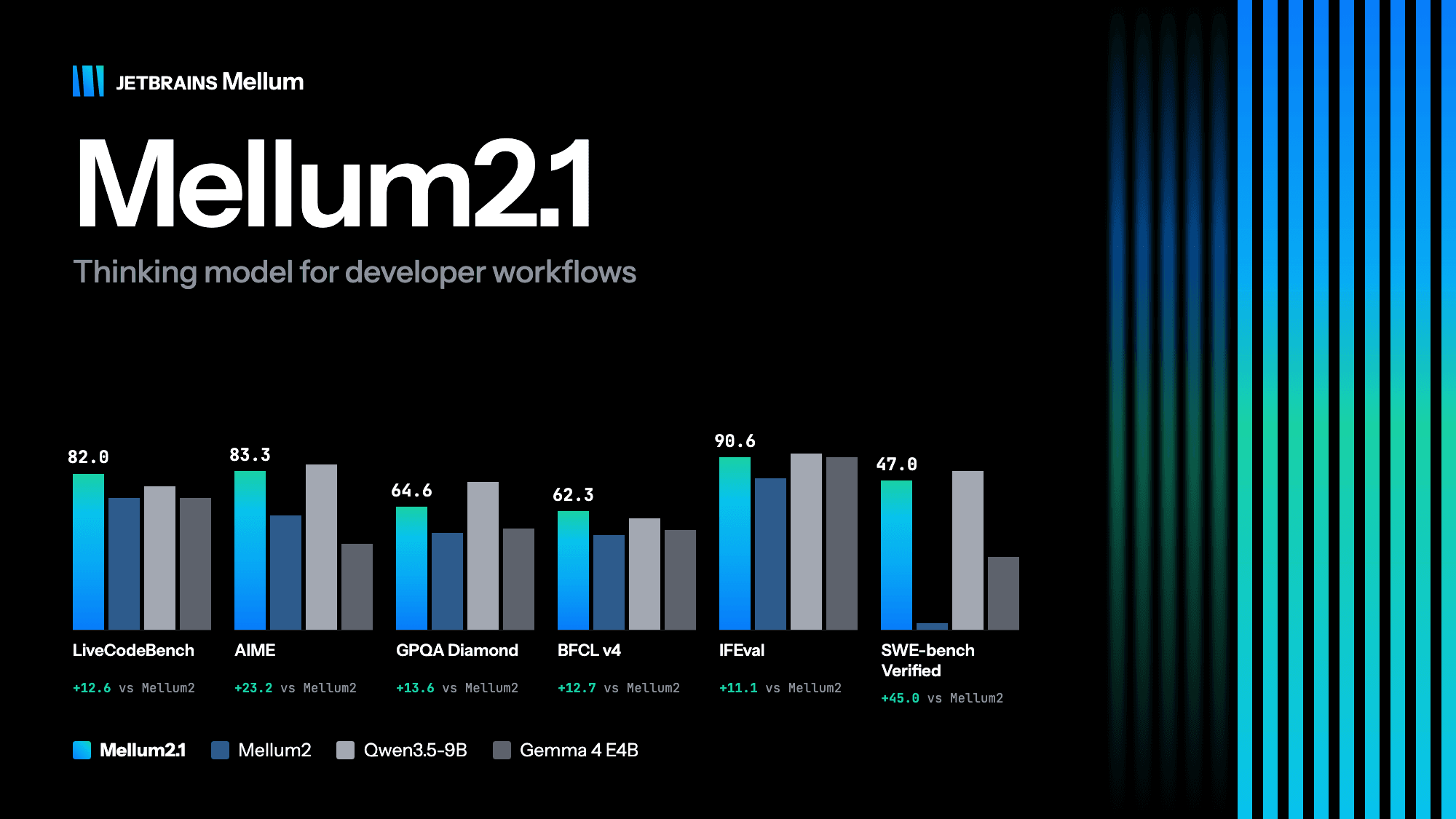
JetBrains has open-sourced Mellum 2.1, a 12B MoE model activating only 2.5B parameters per token. With its architecture unchanged since June, reinforcement learning in real environments lifted SWE-bench Verified from 2.0 to 47.0. Apache 2.0 licensed and self-hostable, it is positioned as the fast, cheap execution layer for coding agents — strong on coding and tool use, still trailing Qwen3.5-9B on the hardest agentic tasks.