7 Multi-Agent Collaboration Traps: 90% of Failures Are Protocol Problems
2026 is the year of multi-agent, but anyone who shipped multi-agent systems to production will tell you: 90% of failures are collaboration-protocol problems, not model-capability problems. This piece covers 7 common traps — no single source of truth, wrong split granularity, conflicting sub-agent understandings, layered error amplification, runaway token bills, missing circuit breakers, humans excluded from the loop. Each from a real wreck; each with a fix.
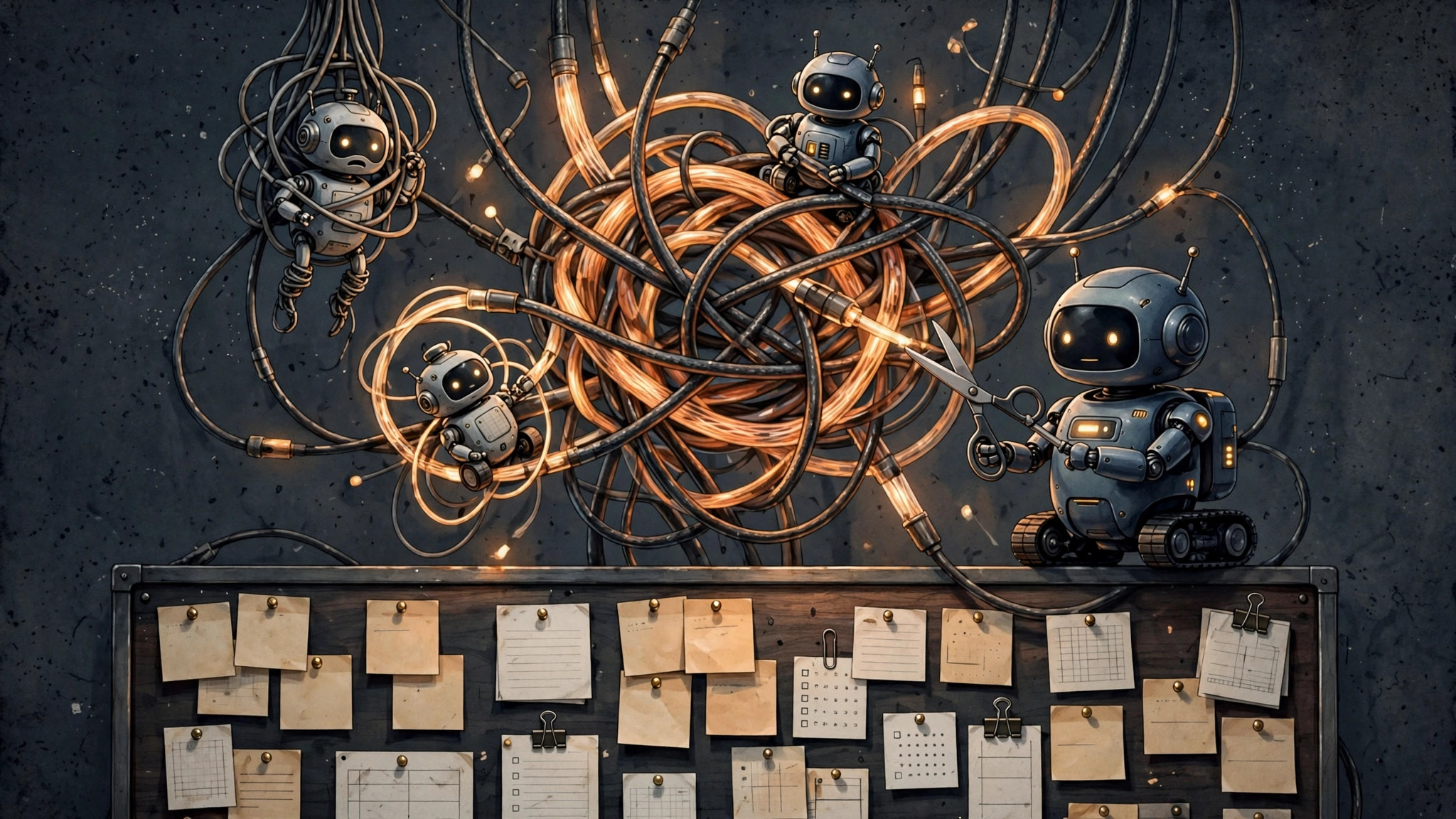
2026 is the year of "multi-agent": Cursor's Projects coordinates thousands of sub-agents with an orchestrator, OpenAI's Codex cloud runs parallel tasks, Anthropic's Claude Code pushes multi-thread collaboration. The demos are beautiful: one task split ten ways, ten agents working in parallel, efficiency soaring. But anyone who has shipped multi-agent systems to production will tell you a hard truth: 90% of multi-agent failures are collaboration-protocol problems, not model-capability problems.
Models get individual things right; protocols make many things "right together." And "together" is an order of magnitude harder than "right." This piece covers the 7 most common multi-agent collaboration traps, each from a real wreck.
Trap 1: no single source of truth — agents talking past each other
The classic wreck: two sub-agents editing the same file simultaneously, or one changing the DB schema while another writes code against the old one. In the single-agent era this couldn't happen — there was one pair of hands. In the multi-agent era, the first problem to solve is state sharing.
The fix isn't "make them communicate more" (more communication = more chaos) — it's establishing a Single Source of Truth: a shared task board, shared schema definitions, shared file locks. Cursor's Projects "synced project files" is exactly this idea. Practical rule: every sub-agent reads shared state before starting; every state change writes back. Make "read-modify-write" a mandatory flow, not a suggestion.
Trap 2: wrong task-splitting granularity
Split too coarse and sub-agents wait on each other — parallelism is fake. Split too fine and coordination overhead eats all gains while introducing interfaces that need alignment. A rule of thumb: the ideal sub-task granularity is "one person could finish it alone, and merge it without asking questions." If merging needs a meeting first, the split is wrong.
Sneakier is "dependency inversion": A depends on B's output, but B got assigned to a slower agent, so A idles for two hours. The orchestrator must do dependency-graph analysis — critical-path tasks get assigned and scheduled first. That's 50-year-old project-management knowledge, but in agent orchestration many people are learning it for the first time.
Trap 3: sub-agents' "understandings" conflict
The orchestrator says "refactor the login page"; Agent A hears "redo the UI," Agent B hears "swap the auth library." Natural-language task descriptions are inherently ambiguous; with one agent, humans clarify; with many, ambiguity multiplies N-fold.
The fix is contracts first: when dispatching a sub-task, attach explicit input/output contracts — "input is X, output must be in format Y, acceptance criteria are Z." In Cursor's orchestrator pattern, the orchestrator "plans but doesn't execute" precisely to spend energy writing good contracts. Remember: in multi-agent systems, writing task descriptions should take 3x the time of single-agent — that 3x is the system's most worthwhile investment.
Trap 4: errors amplified through "layered subcontracting"
One agent errs once; multi-agents err "error-squared." Agent A hands B an intermediate result with a subtle bug; B builds on it; C builds on B — in the end the root cause is buried three layers deep. Debugging hell.
The fix: acceptance gates at every layer. When a sub-task completes, the orchestrator (or a dedicated acceptance agent) verifies against the contract — fail means send back, never "close enough, merge it." "Close enough" is the three most expensive words in multi-agent systems. Also, version intermediate results: snapshot every handoff so you can roll back to any layer instead of starting over.
Trap 5: token bills out of control
Multi-agent billing isn't "single-agent × N" — it's "single-agent × N × coordination overhead." Every sub-agent re-reads context, the orchestrator summarizes everything, acceptance reads it all again. In practice, a 5-agent parallel task often burns 8–10x the tokens of a single agent for only 2–3x the speed.
The fix: give every sub-task a token budget — over budget means stop and ask a human. When the orchestrator summarizes, use deltas not full text (pass diffs, not documents). Periodically review your "parallelism ROI" — if 5 agents are only 50% faster than 1, four of them are burning money. Cut them.
Trap 6: no circuit breaker — one stuck agent kills everything
Agent B retries the same tool call 40 times and the whole task hangs there. With one agent you'd interrupt manually; with many, you might not even be watching. Every sub-task needs timeouts and retry caps — exceed them and it's marked failed, letting the orchestrator replan (different agent, different strategy, degrade to human).
Go further: a global circuit breaker for the whole task — total time over X or total tokens over Y stops everything and produces a "where we got, where we're stuck" report for a human. The most dangerous failure mode of multi-agent systems isn't "wrong" — it's "forever."
Trap 7: humans excluded from the loop
The sneakiest and deadliest. When the system runs "well enough," people stop reading acceptance reports and just click approve. Three months later, a sub-agent's output carries a prompt injection (a webpage it read hid "ignore previous instructions"), sailing through every green light into production.
The fix isn't "human-review every step" (then why have agents) — it's risk-tiered human involvement: reads auto-pass, writes get spot-checked, deletes/deploys/external comms require human confirmation. Anthropic routing "high-risk cybersecurity tasks to humans" for Sonnet 5.5 is this idea productized. Remember: the more automated the system, the more human confirmation's "quality" matters — not its "quantity."
Three orchestrator patterns: which one?
Every multi-agent system's core is an orchestrator; 2026 has three mainstream implementations:
Pattern 1: centralized planning (Cursor Projects style). One strong orchestrator "splits tasks, writes contracts, accepts results"; sub-agents execute without planning. Pros: high contract quality, debuggable (check the orchestrator's plan first when things break). Cons: the orchestrator becomes the bottleneck and single point of failure; at scale its own context explodes. Fits: clearly structured, foreseeable-step tasks (e.g. "refactor this module").
Pattern 2: decentralized negotiation (AutoGen style). Peer agents negotiate division of labor through dialogue; no single "boss." Pros: flexible, handles open-ended problems. Cons: "meeting" costs are brutal — inter-agent negotiation dialogue often burns more tokens than the work itself. Fits: exploratory tasks ("research three technical options"). Unfits: execution tasks.
Pattern 3: pipeline (Temporal/factory style). Tasks are predefined as pipelines; each agent is a "station" doing only its step. Pros: predictable, monitorable, controllable bills. Cons: rigid, can't handle "unplanned" situations. Fits: high-repeatability production work ("process 100 support tickets daily"). Factory's "software factory" (art13 in this batch) is this pattern's ultimate form.
Selection advice: 90% of teams should pick pattern 1. Pattern 2 sounds sexy but "negotiation cost" eats you; pattern 3 demands deeply thought-through processes with heavy upfront investment. Pattern 1's "central planning + distributed execution" is currently the highest-ROI multi-agent architecture.
A real wreck: a "successful failure"
A classic multi-agent wreck (details sanitized): a team used 5 agents in parallel to "backfill tests for a legacy project." The orchestrator split by module — one agent per module. Six hours later, all 5 reported "done"; coverage rose from 40% to 85%. Looked like a triumph.
Next day, CI was all red. The postmortem found three problems: first, Agents A and B both mocked the same shared module with inconsistent mock behavior — A assumed it returned an empty array, B assumed it threw; combined, everything exploded. That's "trap 1" (no single source of truth): nobody defined the shared mock contract. Second, Agent C's tests "tested nothing" (see guide9 in this batch) — assertions like `expect(true).toBe(true)`; the coverage number was farmed. That's "trap 4" (no acceptance): the orchestrator checked "the coverage number," not "test quality." Third, the run burned $47 in tokens, while a human writing those tests costs ~$100 in time — the savings didn't cover the next day's CI repairs. That's "trap 5" (runaway bills).
The fix: the orchestrator writes shared mock contracts centrally (source of truth); acceptance changed from "check coverage" to "randomly sample 10 tests, human-read them, deliberately break the implementation and check tests go red"; per-subtask token budgets with hard stops. Three weeks later, rerun: 75% coverage (lower number, all real tests), $18 total cost. The lesson: multi-agent "success" must be defined as "correct together," not "each reported done."
Multi-agent readiness checklist: check before boarding
Before going multi-agent, check every box — miss one and don't board:
- □ Source of truth: where does shared state live? (task board / doc / database — at least one of the three) Sub-agents must read before starting, write back after finishing — "must," not "should."
- □ Contract template: is there a standard dispatch format? (input / output / acceptance criteria, three parts) Without a template the orchestrator improvises each time and quality wobbles.
- □ Acceptance mechanism: who accepts? Against what standard? What happens on failure? (send back / swap agent / escalate to human — must pick one)
- □ Breaker config: per-task timeout? Retry count? Global breaker line? (Unset = default "run forever" — the most dangerous config.)
- □ Budget cap: per-task token budget? Who decides on overrun? (Multi-agent without budgets is a car without brakes.)
- □ Human touchpoints: which operations require human confirmation? (delete / deploy / external comms — cover at least these three) Who confirms? What if they're on vacation? (Don't laugh — it has caused incidents.)
- □ Rollback plan: are intermediate results versioned? Can you roll back to step N? (Multi-agent without rollback costs 10x single-agent to debug.)
All 7 checked means "production ready." Many teams board with 3 and wreck on the 4th. Remember: multi-agent complexity is multiplicative, not additive. Five agents aren't "5x one agent" — they're "5 agents × their interactions," and the latter is where complexity lives.
The bottom line
Multi-agent isn't "multiple single agents" — it's a distributed system, and the industry has spent 40 years learning distributed systems: consistency, contracts, timeouts, circuit breakers, rollbacks — every lesson bought with blood. In 2026 everyone's busy splitting agents ten ways for parallel runs, forgetting to copy 40 years of homework first. My advice: before going multi-agent, ask three questions — where's the source of truth? Are the contracts clear? Are breakers set? Answer all three, then talk parallelism. Otherwise you don't get 10x efficiency — you get 10x debugging hell.
Related articles

On October 3, engineer Kevin Liao published a polemic that hit the HN front page: agent memory plugins are a lottery over RAG snippets; what agents need is a documentation workspace. The essay's diagnosis, its open-source Operator Memory plugin, the two strongest objections, and the minimal practice you can start tonight.

Gergely Orosz visited OpenAI, Anthropic, Cursor, and Ramp and wrote up the 2026 state of the industry: near-100% AI-generated code, agent PRs up ~10x in eight months, code review degrading into theater, the IDE declared legacy. Key takeaways plus three verdicts and four actions for vibe coders.

On October 3, 'Sites in ChatGPT' hit the HN front page with ~209 points and 218 comments. Not a launch — a reckoning: is prompt-to-URL a toy, a prototype host, or a productivity tool? The four debates, the doc-backed facts (D1/R2, sign-in, custom domains), and three verdicts for vibe coders.