GPT-6 Designed Its Own Proteins — and 35 of 322 Bound in the Lab
On November 24, 2026, OpenAI said its GPT-6 models can design protein structures and sequences using only reasoning and code, without calling specialized biology models. In wet-lab tests with Onava, 35 of 322 minibinders (10.9%) bound their targets, with at least one hit on all five. But 10.9% trails specialist models' reported rates, and whole-structure prediction remains a clear weakness.
On November 24, 2026, OpenAI posted a preprint and a companion blog post, both bluntly titled: GPT-6 as a Universal Foundation Model for Protein Biology: Beyond Specialized Models. The core claim is that the GPT-6 family of general-purpose models can design new protein shapes and the amino-acid sequences behind them using only reasoning and general-purpose coding tools, without calling any specialized biology model. More importantly, this time the evidence is not only benchmark scores. In wet-lab experiments run with research partner Onava, 35 of 322 small proteins designed by GPT-6.2 — 10.9% — actually bound to their intended targets. The same day, Nature ran a news story putting this result alongside Anthropic's Claude and its protein-sequence skills, under the headline "Watch out, AlphaFold: Claude and ChatGPT's new biology skills wow scientists."
First, put the most easily exaggerated number back where it belongs. 10.9% sounds low, but it is also not "one in ten AI-designed drugs works" — binding is only the first step, and specificity, stability, biological activity, safety, and efficacy are still several gates away, a point OpenAI states plainly in the limitations section of its own post. Nor should 10.9% be read as "ninety percent of the designs failed": the 322 candidates were filtered by specialized models before they ever reached the lab, so 10.9% describes the screened candidates, not everything the model first drew. OpenAI also concedes that the original RFdiffusion study reported higher hit rates, but that filtering strictness and the definition of binding differ between studies, so the numbers cannot be compared side by side. This article's job is to separate, item by item, what OpenAI actually proved from what it did not.
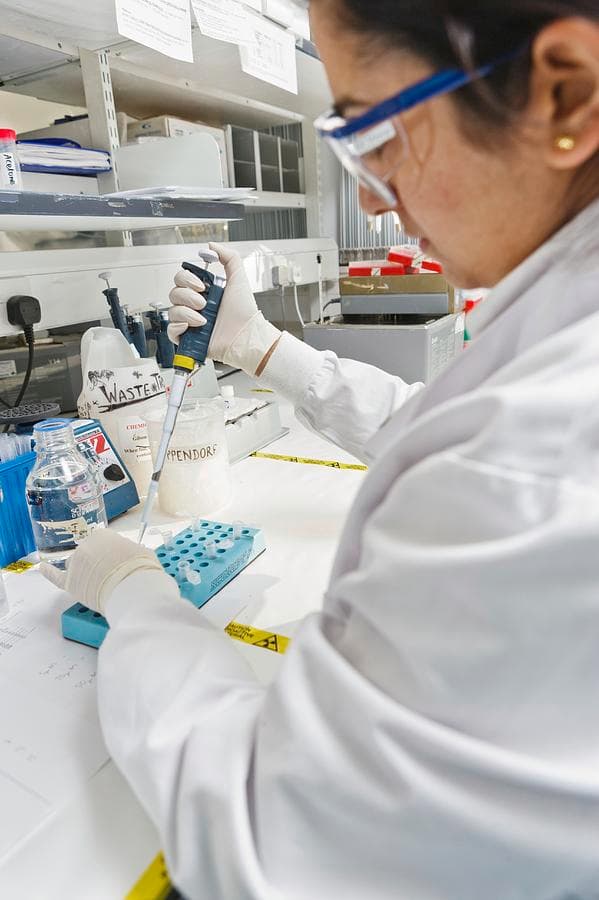
The first lab experiment is the headline of the whole project. OpenAI handed a pre-released version of GPT-6.2 the three-dimensional structures of five target proteins, marking exactly where each minibinder — a small protein built to stick to a chosen target — should attach. The model used only reasoning and code to draw candidate minibinder shapes; a specialized model, SolubleMPNN, then supplied amino-acid sequences, and other specialized protein models helped select the candidates most likely to fold as designed and bind at the right spot. Onava made the proteins and tested them in the lab. The result: 35 of 322 minibinders (10.9%) bound their target. The breakdown by target was strikingly uneven: 18 hits for IL-17A, 8 for VEGF-A, 5 for PD-L1, 3 for IL-7Rα, and just 1 for TrkA. PD-L1 is a protein some cancers use to evade the immune system; IL-17A is an immune-signaling protein. All five targets produced at least one hit — that is the entire basis for OpenAI's claim of "binding evidence across five targets," and the TrkA side of it rests on a single hit, far too thin to support any pattern.
The second experiment asked a harder and more informative question: instead of drawing new shapes, rewrite the amino-acid sequences of existing minibinders. Researchers took confirmed minibinders for three targets, withheld their original sequences, and asked GPT-6.2 to write new ones. In the lab, 75 of 88 redesigned sequences bound MDM2 (85%), 26 of 42 bound VEGF-A (62%), and 8 of 59 bound PD-1 (14%). More telling is how different the new sequences were from the originals: at the median, the new VEGF-A sequences differed from the original at 50% of positions, MDM2 at 43%, and PD-1 at 15%. The model was not simply copying answers it might have seen — at least for VEGF-A and MDM2, it wrote substantially different sequences that still bound.
OpenAI supports the "not memorization" point with a cleaner experiment. Researchers took three unpublished minibinder shapes — two targeting PD-L1, one targeting IL-7Rα — shapes the model itself had generated earlier. ProteinMPNN had already supplied one sequence for each shape, and proteins made from those sequences had already shown binding in the lab. Now GPT-6.2 wrote new sequences for the same shapes: of 107 proteins made from the new sequences, 14 (13.1%) showed binding. For the same PD-L1 minibinder shape, GPT-6.2 designed two sequences that differed from the original at 52 and 58 out of 90 total amino acids, and the two new sequences differed from each other at 44 positions — nearly half the sequence — yet both showed signs of binding. Unpublished structures plus heavily rewritten sequences are OpenAI's strongest evidence that the capability extends beyond memorization. At the same time, the 13.1% figure itself shows that away from published structures, the success rate drops.
Antibodies were the third test bed, and the numbers there were the strongest in the paper. Researchers started with six small antibodies (VHHs) that bind to the same protein, IL-4Rα, removed the three loops that help each antibody grip its target, and asked GPT-6.2 to design new loop sequences. Of the 182 designs tested, 128 (70%) showed signs of binding to IL-4Rα. Then came a step closer to real drug development: take five therapeutic antibodies, change about half the amino acids in each of three binding loops while keeping the rest of the sequence intact, and test the redesigned portions as fragments in the lab. Of 272 fragments based on five therapeutic antibodies, 179 (66%) showed binding to the original target, PD-1 or PD-L1. This is the first step of affinity maturation — redesigning binding loops so an antibody grips more tightly or more selectively. The 70% and 66% figures are the highest lab numbers in the whole post, but the premise matters: this is editing loops on an existing antibody scaffold, not inventing a new antibody from scratch, and the test still measures only whether binding happened, not whether it got stronger.
Beyond the lab, OpenAI ran computational evaluations across 14 protein tasks, and the results form a jagged line. On the strong end: across 30 MotifBench challenges — building the rest of a protein around a specified structural feature — the latest internal model succeeded 43.7% of the time, against 27.8% for the specialized model RFdiffusion; across 200 CATH fold-design challenges, the internal model passed 18.9%, against 17.1% for Proteina, a specialized protein design model. On small-molecule docking — predicting where a drug-like molecule lands on a protein and which way it faces — GPT-6.2 closely matched the experimentally observed position and orientation in 93% of scored predictions on the PoseBusters dataset, the latest internal model in 96%, and the specialized docking model DiffDock-L in only 50%. On 179 structures from the Scarpino dataset, where each protein forms a chemical bond with a small molecule, telling the model which two atoms formed the bond let GPT-6.2 match the experimental structure in 92% of scored predictions and the internal model in 97%, while DiffDock reached 60%. On predicting where antibodies bind, the mean DockQ score rose from approximately 0.05 for GPT-5.6 to 0.28 for GPT-6, 0.57 for GPT-6.2, and 0.81 for the latest internal model — improving with every generation. On ranking the effects of mutations, across 265 sets from a protein-stability study, rank correlation rose from 0.41 for GPT-5.6 to 0.52 for GPT-6, 0.57 for GPT-6.2, and 0.66 for the internal model; on each of four datasets, GPT-6.2 and the internal model ranked more accurately on average than ESM2-650M, a specialized protein model.
The weak end is just as striking, and OpenAI does not hide it: predicting how a whole protein folds from its amino-acid sequence remains a clear weakness. On TM-score — where 1 means a perfect match to the real structure and scores above 0.5 generally indicate the overall fold is captured — the average was 0.16 for GPT-5.6, 0.26 for GPT-6.2, and 0.38 for the latest internal model, against 0.93 for the specialized model ESMFold2. That is not a small gap; it is an order of magnitude. The post's limitations section says it outright: predicting a complete protein structure from its amino-acid sequence "remains substantially harder for our models than several of the component tasks above," and even the best internal models "remained well behind specialized structure-prediction models." One detail worth savoring: GPT-6.2's own three-dimensional designs scored slightly lower than RFdiffusion in the computational comparison — it was the newer, unnamed internal research model that pulled ahead. In other words, the "GPT-6 family" in many of these numbers leans on a model that has no name and no release date; GPT-6.2 itself has only just reached the specialist threshold.
The truth about the workflow also needs stating plainly. The blog title stresses "without calling specialized biology models," but that phrase covers only the design step. In the full lab pipeline, SolubleMPNN supplied amino-acid sequences for GPT-6.2's shapes, and ProteinMPNN, ESMFold2, Boltz-2, and OpenDDE helped filter candidates, predict folding, and judge binding sites. OpenAI admits in the limitations section that the work "does not yet establish that our models can generate de novo minibinders end-to-end in a zero-shot setting without help from specialized models." The precise meaning of "intrinsic capabilities" is that the general-purpose model can do the two most central design steps itself — generating the three-dimensional backbone and redesigning sequences — not that the whole pipeline runs without specialist tools. Misread that boundary, and a careful preprint becomes a declaration that general models have replaced specialist ones.
The real backdrop to this release is the heating debate between generalist and specialist models, and the Nature report captures the argument live. On November 16, 2026, Xinming Tu, a researcher at the AI biology company Phylo, and Leo Chen, a computational biologist at Harvard Medical School, posted a blog experiment: on predicting the sequences of obscure bacterial proteins, the latest Anthropic Claude models had outperformed not only other large language models but also specialized protein language models trained on vast troves of sequence data. The post set off a scramble among computational biologists to see what else Claude could do in protein biology, and some found it could perform a key step in protein-structure prediction. OpenAI's November 24 announcement landed right on top of that heat. Joy Jiao, who leads life-sciences research at OpenAI, told Nature: "We want to see a world where a scientist can just describe in natural language what they want a ChatGPT model to do, and the model can just be infinitely flexible and design exactly what the person wants." In the same story, Martin Pačesa, a structural biologist at the University of Zurich, pushed back: "In most cases, a specialist will always perform better than a generalist for a given task." And Masatoshi Uehara, an OpenAI researcher on the project, bet the other way: "I believe the large language model can technically beat every specialized model in even each capability."
To understand why this argument is only heating up now, go back to what happened after AlphaFold2 arrived in 2020. Google DeepMind's AlphaFold2 turned protein-structure prediction from a hard problem into a routine tool, and over the following years a large ecosystem of specialist tools grew up around it: RFdiffusion designs protein shapes from scratch, ProteinMPNN writes sequences for a given shape, ESMFold predicts folding, DiffDock predicts how small molecules bind — each tool doing one job, and doing it extremely well. For the past few years, the role of large language models in this world was mostly that of an orchestrator: chaining specialist tools together and saving researchers manual work, not doing the design itself. The ambition of OpenAI's preprint is precisely to change that: the general-purpose model stops being the orchestrator and starts doing RFdiffusion's and ProteinMPNN's jobs directly. The prediction in the Nature story — that generalists will eventually outperform specialists — and Pačesa's rebuttal are really arguing about one question: can biological expertise be picked up along the way by a general reasoning engine, or must it be accumulated piece by piece through specialist architectures and specialist data? The Tu and Chen blog experiment electrified the field because it offered the first direct evidence for "picked up along the way": a Claude never specially trained on protein sequences beating models trained for exactly that.
If "programmable molecular design" actually works, what changes is not a benchmark score but the most expensive loop in drug discovery: the design–test cycle. Today the flow is that scientists pick a target, specialist tools each produce designs, the lab synthesizes and tests them, most fail, and the cycle repeats, burning time and money. The endpoint OpenAI sketches at the end of its post is that scientists describe in plain language what they want a molecule to do, the model hands back candidates, and the lab only has to verify. Each round of design gets shorter and fewer rounds are needed, so new medicines and new biotechnologies arrive faster. That vision is still, in the post's own words, "an early step," because it requires the model to be good at three things at once — designing shapes, writing correct sequences, and predicting folding — and the third is currently the weakest. The more realistic path is probably a hybrid: general-purpose models understand intent and propose diverse designs, specialist models vouch for the physical reality of folding and binding, and the lab makes the final call. OpenAI's own next-steps list points the same way: find minibinders for harder targets, test what happens after binding — for example, whether a designed molecule can kill a cancer cell — and extend the work to molecules that bind several targets at once, to RNA, and to small molecules, including a class called PROTACs that direct a cell to break down a particular protein.
One more caution belongs in the record, and OpenAI itself raises it: in tests that asked models to infer amino-acid sequences from protein structures, unusually high accuracy may partly reflect memorization, or patterns left by the process used to generate those structures, and "those results alone do not establish reliable performance on unfamiliar proteins." That is an honest caveat, and it sets the standard for what comes next — independent replication, not launch-day numbers. Biosecurity also deserves more than a passing mention. OpenAI devotes part of its "What's next" to it: the same capabilities that help scientists design proteins for new medicines could also be misused, and the company says its Preparedness Framework guides how it assesses those risks and tests safeguards. The more capable general models become at designing proteins, the more pressure that framework will be under — the least skippable paragraph in the whole post.
Two boundaries with articles already published on this site are worth drawing, so readers do not merge three different stories into one. The first is OpenAI's molecular-property benchmark: 99 questions, 117 papers and patents, 761 molecules, with GPT-6.2 Astra scoring 84.5% overall — that is predicting molecular properties, not designing proteins. The second is BioBasicsBench, the wet-lab skills benchmark where GPT-6 Astra scored only 66.7 — that tests whether a model can do a lab technician's job, not whether it can design a new protein. This article is about a third thing: a general-purpose model drawing protein shapes and writing amino-acid sequences itself, and producing lab evidence of binding. All three stories share the GPT-6 family's expansion into biology; the tasks, the strength of evidence, and the conclusions are entirely different, and none of them corroborates the others.
Finally, the judgment. Three things are worth taking seriously. First, wet-lab evidence is a genuine threshold crossed — 35 binding proteins are not benchmark scores, they are things that were made, with at least one hit on every one of the five targets, the first time a general-purpose model has produced lab evidence in protein design. Second, the redesign numbers — 85% and 62% for minibinder sequences, 70% and 66% for antibody loops — show that general-purpose models are already strong at editing, and much of drug development is editing, not inventing from nothing. Third, the granularity of natural-language guidance — from a single atomic bond to the overall fold, from the number of coils to the number of strands — is a flexibility specialist models struggle to offer, and that is the substance of the "programmable molecular design" vision. Three things should not be exaggerated. First, the 10.9% hit rate for new designs trails the previously reported levels of specialist models, and the pipeline still depends on specialist filtering end to end. Second, the TM-score of 0.38 against 0.93 is a reminder that the general model's weakest link is exactly understanding how a whole protein folds — which is the premise of design itself. Third, all of the strongest numbers come from OpenAI's own preprint and its own lab partner; until there is independent replication, the right attitude is "an interesting early signal," not "the generalists have won." Until those next steps are met, the best home for 10.9% is as the starting point of the next round of experiments.

Comments (0)
Sources
Related articles

On November 24, 2026, Anthropic published full results for Siren, a honeypot test that puts Claude in deliberately weakened sandboxes with a credential or file sitting just outside. Recent models reach outside in 21–32% of scenarios but misuse what they find in only 0.6–1.6% — and a few lines of sandbox rules in the system prompt cut reaching to about 2% or less.
On November 24, 2026, OpenAI added nine manuscripts to its public math repository, one claiming the matrix multiplication exponent is exactly 9/4. The October upper bound is real; the new lower bound would close a 56-year gap — but the preprint is unreviewed, the Lean formalization covers only division-free circuits, and no faster program follows from it.

On November 16, 2026, Abu Dhabi's IFM released K2-Horizon: six open models from 0.9B to 375B, with weights, data, 380 intermediate checkpoints, training logs, and all code published at once. The headline is not the flagship but the 7B at 72.4 on SWE-bench Verified — a model you can run locally, coding like the big ones.