OpenAI Will Give Power Back to the Grid: 1,000 MW in Georgia
On Nov 2, 2026, OpenAI launched the Grid Protectors Program: its future compute campuses will cut power use when the grid is strained. The Georgia pilot offers up to 1,000 MW of flexible demand — about 700,000 households' worth. The catch: the campus is not built yet, and the savings figures belong to the utility's whole portfolio.

On November 2, 2026, OpenAI announced a programme that sells no model and no app. It is called the Grid Protectors Program, and its idea can be stated in one sentence: the compute campuses OpenAI builds in future should use less electricity when the grid is under strain, handing power back to households. The first stop is a campus still under development in Effingham County, Georgia, where an agreement with Georgia Power allows up to 1,000 megawatts of demand to be given up — OpenAI's conversion puts that at roughly the average electricity demand of about 700,000 households, more than the households of Washington, D.C. and Boston combined.
This is worth writing about not because it has already changed anything, but because it marks a shift in what the AI industry argues about. For the past two years, the argument was about whose model is smarter; now it is about where the electricity to build models comes from, and who pays for it. US data centre capacity is projected to exceed 100 gigawatts by 2030, OpenAI's announcement notes, citing BloombergNEF. The grid is not being built that fast, and community opposition is arriving faster — on November 3, US midterm election day, voters in 10 states voted to restrict data centre construction. OpenAI launched this programme the day before the election, and the timing itself is a statement: it wants to show that an AI campus can be a helper to the grid, not a burden on it.
The Georgia pilot: take the numbers apart one by one
First, pin down the Georgia numbers, because they are the easiest part of this announcement to misread. The Effingham County campus is expected to need about 3,200 megawatts of power in total, according to Georgia Power's announcement of July 22, 2026; up to 1,000 megawatts of that can be given up at times of high demand, about 31% of the total. The agreement runs for 25 years, and Georgia Power will be able to reduce the energy delivered to the campus during certain periods to support grid stability. Georgia Power says this is among the largest single-facility demand response commitments in the country. The agreement was approved by the Georgia Public Service Commission in August 2026, and the project is to be delivered in phases between 2028 and 2032.
On money, the announcement contains two figures with completely different owners, and they must never be added together. The first is OpenAI's own commitment: it will pay the full infrastructure and electric-service costs required to serve the project, and long-term contracts and financial assurances are meant to protect other customers if a project is delayed, reduced or cancelled. The second is Georgia Power's projection: from 2029, its portfolio of large-load agreements and expected growth should deliver about $950 million a year in customer savings, worth at least $15 a month for a typical residential customer using 1,000 kilowatt-hours. Note that the $950 million is a projection for Georgia Power's whole large-load portfolio, not savings delivered by OpenAI alone; writing it as "OpenAI saves Georgia $950 million a year" would be wrong.
There is one more key qualification: the campus is still under development, and the 1,000 megawatts is a commitment for the future, not electricity already handed back. OpenAI says so itself in the announcement, describing Effingham as the pilot for the programme. The first phase is not due to come online until around 2028, which means the promise will face its first real test — a hot afternoon, the grid in trouble, does the campus really turn down? — at least two years from now. Until then, Grid Protectors is first a plan and a contract, not a handover that has already happened.

How it works: how a campus "gives power back"
The mechanism itself is not mysterious. OpenAI says it will work with utilities, regulators and policymakers in each place to agree how much demand can be reduced, how quickly and for how long, with the arrangements differing by location. Beyond turning demand down, OpenAI says it will work with grid operators to supply power from on-site generation or storage where local grids need it, and use batteries and power controls to smooth swings in demand. In other words, "giving power back" is not only about switching off some servers — it also covers generating power on site, storing it, and adjusting it.
OpenAI explains the logic with a restaurant analogy: a restaurant in a vacation town needs enough tables and kitchen space for the busy season, but has to pay for that capacity year-round; regular customers help keep it in use and cover the bills when tourism slows. OpenAI proposes to be that regular customer: compute campuses need power all year round, and that steady demand can help spread the grid's fixed costs across more electricity sales, while flexibility lets demand fall when the system is busiest. Power lines, substations and other grid infrastructure cost the same whether demand is high or low; adding a steady large customer to share those costs, and building less new generation to meet peak demand, should in theory leave everyone's bill a little lighter.
But OpenAI also draws a line in the announcement itself: "Flexibility cannot replace investment in new energy supply and transmission." That sentence matters, because it blocks the most common misreading: demand response is not a substitute for power stations. Even the most flexible campus cannot conjure new electricity; all it can do is reallocate what exists. Putting that sentence in the announcement shows OpenAI knows how it will be challenged — saying the boundary itself is better than having someone else point it out.
The November 5 follow-up: from one pilot to a set of commitments
Three days later, OpenAI published another announcement widening Grid Protectors into a fuller set of commitments, titled "Setting a new standard for responsible AI infrastructure". It published two documents: a National Community Compact and a Compute Campus Policy Blueprint. The compact covers what communities can expect from OpenAI at future campuses it owns and operates; the blueprint asks policymakers to make similar rules apply to everyone who builds.
The compact is broader than Grid Protectors. Every future campus OpenAI owns and operates will have its own local compact, and OpenAI commits to: pay the full cost of the electricity it uses and the infrastructure needed to serve it, providing financial assurances before major spending begins; develop a water plan for each campus, prioritise closed-loop or low-water cooling, and publish site-level water and electricity use; publish construction plans and independent noise studies before operations begin and annually afterwards; not use non-disclosure agreements (NDAs) with public officials, allowing only narrow protections for legitimate security information, trade secrets or proprietary information; publish the jobs it expects to create, work with unions and training providers to help residents prepare for them, and report annually on hiring and apprenticeships; and invest in priorities residents help select — in Effingham County, residents shaped a $4.8 million grant to provide free school meals for all 14,000 students in the county; in Pike County, Ohio, families identified childcare as the priority, leading to a joint $6 million commitment from OpenAI and SB Energy.
The blueprint is the "please do this too" part. OpenAI calls for state utility commissions to require large electricity customers to cover the costs they add to the grid and protect other customers if a project falls through; for utilities to make it easier for campuses to connect if they can safely cut demand when power is scarce; for Congress to speed up transmission upgrades and restore and expand tax incentives for clean electricity; for the terms of tax incentives to be public, with measurable commitments and a way to recover benefits if a developer falls short; and for developers to share purchasing plans early enough for local suppliers to compete, and for employers, building trades unions and community colleges to use hiring forecasts to train residents for jobs they know will be available — from electrical work during construction to maintaining power and cooling systems for years afterwards.
The sceptical case: this is a commitment, not a report card
Put the praise aside for a moment; there are four places where this plan cannot bear being read as something already delivered. First, the Georgia 1,000-megawatt agreement was actually announced in July and approved in August; what is new on November 2 is the "Grid Protectors" name as a national programme, and the promise to extend it to other campuses. In other words, the pilot itself was not negotiated in November — November put a national brand label on it. Second, the announcement publishes no operating details at all: what triggers a cut, how fast the response must be, how long a cut can last, or how it would be measured and verified. Without those details, outsiders cannot now judge how reliable this promise would be in a real peak.
Third, the savings figures are projections, not bills. The $950 million and $15 a month are Georgia Power's projections for its whole large-load portfolio, depending on future load growth, contracts being delivered and regulators following through, and only starting to show from 2029. Fourth, the whole programme is non-binding. Independent commentators have noted that OpenAI's January pledge to "pay its own way" was non-binding too, and Grid Protectors says nothing about what happens if the promise is not kept. Long-term contracts and financial assurances are in the announcement, but they protect other customers if a project is delayed or cancelled — not if a promised cut of demand never happens.
There is also a bigger backdrop worth putting into the judgement. The conflict between data centres and communities became public in 2026: voters in 10 states voted to restrict data centre construction, local governments began questioning tax breaks, and rising electricity prices became a cost-of-living issue. OpenAI is not the only company feeling the pressure, but it is among the fastest to act — Grid Protectors on November 2, the community compact and policy blueprint on November 5, and a pledge on November 6 to stop using NDAs with public officials on data centre projects. Three moves in one week, a pace that itself shows this is first a political response, and only second an engineering plan. The two are not contradictory, but readers have a right to know which came first.
Demand response is not a new invention — who does it is what changed
It is worth saying that "using less power at peak times" is not OpenAI's invention. Demand response is a grid tool decades old: utilities have long asked factories and large commercial users to cut load at peak times, sometimes paying compensation, sometimes under long-term agreements. What has changed is who does it. The main participants used to be factories and shopping centres; now it is data centres — the newest and hungriest class of users. Data centres differ from traditional factories in that their load can be adjusted faster and more precisely: training jobs can be paused, moved to another time, or shifted to another campus. That flexibility is the basis for OpenAI's confidence, and the reason its announcement stresses that "these compute facilities are much different than data centers built even a few years ago".
But flexibility has limits too. Inference workloads cannot be paused as freely as training jobs: a conversation a user is having cannot wait until midnight to be answered. OpenAI does not say in the announcement which loads the 1,000 megawatts would come from — training jobs, some inference, or a uniform cut across the whole campus. Until that question is answered, outsiders can hardly assess how credible the promise is: a campus dominated by training is relatively easy to turn down; one dominated by real-time inference pays a much higher price for cutting. What the Effingham campus will actually run will only become clear after it opens.
Other companies are answering the same pressure in their own ways. Google is exploring Project Suncatcher, putting compute in orbit powered by solar energy; Meta's president spoke at a Wall Street Journal tech conference on November 4 about what the midterm results mean for the company's construction pipeline. Reports suggest that after the election, every company's language is changing: less "how much compute we will build", more "how we get communities to accept it". OpenAI's Grid Protectors is the most systematic response in this shift so far, but it will not be the last — the grid's ability to absorb new campuses is becoming a shared bottleneck for every AI company, and whoever produces a credible plan first gets the ticket to keep expanding.
Seen in a larger ledger
Zoom out further, and Grid Protectors is one step in a combination OpenAI has played across the second half of 2026. In January, it announced the Stargate community commitments, saying it would pay its own way on energy; in July, Georgia Power announced the Effingham County project and the 1,000-megawatt demand response agreement; on November 2, the agreement was packaged as a national programme; on November 5, the community compact and policy blueprint followed; on November 6, OpenAI pledged to stop using NDAs with public officials on data centre projects. In six months, a single project agreement became a complete narrative about how to build campuses: pay your own bills, let communities take part, accept public scrutiny, and push the whole industry towards rules.
Whether that narrative holds will ultimately be decided by numbers. Georgia Power's projected $950 million a year in savings, $15 a month for a typical household, and 1,000 megawatts of demand response must all be tested after the campus opens in 2028. The test criteria are specific: at grid peak, did the campus really turn down; when it did, were user-facing services affected; and are Georgia residents' electricity bills actually lighter than they would have been without the agreement? If all three hold, Grid Protectors will turn from a public-relations plan into a template others can copy; if they do not, it will become one more footnote in the AI industry's record of promising more than it delivers.
Three things are worth watching next. First, commitments at other campuses: OpenAI says it will publish more arrangements as agreements are finalised — watch whether it can replicate a second or third 1,000-megawatt-scale case beyond Georgia. Second, where the policy blueprint goes: whether any state utility commission or Congress actually adopts the "large users pay the grid costs they add" requirement, or whether it stays a suggestion. Third, and most concrete of all: after the first phase of the Effingham County campus opens in 2028, in the first hot summer, will Georgia Power actually call on that 1,000 megawatts of demand response, for how long, and with what effect? The record of that day will say more about what Grid Protectors really is than any announcement from November 2026.
Comments (0)
Sources
Related articles
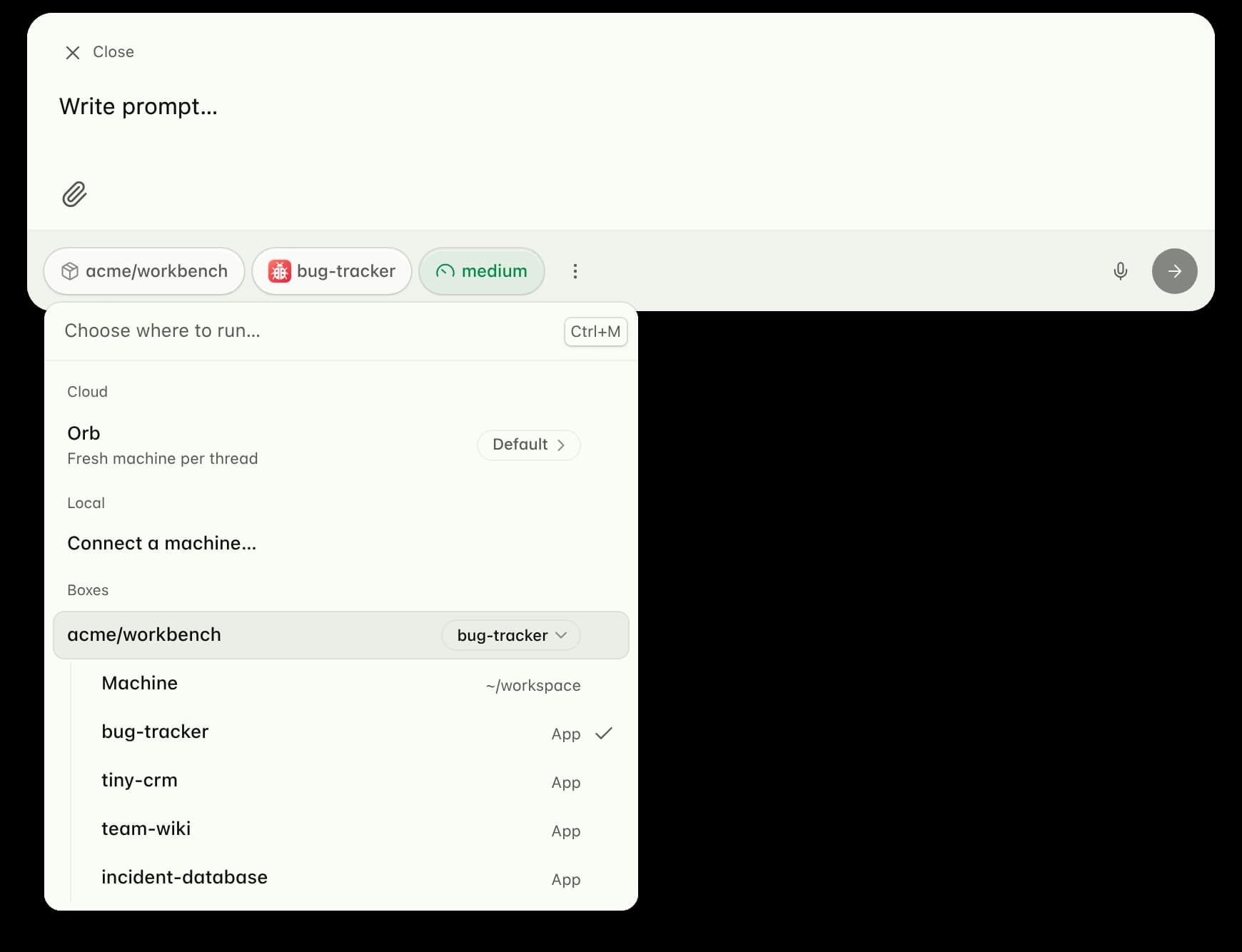
On 10 November 2026, Amp launched Boxes: always-on mini-computers from $18 a month for deploying software you built with an agent. Each box runs its own runner, so the agent can edit live production data right there; the same month Amp also shipped Spaces, retired the Dial, and arrived on Windows — the agent's workplace is moving off the laptop into the cloud.

On 20 November 2026, Thinking Machines Lab released Inkling 2 Mini: a 26.4B-parameter looped transformer that runs its middle 12 layers three times per token, fits in about 20GB, and runs offline on a laptop. It leads open-weights models of its size on DeepSWE and SWE-bench Verified — with the caveats printed in the same announcement.

On 18 November 2026, Google Research and co-authors posted BuggyMLE to arXiv: bugs injected into 222 working ML repositories, and 14 models slide from 95% on the easiest tier to 9% on the hardest. A 9-billion-parameter model trained easy-to-hard beats Claude Opus 5.5 on the 10-bug tier.