From $44B to $60B in Four Months: Ramp Is Betting on Financial Infrastructure for the AI Agent Era
Ramp raised $1.85B at a $60B valuation, up 36% in four months. The real story is its AI pivot: agents inside finance products, a corporate card for AI agents, a model-routing business with token spend management, and Glass. Keith Rabois: 'We're going to compete with Anthropic.'
What happened: a 36% valuation jump in four months
On October 15, TechCrunch (first at 14:47 UTC) and Reuters reported the same day: U.S. fintech Ramp closed a $1.85 billion funding round at a $60 billion valuation. Just four months earlier, in June, it raised $750 million at $44 billion — a 36% valuation increase in one quarter.
The round was co-led by Dragoneer Investment Group, Thrive Capital, Founders Fund, Sands Capital, and Avenir Growth, with a long tail of followers including Fidelity, T. Rowe Price, Coatue, Khosla Ventures, Lightspeed, General Catalyst, and GIC, among more than two dozen others. Including this round, Ramp has raised about $5 billion in total equity financing. The company says it has positive cash flow.
Start with the business numbers — the foundation under the $60 billion: annualized revenue has crossed $2 billion (it was $1.5 billion in June), with revenue growth running 25% faster than around this time last year; annualized purchase volume exceeds $275 billion, up 175% year over year; 85,000 customers (up from 70,000 in June), including Visa, Uber, Shopify, Robinhood, Anduril — plus familiar AI-circle names like Notion, Cursor, and Figma.
Founded in 2019 in New York as a corporate-card and expense-management startup, Ramp has since spread into payments, fraud detection, procurement, vendor management, and most recently accounting — colliding directly with Rippling, the HR and payroll company pushing from the other direction into corporate cards, expenses, and bill payments. The two are now fighting over the same finance-team budgets.
The real story: Ramp is rebuilding itself as an AI company
But numbers are just the ticket in. The real narrative of this round is Ramp's AI pivot, which TechCrunch devoted a full section to — four moves:
First, AI agents inside the products. Procurement, expense management, accounting, and budgeting products all have AI agents embedded. This isn't "we added a chat box" — it's agents doing the work finance teams used to do by hand.
Second, a credit card for AI agents. Ramp launched a corporate card specifically designed for AI agents to use (agents.ramp.com). If an agent is going to book your flights, procure supplies, and place orders on your behalf, it needs payment rails — Ramp wants to be that layer.
Third, the model-routing business. In August, Ramp entered model routing: tapping the booming AI inference market while giving existing clients a routing service, bundled with AI token usage monitoring and token spend management. Note the combination: routing (cut costs) + monitoring (see it) + spend management (control it) — a complete "token finance" stack.
Fourth, Glass. Launched earlier this month, Glass is a workspace that collects and remembers the AI automations, prompts, and skills an organization's employees build, so collective knowledge gets reused. (We covered Glass in a standalone piece earlier — no need to repeat it here.)
"In just a few years, Ramp has become a much broader financial operations platform, with AI deeply embedded in how the company builds and operates. We believe Ramp is well on its way to becoming one of the defining companies of this era," said Christian Jensen, partner at Dragoneer, in a statement.

Rabois's bold claim: "We're going to compete with Anthropic"
The most quotable line of this round comes from early investor Keith Rabois (who backed Ramp through both Founders Fund and Khosla Ventures). He told TechCrunch last month:
"Ramp is not worried about Rippling. We're going to compete with Anthropic. That's the goal. I want to be larger and more successful and more important than Anthropic. Ramp is going to be the primary way people manage their token spend, how they optimize it, how they measure ROI, and that will lead us to collide probably with Anthropic in many ways."
A corporate-card company going up against a frontier model lab sounds wild — but the logic holds: if AI agents really become the enterprise's main "workforce," then "how much did the agents spend, and was it worth it" becomes a core CFO question. Model companies sell capability; Ramp wants to sell the financial ledger for that capability.
Four judgments
First, how to read the $60 billion. $2 billion in annualized revenue against a $60 billion valuation is a 30x price-to-sales multiple. By expense-software logic, that's absurd; by "financial infrastructure for the AI agent economy" option logic, it makes sense. Investors aren't betting on what Ramp earns today — they're betting on whether "enterprise AI spend" grows into a standalone category.
Second, "token spend management" is becoming a category. Remember our October 7 piece on Simon Willison's argument that every metered service should have hard budget caps by default — because AI agents made "burn tens of thousands overnight" too easy? Ramp's model routing plus token usage monitoring plus spend management is the commercialized form of that demand: Willison argued the "should," Ramp is building the business. Read together, the trend is unmistakable.
Third, what it means for vibe coders and indie developers. Token-cost observability is becoming table stakes. If you build AI features for clients, your quotes may soon need a new line item: token cost. People who can say "this feature burns X tokens a month and returns Y in ROI" will charge more than people who just call APIs. This $1.85 billion round is effectively a $1.85 billion vote for that thesis.
Fourth, the risks, stated plainly. Is the "collision" with Anthropic real? Anthropic is moving into enterprise tooling itself — if it comes to a direct fight, Ramp's distribution advantage (financial data from 85,000 companies) versus Anthropic's model advantage is genuinely hard to call. A 30x multiple also needs the AI story to keep delivering — the good news is positive cash flow, the bad news is the market's patience for "AI narratives" is thinning. And don't forget: a 36%-in-four-months valuation curve has historically belonged to model labs, not card issuers.
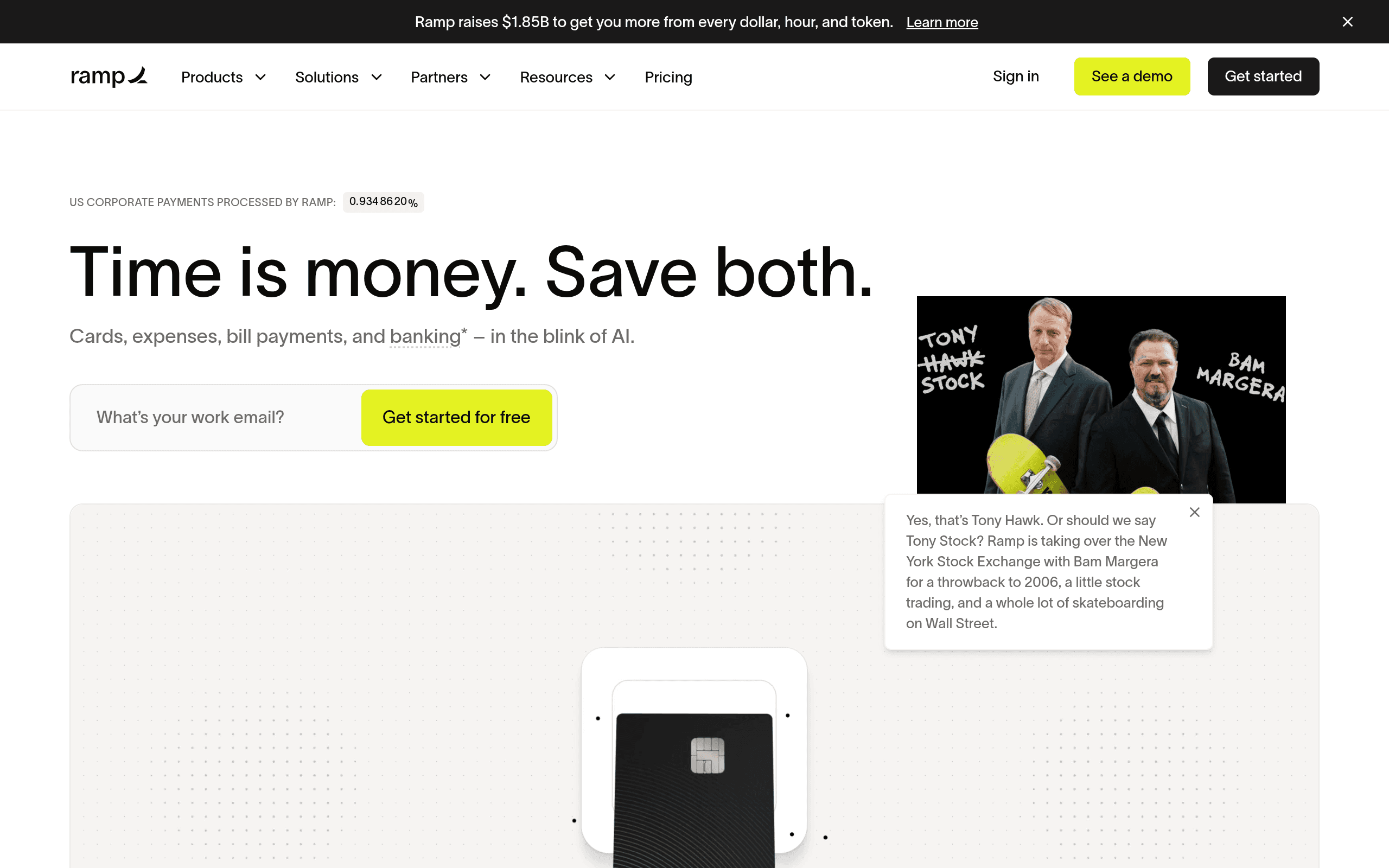
One last detail worth savoring: visit Ramp's homepage and the top banner reads "Ramp raises $1.85B to get you more from every dollar, hour, and token." (see this article's cover image) — dollar, hour, token, side by side. The day token becomes financial vocabulary may be the real story this round is trying to tell.
Comments (0)
Sources
Related articles

On October 17, The Verge reported that major websites are shutting out AI agents: JPMorgan Chase and Charles Schwab confirmed blocking agents from customer accounts, Yelp only admits agents that pay for data licensing, and Delta has no third-party agent partnership. We map who is closing the door and why, revisit Amazon's year-long war with Perplexity, and give vibe coders four judgments on building in the age of the 'right-of-way war.'
On October 13, Liquid AI released LFM2.5-24B-A2B: an open-weight 24B MoE with ~2B active parameters per token, built for fast on-device agents. Its real story is the training recipe — agentic RL inside real harnesses like OpenCode, Pi, OpenClaw and Hermes Agent. We break down the five-stage post-training, the 16 vendor-run benchmarks (strong on tool use and instruction following, weak on knowledge-heavy coding), and who should actually deploy it.

On October 14, Alibaba's Qwen team open-sourced BlenderWorld: a benchmark testing visual agents on real 3D creation inside Blender — 223 tasks, 2,651 binary rubric criteria, and submissions are editable .blend project files, not renders. We break down the exam format, the judging pipeline, and what it signals for agent evaluation.