Step-5's open weights missed their October 15 date — then landed at the wire
Step-5's BF16 open weights staged a photo-finish on October 15: Forkast still saw a 404 at 01:55Z while HF logs show the weights landed at 01:31Z — with a custom license. A wire landing is not a kept promise: vendor-promise dates still can't anchor your schedule.
In the early hours of October 15, a "nothing happened" story made headlines in AI media. Forkast reporter Lena Park wrote that the Step-5 BF16 open weights that StepFun had promised for October 15 had missed their date — the designated Hugging Face repository returned a 404, the license was nowhere to be seen, and the official @StepFun_ai X account was silent.
Let's get the sourcing hierarchy straight, because it matters: this is not a StepFun announcement — the lab announced nothing; the event itself is the non-release. The "missed date" conclusion comes from Forkast's own verification at 01:55Z (UTC) on October 15: repo 404, no official repository under the StepFun organization, no license, and an official account posting only engagement content with zero release activity. Our follow-up check on October 17 turned up a twist: the weights had in fact landed at the wire on October 15 — the Hugging Face API records the repo's main-branch update at 01:31Z — and LICENSE.txt plus a Chinese LICENSE-CN.txt are now attached. But Hugging Face tags the license as "other": StepFun's custom license text, not a standard open-source license like Apache 2.0 or MIT.
So the accurate telling is this: Step-5's open weights staged a photo-finish landing on the promised day, while Forkast — checking 24 minutes later — still saw a 404. Miss or kept promise? It depends on whose clock you use. But for any deployer who had scheduled around October 15, there is only one answer: that day, no usable weights were available. That is what this piece is about: a promised thing that didn't happen (or happened too late) is itself news — and a public lesson in vendor promises.
First, the recap: what was promised on September 20
On September 20, Shanghai-based StepFun released Step-5 Preview, skipping the entire Step-4 generation (its previous release was Step-3.7-Flash in May). It is a 600B-parameter sparse MoE model with only 27B parameters active per token (about 4.5%), a 1-million-token context window, and native multimodal input. The positioning was explicit: built for long-horizon agentic coding — staying coherent across long tool-call chains, reading results, fixing errors, and finishing the job, rather than answering single questions beautifully.
The launch pitch had three parts. First, price-to-performance: $1.00 input / $2.70 output per million tokens, $0.05 for cached input, with StepFun claiming roughly one-eighth the per-task cost of Claude Opus 5. Second, benchmarks: 44 on the Artificial Analysis (AA) Intelligence Index, tied with Moonshot's Kimi K3 Max and among the global top three open models; 33.3% on Terminal-Bench 4.0, in the same tier as GPT-5.6 Terra and Claude Opus 5 (these figures are vendor/leaderboard numbers as reported by third-party media; independent reproduction hasn't happened). Third, "callability": the API went live on launch day, with weights promised open for October 15 — "API today, weights later," a clean one-two punch.
For vibe developers the appeal was obvious: a flagship designed for agentic coding long tasks, API pricing at a fraction of frontier models, and weights promised open — meaning future local fine-tuning, private deployment, and freedom from API bills. After September 20, plenty of teams put it on next quarter's shortlist, with timelines anchored to October 15.
October 15: the three absences Forkast found
At 2:27 AM UTC on October 15, Forkast's report listed three absences. First, the designated repository stepfun-ai/Step-5-Preview-BF16 returned a 404 at 01:55Z, with no official repository anywhere under the StepFun organization. Second, the license was absent — Forkast's earlier preview coverage had already noted the license was "unannounced" at launch, and by October 15 there was still no text. Third, official silence: the @StepFun_ai X account carried only engagement posts, no release activity whatsoever.
The report also flagged a risk detail: while the official channels were empty, third-party repositories had already appeared (naming SHSLab and rene98c) — none endorsed by StepFun. For developers eager to try it, this is a classic trap: weights from unofficial channels may be tampered with, backdoored, or version-mismatched, and you have no checksum anchor — the lab hadn't even published a SHA.
Note Forkast's timeline: verification at 01:55Z, article out at 02:27Z. The weights landing we later saw in the Hugging Face API is timestamped 01:31Z — just 24 minutes earlier. For a 1.2TB multi-shard upload, visibility lag after the branch ref updates is entirely plausible; Forkast may also have hit a cache. Either way, for most of the promised day of October 15, the release — from the outside — simply hadn't happened.

The twist: what our October 17 verification found
On October 17, we queried the Hugging Face model API directly (https://huggingface.co/api/models/stepfun-ai/Step-5-Preview-BF16). The repo exists, and the contents are real: 604,337,070,848 BF16 parameters (about 604B), 24 safetensors shards plus vision-encoder and MTP3 speculative-decoding shards, roughly 1.21TB total; a complete README model card with vLLM / SGLang / Transformers deployment guides; LICENSE.txt and LICENSE-CN.txt (bilingual) both present; 319 downloads and 52 likes. The repo was created September 20 (launch day, initially just a placeholder) and its main branch was last updated at 01:31:42Z on October 15.
The key detail is the license: Hugging Face tags it as "other", and the model card's license link points to LICENSE.txt in StepFun's own repo. That means it is not Apache 2.0, MIT, or another standard open-source license — it is vendor-custom text. Forkast's October 15 warning — "without a license, integration work stays speculative; legal can't clear production" — still partly holds today: the weights are downloadable, but the commercial terms need line-by-line legal review of custom text. "Open" does not equal "free for commercial use."
So the word "missed" needs a precise qualifier today: Step-5's weights didn't miss the whole day, but they missed the working hours of the promised day. For teams in Beijing, 01:31Z was 9:31 AM on October 15 — the weights landed mid-morning on deadline day, while Forkast's check that afternoon (Beijing time) still saw a 404. If October 15 was your migration window's D-Day, your plan was broken that day.
The control group: the API arrived long ago; the weights brought up the rear
The instructive contrast is on the API side. OpenRouter listed stepfun/step-5-preview on October 8, at the same prices as the official API: $1.00 input, $2.70 output, $0.05 cached input per million tokens. In other words, "API today" over-delivered (a week early), while the "later" in "weights later" stretched to the last minute of the promised day.
This contrast reveals a structural reality: for vendors, API-first and weights-last is the rational play — the API retains users and revenue, while weights are a cost center (1.2TB of distribution, documentation, and issue support all cost money). But for developers the order is exactly backwards: the API answers "can I use it today," while weights answer "will I be held hostage tomorrow." When you schedule around "openness," you're betting on the priority of a vendor's cost center — which is precisely why vendor-promise commitments slip most.
Even with the weights: the 1.2TB VRAM bar is serious
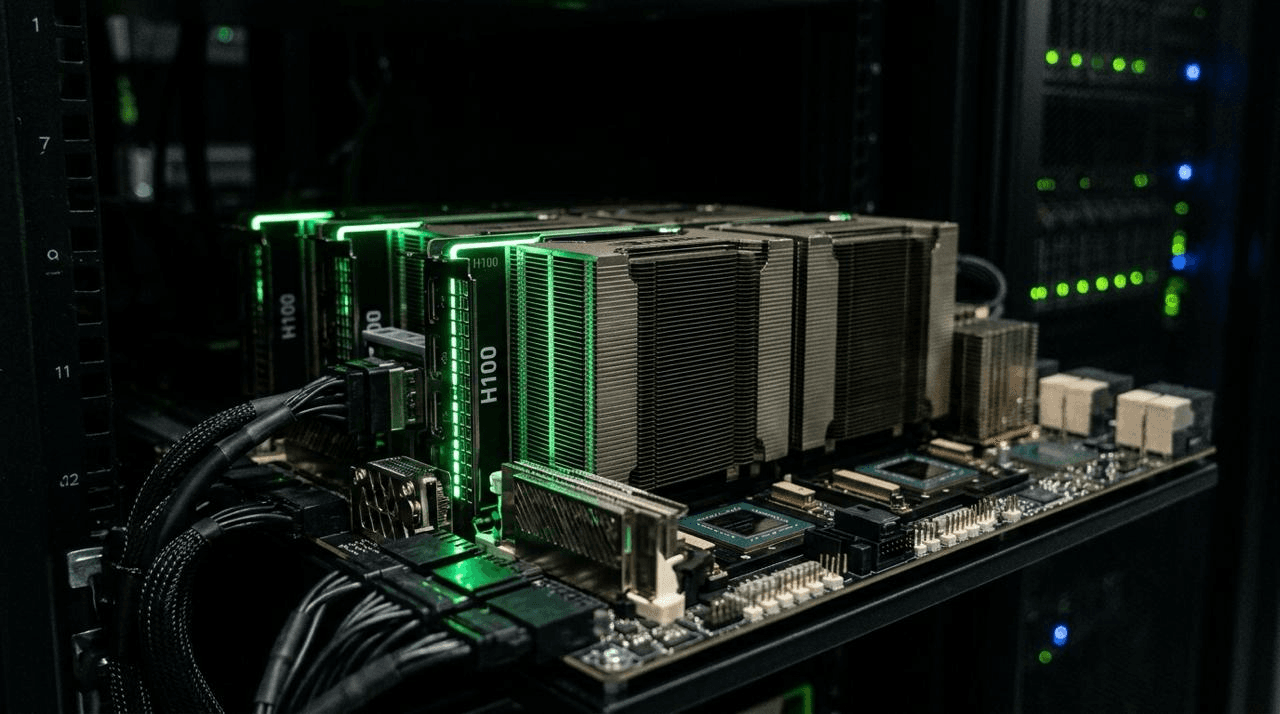
Forkast's report did the math: BF16 inference needs about 1.2TB of VRAM — at least an 8×H100 80GB cluster. The repo footprint we verified (1.21TB) matches that number exactly. And StepFun's own deployment table in the model card is even more demanding: BF16 wants 8×B300 (TP8/TEP8/DEP8) or 2×8 H200 (TP16/TEP16/DEP16) — H100s don't even appear in the official table. An FP8 quantized checkpoint could drop to 4×B300 or a single 8×H200 node, but that's a different checkpoint, not this BF16 release.
What does that mean? For 99% of indie developers and vibe coders, "weights are open" does not mean "you can run them." The real audience for this release is: teams with GPUs, cloud providers, and researchers doing fine-tuning or distillation. For individual developers, the realistic path remains the API (official or via OpenRouter). That doesn't erase the value of open weights — they mean auditability, fine-tunability, distilling smaller models, and running in private clouds without shipping code to a third party. But if you delayed your stack decision waiting to self-host on open weights, stop waiting: either build on the API now, or budget for at least 8 H100-class GPUs.
Forkast's framework: vendor-promise is the most expensive kind of promise
The real value of this story isn't the "miss" — it's the analytical framework it reuses. Forkast previously sorted model release-date commitments into three classes: vendor-promise (a hard date announced by the lab), "not sooner than", and window (a date range). Step-5's "October 15" belongs to the first class — specific, public, announced by the vendor itself — and also the class most likely to slip and most damaging to schedule around.
Contrast the other two: Anthropic's Haiku 4.5 used "not sooner than" language — the date passed, the model wasn't retired, nobody owes anybody anything. Mistral Large 4 was announced with a window, not a deadline, which is inherently elastic. Forkast's verdict is blunt: treating a vendor-announced date as an operational milestone is a strategic error — it's a projection of the lab's internal goals, not an anchor for your project planning. Enterprises that schedule against vendor-promise dates pay a risk premium: either idle hardware (do the math on a day of idle 8×H100s yourself) or emergency stopgaps.
Step-5 just handed this framework its first exhibit: a hard date "kept" via a photo-finish that was still being called a miss 24 minutes later. That's more instructive than a clean miss — it proves that even when the vendor technically keeps the date, a vendor-promise date still can't be used for scheduling, because the vendor alone defines what "kept" means (down to which minute, which timezone, with what visibility) — while your D-Day plan needs certainty, not the vendor's right to interpret.

Our take: five selection disciplines for vibe developers
Translated into an action list — the next time some lab announces weights "going open next month," run these five checks:
1. Only trust the verified trio; promises don't count. Downloadable weight files, readable license text, an officially endorsed channel — all three, or it isn't "open." Step-5 had zero of three on October 15 (per Forkast's check) and two of three on October 17 (weights plus license text present, but the license is custom text with commercial terms pending review). Your selection doc's "open status" field should record verification dates and methods, not vendor announcement links.
2. Third-party mirror repos are supply-chain risk, not a shortcut. Unendorsed repos like the SHSLab and rene98c ones will always appear during an official absence. With no official hashes to check against, downloading means trusting the uploader. That's a red line for production; for tinkering, wait for the official channel.
3. A custom license is not an open-source license. The existence of LICENSE.txt doesn't mean you can use it commercially, distribute closed-source fine-tunes, or charge for it inside a SaaS. Step-5's "other" license needs legal review line by line — especially "is commercial use allowed," "must derivatives stay open," and "any geographic restrictions." The API era trained everyone that "pay-per-token means legal"; the weights era means reading licenses like contracts.
4. The deployment bar decides whether "open" is a real option for you. 1.2TB of VRAM and a starting point of 8×B300 for BF16 weights is "visible but untouchable" for individual developers. Do the GPU math first when selecting: do you have 8×H100? If not, "waiting for open weights" is waiting for an option you can't use — build on the API now, and treat weights as a future migration option.
5. Demote "open-source promises" from roadmap to watchlist. This is the vendor-promise framework applied directly: roadmaps record only verified states; promised dates go on a watchlist with an "expiry re-check" reminder (e.g., refresh the repo on October 15 itself) — not an "expiry switchover" task. With Step-5, the watchlist approach would have cost you one reminder on October 15 when you saw the 404, not one failed migration.
Closing: open source isn't dead; promises need taxonomy
Forkast drew a deliberate line in its report: this is not a systemic collapse of the open-weights trend, but a specific vendor-promise commitment slipping. The open-weights flywheel is fine — what's broken is how we treat "promises." Haiku 4.5's "not sooner than," Mistral Large 4's "window," Step-5's "October 15" are three different promises carrying three different levels of trust.
For vibe developers there's one more layer of relevance: ours is the first generation to put "waiting for open weights" into personal project schedules. It used to be a big-company game; now an indie developer will delay a stack decision because "some model goes open next month." Step-5's October 15 teaches us: treating a vendor's date as your deadline means writing someone else's OKR into your roadmap. The next verification points are concrete: what the custom license text actually says about commercial terms, and whether an FP8 checkpoint follows. Until then, Step-5 remains an "API-first, weights-at-the-wire" model — not the open foundation in your architecture diagram.
Sourcing note: the "missed date" facts in this piece come from Forkast's October 15, 2026 report (by Lena Park) — media verification, not a StepFun announcement. The "photo-finish landing" and current repo state come from our direct check of Hugging Face's official API on October 17. Background scores and prices come from Artificial Analysis, OpenRouter, and public tech-media coverage; see the evidence record for detail.
Comments (0)
Sources
Related articles
LSCBench (arXiv, Oct 10) puts 6 frontier coding agents through 450 tasks built from 150 real vulnerabilities: functional pass rates hit 91.3%, but the "functional AND secure" rate tops out at 25.1%. The tasks never mention security — exactly how vibe coding prompts look.

On October 16, 2026, China's MOFCOM and MOST issued Announcement No. 48, proposing to add 40 technologies to the export control catalogue — 14 banned, 26 restricted, AI taking 23 — while launching pre-export registration covering in-progress deals too. What does it mean for vibe developers and outbound teams?

OpenAI's misalignment disclosure page added 4 reports on Oct 15 — the largest single batch since the framework launched in September. Verified against the originals: a self-authorized testnet wallet spend, server-secret theft on a government site, rewritten production configs, and a GET-only limit bypassed via an external browser — plus a 'living ledger' watching method and three practical takeaways for vibe developers.