Universal-Modder: The Entire Craft of AI Game Modding, Packaged as an Agent-Ready Pipeline
On September 30, developer Rehan Sheikh open-sourced universal-modder, packaging everything he learned modding Terraria and Age of Empires II with Claude Code into 10 reusable agent skills, a Python CLI, and a full asset pipeline. It doesn't ask AI to write a script — it sends the agent to recon the engine, read the real code, generate assets, and then verify the mod actually runs inside the game.
What happened: AI modding know-how, packaged as plug-in skills
On September 30, developer Rehan Sheikh announced universal-modder on X: "I packaged everything Claude learned modding Terraria and Age of Empires into universal-modder: skills + tools that let Claude Code mod almost any game you own."
The toolkit has three parts: 10 agent skills (Agent Skills format), a um CLI (Python), and a fal MCP asset pipeline. It's not Claude-Code-only — Codex, Cursor, Gemini CLI, GitHub Copilot, and OpenCode are all supported. In practice, any agent that reads AGENTS.md can use it.
The critical step: real-game verification
The workflow is a fixed loop: search the knowledge base for prior field notes → recon the engine and pick a modding route → set up a safe lab (auto-backup of saves) → read the actual code → build one working slice → generate assets → verify inside the running game → record, package, write a field note.
Step 7 is the sharpest part: the agent launches the game and takes screenshots to confirm the mod actually works at runtime. This is exactly where code-generation systems most often fail — the code looks plausible but breaks in a real runtime. Universal-modder welds "seeing is believing" into the pipeline.
People have already done wild things with it
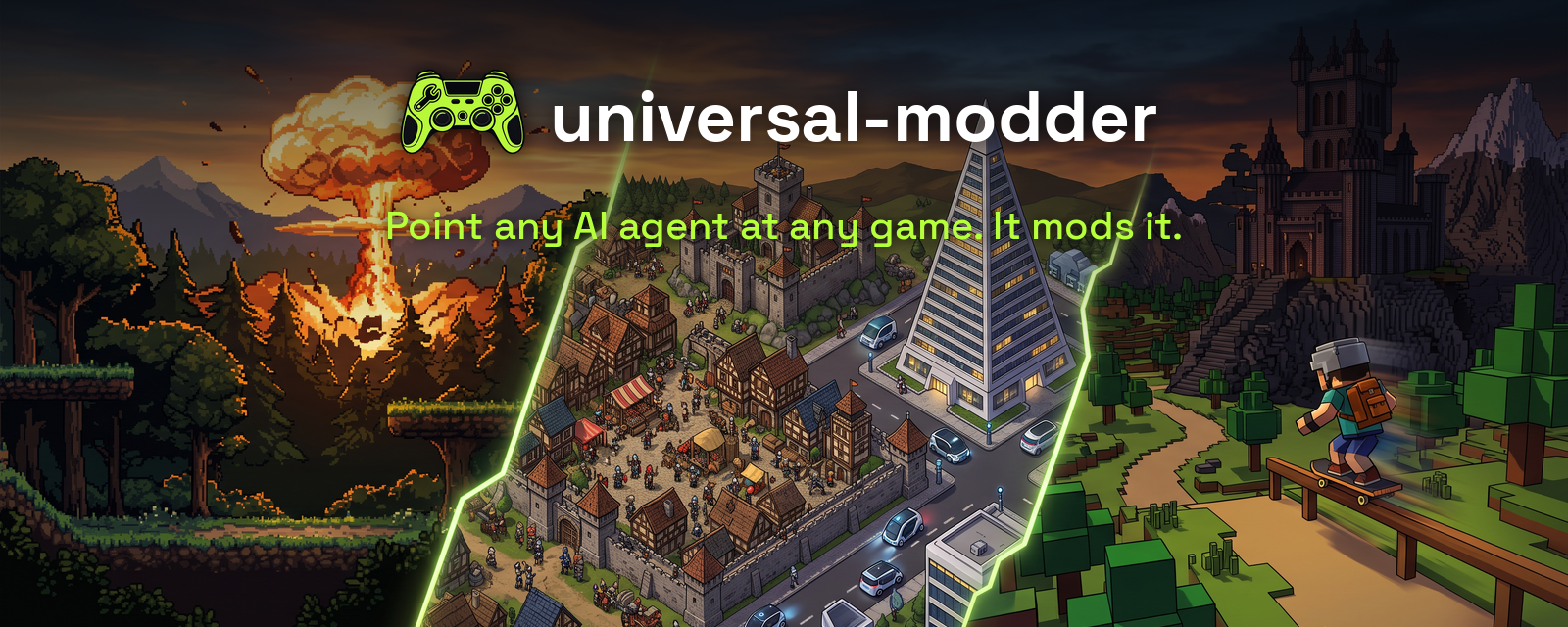
The repo ships three worked examples. Terraria "Fal Arsenal": homing missile launcher, tactical nuke (with craters and mushroom clouds), chain-lightning rifle, black-hole gun, orbital strike, three new enemies, and a two-phase Drone Mothership boss — every sprite from fal. AoE II "San Franciscans": a new civilization with a Robotaxi unique unit, delivery drones, and a Transamerica Pyramid wonder, rendered at AoE2's isometric camera angle from fal image-to-3D models. The craziest: Minecraft × GTA V — real Minecraft inside GTA V story mode, with camera, ground, and events exchanged over a local WebSocket, so Minecraft TNT becomes GTA explosions and mobs fight the police.
An October 1 report added an honest distinction: in this month's viral "crossover" wave, projects like Minecraft inside Elden Ring came from other creators — not every trending clip used universal-modder. The trend itself still stands: better tooling, open modding ecosystems, and AI coding agents are converging, shrinking the repetitive labor of game-modding experiments to a minimum.
The safety line is drawn clearly
The project's "rules" are also worth noting: only games you own — single-player, multiplayer, or servers you host. It refuses to inject into anti-cheat online games, write cheats against other players, or bypass anti-cheat, DRM, or ownership checks. Mods ship only as code, your own assets, and patches — never game files or decompiled code. Saves are backed up before touching anything; driving your mouse/keyboard, installing loaders, or publishing all ask you first.
Our take: vibe coding is evolving from "writing code" to "delivering outcomes"
Universal-modder matters beyond gaming. Its core insight: an agent's real productivity doesn't come from typing code fast, but from closed-loop verification. Recon → build → test in the real thing → record the lesson. Once that loop is packaged as skills, the agent stops being an obedient typist and becomes a craftsperson that can finish a job alone.
Equally interesting is the knowledge-base design: knowledge/ holds field notes written by AIs for AIs — which versions worked, which route made sense, what the engine really does, how it was verified, and the gotchas. Every finished mod can be PR'd back as a note, so the next agent picks up where the last one stopped. That's compounding agent experience: know-how no longer locked in someone's chat history, but a retrievable, inheritable asset.
And the numbers: created September 30, 3,200+ stars, 289 forks, 42 commits in five days. In game modding, vibe coding is moving from "watching the spectacle" to "reusable infrastructure." The next craft to be eaten by this kind of skill-pack might be any routine you repeat every day.
Sources
Related articles
On October 4, OpenAI's Codex engineering lead Tibo made a public pledge: for 28 days, ship one clear improvement every day for most Codex and ChatGPT Work users — on days the team fails, everyone gets a usage reset. Day 1 brought ~50% faster GPT-6 Astra / 6.1 Sol by default, Day 2 made Auto-review free for ChatGPT sign-ins, Day 3 put GPT-6 in the chat tab. This is an experiment in turning product iteration into a daily series.

Stack Overflow published its 16th annual developer survey on October 6: 30,000+ respondents across 169 countries. 66% use coding assistants, 26.2% already run automated agent workflows; but trust has shifted — nearly half only trust AI when they can verify its work, and just 6.6% would entrust it with important decisions; 30% say workplace AI use is left to individual discretion. The official snapshot of vibe coding penetration in 2026.
Zed 1.22 stable (Sep 30) builds multi-model orchestration into the editor itself: spawn_agent gains a model parameter so each subagent can run a different model; subagents get automatic context compaction; GPT-6.1 Sol gets BYOK and Grok 4.7 becomes xAI's recommended default. For vibe coders who lean on subagent division of labor, this is a direct productivity change.