When One Person Isn't Enough: Outsourcing and Hiring as the Client for Vibe Projects
The vibe coder's bottleneck eventually shifts from writing code to running out of hours. This guide gives indie developers the complete client-side playbook: when to hire (buy time vs. save money), the reverse-SOW method for decomposing tasks from acceptance criteria, channel and quote traps, milestone payment control, AI-generated code acceptance, NDA and IP, and a graceful four-step exit.
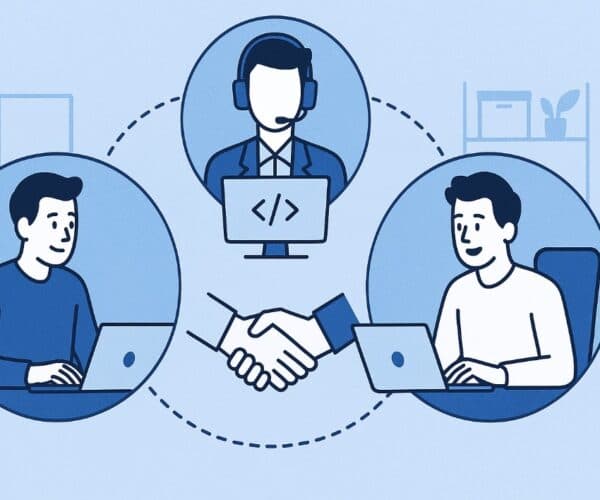
Lesson One: Hiring Is Buying Time, Not Saving Money
Every vibe coder eventually hits a wall — not in writing code, but in running out of hours. Mockups uncut, landing pages unwritten, thirty support tickets piling up, invoices nobody handles. Your first instinct is "get help." But behind that instinct hides a calculation most indie developers never make: are you buying time, or saving money?
They look the same but are opposites. Buying time means spending money to reclaim your hours for things only you can do: product decisions, core architecture, acquisition. Saving money means finding the cheapest person to get the job done. Time-buyers pay a premium for certainty — reliable people, on-time delivery, low communication cost. Money-savers optimize for unit price and usually end up redoing the work three times, spending every saved dollar on their own overtime.
My rule is simple: compute your effective hourly rate. Divide last month's net income by the hours you actually put into the project (productive hours only). For any task you'd outsource, if doing it yourself takes T hours and the quote is P, outsourcing only makes sense when P < your effective hourly rate × T × 1.5 — the 1.5 covers communication and acceptance overhead. First-time clients always underestimate this: writing requirements, answering messages, reviewing, rework — all of it is your time.
Don't forget the hidden line item: context-switching tax. Doing chores yourself costs not just those two hours, but the half hour it takes to get back into flow after each interruption. Outsourcing doesn't just save T hours — it protects your unbroken four-hour deep-work blocks. Factor in "how many times will this interrupt me": high-interruption chores are worth outsourcing even at a premium.
Then apply the three-quadrant decision framework. Score each candidate task on frequency × technical barrier:
- Quadrant 1: high frequency, low technical barrier (support tickets, customer service, data cleanup, release checklists) — the best outsourcing candidates. Highly standardizable: hand over once, benefit long-term. Hire a long-term part-timer or virtual assistant first.
- Quadrant 2: low frequency, high technical barrier (brand design, legal contract review, SEO technical audits, app-store compliance) — outsource per project, buying an expert's certainty in one shot. Don't try to learn it yourself: what takes you three months takes an expert two days, without mistakes.
- Quadrant 3: core capabilities (product direction, core architecture, pricing strategy, key user conversations) — never outsource. Outsource this quadrant and you're no longer a founder, you're a middleman. Once the soul of the project is outsourced, rework cost is infinite.
Before deciding, run the "hold on two more weeks" checklist. If all five are "yes," you can wait; a single "no" means start hiring:
- Will skipping this for two weeks cost users or revenue?
- Am I already proficient at it (not learning on the job)?
- Won't it crowd out my core work (shipping / acquisition) these two weeks?
- Is the rework cost controllable if it goes wrong?
- Can my sleep and mood survive it?
The last one isn't a joke. Indie developer burnout has no HR department to warn you. Hiring is the cheapest burnout insurance there is.

The Reverse SOW: Write the Task Backwards from "What Counts as Done"
Outsourcing failures have one near-statistical root cause: the client and the contractor never aligned on the definition of "done." The contractor thinks "it runs" is done; you think "three days live with no bugs" is done. That one-word gap is the entire source of disputes, surcharges, and abandoned work. So the statement of work must be written backwards: write the acceptance criteria first, then the task description. If you can't write the acceptance criteria, the task isn't decomposed enough to outsource.
What is "acceptable granularity"? Three golden rules, all required:
- Inputs and outputs describable: you can say in one sentence what you give and what you get back. Give: Figma link + final copy; get back: responsive pages for 375px/768px/1440px breakpoints + Lighthouse performance ≥90. Tasks you can't describe this way ("make the product prettier") are un-outsourceable.
- Estimable duration: a task package should run 3 days to 3 weeks. Shorter than 3 days — don't outsource, communication costs more than the work. Longer than 3 weeks — split into milestones (see the payment section).
- Judgable quality: at acceptance you check boxes, not "get a feeling." Anything only feelable ("does this design feel premium?") must first be translated into judgable criteria (brand palette colors, type scale consistent with existing pages, no horizontal scroll on mobile first screen).
Here is a reusable acceptance-criteria template. Fill it in before sending any task — every cell you can't fill is something you haven't thought through:
| Item | Criterion (checkable) | How to verify |
|---|---|---|
| Completeness | Every requirement-list item has a matching implementation, no "later" | Demo each item against the list |
| Edge behavior | Empty, loading, error, and overlong-text states all handled | Trigger all four states, screenshot |
| Performance baseline | First paint ≤2s on weak 4G, no jank scrolling lists | Lighthouse / real-device recording |
| Compatibility | Latest two versions of Chrome/Safari/in-app browsers work | Tested screenshots on three targets |
| Code/files delivered | Source + reproducible build steps, full dependency list | Build from zero in a clean environment following the docs |
| Documentation | README explains how to run it, how to change it, who to ask when it breaks | You follow the docs yourself once |
| Defect warranty | Bugs found within 14 days of acceptance fixed free (scope per requirement list) | Written into the contract |
Note the last row: the defect warranty must be in the contract. A verbal "just ping me if anything breaks" expires the moment the final payment clears. That's human nature, not a moral failing.
One more reverse-writing principle: the SOW should state not only "what to do" but "what NOT to do." The freelancer-side contracting guide covers this from the other side; it applies equally here — "logo design excluded," "IE compatibility excluded," "post-launch operations excluded." Every "excluded" is a vaccine against a future surcharge dispute.
Finding People and Comparing Quotes: Channels and Three Traps
Rank channels by trust cost, lowest first: friend referrals > vertical communities > domestic gig platforms > international platforms like Upwork/Fiverr. A referral front-loads trust — someone already paid your trial-and-error cost; 20% more expensive is worth it. Vertical communities (designer hubs, developer collectives) offer verifiable portfolios and traceable reputations. Gig platforms suit highly standardized work (logos, video editing, translation) but expect sifting. International platforms fit tight budgets if you can handle English communication and time zones — remember to add the 10–15% platform fee before comparing.
Evaluate quotes with the anchor method: always collect three quotes first. Three quotes form a price band automatically — drop the highest and lowest, and the middle one is usually closest to the true market price. Then ask the cheapest bidder one question: "If I add requirement X, how much extra?" The more specific the answer and the clearer the surcharge logic, the more reliable the person. Anyone who vaguely says "it's all included" hides their surcharges until after delivery.
Three quoting traps built for first-time clients:
- The lowest-bid trap: a quote at half the others' price usually means "win the bid cheap, surcharge at delivery" or "subcontract to someone even cheaper." Counter: require the bidder to break the quote into "person-days × daily rate." A low price that can't be decomposed is a risk quote.
- The package-price trap: "8,000 all-inclusive, everything covered." Sounds worry-free, but it hands the definition of "done" to the other side. Counter: insist on mapping every acceptance-criteria item to the package price. "All included" that can't be written into the checklist means nothing.
- The hourly-rate trap: under hourly billing, the contractor has no incentive to be efficient, and inflated hours are unverifiable. Counter: use hourly only for exploratory work (e.g., a technical spike); fixed total price + milestones for anything deliverable.
One vibe-project-specific screening question: ask whether they use AI to write code or designs. This isn't discrimination — using AI for leverage is normal in 2026 — but you need to know: can they read what the AI generated, modify it, and diagnose problems in it? If they can't answer, you've hired a "prompt subcontractor." See the AI-acceptance section for the risks.
Trial Tasks: Buy One Small Sample of the Partnership
Before signing a big contract, run a paid trial task: carve a 1–3 day micro-task out of real demand, pay the normal rate, and observe the full delivery performance. Trials don't test skill — portfolios do that — they test three things: communication responsiveness (instant, hourly, or vanished), first-pass acceptance (do you have to pick through it line by line?), and documentation habits (is the handover directly usable?). These three decide your next three months.
Three trial disciplines: it must be paid — free trials attract only people with no work; reliable people don't work for free. Use a real task — not a "test question" but a genuine item from your backlog, so the deliverable is directly usable and nobody's time is wasted. Trial one person at a time — trialing three people for comparison triples your review time. The pass criterion is simple: you'd hand them the next, bigger task without needing to "think about it."
Payment Control: Milestones Are the Client's Only Leash
Payment rhythm is the client's only real control. You may not be able to judge code quality, but everyone understands who holds the money. One iron rule: never pay in full for anything unaccepted, and never squeeze the final payment so small the other side stops caring.
Two classic splits:
| Split | Structure | When to use |
|---|---|---|
| 30-30-40 | 30% kickoff → 30% mid-term acceptance → 40% final | 2–4 week mid-size tasks; a 40% final payment keeps final acceptance serious |
| 50-50 | 50% kickoff → 50% final | Tasks under a week; finer splits cost more in coordination than they save |
For work over a month, split monthly: accept each month's deliverables, then pay that month, with the final payment no less than 20%. The psychological line for final payment is 20%: below it, the contractor does the math and walking away becomes rational; above 40%, your cash is tied up too early and mid-term acceptance loses its teeth.
Write the failed-acceptance deduction language into the contract in advance — it beats improvising during a dispute by a mile. Three sentences, and missing any one hurts you later:
- Re-inspection window: "If acceptance fails, the contractor shall remediate free of charge within 5 business days and resubmit; if re-inspection still fails, the client may deduct the amount corresponding to the unmet items."
- Deduction anchors: deductions must map to specific items in the acceptance template ("compatibility item unmet: deduct 15% of the corresponding amount") — never "the client may deduct at its discretion." "Discretion" means nothing in a dispute.
- Termination right: "After two consecutive failed re-inspections, the client may terminate and settle only for completed, accepted portions." This is your nuclear button — rarely used, but it must exist.
One more thing: get the schedule commitment before paying the kickoff — start date, first-draft date, weekly sync day. A kickoff payment with no schedule hands over all initiative at once. Keep progress syncs to "one short written brief per week + runnable interim results" — you want evidence, not meetings.

AI-Era Acceptance: How to Take Over Code Someone Else's AI Wrote
This chapter didn't exist in outsourcing guides before 2024 — and it's now where failures cluster. A contractor "writes" 3,000 lines in a day with AI, the demo flies, you pay the final installment. Three months later you need a feature, open the repo, and find: variable names that read like AI glossolalia, business logic scattered across seventeen files, comments that say "TODO: optimize." You can't take it over — you can only rewrite it. That's paying twice for one lesson.
The three-piece AI-code acceptance kit, written into the "code/files delivered" row of your acceptance template:
- Readability gate: require passing your chosen lint rules (ESLint / Ruff / go vet per stack), and functions over the complexity threshold must be refactored. One simple rule, filters 80% of AI-glossolalia code. Also require: core business logic must carry comments explaining why it's written this way — comments that only say what don't count.
- Secret and license scanning: AI-generated code mixes in hardcoded secrets and test tokens far more often than human code. Run a secret scan (gitleaks or trufflehog) before acceptance, and check third-party dependency licenses — AI loves pulling in GPL/LGPL components, and if your product is closed-source commercial, one license contamination costs more in legal fees than ten outsourcing contracts.
- Documentation completeness: require an "AI usage note" — which modules were AI-generated, which models, the key prompt thinking. This isn't harassment: three months from now when something breaks, you'll at least know what to ask the AI to reproduce the original generation logic.
Same for design deliverables: require source files (the Figma source, not exported PNGs), sane layer naming, componentized reuse. AI-generated design looks gorgeous, but layers named "Rectangle 47 copy 12" will make your next designer want to scream.
One red line: have the contractor warrant that deliverables contain no code or assets owned by others, in writing, in the contract. AI-generated content's copyright status is still gray in most jurisdictions, but "no plagiarism" is black and white. In a real dispute, that sentence is your basis for claims.
NDA and Non-Competes: It's About Timing, Not Ritual
Indie developers fall into two extremes: sign nothing ("who'd steal from a small project?") or slap down a copied non-compete that scares reliable contractors away. The right posture is layered:
- NDA: sign it before the first substantive conversation — before you've laid out your product idea, data, and user numbers. Signed late equals never signed. NDAs don't need complexity: three elements suffice — scope of confidential information ("all information marked confidential or reasonably considered confidential"), term (2–3 years), liability (one sentence). Online bilingual templates are fine; what matters is that it's signed, not how beautiful it is.
- Non-competes: against small contractors (solo freelancers, tiny studios) they're basically unenforceable — non-competes typically only bind employees in employment relationships anyway, and you can't afford the "non-compete compensation" that makes them valid. Don't waste negotiating chips here; concentrate on the next item.
- IP ownership: this is the one that actually kills. The contract must contain: "All work product created by the contractor in performing this agreement (including code, designs, and documentation) — IP ownership vests in the client upon creation; the contractor shall cooperate in executing any transfer documents." Without this sentence, copyright defaults to the creator (the contractor) — your payment buys only a usage license, and they could theoretically sell the same code twice. This clause outranks everything.
Engineering-side counterpart: least-privilege repo access. Give contractors write access to their own branch, never merge rights on main; use temporary or read-only keys for third-party services; revoke everything the day the engagement ends. Revoking access isn't distrust — it's process, as natural as returning a hotel key card. Write into the contract: "within 3 business days of termination, the contractor shall delete locally retained confidential information and confirm in writing." It saves arguments later.
The Graceful Exit: A Four-Step Termination Process
Every engagement ends; ending well is a skill, and ending a bad one well is a discipline. When these red-line signals appear, don't hesitate — start the termination process: two consecutive missed schedules with no reasonable explanation, cliff-drop in delivery quality (probably subcontracted out), communication degrading from hourly to daily with no warning, demands for full payment before continuing. Any one of these: talk once first; if nothing improves within 3 days, run the process. Delay only grows sunk cost.
The four-step termination flow:
- Step 1: written notice citing the clause. Send termination by email (not voice message), citing the contract's termination right, stating the effective date. Verbal doesn't count; email is evidence. Keep it professional and neutral — no blame, no score-settling. It's a small world; people who exit gracefully will take your next order.
- Step 2: settle only for accepted work. Pay only for what passed acceptance. Unaccepted work doesn't get paid; kickoff money already paid but undelivered gets deducted or clawed back per the contract. This is where people go soft: remember, going soft once teaches every future contractor that "almost done" earns full pay. "Almost done" ≠ "done" — the acceptance template is the ruler.
- Step 3: enforce the handover checklist. Source code, design sources, account credentials, third-party service configs, status notes on unfinished items — checklist, tick by tick. Require a 30-minute recorded handover walkthrough. Those 30 minutes save you three future weeks of "what does this code do" mysteries.
- Step 4: revoke access, confirm confidentiality. Pull repo permissions, void temporary keys, remove them from collaboration tools; get written confirmation that local confidential copies are deleted. Only then is the engagement truly over.
Finally — when should "outsourcing" become a long-term relationship or even full-time? When three signals coincide: this person has delivered steadily for three months, what they do is becoming your core capability (quadrant 3 expanding), and what you pay them in outsourcing fees approaches a full-time salary. Then don't economize on the admin overhead — converting a reliable person into your own people is the most profitable "acquisition" an indie developer can make.
Back to the opening line: outsourcing failures never blame the contractor; they blame the client who never wrote down what "done" means. Being a client is a craft. Its core skill isn't the mysticism of judging people — it's the unglamorous work of translating vagueness into checkable lists. Every vague sentence you send out becomes a surcharge on the invoice; every standard you write down is sleep you don't lose to 2 a.m. bug fixes. When one person isn't enough, learn to be a client first — then go find people.
Comments (0)
Related articles

AI drove the cost of building to the floor, making one-person multi-product portfolios possible — but running complexity explodes. Three tiers, 20/50/30 time split, shared infrastructure, and a quarterly decision matrix: run your products like a fund manager.

A waitlist collects headcount; a private beta buys truth. This guide gives solo teams the complete pre-launch closed-validation playbook: the four-quadrant recruiting filter, three-tier rollout with entry/exit criteria, a beta-only feedback funnel with the noise-vs-signal three-question filter, five graduation numbers plus three red lines, and six anti-patterns.

Models are rented; data is owned. This guide gives solo developers the complete data-flywheel playbook: the four links and the minimum closed loop, collection design (the three questions), a lightweight labeling pipeline, dataset versioning and eval-set growth, four reflow paths ordered cheapest-first, cold-start data sources, and a one-page weekly checklist.