Privacy Compliance Playbook for Vibe Projects: From Data Map to Deletion Button
A day-one privacy compliance framework for vibe projects: data map, 8 must-have privacy policy clauses, cookie banner rules, deletion-right engineering, and 3 extra red lines for AI features. No legal background needed.
The Bottom Line: Privacy Compliance Is a Launch Prerequisite, Not Legal's Problem
Many vibe coders' launch checklist looks like this: features work → buy domain → deploy → launch on Product Hunt. Privacy policy? "Ship first, paste a template later." Then three months later the first user email arrives: "Please delete my account and all my data." — and you discover user data scattered across seven tables, a copy in your analytics tool, another in backups. Deletion is suddenly impossible to do cleanly.
Privacy compliance is not the same as SOC2-style enterprise certification (we have a dedicated SOC2 guide — that's for B2B sales). This guide covers product-facing privacy compliance: what user data you collect, what you do with it, and whether users can delete it. For consumer vibe products, getting this wrong means app-store removal at best and fines at worst — and it has nothing to do with code quality. It's pure product design.
One more distinction: we also have a "pre-launch legal three-piece" guide covering what to write in your privacy policy, terms of service, and cookie notice — that's the paperwork. This guide covers what to do (data map, deletion SOP, consent records). The two pair up without overlapping.
The good news: most privacy compliance work is "making the right product decisions at the right time" — no legal background needed. Here's a battle-tested framework you can apply from day one.
Step 1: Draw Your Data Map (Mandatory Before Launch)
Before writing a single line of privacy policy, fill in this table — on paper or in Notion:
- What do you collect? Email, username, IP, device info, payment details, user uploads, behavioral events… list every item.
- Why? Each item needs a "the feature breaks without it" justification. Can't answer? Delete it. That's data minimization, the first principle of every privacy regulation.
- Where is it stored? Which database, which cloud vendor, which region. European users but data on bare metal in the US? That's a liability.
- Who else can see it? Your third-party SDK inventory: analytics (PostHog/Umami), error tracking (Sentry), payments (Stripe), email (Resend), auth (Auth0/Clerk). Every third party is a data sharing event that must be named in your privacy policy.
- How long is it kept? Logs 30 days? Analytics 13 months? After account deletion? Data with no retention period is future liability.
Once this table exists, 80% of your privacy policy writes itself. More importantly: filling it in after launch costs 10x — because the data has already escaped.
 Data map template: what, why, where, who else, how long
Step 2: The 8 Clauses Your Privacy Policy Must Have
Don't copy a template. Templates don't know what you collect. Write these 8 sections by hand from your data map (2–3 honest sentences each beats pages of boilerplate):
- 1. What we collect and why: grouped by feature ("account features need your email", "analytics collects anonymized usage"). Never "we may collect the following information" — correctly useless.
- 2. Third-party sharing inventory: name every sub-processor + what data it gets + link to its privacy policy. The section users most want and developers most often skip.
- 3. Cookies and tracking: which cookies, what for, expiry. EU users need a separate consent banner (below).
- 4. Data retention periods: how long each category lives, how fast deletion happens after account closure. Can't write it? Go back to step 1.
- 5. User rights: access, correction, deletion, export, withdrawing consent. Provide at least one working contact (not just a noreply address).
- 6. Minors: are under-13/16 users allowed? If not, say so and gate by age. If yes, you need parental consent — most vibe projects should choose the former.
- 7. Cross-border transfers: which regions host your servers, does user data leave the country. One sentence suffices, but it must exist.
- 8. Policy updates: how users are notified of material changes (email/in-app), how many days before they take effect.
Have a knowledgeable friend read it and ask: "As a user, would you sign up after reading this?" If not, rewrite.
Step 3: Cookie Banners — the Life-or-Death Line for EU Traffic
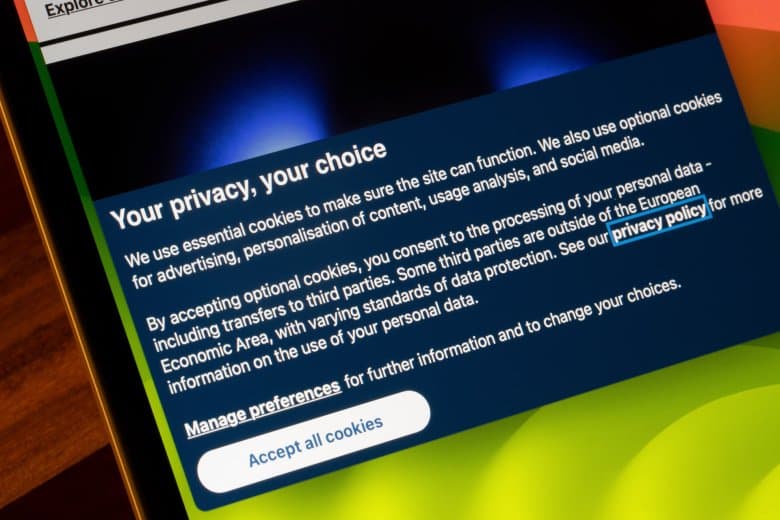
If you have EU users (ePrivacy/GDPR territory), this is mandatory: non-essential cookies/trackers must be OFF before the user clicks "accept." Three classic failure modes:
- Fail 1: "Continued use means consent." No. Consent must be an affirmative action (clicking a button); pre-ticked boxes don't count either.
- Fail 2: Reject buried three layers deep. "Accept" in one click, "reject" three menus down — regulators have explicitly called this a violation. Both buttons must be equally prominent.
- Fail 3: Load analytics first, ask later. Backwards. Correct order: only "strictly necessary" (login state, security) loads by default; analytics/ads inject dynamically after consent. GTM Consent Mode or a 50-line homegrown module both work.
For China-focused products, the PIPL's keyword is "separate consent." On first app launch, don't bundle 5 permissions plus the privacy policy into one "I have read and agree" — sensitive processing (face, location, contacts) needs its own popup. App-store reviewers now test this for real.
Step 4: The Right to Deletion — the Most Underestimated Engineering Requirement
"Delete my account" is the most engineering-expensive user right, because it tests your data architecture. Three classic ways vibe projects die:
- Death 1: users table deleted, email still in orders/logs/analytics. Fix: internal UUIDs as primary keys, PII (email, phone) in one dedicated table; deletion = drop the PII table + anonymize linked tables.
- Death 2: third parties can't be deleted. Sentry issues carrying user emails, PostHog events carrying userIds. Fix: mark each third party's deletion API in your data map, and write an internal
DELETE /me/datascript before launch that walks the list. - Death 3: backups still have it. 30-day backup retention is reasonable, but state in your policy that "backup data is naturally purged within X days through backup rotation" — the regulator-accepted standard practice.
Recommended product shape: "Export my data" (JSON download) and "Delete account" in settings, with a two-phase "30-day cooling period, then real deletion." Not hard to build, and among the strongest trust signals you can ship.
Step 5: Three Extra Red Lines for AI Features
Most vibe projects ship AI features, which add three more privacy layers:
- 1. Do user inputs enter training sets? If you call third-party APIs (OpenAI/Anthropic), read the data terms: API mode doesn't train on your data by default, but some "share data for discount" options do. One sentence in your privacy policy settles it.
- 2. Don't stuff PII into prompts. The classic failure: concatenating a full user record (email, order numbers) into a prompt sent to a model. Fix: prompts carry only fields the task needs; sensitive fields get masked or tokenized first.
- 3. RAG permission inheritance. If your AI can search user documents, results must respect the source documents' permissions — user A's agent must never surface user B's documents. Our anti-clone/permissions guides stress this; it's equally fatal from a privacy angle.
48-Hour Pre-Launch Checklist
- ☐ Data map v1 documented (items / purposes / storage / third parties / retention)
- ☐ Privacy policy's 8 clauses hand-written from the data map, linked in footer
- ☐ Third-party SDK inventory matches the named list in the policy (update policy on every new SDK)
- ☐ Cookie banner: non-essential tracking off by default, accept/reject equally prominent
- ☐ Settings page has "Export data" and "Delete account" (or a firm plan to add within two weeks post-launch)
- ☐ Prompt PII-scrubbing + third-party API data terms confirmed for AI features
- ☐ Everyone on the team knows: when a user asks for deletion, who owns it and what the process is
One honest closing note: vibe projects with good privacy compliance convert better — the line "we only collect what the features need; the full policy is 800 words" on your signup page is itself a differentiator. Users don't mind sharing data; they mind sharing data that goes "somewhere unknown."
Regulation Cheat Sheet: Four Regimes, One Table
No need to memorize statutes — just know which game you're playing:
- EU GDPR + ePrivacy: the strictest. Consent must be freely given, specific, informed; users hold deletion, export, and withdrawal rights; cookie banners are an ePrivacy requirement (non-essential tracking off by default). Fines up to 4% of global revenue. EU users = play by this;
- China PIPL: keywords are "separate consent" and "minimum necessity." Sensitive personal info (face, location, financial accounts) needs its own popup; apps get delisted for over-collection. Mandatory for China launches;
- US California CCPA/CPRA: centered on the right to opt out — "Do Not Sell or Share My Personal Information" needs a conspicuous entry point. Post-hoc opt-out logic, unlike GDPR's prior-consent logic;
- Others: Brazil's LGPD, Canada's PIPEDA, Singapore's PDPA are roughly GDPR variants. One rule of thumb: comply with the strictest; it travels well. What's built for the EU/China mostly suffices elsewhere.
A special note for vibe teams: many indies think "we're too small to matter." Reality: app stores (Apple/Google) and cloud vendors are the first enforcers — wrong privacy labels or permission grabs at first launch mean delisting, no "small size" defense. Your first compliance audience isn't regulators; it's app reviewers.
Data Map Template: Copy and Use
The "data map" from step 1, as a copyable table — one row per data category:
- Item: user email | Purpose: login & notifications | Storage: Postgres users table (us-east-1) | Third parties: Resend (email) | Retention: deleted 30 days after cancellation | Deletion: DELETE /me script + Resend suppression list
- Item: usage events (pages, clicks) | Purpose: product improvement | Storage: PostHog Cloud (EU) | Third parties: PostHog | Retention: 13 months | Deletion: PostHog deletion API
- Item: error logs (with device info) | Purpose: crash debugging | Storage: Sentry (US) | Third parties: Sentry | Retention: 90 days | Deletion: Sentry data deletion + local log scrubbing (see our log-redaction guide)
- Item: user-uploaded files | Purpose: core feature | Storage: S3 (us-east-1) | Third parties: none | Retention: deleted when user deletes | Deletion: S3 delete + CDN cache purge
Keep it in the team wiki; add a row per new SDK. Three readers: you writing the policy, you building deletion, and (if it comes to it) the regulator asking questions. One table, three jobs.
6 Privacy-Policy Anti-Patterns
- Anti-pattern 1: paste a template verbatim. The template says "we may use GPS location"; your product has no location feature. Users smell evasion; regulators smell dishonesty.
- Anti-pattern 2: "We may collect the following" + 20 items. "May" is the worst word — do you or don't you? Write "we collect X for Y" from your data map; certainty itself builds trust.
- Anti-pattern 3: third parties as "see each provider's policy." That's writing nothing. Name + what data + link, all three required.
- Anti-pattern 4: no update date. No "Last updated" means users assume it's three years old. Bump the date every update; notify on material changes.
- Anti-pattern 5: contact is noreply@. Your rights clause promises deletion; the contact is noreply — performance art. Provide an inbox a human answers (or a ticket entry).
- Anti-pattern 6: bilingual versions out of sync. Chinese policy updated, English stale. State upfront which version prevails.
Third-Party SDK Review: 5 Minutes Before Every Integration
The "third parties" column rots fastest, because SDKs get added casually by agents. Team rule: before integrating any third-party SDK/API, spend 5 minutes filling 4 boxes: what data does it take? Where is it stored? What's its deletion API? Link to its privacy policy? Only merge after filling.
Frequent offender categories:
- Analytics (PostHog/Amplitude/Mixpanel): may collect IP, device fingerprints by default. Enable anonymous mode; disable unneeded auto-capture (e.g., heatmap text collection);
- Error tracking (Sentry): breadcrumbs may carry user info by default. Enable scrubbing (scrub emails/tokens in beforeSend);
- Ads/attribution (AdMob/AppsFlyer): the data-sharing hot zone — avoid if possible; if integrated, disclose loudly in the policy;
- AI APIs: confirm data terms (training-set question), scrub prompts (see step 5). Watch out: some "AI support" SDKs store full chat histories on their servers — another sharing event.
SOP: When a Deletion Request Arrives
One day the email comes: "delete my data." Don't panic — run the SOP:
- 1. Verify identity (reply within 24h): came from the registered email? Proceed; otherwise ask for verification. Don't delete A's data on B's word;
- 2. Run the deletion script: walk the data map's "deletion" column — PII tables first, anonymize linked tables, third-party deletion APIs, S3/CDN purge. Write the script in advance, not on the day;
- 3. Backup note: tell the user "live data deleted; backup copies purge within X days through rotation" — standard, regulator-accepted language;
- 4. Receipt: confirm by email within 72h, listing what was deleted, what was kept (e.g., legally required transaction records) and why;
- 5. Retro: how long did it take? Which third party resisted? Update the data map.
A written SOP earns points on its own: when app reviewers or regulators ask, "we have a documented process" is half the battle. Much of compliance is looking professional.
Edge Cases: Minors and Sensitive Verticals
Two product types need a higher compliance tier. First, possible minor users (education, games, social): under-13 (US COPPA) / under-16 (GDPR default) is the red line. Cheapest compliant path: an age gate — ask at signup, refuse under-14 with a parent contact channel. Never "collect first, ask later"; children's-data fines assume willful violation.
Second, health/finance data handlers (health trackers, budgeting, AI triage): "sensitive personal information" everywhere — separate consent, encrypted storage, shorter retention. If your vibe project wanders here (an "AI nutritionist" starting to store lab reports), either go medical-grade or cut the feature. Binary choice, no middle.
The litmus test: does your data map contain ID numbers, faces, location trails, health, or financial accounts? Yes → treat as sensitive; unsure → treat as sensitive. Over-protection costs far less than under-protection.
Closing: Turn Compliance Into a Feature
Many developers treat privacy compliance as a tax. Reframe it: in 2026, with AI-generated content everywhere and breaches weekly in the news, "we don't do evil" is the cheapest differentiator. "We only collect what the features need; the full policy is 800 words; deletion is one click" on your signup page may convert better than three months of landing-page copy tuning.
Compliance isn't legal's job; it's product's. Not a post-launch job; a day-one job. Build the data map today — 30 minutes. Then check off this guide's list, one item at a time.
 Cookie consent banner: correct vs wrong patterns
Comments (0)
Related articles

Shutting down isn't the end — dying confused is. A five-question postmortem framework, a failed-asset recovery checklist, a public-postmortem writing guide, and three real indie failure cases dissected — turning this death into fuel for the next run.

Dev-side AI spend playbook: Cursor / Claude Code / Copilot / Codex billing models explained in one place, a tier-selection decision table, three money-burning traps with circuit breakers, four cost-cutting moves, and a 15-minute weekly bill audit SOP. All prices verified against official pricing pages on 2026-10-23.

The AI's "done" is rarely your "done". Learn to write five-element DoD task cards, use cheat sheets for four task types, an AI self-review prompt, and a 10-minute human acceptance pass — turning rework from mystery into checklist.