28 Layers, Run Twice: GLM-5.4's Loop Gambit Claims 2T Brains at 750B — Without a Scorecard
On November 23, 2026, Z.ai released GLM-5.4: its first Loop Transformer flagship, running 28 shared layers twice per forward pass at about 750B parameters and claiming intelligence comparable to 2T–3T models. The three engineering fixes are real; but no flagship benchmarks have been published, so the 2T claim still has no scorecard.
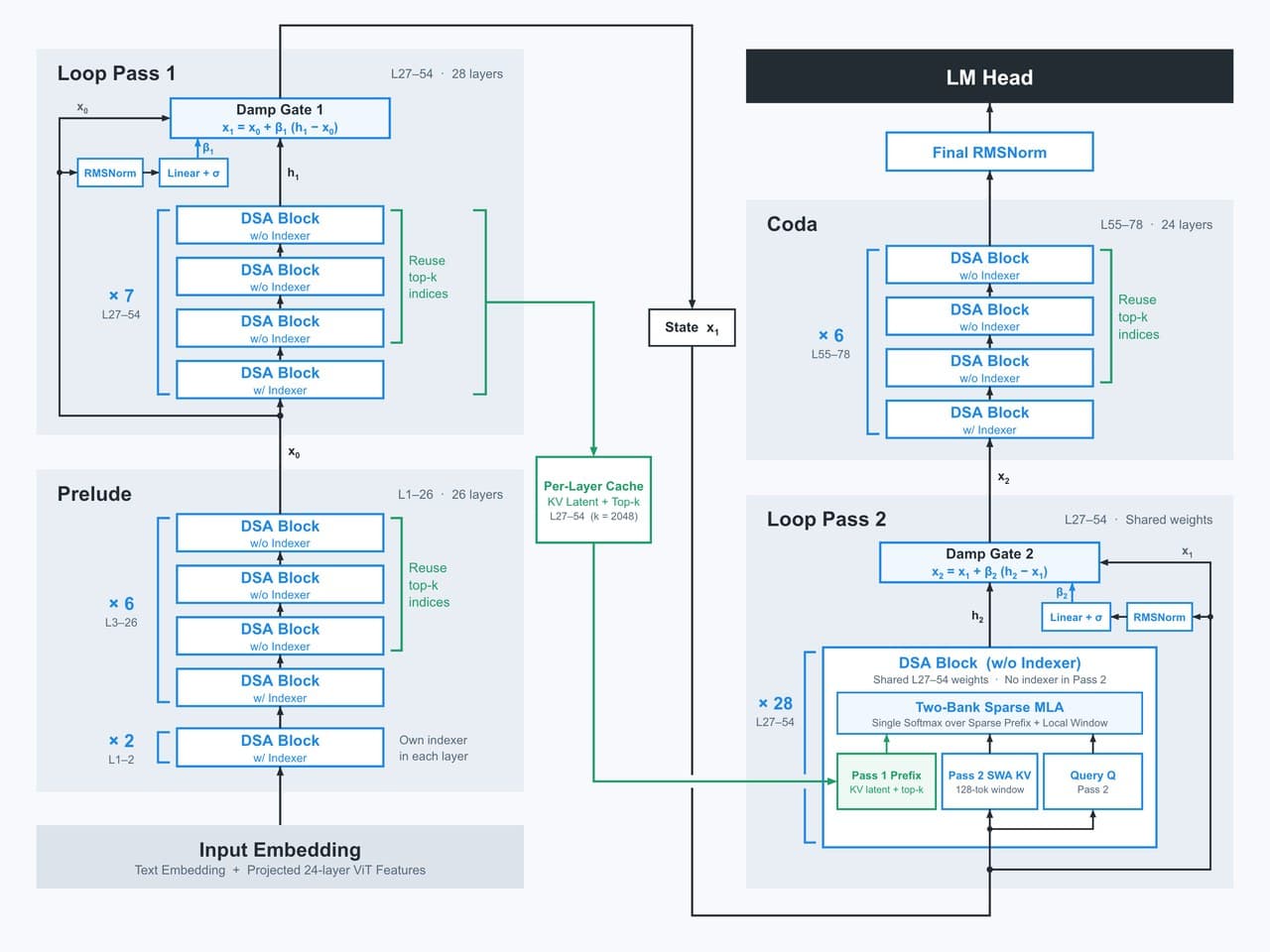
On November 23, 2026, Z.ai — the company behind Zhipu AI — released GLM-5.4. There was no parameter-count arms race, no "world's best" banner, just a technical blog post and a new phrase: the Loop Transformer. GLM-5.4 is Z.ai's first flagship built on a looped architecture: it takes 28 layers from the GLM-5 base model and runs them twice in every forward pass, using the same weights twice to buy a deeper network without adding parameters. The official claim is that a roughly 750B-parameter model reaches intelligence levels comparable to conventional models with 2T to 3T parameters. The same day, the ZCode editor shipped version 4.0.0 with GLM-5.4 preconfigured, and GLM Coding Plan subscribers could use it immediately. November has been a crowded month for model launches, but GLM-5.4 is the only one that took a knife to the architecture itself.
First, the idea of "looping" in plain language. In a standard Transformer, every layer runs once per forward pass: the input travels from layer 1 to layer 78, produces the next token, like reading an article once through and then answering. A Loop Transformer is different: it picks out a block of layers and sends the token through it one more time. The first pass builds a global understanding; the second pass refines it using what the first pass found — like re-reading a hard paragraph before answering. GLM-5.4 runs 28 layers of shared weights twice, so the total parameter count stays around 750B while the network's effective depth grows. The idea itself is not new: the 2018 Universal Transformer proposed weight-shared depth, and research on looped depth at small scales has continued ever since. Z.ai's real bet is that an idea that works on small models also works at 750B flagship scale.
Z.ai did not train a looped model from scratch. Instead it converted an already pre-trained GLM-5 base into a looped architecture through continued training, turning the middle 28 layers into a two-iteration loop. The official blog is candid about why: looped models trained from scratch still lag behind unshared models under the same pre-training compute budget. So they took a different road: start with a trained large model, convert it to a loop, and raise the intelligence ceiling for relatively little extra compute. To prove the change holds at scale, they did something unusually thorough for this industry: they validated the loop architecture progressively across 1B, 4B, 30B and 750B base models before committing the flagship to it. They call this "Scaling Correctness": any architectural change must still work at scale before it earns a place in the flagship.
Running 28 layers twice sounds simple, but there are three engineering pitfalls, and Z.ai has an answer for each. The first is exploding activations: directly overwriting hidden states and running them again makes activation norms blow up across iterations, so downstream layers receive representations outside their expected scale and distribution. The fix is Gated Progressive Updates: independent per-token gates for each iteration write candidate updates back into the residual stream proportionally. After training, the two passes develop a clear division of labour: the first pass writes conservatively with small gate values to keep scales stable and build global context; the second pass reuses that state to refine the output, opening the gates to write full updates. The gates also adjust step size dynamically based on token difficulty — harder tokens get more aggressive first-pass writes, so complex predictions benefit more from iterative refinement.
The second pitfall is memory. A naive implementation keeps a full KV cache for every loop iteration, multiplying memory usage with the loop count — unworkable at 1M context. The fix is a Hybrid KV Cache: the second pass reuses the sparse KV selected in the first pass, keeping only its own newly generated KV within a local sliding window. The two KV streams can overlap at the same positions, letting the model attend to both the first-pass context representations and the updated local representations from the second pass. The result: one extra loop costs one sliding window of KV cache rather than a full context cache. Z.ai says this keeps GLM-5.4's deployment cost increase over GLM-5.3 "well under control" at 1M context lengths.
The third pitfall is the cost of computing attention indices. GLM-5.4's base model uses sparse attention, which first computes an index of "where to look" on every forward pass. Recomputing that index on the second pass would eat back the savings from looping. The fix is Sparse Attention Index Reuse: the second loop directly reuses the indices generated by the first loop's indexer, adding zero indexing overhead, with experiments showing performance "nearly identical" to recomputing indices every pass. These three mechanisms together are GLM-5.4's real technical content: looping itself is an old idea; making looping run — and run stably — at 750B scale is the new part.

But an honest line has to be drawn here: the strongest evidence Z.ai has published is not a result from GLM-5.4 itself, but a controlled experiment on a separate 30B model. With identical parameter counts and only about 10% more total training compute, the looped version showed clear gains in mathematics, scientific reasoning and long-context tasks, and average output length dropped by 10–14% on benchmarks such as GPQA-Diamond and MMLU-Pro, mostly from shorter chains of thought. In the company's words, part of the reasoning shifts from explicit output tokens into the implicit depth of the loop. The experiment is clean — a controlled iso-parameter comparison — but it tested a 30B model, not the 750B flagship. What holds at 30B does not automatically hold at 750B, and the official blog only says the architecture was "validated" at 750B; it publishes no 750B benchmark table.
So the headline claim — "750B matches 2T to 3T models" — currently has no scorecard behind it. The official blog includes a win-rate chart for the flagship model without explaining how the comparison was run: who the baselines were, what evaluation set was used, how many runs — none of it is stated. As of November 24, Z.ai has published no official benchmark scores for GLM-5.4, no model card and no weights. Third-party testing got there first instead: in testing reported by VentureBeat, GLM-5.4 placed seventh on the KingBench 4 coding benchmark, and at maximum reasoning effort it took about four times as long as Gemini 4 Neon to finish the suite. DataCamp put it bluntly: as of November 23 there was no model card, no official benchmarks and no weights, "so treat every number here as provisional." A model can have both a genuinely interesting architecture and no evidence for its headline claim — GLM-5.4 is both at once.
The speed numbers deserve a two-sided reading too. Z.ai says GLM-5.4 reaches up to 200 tokens per second off-peak and holds 70–80 tokens per second at peak load. For a multi-pass looped model, that speed was achieved through close co-design between the model and the inference infrastructure, including the KV cache and index-reuse designs above, plus systems-level kernel fusion to cut the fragmented overhead that looping amplifies. The other side of speed is thinking time: Z.ai openly admits the model tends to get caught in overly long "marathon thinking" loops. Longer thinking does improve accuracy — the company says this prolonged reflection and self-correction "does consistently improve accuracy beyond its parameter count" — but it costs time and tokens. TechRepublic's advice is practical: run GLM-5.4 and your current coding model on the same routine bug fix and the same multi-file change, with the same starting code and time budget, and compare three things — time to a mergeable patch, review burden, and usage per completed task. There is no scoreboard; your own tasks are the benchmark.
GLM-5.4 is not just a coding model. Z.ai calls it the start of "Generalized Coding": using code as the foundation for work traditionally handled by specialised creative and engineering tools. The official blog shows four demos: producing a self-narrated music video called "Hello World"; engineering-grade CAD modelling of a six-axis robotic arm in FreeCAD; building a complete game from scratch, covering character movement, physics, maps, combat systems and art assets; and generating an interactive 3D bird-watching experience from pure mathematical geometry and custom GLSL shaders. The model adds vision capabilities, reading screenshots and images to help with visual coding, and has a one-million-token context window with up to 128,000 tokens of output. The demos can only be taken on the company's word for now: with no weights and no API, third parties cannot reproduce them. Demos are impressive, but a demo is not a benchmark — and that applies to GLM-5.4 more than most.
Then how to get it, and what it costs. Right now the only route is a subscription: the GLM Coding Plan, starting at $18 a month for Lite, $80 for Pro and $168 for Max; it is also available directly in the ZCode editor and Z.ai Chat, as glm-5.4 in most tools and glm-5.4[1m] in Claude Code. A pay-as-you-go API is listed as "Coming Soon" with no date; open weights are promised "after completing necessary safety hardening," also with no date. There is one concrete discount in the subscription pricing: GLM-5.4 burns about a third fewer credits per token than GLM-5.3 (its output multiplier is 16, down from 24), so subscribers get about 50% more tokens at the same plan quota. For existing GLM-5.3 subscribers, the upgrade is close to free: the same money, more tokens, a stronger model. For everyone else, the $18 Lite tier is the cheapest way to try it — but remember: with no API and no weights, your code can only run on Z.ai's service.
Why looping is reaching flagship scale only now is worth a few more words. The 2018 Universal Transformer proposed weight-shared depth — reusing the same layers so a model gets deeper without adding parameters — and the idea has been worked on in academia ever since, but it stayed on small models because looped models trained from scratch simply lose to conventional models on the same compute. The turning point is a change of approach: instead of training a looped model from scratch, convert a trained large model into a looped one. Continued training costs a fraction of pre-training from scratch, yet the model's reasoning changes: some of what used to be memorised in parameters is now derived by computing twice. That is what GLM-5.4's 30B ablation actually proves — not that "looped beats conventional," but that converting an existing model to a loop, for about 10% more training compute, buys clear gains on maths and long-context tasks.
One more sum has to be done honestly, or the "750B matches 2T" line will mislead. Looping saves memory, not compute. The parameter count is still 750B, so the weights you load at deployment are still 750B worth — roughly two-thirds less weight memory than a 2T to 3T model, which is real — but generating each token means computing those 28 layers twice. The compute is not saved; it just does not double the way parameters would. As TechTimes put it, rerunning the layers saves memory, not compute. The reported 200 tokens per second off-peak and 70–80 at peak were achieved on that basis. Judging GLM-5.4's value means keeping both books at once: weight memory is cheaper, per-token compute is more expensive. If your bottleneck is memory and deployment cost, it is a good deal; if your bottleneck is inference speed and latency, it may not be faster than a conventional model of the same size.
Where the data goes is something to settle before using it. GLM-5.4 currently has only one access route — hosted subscription. No API, no weights, so code and documents can only be sent to Z.ai's service. Z.ai is a Beijing company, and its hosted service is governed by Chinese law. For developers inside China, that is no different from using any other domestic model service; but for teams elsewhere, or anyone holding proprietary code or regulated data, it means sending sensitive material to a service they cannot audit. TechRepublic and TechTimes both raised this, from different angles, with the same conclusion: until official benchmarks, an API and weights arrive, GLM-5.4 fits public, non-sensitive work; anything involving trade secrets or regulated data should wait until the weights can be run on your own hardware. That is not a judgement on the model itself, but an honest note about a hosted-only product.
Z.ai's closing section — "Looking Ahead" — is worth reading too. Next they want to explore adaptive compute, so harder tokens dynamically get more iterations instead of every token running a fixed two; they also want to study how the returns from looping behave as both loop count and model size keep growing. The company says it is not choosing between scaling depth and scaling model size but pursuing both: GLM-5.4 validates computational depth, and the next, "significantly larger" model will carry forward everything learned here — and "will be ready soon." Translated: GLM-5.4 is a pathfinder, and the real flagship is still coming. If looping is validated at 750B, the looped version of the next larger model is what Z.ai actually wants to sell. In other words, subscribing to GLM-5.4 today partly pays for the next generation's experiment — except this time the experiment comes with a genuinely usable coding model attached.
Seeing GLM-5.4 next to the month's other "looped" model is instructive. On November 20, Thinking Machines released Inkling 2 Mini: a 26.4B-parameter looped MoE with 3.4B active parameters, Apache 2.0 open weights, built to fit on a laptop. We have already covered it here. Inkling 2 Mini and GLM-5.4 share the same big idea — loop the layers to buy depth — but took opposite roads: a 26B open small model you run yourself, versus a 750B closed flagship you can only subscribe to. Neither road is better; they are different bets. Inkling bets that looping makes a small model good enough; GLM-5.4 bets that looping makes a large model better value. Two looped models in one month suggests the architecture is moving from papers to products, and more than one lab is betting on it.
One more boundary, against our own earlier Zhipu coverage. In October 2026 we reported on GLM-5.3 arriving on AWS Bedrock — a 753B-parameter model sold on the same cloud as American models; earlier still we covered Prime Intellect's rewrite of itself in Rust, which used 200B GLM-5.3 tokens in training. GLM-5.4 is not a minor revision of GLM-5.3: 5.3 is a conventional Transformer, already open-sourced and on Bedrock; 5.4 is a looped architecture, not yet open-sourced, with no API and no benchmark scores. The names differ by 0.1, but the product form and the completeness of information are entirely different — do not carry 5.3's scores and reputation over to 5.4.
The conclusion differs by reader. If you already subscribe to the GLM Coding Plan, upgrading to GLM-5.4 is close to a no-brainer: more quota, decent speed, ZCode 4.0.0 preconfigured — try it on everyday coding and multi-file changes, and set the reasoning effort explicitly lower so it does not fall into marathon thinking on simple tasks. If you choose technology for a team, do not switch your main model yet: wait for official benchmarks, the API and the weights. Until those three arrive, the 2T to 3T claim is best heard as the vendor's vision; use it as a second opinion for review or security audit, not as your only source of code. If you study architectures, the blog itself is worth reading: gated updates, the hybrid KV cache and index reuse are genuine engineering answers for running a looped architecture at 750B scale, and those three will outlast whatever GLM-5.4's final scores turn out to be.
One line to sum up: GLM-5.4 is the most interesting model launch of November — not because it has proven itself, but because the direction it bets on may be right. Looping layers to buy depth instead of stacking parameters to buy capability, if it works, rewrites part of the industry's "bigger is better" scaling logic. But today's GLM-5.4 is still a model with an idea and no scorecard: the 750B parameters are real, the 28 layers run twice are real, the three engineering fixes are real; the 2T to 3T comparison is the vendor's claim, the win-rate chart has no methodology, and there is not a single flagship benchmark. What Z.ai has to do next is clear: publish the benchmarks, open the API, release the weights. If it does, GLM-5.4 becomes a milestone for looped architectures; if it does not, it becomes one more November name with a blog post and no evidence.
Comments (0)
Sources
Related articles

On November 24, 2026, Anthropic published full results for Siren, a honeypot test that puts Claude in deliberately weakened sandboxes with a credential or file sitting just outside. Recent models reach outside in 21–32% of scenarios but misuse what they find in only 0.6–1.6% — and a few lines of sandbox rules in the system prompt cut reaching to about 2% or less.
On November 24, 2026, OpenAI added nine manuscripts to its public math repository, one claiming the matrix multiplication exponent is exactly 9/4. The October upper bound is real; the new lower bound would close a 56-year gap — but the preprint is unreviewed, the Lean formalization covers only division-free circuits, and no faster program follows from it.

On November 16, 2026, Abu Dhabi's IFM released K2-Horizon: six open models from 0.9B to 375B, with weights, data, 380 intermediate checkpoints, training logs, and all code published at once. The headline is not the flagship but the 7B at 72.4 on SWE-bench Verified — a model you can run locally, coding like the big ones.