LogLineAlign
Merge scattered log files into one chronological timeline — offline, in your browser or CLI
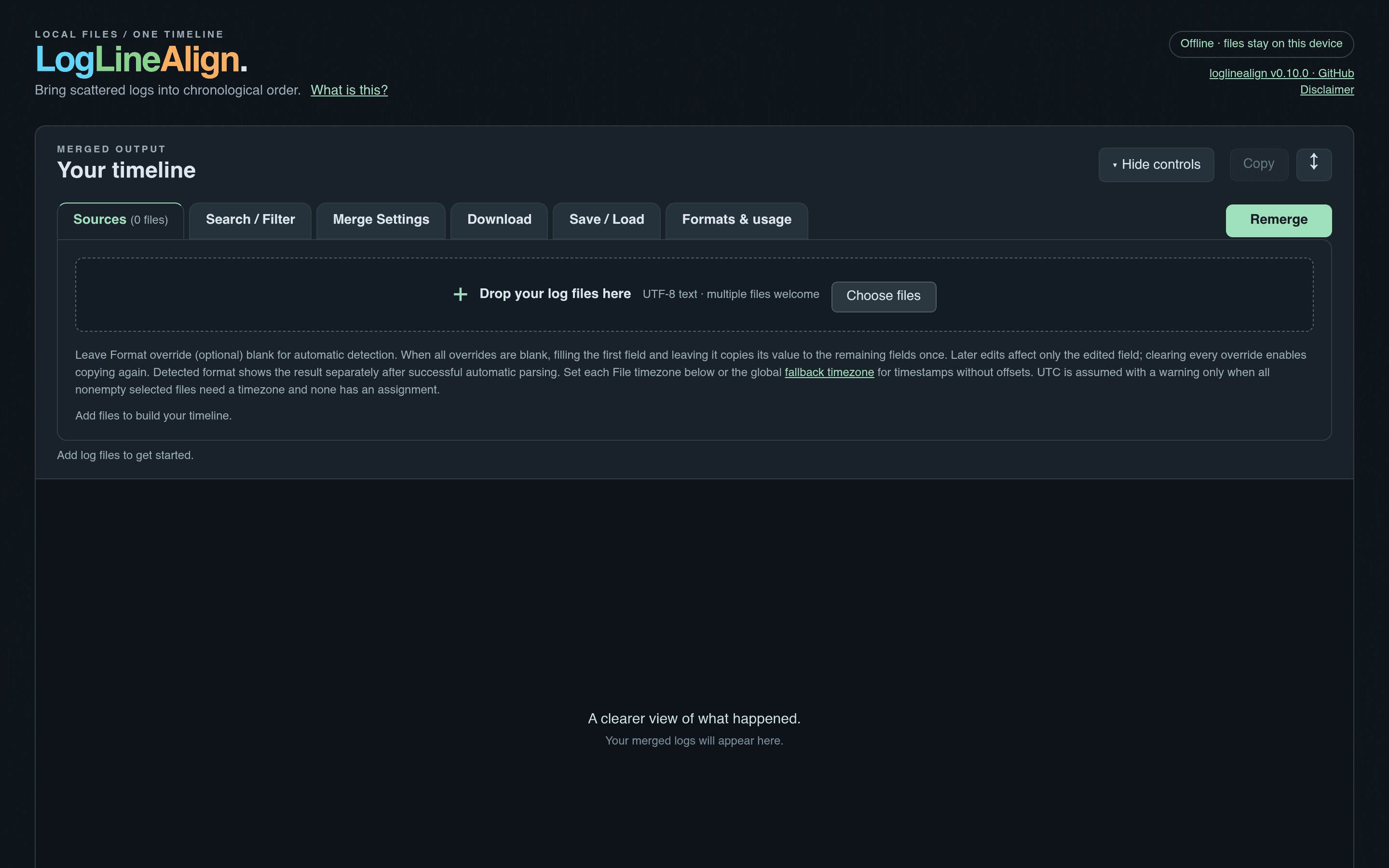
LogLineAlign does one thing and does it well: it takes multiple UTF-8 log files — unsorted, from different machines, in different timezones — and merges them into a single chronological timeline. Timestamps are auto-detected (with a manual format override when detection stumbles), per-file timezone offsets can be assigned, and multiline entries, duplicates, and nanosecond precision survive the merge intact. It ships as two interfaces on the same TypeScript engine: a standalone browser page that needs no server, and a Node.js CLI. The use case is incident response, and the author's own demo nails why it matters: a fibre-channel fault that three teams couldn't trace because their logs were written in two timezones without offsets — until everything was merged onto one clock. Timezone handling is the unglamorous part done properly here: set each file's source offset, or a global fallback, and the tool warns you when it has to assume UTC. There is also search/filter, remerge-on-settings-change, and copy/download of the full merged result, not just the visible preview. What makes this one worth noting is the README's unusual honesty. It states, verbatim: "This project was 100% vibe coded. All of its code and documentation were generated by Claude Opus 5.5 and GPT-6-Astra." But it doesn't use that as an excuse — the repo carries 60+ automated CLI tests, 12 releases in its first two weeks, and a narrated explainer video walking through a real debugging scenario. The disclaimer is equally blunt about limits: misdetected timestamps and wrong timezone assumptions are possible, so "check the entries that matter against the original log files" before acting on a timeline mid-incident. That is exactly the right posture for a tool people will reach for at 3 AM. Privacy is a genuine design choice, not a marketing line: everything runs on your device, files are never uploaded, and the browser page works with no network access at all. Fresh off its Show HN debut on October 12 and still at zero stars, LogLineAlign is an early look at a focused, genuinely useful utility for DevOps and SRE folks who have ever tried to reconstruct the order of events across app.log, database.log, and a firewall log by hand. MIT licensed.