项目大厅

探索全部独立开发者项目与共创求助

大赏
已上线
音乐音频

Folia

以全屏沉浸式歌词动画为核心的音乐播放器,支持网易云、Navidrome 与本地音乐库

Folia(辞曲新境)是一个把"看歌词"做成主角的音乐播放器。它的核心不是歌单管理,而是全屏沉浸式的歌词舞台——内置多种歌词动画主题(浮名、流光、心象、云阶、群唱、倾诉),每种主题有不同的排版氛围和可调参数,播歌时歌词像文字 PV 一样动起来,同时兼顾响应式布局,窗口大小随便拖都不乱。 音源方面覆盖得挺全:网易云、酷狗、Navidrome 私服,外加本地音乐库。本地歌曲会自动匹配在线歌词与封面,匹配不准可以在右侧面板手动修正;也支持同目录同名歌词文件(.lrc/.vtt/.ttml/.qrc/.yrc/.krc)和音频内嵌歌词。还有个有意思的功能是 AI 主题生成——根据歌曲情绪和歌词内容自动生成沉浸式背景和视觉参数,每首歌的"舞台"都不一样。另外支持通过系统 Now Playing 服务接入外部播放器的歌曲、时间轴和歌词信息,反过来驱动 Folia 的舞台视图。 多端都齐了:Electron 桌面端(Windows/macOS/Linux,开箱即用),Web 版可以一键部署到 Vercel。另有可选的官方同步服务端 sync-server,自托管后能在多设备间同步外观设置和 AI 主题库。 作者在 README 中明确写道"本项目在 AI 的广泛协助下开发",是一个 vibe-coded 项目。开源协议 AGPL-3.0,仓库地址 https://github.com/Jirankun/folia-major。

大赏
已上线
AI 应用

Sidelong

A sideways LLM chat interface — every Q&A is a page, topics get color codes, and chat runs on your own Claude Code subscription.

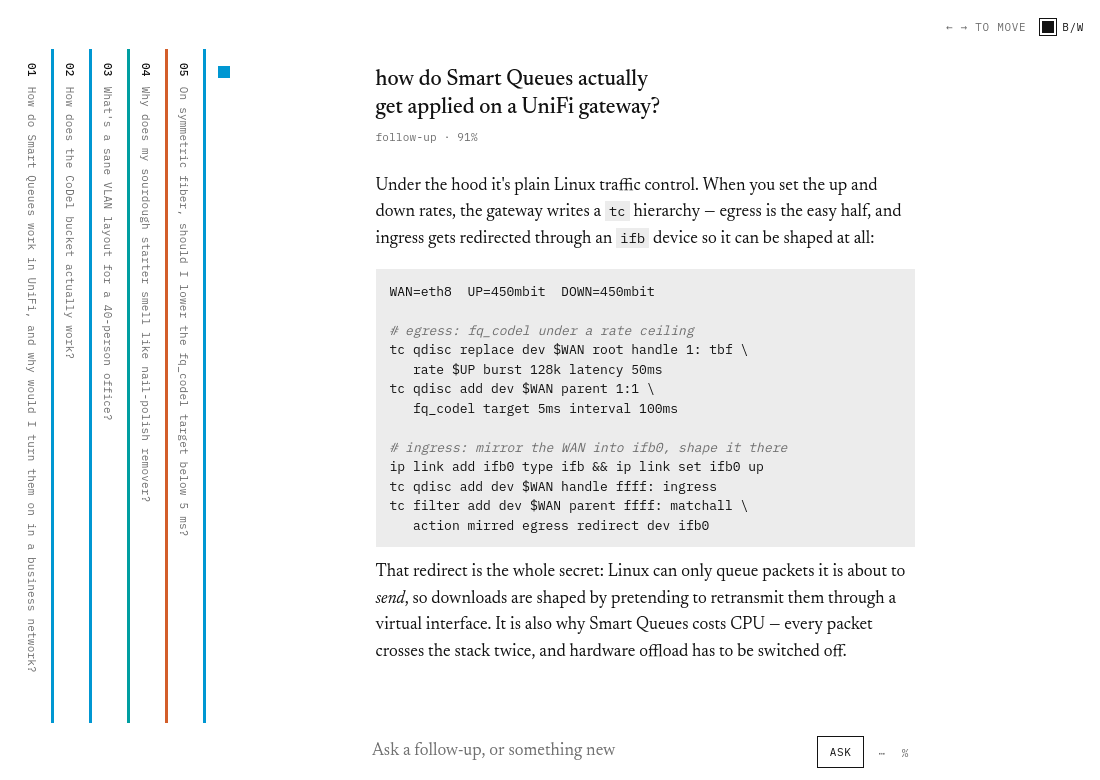
Sidelong is a chat interface laid out sideways — and it fixes a real annoyance with LLM conversations. Instead of one endless vertical scroll where topics blur together, every question-and-answer pair becomes a page: the open page sits in the middle of the screen while older pages collapse into thin vertical strips on the left, so a long session reads as a row of tabs. Each page gets a colored mark — hue encodes topic, saturation encodes classifier confidence — so follow-ups share their thread's color and you can spot a conversation in a stack of twenty pages without reading a word. There are no API keys to manage: chat runs through the Claude Code CLI you're already logged into, billed to your normal Claude subscription like any other claude session (one deck = one resumed Claude session, turn by turn). Topic embeddings come from a local Ollama model and never leave your machine — the whole thing is local-first by design. The author says it plainly in the Show HN thread: "It's vibe coded, but I think it's actually a better way to not get stuck in a loop of forgetting everything while you use them." Scouted the day after it was created, with two stars — a one-day-old experiment in rethinking how we talk to LLMs.

大赏
已上线
AI 应用claude-codecodex+1

ImageAI

Desktop + CLI client for multi-provider AI image and video generation — prompt tools, social-size presets, cost estimates, MIDI-synced video workflows.

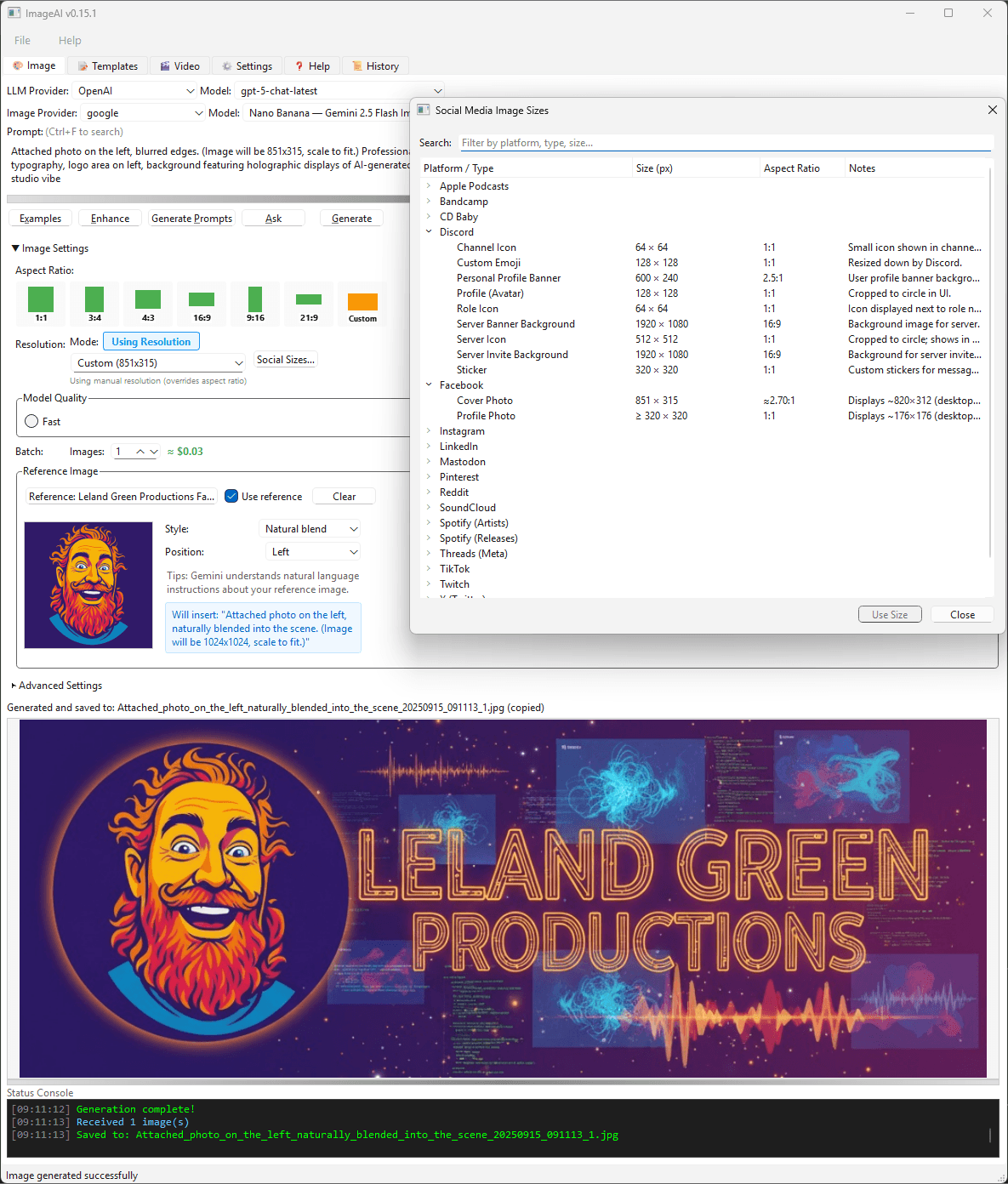
ImageAI is a desktop application and CLI for multi-provider AI image and video generation — the kind of power-user client the big labs never ship themselves. Pick an LLM provider and model (OpenAI, Google's Gemini 2.5 Flash Image, and more), tune aspect ratio, resolution, batch size and reference-image blending in natural language, and generate; a built-in social-media size table covers every platform from Discord emojis to Facebook cover photos, and there's even a MIDI-synced karaoke/video workflow for the adventurous. The app is enterprise-flavored in a way most vibe-coded toys aren't: multiple authentication methods, provider failover, prompt-enhancement tools, a status console with per-generation cost estimates ("≈ $0.03"), and a full history view. Version 0.49.1 was current at scouting time. The author is unusually transparent about the build: "Created primarily with Anthropic Claude Code, with PyCharm IDE and AI assistance from Junie (early-on), Codex." With 15 stars and commits three days before scouting, it's a living example of a complex, multi-provider AI desktop app assembled almost entirely by agents.

大赏
已上线
办公claude-code

Job Tracker

A spec-driven job application tracker — kanban board, table view and follow-up reminders for your entire job hunt.

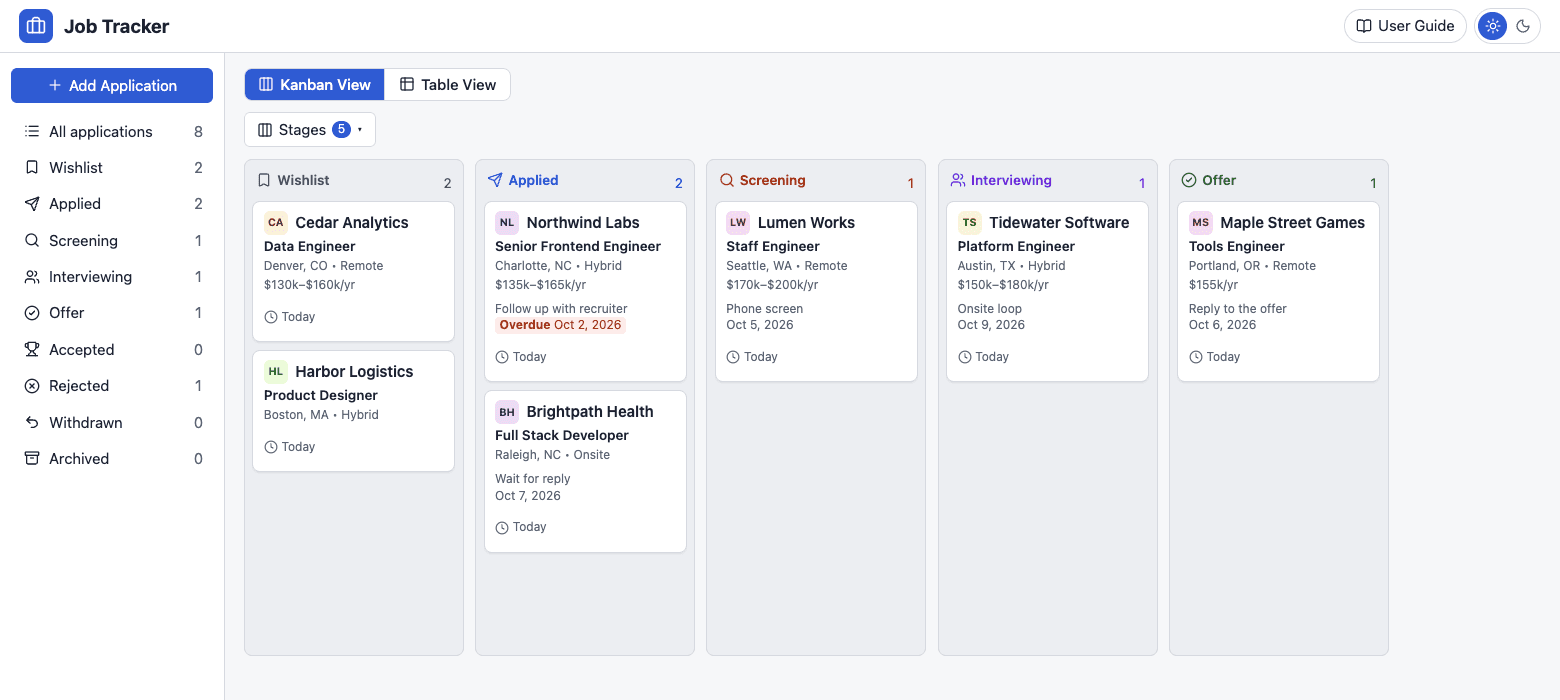
Job Tracker is a personal tracker for job applications, and a neat case study in spec-driven vibe coding. Every feature starts as a written spec in docs/specs/ before a line of code exists, with the planned build order tracked in a public roadmap. The app itself covers the full job-hunt loop: a kanban board (Wishlist → Applied → Screening → Interviewing → Offer → Accepted/Rejected), a table view, and per-application pages with requirements, timelines and contacts. Under the hood it's a TypeScript monorepo — Express backend, React frontend, SQLite storage, npm workspaces — with light and dark themes, drag-and-drop between stages, and follow-up reminders (the screenshots even show an "overdue" nudge on a stalled application). The author notes the screenshots use made-up sample data. The repo description says it directly: "built with Claude Code using Spec Driven Development." Zero stars and five days of commits at scouting time — a fresh, honest, small-scope office app that does one job well.

大赏
已上线
工具

X-Shot

Screenshot capture and editing from your system tray — global hotkey, automatic PII masking, OCR, and polished presentation exports.

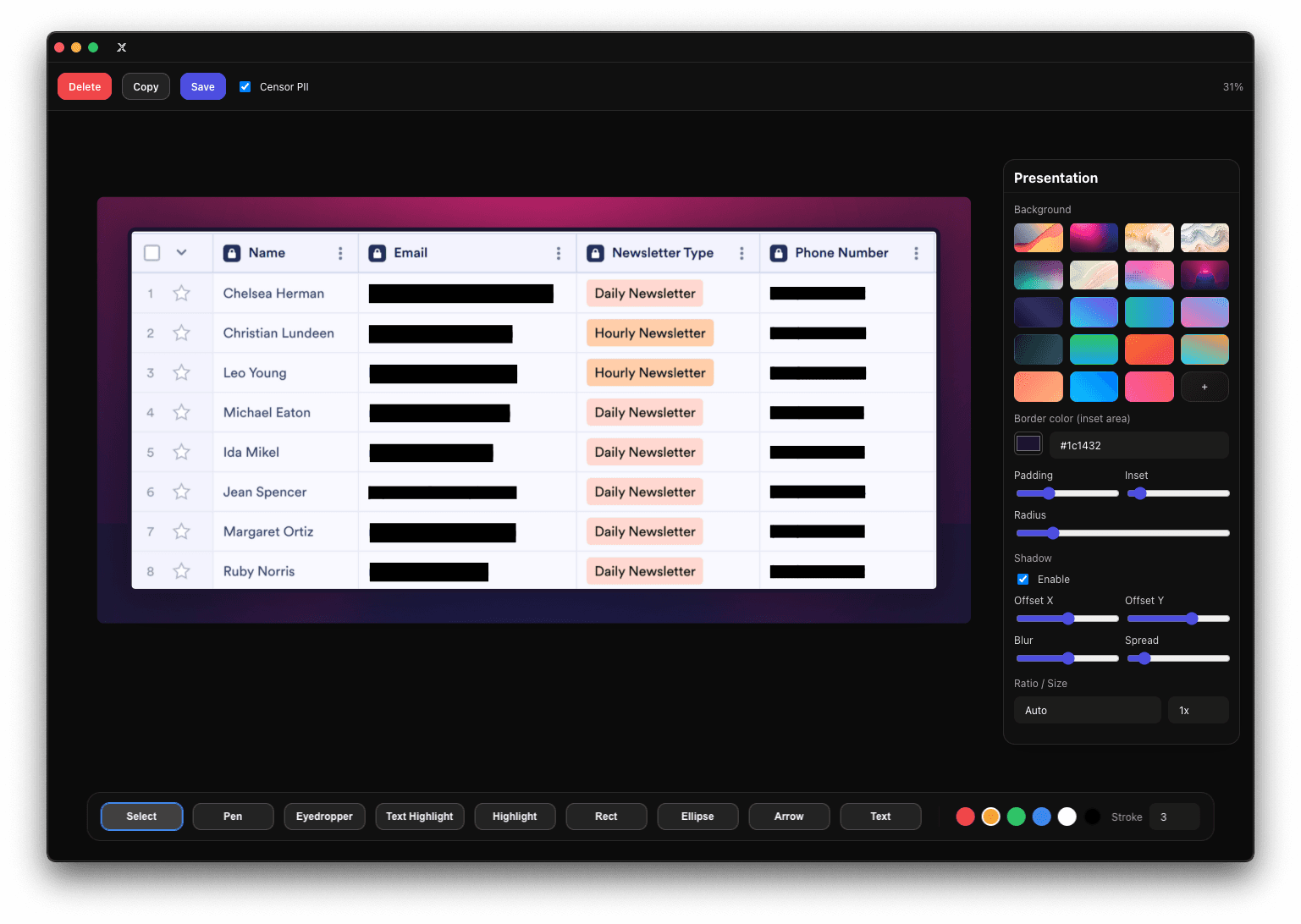
X-Shot is a screenshot capture and editing app that lives in your system tray: hit the global hotkey, grab any screen or window, and land in an editor with rectangle, ellipse, arrow, freehand pen and text tools. Its standout trick is PII masking — it automatically detects and blacks out sensitive data in your screenshots, plus OCR text extraction via Tesseract.js for pulling text out of any capture. The presentation mode is what sets it apart from bare-bones snipping tools: background gradients and images, padding, radius, shadows and aspect presets turn a raw screenshot into a polished share-ready graphic. Exports go to clipboard or file with configurable filename patterns, multi-display capture is supported, and it runs on macOS, Windows and Linux. The author's repo description says it straight: "Majority of this was Vibe coded." Built with Electron and React, tested with Jest and Playwright smoke tests, and maintained since 2025 — this is a vibe-coded utility with real staying power, not a weekend throwaway.

大赏
已上线
AI Agent

BlindPilot

A screen-reader-first desktop frontend for AI coding agents — run ten agents in real windows NVDA, JAWS and VoiceOver can actually read.

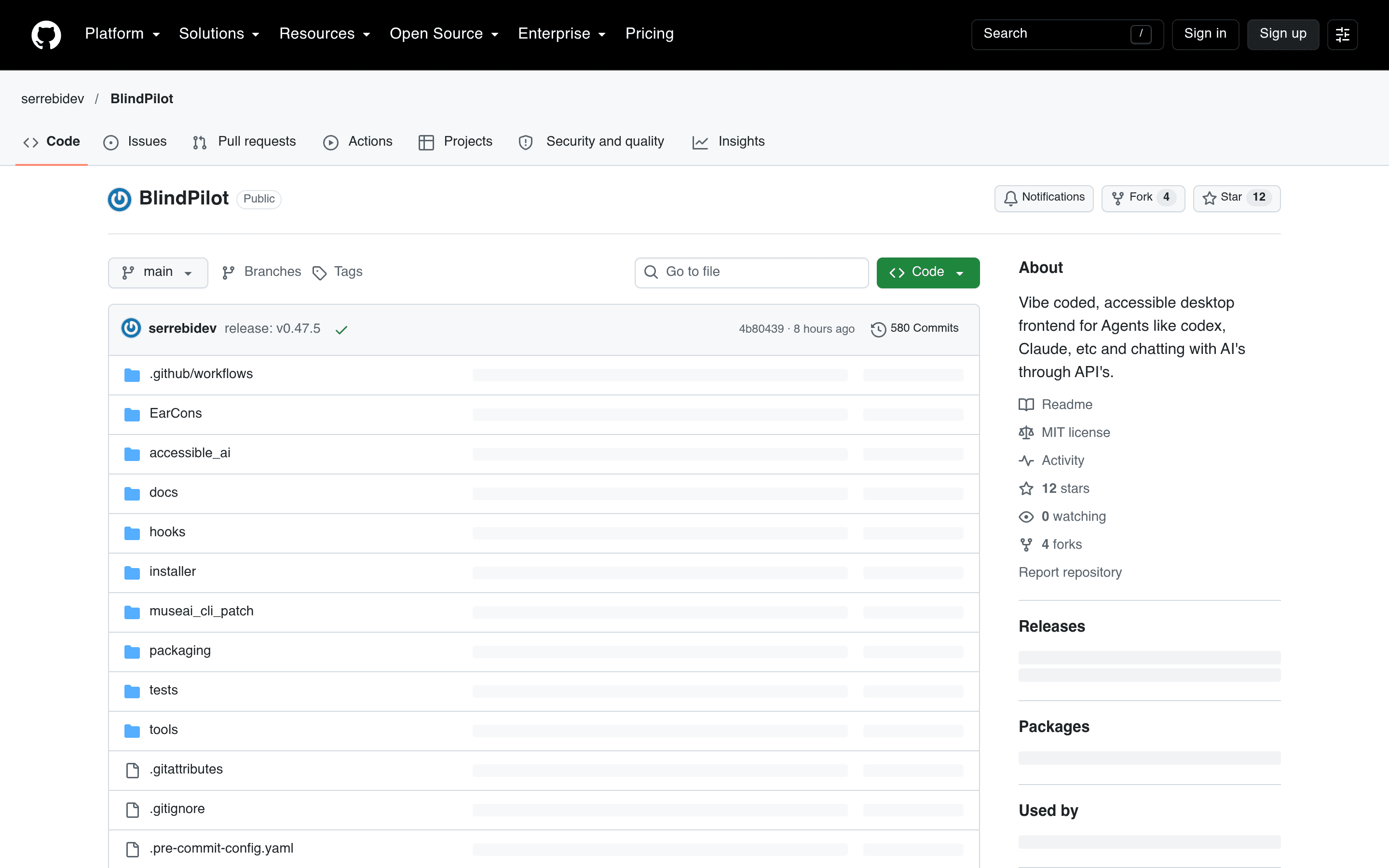
BlindPilot is a screen-reader-first desktop app for AI coding agents — and a genuinely different take on the agent UI problem. Coding agents live in terminals, and terminals are miserable with a screen reader: output scrolls past, the screen redraws under you, and you can't tell if the thing is working, stuck, or waiting on you. BlindPilot puts the agent in a real window your screen reader understands — every answer becomes a list you can arrow through, and it announces when something happens. It runs ten coding agents in tabs (Claude Code, Codex, FreeBuff, opencode, Hermes, Muse Code, muse.ai, Command Code, Gemini CLI, Antigravity CLI), splits every answer into navigable rows (one per heading, paragraph, code block, tool step), reads answers aloud as they arrive, and can even run agents in bypass-permissions mode for uninterrupted flows. It ships on Windows, macOS and Linux with installers on the releases page. The author states it verbatim in the README: "BlindPilot is vibe-coded. I use it every day." It started as a fork of Claude Code Reader, keeps that project's accessibility design, and is being shipped at a furious pace — v0.47.5 landed hours before it was scouted, with 580 commits behind it. Accessibility-first agent tooling is a rare corner of the vibe-coding wave, and this is one of its most serious entries.

大赏
已上线
工具

Evlat

A thin strip on your Mac's screen edge that shows which AI coding agent is waiting on you — one click jumps back in.

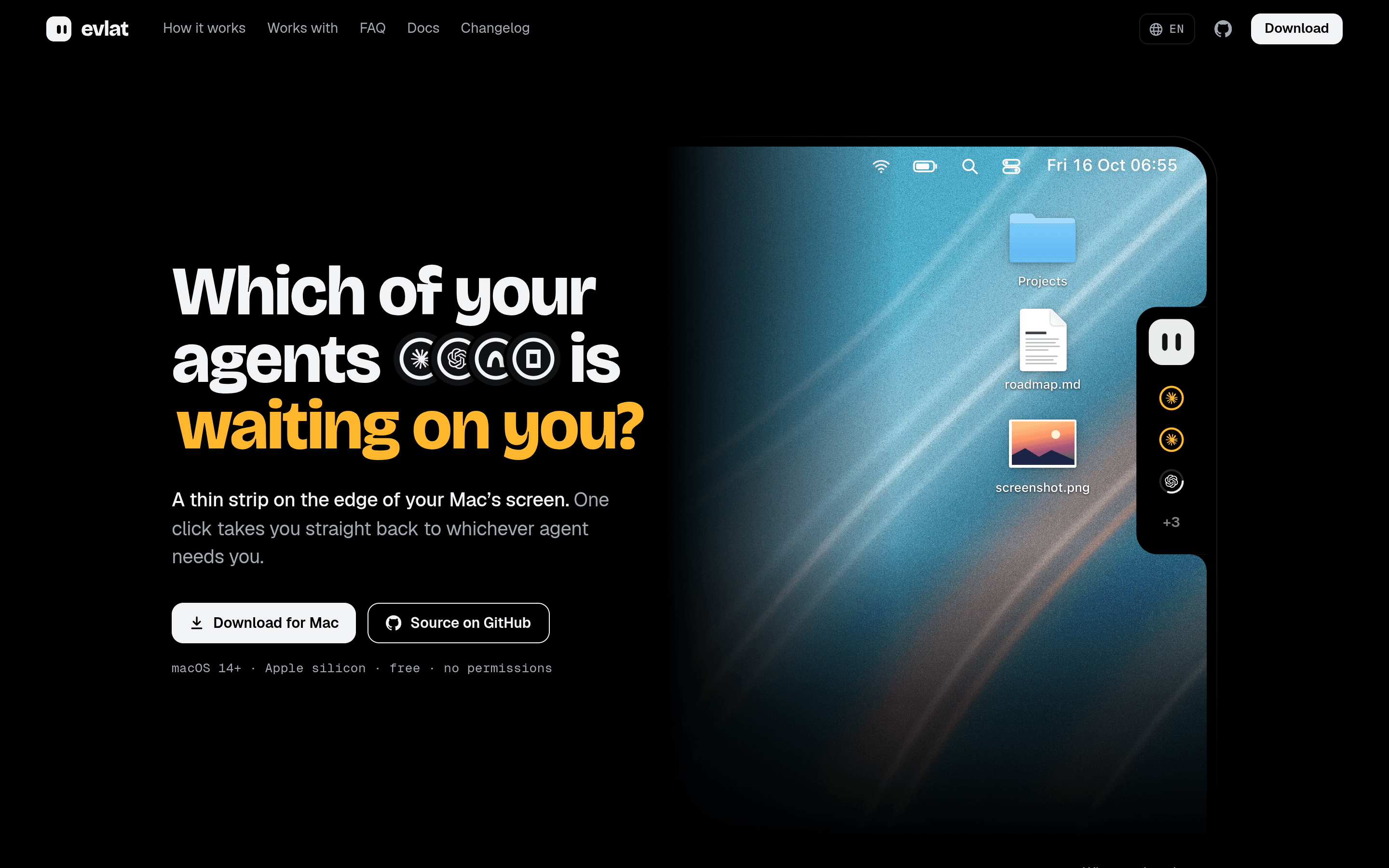
Evlat is a thin strip docked to the edge of your Mac's screen that answers one question at a glance: which of your AI coding agents is waiting on you? One ring per Claude Code, Codex, Antigravity or OpenCode session, one face for all of them — and an amber pulse the moment a session needs your input. One click takes you straight back to whichever agent needs you, no more alt-tabbing through a dozen terminal windows. It runs on macOS 14+ (Apple silicon), asks for zero macOS permissions, updates itself, and speaks twelve languages including Simplified and Traditional Chinese. Session state is read from each agent's local hooks and logs, and the built-in chat bubble can answer permission prompts or drop files onto a session without switching windows. A playful extra: the strip's mascot is fully customizable, and the site ships a guide for having your own coding agent design one. The author says it plainly in the Show HN thread: "I'm the vibe coder of Evlat app. I use it everyday for tracking my cc sessions." The repo (12 stars, pushed four days before scouting) is a native Swift app with signed and notarized releases, and the whole thing reads like a tool built by someone who lives inside parallel agent sessions — because it was.

大赏
已上线
音乐音频codex

XY Music Notation

Sheet music reimagined in base-12: full scores rendered with pitch-class note heads, built with Codex.

XY Music Notation is a working answer to a niche musician's itch: what if sheet music were written for a base-12 world? The site renders full scores — Satie's Gymnopedie No. 1, Clair de Lune, Fur Elise, the Moonlight Sonata, Chopin nocturnes — in a custom notation where every note in 12-tone equal temperament is a number, N in (0,1,2,3,4,5,6,7,8,9,X,Y), with the pitch class printed right on the note head. The idea is to make the notation isomorphic to a new kind of music keyboard the author has been tinkering with, so you can sight-read a part by interval shape without decoding every note the traditional way. The rendering engine is the clever bit: a music-score backend built on MuseScore with custom note heads that display each note's pitch class. The author built it with Codex — his own words on Hacker News: "I used codex to build a music score rendering backend based on MuseScore with custom note heads that display the pitch class of each note." He had been playing with the isomorphic keyboard himself and wanted real sheet music to practice on; the site is the tool he wished existed. It is genuinely usable, not just a demo. Each score gets a playback bar with measure scrubbing, speed and volume controls, optional external MIDI output, PDF download, and a link to the original score — sources are marked cc-zero. Press play and follow along as the custom notation plays; click any note to preview that moment, click a rest to seek. The Hacker News thread (83 points, 79 comments) turned into a lively debate about whether alternate notations help or hurt sight-reading, with guitarists and isomorphic-keyboard owners weighing in. Even the skeptics conceded the rendering itself is impressive. For musicians curious about notation beyond the staff, XY Music is a rare thing: a vibe-coded tool with real craft behind it.

大赏
已上线
音乐音频

Stemyla

Split any song into 6 instrument stems in your browser — Rust + WebGPU, vibe-coded, nothing leaves your computer.

Stemyla does one thing that used to require a studio: it splits a song into its individual instruments — bass, drums, other, vocals, guitar and piano — entirely in your browser, on your own GPU. Drop an MP3 or WAV onto the page, press "Separate 6 stems", and you get six lanes you can mute, solo, slow down without changing pitch, loop a section of, and save as WAV or MP3. Nothing ever leaves your computer: the page, the model and your songs all stay local. The engineering is the interesting part. The app is written in Rust and compiled to WebAssembly — including the GPU code. The separation model is BS-RoFormer SW, running on WebGPU through hand-written WGSL kernels, which is how it manages serious neural audio separation with no server involved. On a laptop GPU, separating a 3.5-minute song takes about seven minutes. The page needs a one-time 350 MB model download (kept in the browser's own storage), and it runs in Chrome or Edge on macOS, Windows and ChromeOS, Safari 26, or Firefox 141 and later on Windows. The backstory is pure vibe coding. The author's own repository description tags it "Vibe-coded!", and the README explains it plainly: "It started as a winter-holiday project for learning to build software with AI, and to hear the guitar part of a song on its own." The repo went up on October 13, 2026, and the published page is live with a demo song you can separate in one click. One honest caveat the author flags himself: the trained model weights come from an unknown trainer on Hugging Face with no stated license, so the repo ships the app without them and leaves it to you to judge whether you may use the weights. For learners, remixers and the merely curious, that transparency is part of the charm — an AI-built tool for pulling music apart, with its rough edges documented in the open.

大赏
已上线
效率

Wattle Notes

A gentle desktop Markdown notebook with encrypted Google Drive sync for macOS, Windows and Linux — mostly vibe coded with AI assistance.

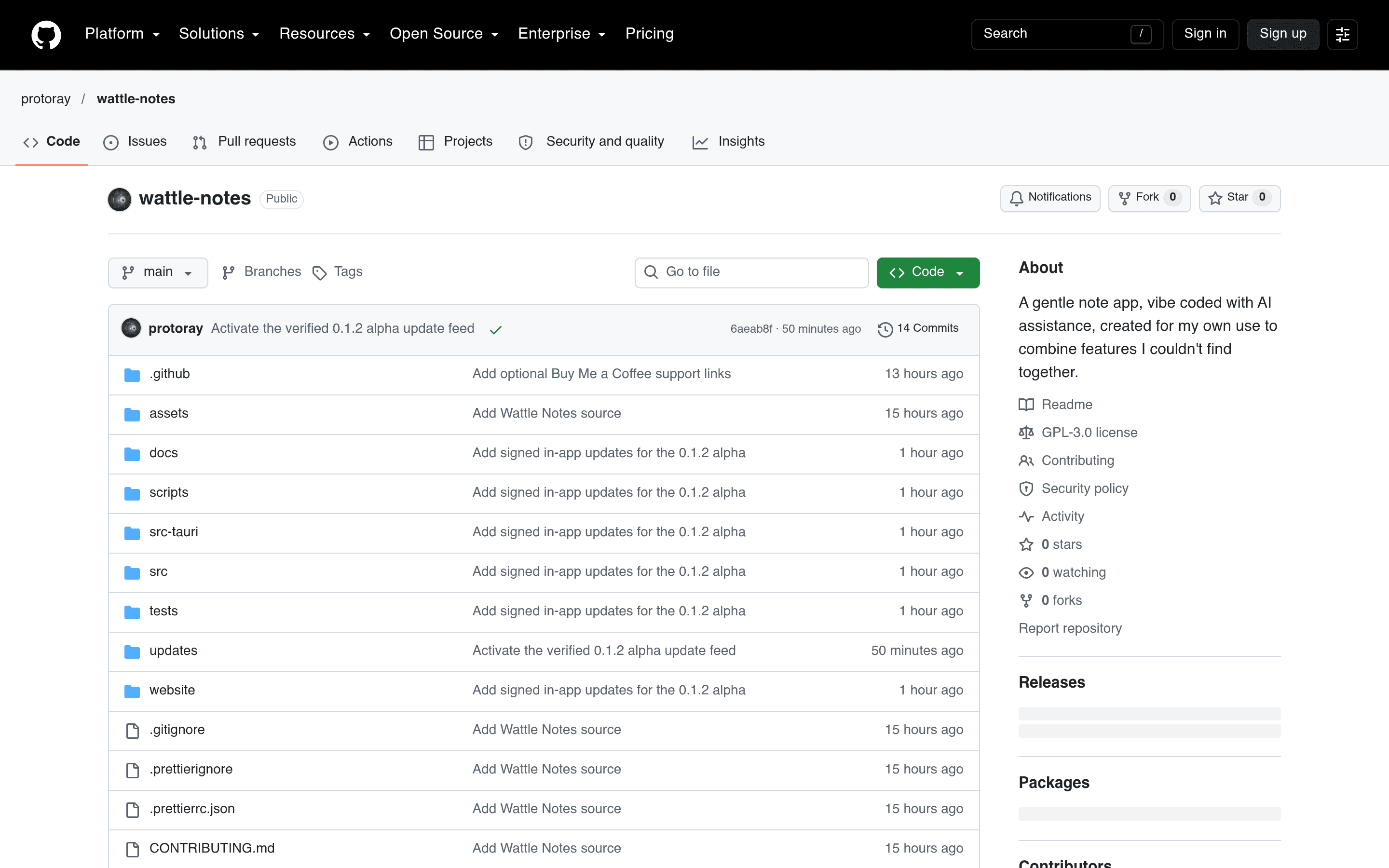
Wattle Notes is a desktop Markdown notebook that started as a very personal itch: its maintainer wanted a specific combination of note-taking features — ordinary Markdown folders, wiki links, backlinks, split preview, and encrypted cloud sync — that he couldn't find together in any existing app. The answer was to build it himself, with AI assistance doing most of the implementation while the design decisions stayed human. The app runs on macOS, Windows, and Linux as a native desktop build (Tauri 2, React, CodeMirror 6, Rust). Notes live as plain Markdown files in folders with YAML frontmatter tags, so nothing is locked into a proprietary format. Writing views include split preview, directly editable reading views, keyboard shortcuts, and five saved appearance themes; local full-text search, wiki links, and backlinks round out the note-taking core. Where it gets ambitious is sync and safety. Wattle Notes can mirror notes to Google Drive with passphrase-protected encryption — local copies and revision history are encrypted before upload, and no note content ever goes to an AI service or telemetry backend. Optional Nextcloud/WebDAV encrypted backups with verified restore, three-way merging of non-overlapping edits, and a conflict screen for overlapping ones handle the messy realities of editing on multiple machines, with signed in-app alpha update checks arriving in the 0.1.2 builds. It is public alpha software (v0.1.2-alpha.1 was cut the same day it was written about here), open source under GPL-3.0, and it carries its origin proudly: the README and release notes both describe it as mostly vibe coded with AI assistance — Joplin, Obsidian, and Zettlr informed the feature goals without contributing a line of code. The honest framing matches the product: a real tool for real note-taking, built the way its author wanted to build it.

大赏
已上线
安全隐私

atpass

A password manager that keeps your vault as end-to-end encrypted records in your own atproto (Bluesky) PDS repo — no proprietary server.

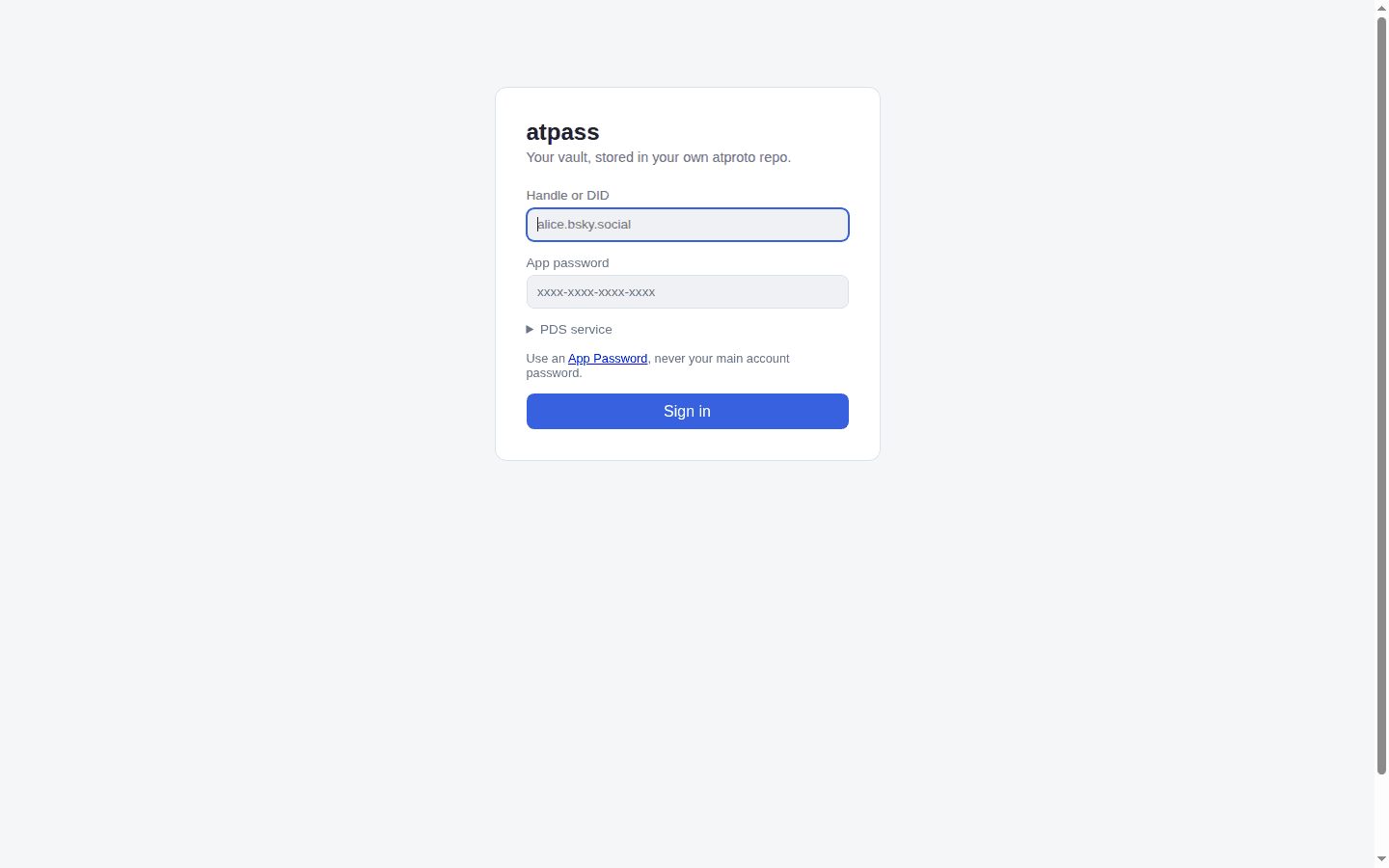
atpass is a password manager with an unusual home for your vault: instead of a proprietary server, it stores every vault item as an end-to-end encrypted record in your own atproto (Bluesky) PDS repo. Your PDS operator — and anyone who can read your public repo — sees only ciphertext: how many items you have and roughly when they changed, never titles, usernames, passwords, URLs, or notes. The master password never leaves your machine; it is run through Argon2id to derive a 256-bit key that encrypts each item with AES-256-GCM, with the record key bound in as additional authenticated data so records can't be swapped between items. It ships as three clients sharing one crypto core: a commander-based CLI, a client-only static web app (Vite + React) that talks directly to your PDS from the browser with the vault key living only in that tab's memory, and a Firefox Manifest V3 extension that autofills vault items into login forms — the derived key stays in the background script's memory and never passes through the popup. The Node and browser crypto adapters (node:crypto with @node-rs/argon2 versus Web Crypto with hash-wasm) are verified byte-for-byte interoperable, so a vault item added from the CLI decrypts correctly in the web app and vice versa. Formal record schemas live in lexicons/ as xyz.atpass.vault.meta and xyz.atpass.vault.item. The author's own framing is the whole pitch and the whole warning, verbatim: "Vibe-coded AF" — and "This is a testbed for vibe-coding and atproto. This is not something you should trust real passwords with." The README's security-model section is admirably blunt about the threat model: a malicious PDS operator learns nothing about contents, but a weak master password or a compromised local machine is not covered, the handle-plus-App-Password login means the PDS momentarily sees your App Password at sign-in (full OAuth is not implemented yet), and the project has not been independently audited. Recent commits show the author hardening it anyway — randomized 128-bit record keys so item titles can't be fingerprinted, and CLI session tokens encrypted at rest. It is early — 27 commits, one v0.1.0 release, pushed two days ago — and reads as a working proof-of-concept rather than a Bitwarden replacement. As an experiment in what password management looks like when the "server" is infrastructure you already own, it is one of the more interesting uses of atproto to show up this month.

大赏
已上线
社交社区claude-code

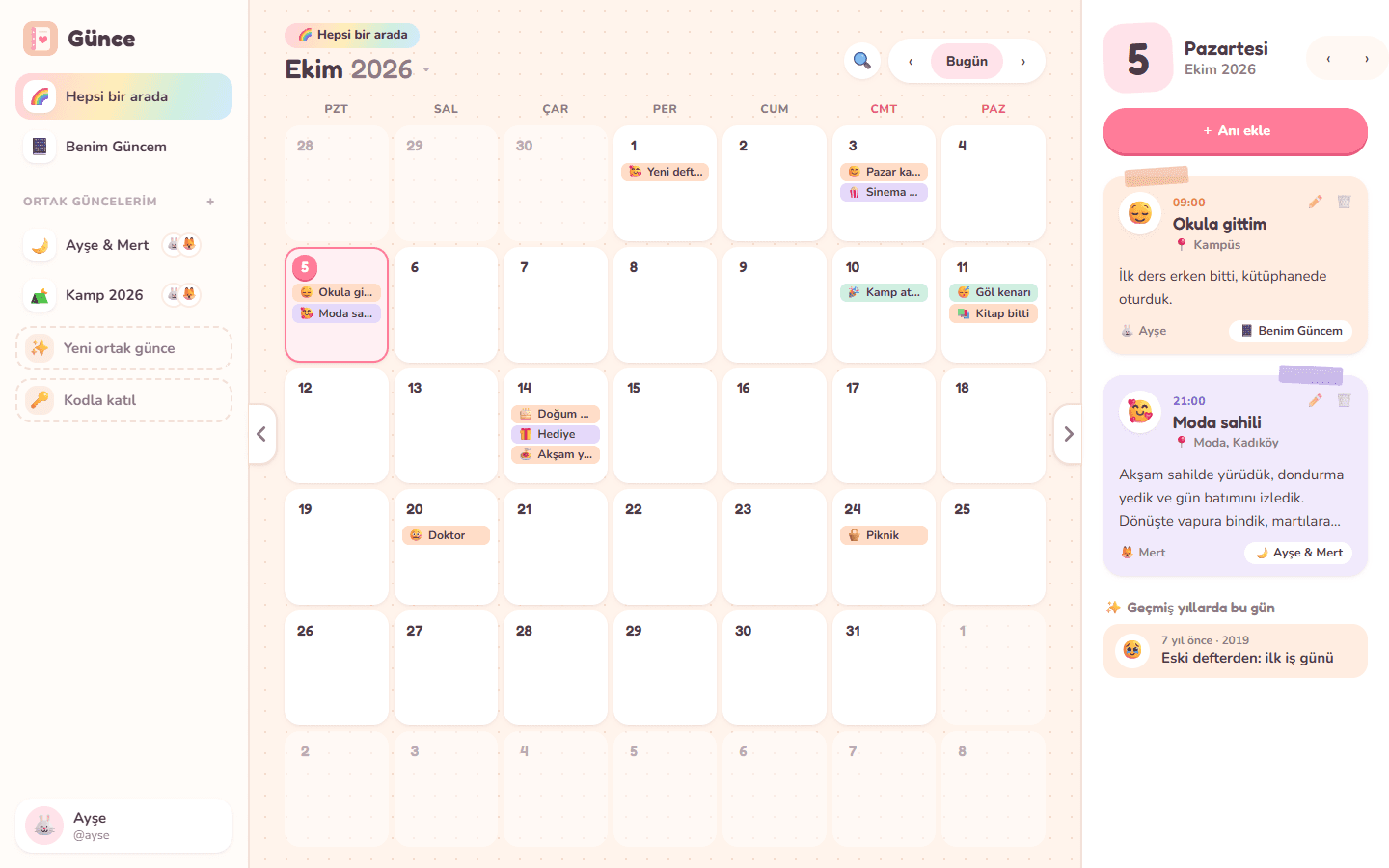
Günce

A cozy journal you keep alone or together — unlimited shared journals with friends and family on a calendar with no year limit.

Günce — an old Turkish word for "diary" — is a cozy journaling app built around a simple idea: some memories are yours alone, and some belong to the people you made them with. Everyone gets one personal journal, and you can start as many shared journals as you like with friends, partners, or family. Write about your morning in your own journal, then write about tonight's dinner in the journal you share with the people you went with. Shared journals are joined with an 8-character code or a /join/CODE link, and every member can add, edit, and delete memories. Everything sits on a monthly calendar with deliberately no year limit — any year from 1 to 9999, dates handled as plain strings so 1987 behaves exactly like 2026. A memory holds an optional time, a mood emoji, a short title, a place, and free text. The "everything together" view merges all your journals onto one calendar, colored by journal; the day panel shows "on this day" entries from other years; search spans titles, text, and places; and any journal exports to JSON. Auth is username plus scrypt-hashed passwords with sessions in HttpOnly SameSite cookies, and the privacy notes are refreshingly plain: only members of a journal can read it, and when you delete your account your personal journal is deleted while shared ones pass to the longest-standing member. The build story is stated verbatim in the README: "This project was vibe coded. It was built by describing the idea in plain language to an AI coding assistant (Claude Code) and iterating on the result together. A person tested it and steered the design, but no one wrote it line by line." The stack is kept small on purpose — Node.js 20 with Express, SQLite through better-sqlite3 stored in a single file, and a frontend of plain HTML, CSS, and ES modules with no framework and no build step, plus API tests via node:test. Deployment is a one-click Railway deploy or a Docker run; SQLite lives on one disk, "plenty for friends and family." It is young — created October 5, 2026, 14 commits, 2 stars, pushed within the last week — and honest about what's missing: no photos on entries yet, no reactions or comments, no real-time updates (open tabs refresh every 45 seconds), and the UI speaks Turkish and English. For a shared family or friends journal that you host yourself, that is a fair trade.

大赏
已上线
内容媒体ox-alpha-glm-53-flash

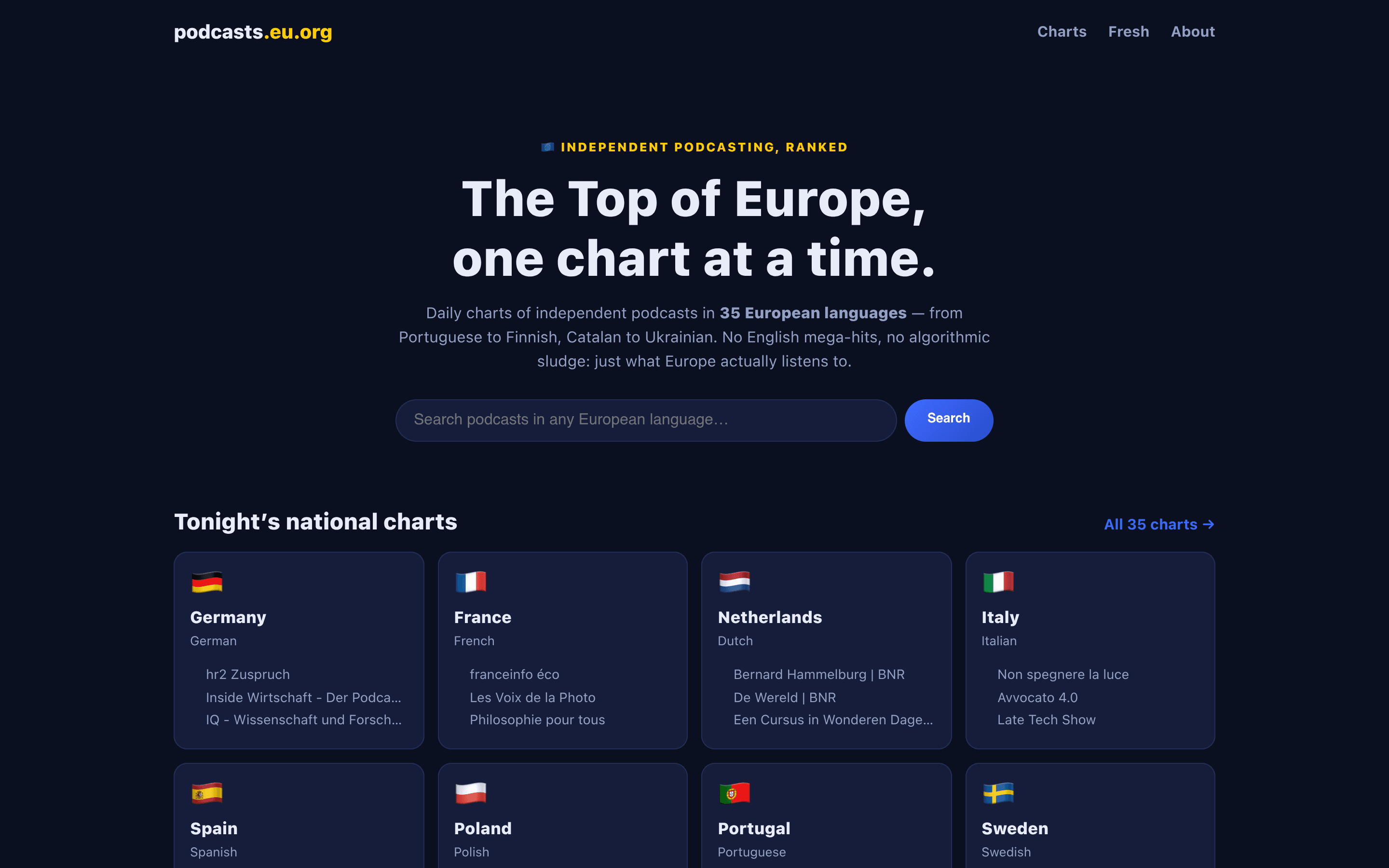
Euro Podcast Charts

Daily independent-podcast charts in 35 European languages — from Portuguese to Finnish, Catalan to Ukrainian.

Euro Podcast Charts is a daily chart site with a simple, stubborn editorial idea: every European language gets its own podcast ranking, computed on equal terms. Thirty-five language codes are covered — Portuguese to Finnish, Catalan to Ukrainian, plus stateless languages like Welsh, Basque, Galician, and Breton. English-language mega-hits are deliberately out of scope ("there are already ten directories for those"), so what you see is what Europe actually listens to, not an algorithmic sludge of US networks. The pipeline is refreshingly legible. Once a day the site pulls trending feeds from the open Podcast Index, filtered to its 35 supported language codes (regional variants included, e.g. de-AT and pt-PT — Portugal's chart filters out Brazilian variants so Lisbon isn't drowned out). The Top 50 per language is snapshotted into a local SQLite database, which the site reads directly, and chart-movement arrows compare against the previous day's snapshot. An hourly "Fresh from Europe" radar records newly discovered feeds in European languages, so the index keeps growing on its own. The author built it with Ox-alpha — Z.ai's GLM-5.3-Flash coding model — during its free unlimited preview week, saying on Hacker News it was "yet another project I did with Ox-alpha (glm-5.3-flash) when it was unlimited." The backend is PHP running on an Oracle free-tier VPS with 1 GB of RAM, which makes the whole thing a small monument to how far a focused side project can go on almost no infrastructure. Whether you want to discover what's charting in Slovenia or just enjoy watching Catalan rank next to German, it's live and updating daily.

大赏
已上线
图片视频claude-code

AfterFrame

Local-first photo library for Mac & Windows — browse, cull, edit and AI-annotate thousands of photos without leaving one app.

AfterFrame is a local-first photo workspace for photographers drowning in exported images: point it at folders scattered across drives and it unifies everything into one catalog you can browse, filter, rate, tag, and collect — while the originals stay exactly where they are. The demo library on its site shows 872 assets in one catalog; the app's own documentation screenshots show real working libraries of 5,562 assets with folder trees, EXIF panels, and AI annotation sidebars. Under the hood it's an Electron + React (Vite, Tailwind) desktop app with a Python sidecar process and a SQLite database living inside each .afcatalog bundle. Beyond browsing, it covers the full culling-to-delivery loop: crop with a proper aspect-ratio and transform panel, text overlays with depth effects, collage batches, camera-style frames (Canon, Hasselblad), people search, and video chapters. The AI features — style-transfer repaint and auto-annotation that generates captions, tags, and location guesses — run in bring-your-own-key mode, and a bundled MCP server lets Claude Code or any MCP client drive your library in natural language. The origin story is the point: the author states verbatim in the README that "this project was vibe-coded with Claude Code," and the commit history reads like an agentic-coding logbook — look-alike photo detection via perceptual hashing, an Electron Playwright e2e suite, and platform-specific builds (signed macOS .dmg, Windows installer) landing within days of each other. With 243 stars and commits shipping the same week it was scouted, it's one of the more serious open-source Lightroom alternatives to come out of the vibe-coding wave: downloads for macOS 12+ and Windows 10/11 are on the releases page, and there's a try-in-browser option on the site.

大赏
已上线
旅行本地claude-code

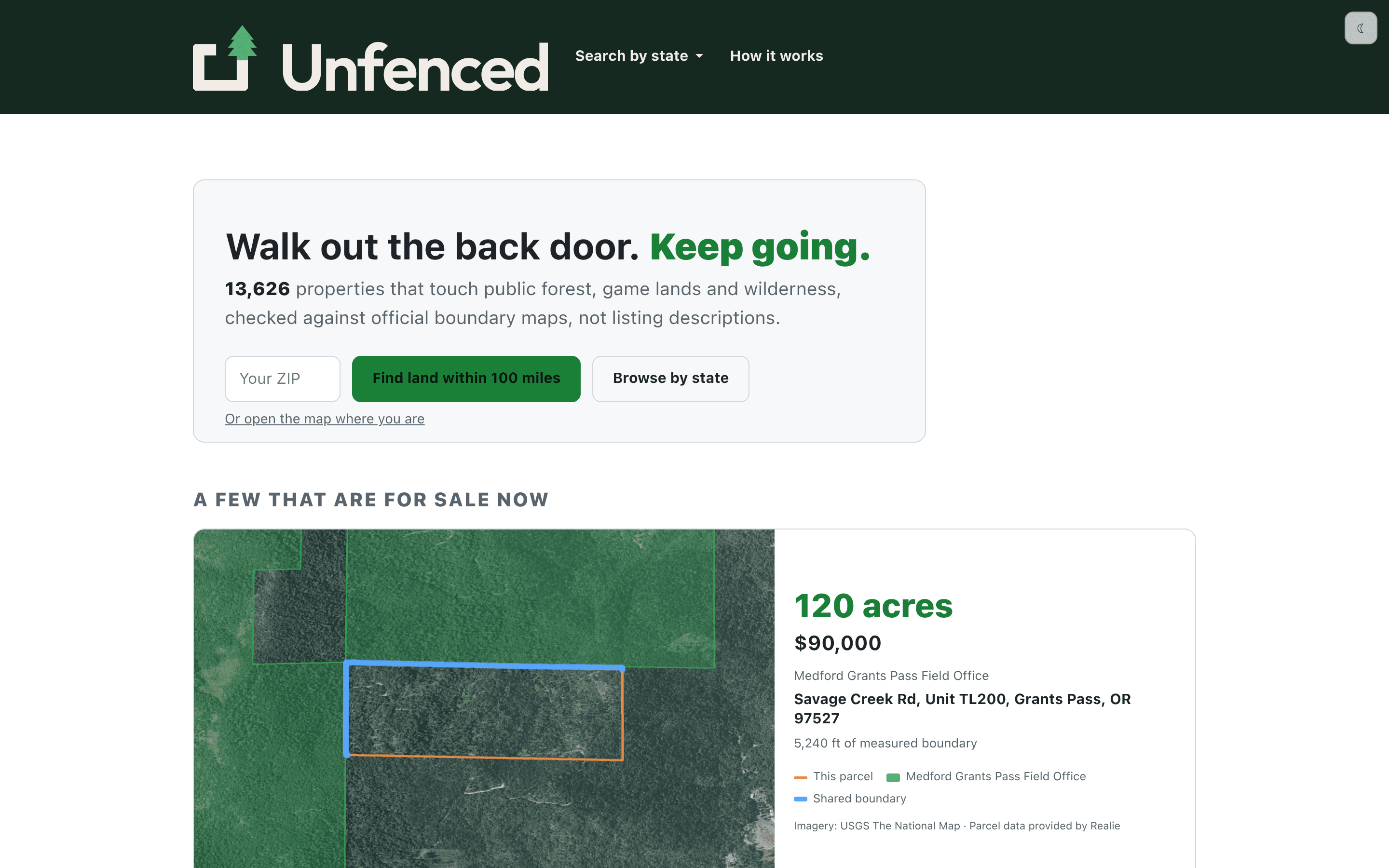
Unfenced

Land for sale that borders public land — 13,626 parcels verified against official boundary maps, not listing descriptions.

Unfenced answers a question that no real-estate search engine bothers to ask: which parcels for sale actually touch public land? The site tracks 13,626 properties bordering national forests, game lands, and wilderness areas across all 50 US states plus DC — and crucially, it verifies adjacency against official boundary maps and parcel GIS data rather than trusting whatever the listing description claims. The hard part, as the author readily admits, is lining up maps from different sources: listings come via the RentCast API, parcel boundaries from state and county GIS services plus Realie. The author — who comes from 3D design and geospatial mapping — made the judgment calls about what counts as "bordering," then let Claude Code do most of the building. His own words on Hacker News: "Mostly Claude Code." It is a textbook case of agentic coding amplifying domain expertise rather than replacing it: the taste and the data decisions were human, the implementation largely AI. The result is a genuinely useful niche tool. Search by state or ZIP, open the full map with satellite and terrain layers, and filter by relation, confidence, public-land type, access, designation, price, and acreage. Each listing shows the measured shared boundary in feet — for example a 120-acre, $90,000 parcel in Grants Pass, Oregon with 5,240 ft of measured boundary against neighboring public lands. That level of specificity is what separates it from a generic land search. Caveats are worth knowing, many of them raised in the lively Hacker News discussion: owning land next to public forest means fence-line headaches, wandering hikers, and seasonal hunters — the romance has practical costs. But as a discovery tool for a very specific dream — walking out your back door and keeping going — Unfenced is the rare vibe-coded launch that is both technically interesting and immediately usable.

大赏
已上线
自动化claude

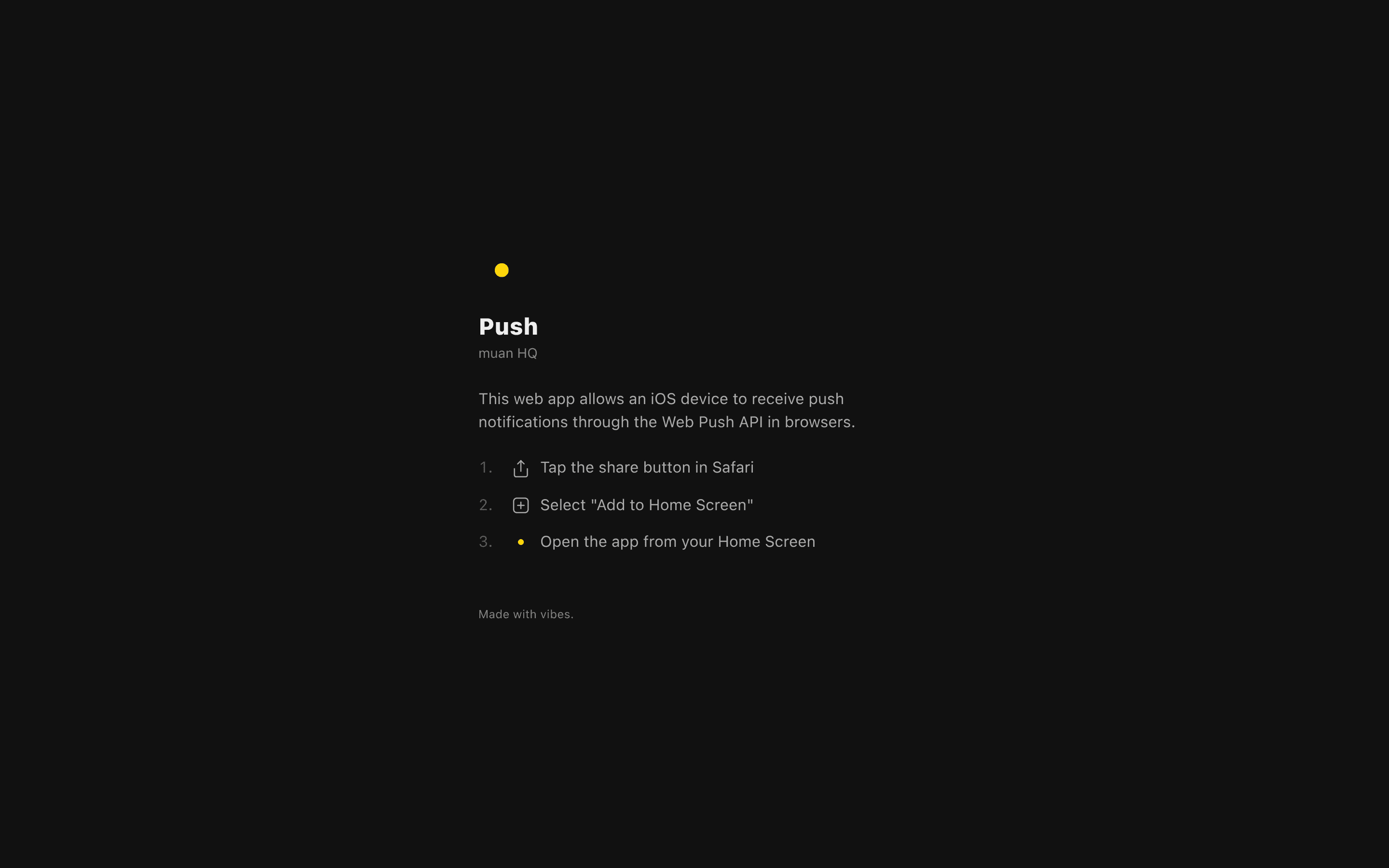
Push: Serverless Web Push for iPhone, Vibe-Coded with Claude

Send push notifications to your iPhone from a web page — no app, no server. Safari Web Push plus GitHub Actions and an Apple Shortcut do the work.

Push solves a small, real problem with an almost absurdly lean stack. The author, Mu-An Chiou (muan), wanted a notification every time the neighbor's cat Chi-chi wandered onto the balcony — the neighbor's camera already had animal detection, but there was no good way to turn that event into an iPhone notification without building an app and a server. Push closes the gap: a web page you add to your iOS home screen subscribes through Safari's Declarative Web Push, an Apple Shortcut fires a dispatch call when the camera automation triggers, and a GitHub Action signs and delivers the notification. No app, no server, no running costs. The README states the provenance plainly: "This is almost entirely vibe-coded with Claude (except this README) and reviewed humanly by me. Reading through the code should take less than 5 minutes." That last line is the whole pitch — the entire kit is index.html, one GitHub Actions workflow, and send.js. Fork it, deploy the page to any static host, add three secrets (a VAPID key pair and subject), and you own a push notification service that runs on GitHub's free tier. The demo page even signs off with "Made with vibes." Honest caveats, straight from the docs: this is Apple-only (Safari's Declarative Web Push, no service workers), the live demo can only send notifications using the author's own keys, and tapping a notification opens com.apple.home:// by default. None of that diminishes the idea — it's a clean demonstration that a personal notification pipeline no longer needs infrastructure, just a shortcut and a workflow file. The repo (muan/push) sits at 6 stars and was pushed days ago; small, maintained, and genuinely useful for anyone wiring home automations to their phone.

大赏
已上线
自动化claude-codecodex-cli

Worth the Walk?: AI Agents Turn Junk Mail Into a Walking Route

Photograph your junk mail — two AI agents sort every flyer, plan a walking route to the deals worth visiting, and stamp each stop like a train ticket.

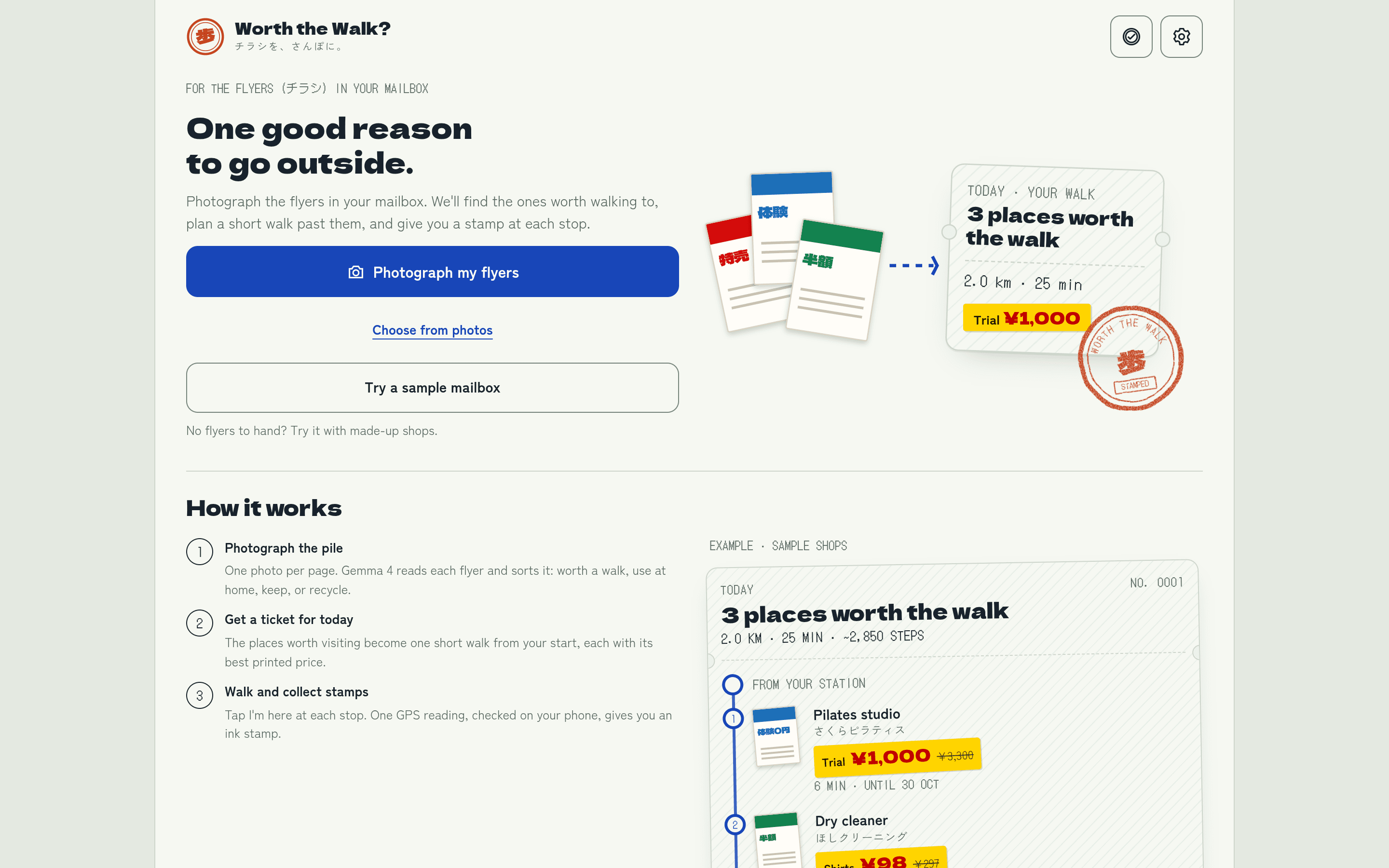
Worth the Walk? starts from a very specific frustration: a mailbox full of Japanese flyers the author can't read well enough to triage. Instead of learning Japanese, they built an app that does the reading — photograph each flyer, and Gemma 4 sorts it into one of four piles: worth a walk, use at home, keep (bills and notices), or recycle. The walkable ones become stops on a route rendered like a Japanese train ticket, each deal printed as a yellow sticker in the flyer's own visual language. At each stop you tap "I'm here," one GPS reading mints an ink stamp, and the day's savings add up — but only from prices actually printed on the flyer. What makes this one worth paying attention to is how it was built. The author's dev.to build log is unusually honest about the process: "Claude Code was the architect. It wrote the specs and the contracts between modules, reviewed every diff, ran the tests and checked the screenshots. Codex CLI wrote most of the modules from those specs." On the final night the two agents ran in a loop for five hours — Claude writing a spec per round, Codex building it, Claude testing against screenshots and sending back what was wrong. The post also documents what broke along the way: a brush-style logo read as two different restaurants, a prompt example leaking its own phone number onto a gold buyer's flyer, a model inventing prices for a yoga studio. This is the rare AI-built project that shows its scars. The engineering choices are pragmatic rather than flashy. Reading is adaptive — whole pages first, then a second pass over a 2x3 grid of overlapping tiles only for dense price lists, which cut a five-flyer pile from four and a half minutes to 38 seconds. Flyers you dismiss and stamps you collect train a TabPFN model through Prior Labs' MCP so the ranking learns your taste; addresses resolve through Japan's free GSI geocoder with SerpApi and OpenStreetMap as fallbacks. The whole mailbox costs about five cents to read, which is why there's no sign-up and no account — photos are read and thrown away, everything else stays on your phone. It's brand new — submitted to DEV's Hacktoberfest Open-Source AI Challenge on October 12, 2026, and the GitHub repo adkbbx/worth-the-walk is sitting at a single star. The demo runs on Render with a "Try a sample mailbox" mode so you can see the ticket, walk mode and stamp flow in under a minute without any Japanese mail. Small, opinionated, and built in the open — exactly the kind of project that makes you want to check what it does with your own junk mail.

大赏
已上线
分析claude-opus-55gpt-6-astra

LogLineAlign

Merge scattered log files into one chronological timeline — offline, in your browser or CLI

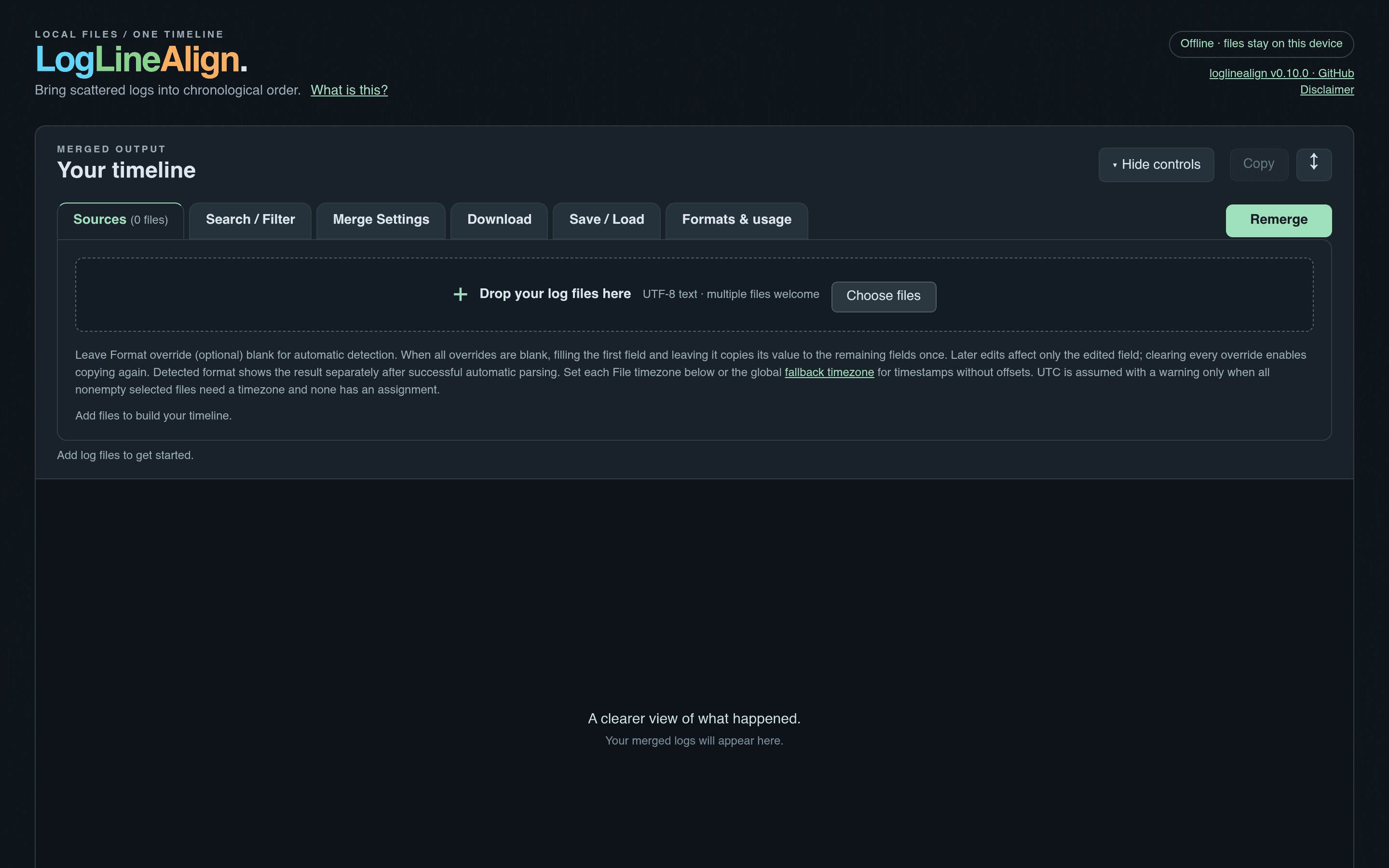
LogLineAlign does one thing and does it well: it takes multiple UTF-8 log files — unsorted, from different machines, in different timezones — and merges them into a single chronological timeline. Timestamps are auto-detected (with a manual format override when detection stumbles), per-file timezone offsets can be assigned, and multiline entries, duplicates, and nanosecond precision survive the merge intact. It ships as two interfaces on the same TypeScript engine: a standalone browser page that needs no server, and a Node.js CLI. The use case is incident response, and the author's own demo nails why it matters: a fibre-channel fault that three teams couldn't trace because their logs were written in two timezones without offsets — until everything was merged onto one clock. Timezone handling is the unglamorous part done properly here: set each file's source offset, or a global fallback, and the tool warns you when it has to assume UTC. There is also search/filter, remerge-on-settings-change, and copy/download of the full merged result, not just the visible preview. What makes this one worth noting is the README's unusual honesty. It states, verbatim: "This project was 100% vibe coded. All of its code and documentation were generated by Claude Opus 5.5 and GPT-6-Astra." But it doesn't use that as an excuse — the repo carries 60+ automated CLI tests, 12 releases in its first two weeks, and a narrated explainer video walking through a real debugging scenario. The disclaimer is equally blunt about limits: misdetected timestamps and wrong timezone assumptions are possible, so "check the entries that matter against the original log files" before acting on a timeline mid-incident. That is exactly the right posture for a tool people will reach for at 3 AM. Privacy is a genuine design choice, not a marketing line: everything runs on your device, files are never uploaded, and the browser page works with no network access at all. Fresh off its Show HN debut on October 12 and still at zero stars, LogLineAlign is an early look at a focused, genuinely useful utility for DevOps and SRE folks who have ever tried to reconstruct the order of events across app.log, database.log, and a firewall log by hand. MIT licensed.

大赏
已上线
金融财务

BudgetTrack

A fully local personal budgeting app: accounts, subscriptions, debts and charts with no server, no account, and data that never leaves your device.

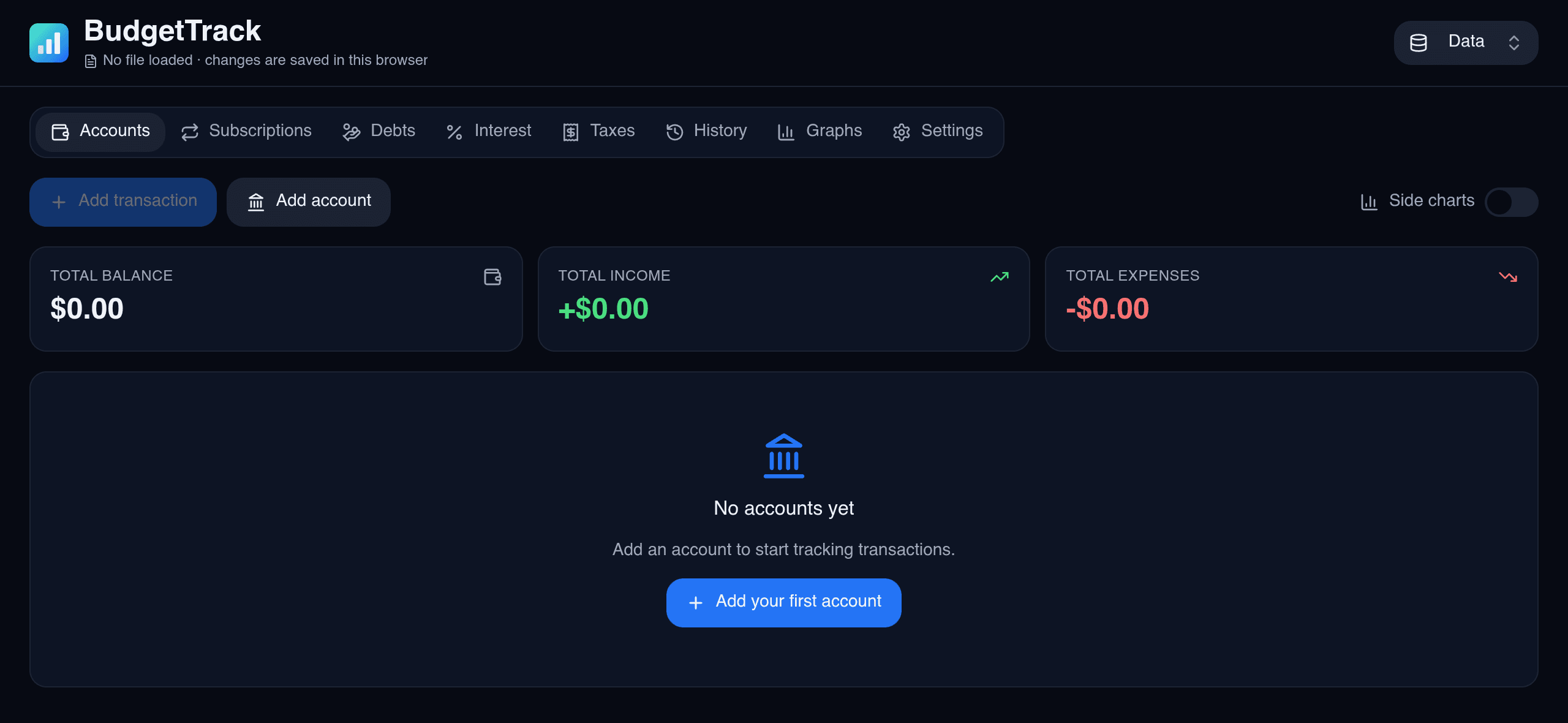
BudgetTrack is a personal finance app that runs entirely in your browser: there is no server, no account, and no analytics. Accounts with full transaction editing (income, deposits, spends, transfers between accounts), recurring subscriptions down to per-item rounding, debts both owed and owing, interest rules with a resident-withholding-tax calculator, tax settings, a history timeline that overlays payments, interest and deductions on a running balance, and more than a dozen charts — category breakdowns, income vs spending, net saved per month, weekday spending, balance projection, debt payoff — all work offline, on your own machine. Nothing you enter ever leaves the device: it lives in localStorage, with .db files (JSON) you export yourself as backup. What makes it worth a look for vibe-coding watchers is how openly it wears its origin. The author's repository description reads, verbatim: "Vibe coded, user friendly, local finance database manager." The commit history backs that up: two of the five commits carry Co-Authored-By: Claude Sonnet 5.5 trailers with Claude Code session links, and the repo root ships AI_RULES.md and CLAUDE.md — running instruction files that keep an AI coding agent aligned with the project as it evolves. For all that, this is not a skeleton. The app ships an NZ student loan preset (12% on income above $24,128 a year), a "stale debt" flag that keeps dead debts on record while dropping them from totals and graphs, and a theming engine that pulls 33 UI styles by 67 colour palettes from a separate package in the background, applying new palettes without an app update. Settings cover exchange rates, interest basis (monthly or yearly), wallpapers and appearance. The tech stack is the author's own declaration: React, TypeScript, Vite, Tailwind CSS, shadcn/ui and Recharts. The live demo is a Cloudflare Pages build; it opens on a fresh, empty dashboard because there is deliberately no server and no sample data — every account on screen is one you add yourself.

大赏
已上线
电商购物google-ai-studiogemini

AutoVista Motors: Vibe-Coded Car Dealership Concept Site

Fictional car-dealership concept site vibe coded in Google AI Studio with Gemini: 24 real car models, side-by-side comparison, and a financing calculator.

AutoVista Motors is not a real car dealership. Saying that up front matters, because everything about this site is designed to convince you it is one: a fictional brand, a fabricated founding story and leadership team, invented testimonials, a made-up 2.18% p.a. financing rate, and a test-drive booking form that sends data nowhere. The author's README says it plainly: "AutoVista Motors is a fictional company. This is a student portfolio and learning project, not a real dealership, and no real sales, bookings, or inquiries happen here." This is a frontend design portfolio piece, and it deserves to be judged as one. Judged as one, it is genuinely impressive. The concept site presents 24 real, correctly named car models across six categories (Sedans, SUVs, MPVs, Electric, Hatchbacks, Coupes, four each), and the Vehicles page is anything but a static grid. It ships real search, sort, and budget filtering, a side-by-side vehicle comparison tool, and detail popups that open without navigation: image galleries with thumbnails, full spec sheets (engine, transmission, seating, fuel/range, dimensions, power, drive type), trim levels with individual pricing, and key features. A "Book a Test Drive" button even passes the chosen vehicle into the booking form. The Offers page goes further with a working financing calculator: pick a vehicle, drag the down-payment slider (20%–50%), choose a 12–60 month tenure, and watch the down payment, financed amount, and estimated monthly installment update live — clearly labeled as an illustrative estimate, consistent with the site's fictional framing. What makes it a vibe-coding story is how it was made. The project was "vibe coded in Google AI Studio using Gemini," starting from a written Product Requirements Document that defined the page structure, a fixed color palette, the exact vehicle list, and one unusual rule: vehicle photography had to be found through search, not generated. Six vehicles use Creative Commons photos from Wikimedia Commons (source and license documented in the code), the rest and the portraits come from Unsplash. It is part of a personal portfolio series by the author — whose primary focus is Data Science, NLP, and GenAI/LLM agent engineering — demonstrating applied vibe coding outside their technical home turf. The presentation details sell the craft: a layered-motion parallax hero, decorative emblems, a founding-narrative watermark, a four-milestone company timeline, and a full About Us page with a fictional four-person executive team. The stated stack is React 19, TypeScript, Vite, Tailwind CSS v4, lucide-react, and Google Fonts (Outfit and Plus Jakarta Sans), all built in Google AI Studio's Build mode. The repo is small (1 star, created 2026-09-30, last pushed 2026-10-01), but the live demo at autovista-car-dealership.vercel.app is worth opening: it is a study in how to build a fully convincing fictional-brand site — honest fictional framing included.