项目大厅

探索全部独立开发者项目与共创求助

当前筛选:AI Agent
大赏
已上线
AI Agent

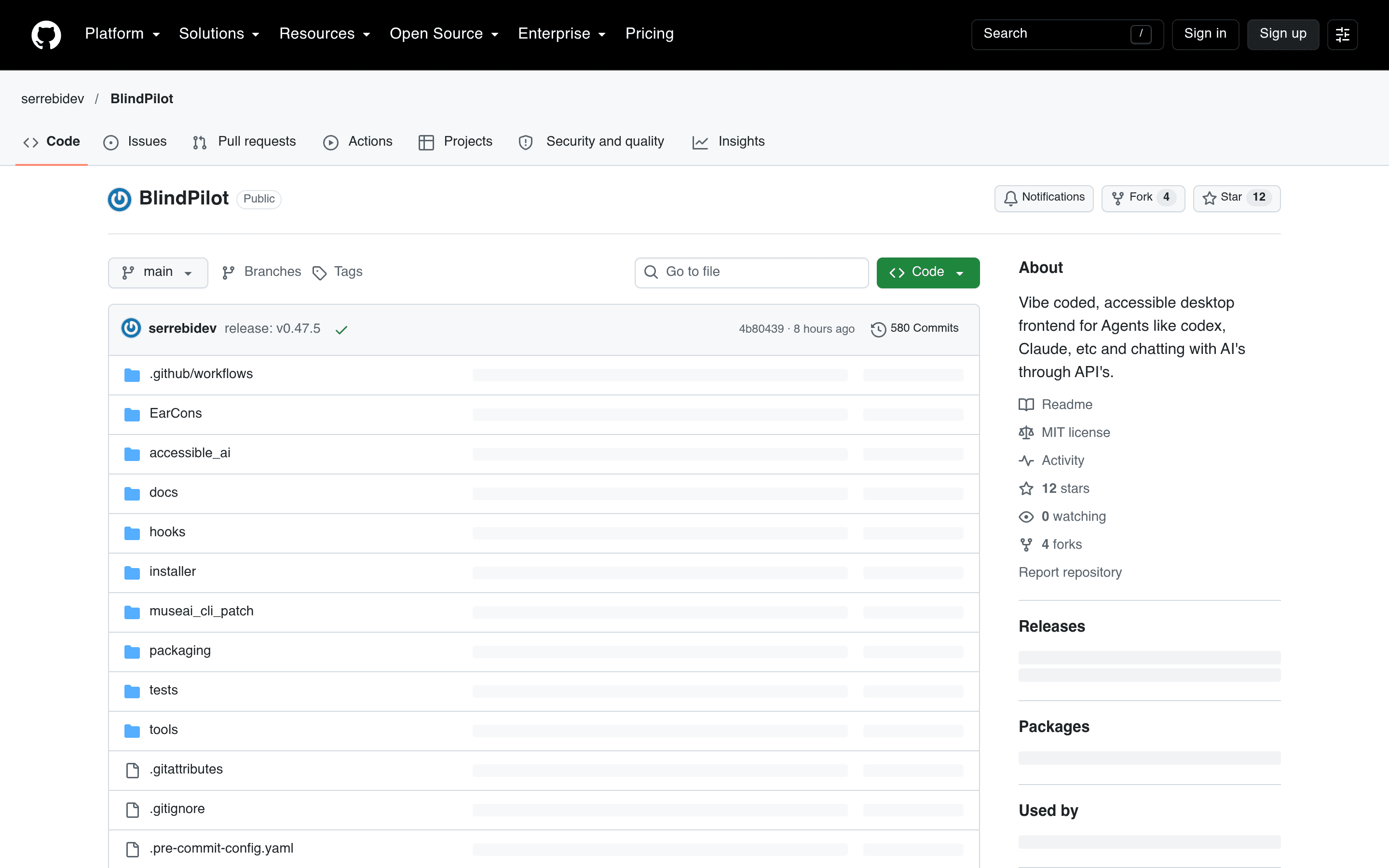
BlindPilot

A screen-reader-first desktop frontend for AI coding agents — run ten agents in real windows NVDA, JAWS and VoiceOver can actually read.

BlindPilot is a screen-reader-first desktop app for AI coding agents — and a genuinely different take on the agent UI problem. Coding agents live in terminals, and terminals are miserable with a screen reader: output scrolls past, the screen redraws under you, and you can't tell if the thing is working, stuck, or waiting on you. BlindPilot puts the agent in a real window your screen reader understands — every answer becomes a list you can arrow through, and it announces when something happens. It runs ten coding agents in tabs (Claude Code, Codex, FreeBuff, opencode, Hermes, Muse Code, muse.ai, Command Code, Gemini CLI, Antigravity CLI), splits every answer into navigable rows (one per heading, paragraph, code block, tool step), reads answers aloud as they arrive, and can even run agents in bypass-permissions mode for uninterrupted flows. It ships on Windows, macOS and Linux with installers on the releases page. The author states it verbatim in the README: "BlindPilot is vibe-coded. I use it every day." It started as a fork of Claude Code Reader, keeps that project's accessibility design, and is being shipped at a furious pace — v0.47.5 landed hours before it was scouted, with 580 commits behind it. Accessibility-first agent tooling is a rare corner of the vibe-coding wave, and this is one of its most serious entries.
大赏
已上线
AI Agent

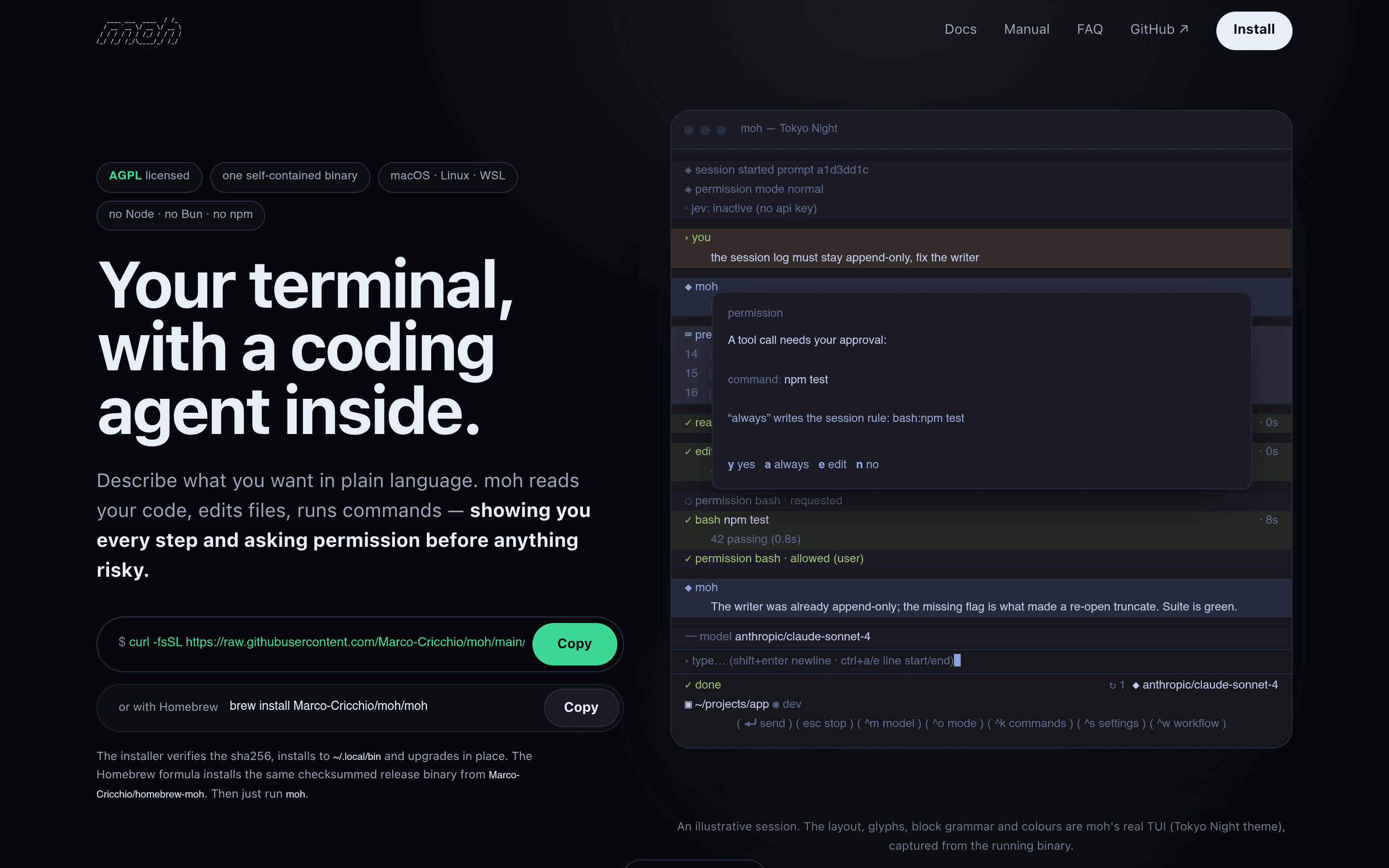
moh

A 100% vibe-coded, AGPL terminal coding agent: plain-language prompts, real TUI, one agent for every LLM backend, no vendor lock-in.

moh is a keyboard-driven terminal TUI coding agent: describe what you want in plain language and it reads your code, edits files and runs commands, showing every step and asking permission before anything risky. Its most distinctive traits are independence and honesty — it is an AGPL-licensed agent you own end to end, with no vendor account in the middle, nothing phoned home, and no lock-in. What stands out most is the project's story. The author states verbatim in the README: "Moh is 100% vibe-coded, with no preference between Western and Eastern LLMs, because AI should be a common good, not a tool of geopolitical power." That philosophy is visible in the product: one agent works with every backend — Anthropic, OpenAI, Google, GitHub Copilot, OpenRouter, Kimi, xAI, plus OpenAI-compatible endpoints and local models through Ollama or LM Studio — and if a provider goes down, moh falls back to the next stop on your own configured list instead of quietly swapping vendor for you. The tool is a single self-contained binary for macOS, Linux and WSL — no Node, no Bun, no npm. Under the hood it pairs a headless core with a thin terminal client: the same engine drives the interactive TUI, scripts and CI (moh run executes a turn with no prompts and fails fast). Sessions, memory and notes live as a plain append-only log under ~/.moh/ on your machine, with a redaction pass at the write seam so secrets never reach the log. Other capabilities include parallel lanes (one git worktree per task), a self-driving browser tool with SSRF protection, subagents with strict tool inheritance, MCP servers, skills and a workflow mode, auditable local usage stats, and a project map that builds a local structural view of your codebase. Development is very active: the repository (Marco-Cricchio/moh) was created on 2026-08-20 and the latest commit landed on 2026-10-14, with 78 open issues and discussions at the time of writing — a project moving fast. Note that its GitHub star count is just 1 as of this writing; it is an early-stage project, not yet widely known, and worth a look if you want an agent that is truly yours. The author does not declare a formal tech stack in the project's documentation (the repository's language field is TypeScript), so none is listed here.

大赏
已上线
AI Agent

Artiface

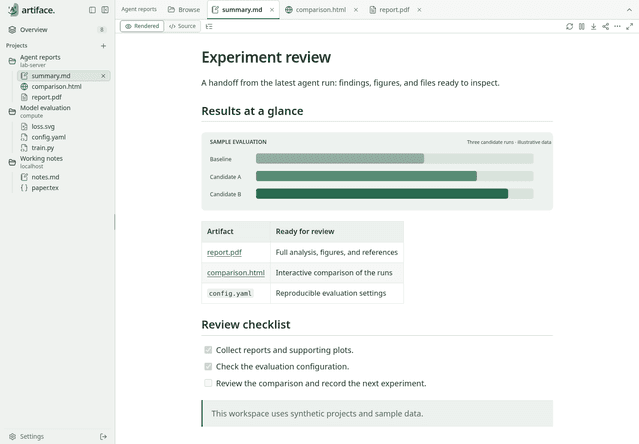
在浏览器里统一查看本地/远程服务器上 AI Agent 输出内容的自托管阅读器:md/html/pdf/代码多格式、多项目多标签页、夜间模式。

Artiface 是一个自托管的阅读器:在浏览器里统一查看本地或远程服务器上 AI Agent 输出的内容。作者的原话很直接——“基于(Vibe coding) Go 和 React,Apache 2.0”。一次部署,之后在网页上随时随地阅读 Agent 生成的报告、对比页和文件,不用再 SSH 进服务器翻目录。 它支持 md、html、pdf、图片、代码等多种格式渲染,多项目多标签页并列查看,还能看 Git 状态、自动刷新、有夜间模式。作者自述是自己先用了一个月、觉得顺手才开源出来的——这是一个先解决自己问题、再分享出来的工具。Docker Compose 一键部署,Apache 2.0 开源。 解决什么痛点 用 AI Agent 跑实验、做调研的人都有这个烦恼:Agent 在服务器上吐出一堆 summary.md、comparison.html、report.pdf,你得一个个 scp 下来或者进终端看。Artiface 把这些输出变成一个可浏览的工作台:左侧项目树、顶部标签页、正文渲染,配上“结果一览”式的卡片——等于给 Agent 的产出配了一个只读仪表盘。 上手 GitHub 仓库 i207M/artiface,Go + React,Docker Compose 部署。把 Agent 的输出目录指给它,打开浏览器就能看。

大赏
已上线
AI Agent

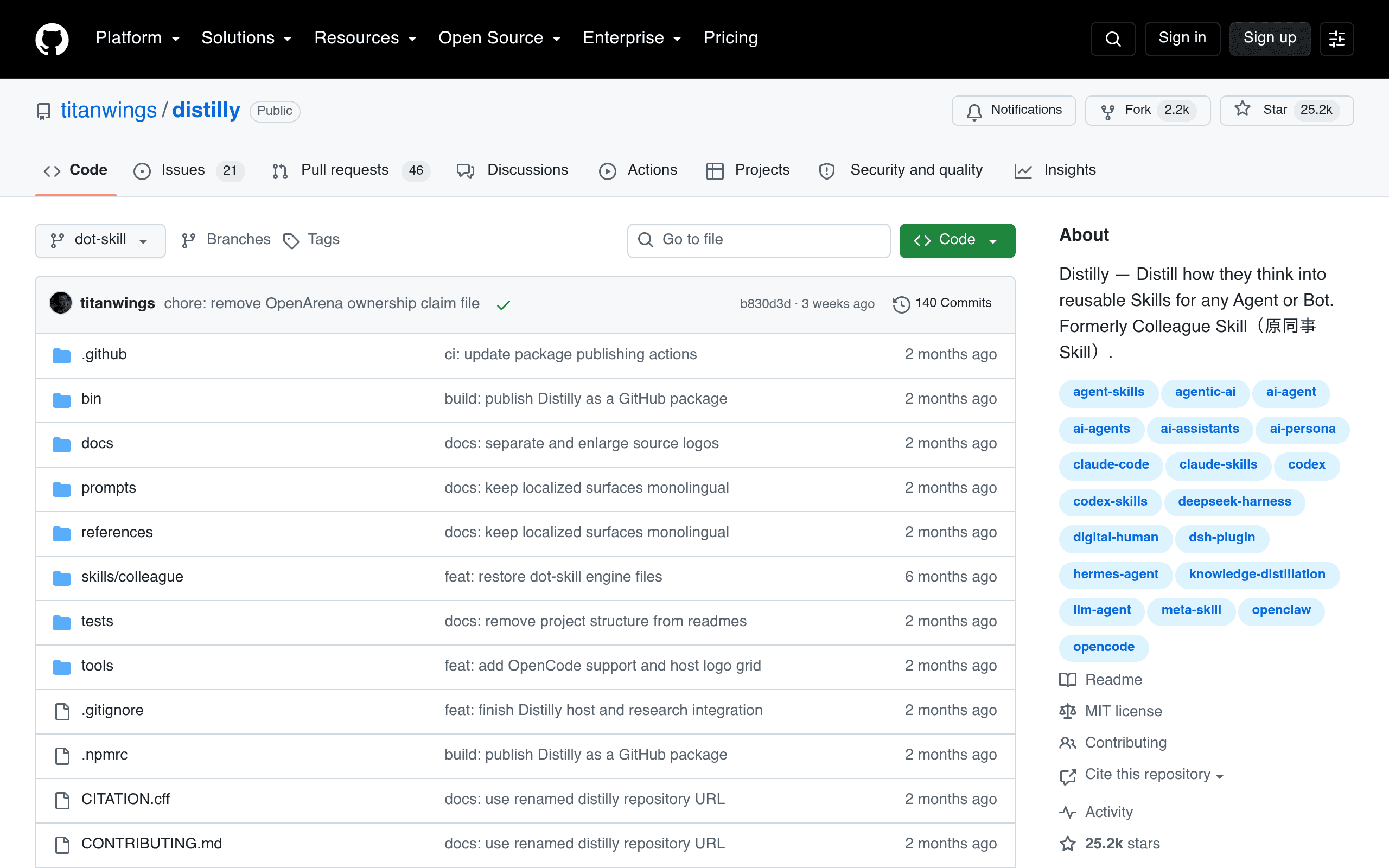
Distilly

从"同事.skill"爆火出圈到改名 Distilly:把人的经验蒸馏成 Agent 可复用的 Skill,2.5 万 star。

2026 年 4 月,中文互联网被一个黑色幽默的开源项目刷屏了:"同事.skill",slogan 是"将冰冷的离别化为温暖的 Skill,欢迎加入赛博永生"。玩法很简单:把离职同事的飞书消息、钉钉文档、邮件截图喂进去,AI 就能生成一个"真正能替他工作"的数字分身——用他的技术规范写代码,用他的语气回答问题,甚至知道他什么时候会甩锅。紧接着,前任.skill、老板.skill、父母.skill 相继冒出来,"同事被炼化了"冲上热搜,连《朝鲜日报》等海外媒体都跟进了报道。 这个项目的作者是 @titanwings,背后有上海 AI Lab 的 AI Safety Center 支持。如今它已经改名叫 Distilly(原同事 Skill),从一个职场玩梗项目长成了 25,241 star 的正经开源项目:2026 年 6 月发布了 arXiv 技术报告,社区贡献的 skill 卡片超过 215 个,支持 Claude Code、Codex 等 8 种 Agent 宿主,覆盖同事、亲密关系、名人三个"蒸馏"场景——甚至能给名人做六维研究(作品、访谈、决策、表达 DNA……),MIT 协议。 Distilly 值得收录,不只是因为它火。它标志着 vibe coding 进入了一个新阶段:AI 生成的不再只是应用代码,而是"人的经验"本身——沟通风格、决策逻辑、甩锅习惯,都被结构化成了可复用的 Agent Skill。恐惧("下一个被炼化的是不是我")和狂欢("散是 Token,聚是 Skill")同时存在,而这恰恰是技术变革期的真实体感。 注:本项目由 VibeFix 编辑从公开渠道精选收录,版权归原作者所有。

大赏
已上线
AI Agent

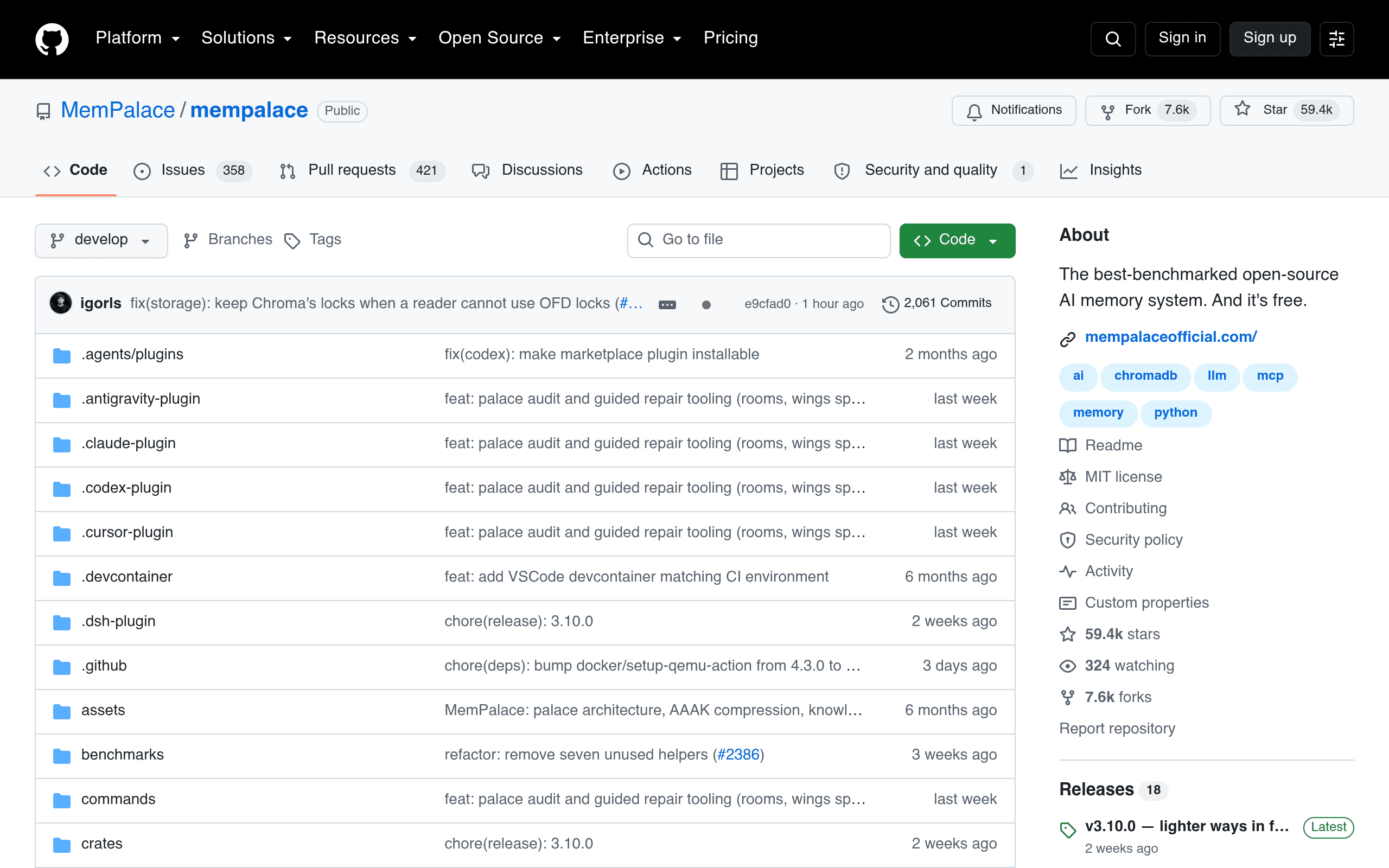
MemPalace

Milla Jovovich and Ben Sigman built an AI memory system with Claude — 59K stars and a benchmark brawl.

MemPalace might be the most unlikely collaboration in open source this year: Hollywood actress Milla Jovovich (Resident Evil, The Fifth Element) and Bitcoin entrepreneur Ben Sigman spent months building an AI memory system with Claude — with Claude Opus 4.6 listed as a co-author in the git history. The repository now has over 59,000 stars and was still being pushed to today. The core idea is borrowed from the ancient Greeks: the method of loci, or memory palace. Instead of letting an AI decide what to forget via summarization, MemPalace stores conversations verbatim and organizes them into a navigable hierarchy — wings, halls, rooms, closets, drawers, tunnels — backed by ChromaDB for semantic search and SQLite for a temporal knowledge graph. It runs entirely on your machine, exposes 19 MCP tools so Claude Code, Cursor or ChatGPT can read and write memories mid-session, and ships under MIT. Then came the benchmark drama, which is honestly the most instructive part. The team claimed 96.6% on LongMemEval with zero API calls, plus a first-ever perfect 100% R@5 with Haiku reranking — and the internet promptly audited them. Critics found methodology issues; the authors published a correction note admitting the 96.6% was raw verbatim mode and that their experimental compression dialect actually regressed performance. The 96.6% raw-mode score has been independently reproduced, so the core result stands, but the episode is a useful reminder. MemPalace earns its place here for two reasons. First, it's a serious piece of AI infrastructure that was genuinely built with AI assistance — the snake eating its own tail. Second, the benchmark controversy played out in public, with unusual honesty from the authors. That's the healthy version of vibe-coding culture: ship fast, claim loudly, but publish your eval code and correct the record when you're wrong. Note: This project is curated by the VibeFix editors from public sources. All rights belong to the original creator.

大赏
已上线
AI Agent

Polsia

"AI that runs your company while you sleep" — built solo by one human plus AI, now at a ~$10M ARR run-rate. The reviews are divided; the numbers are not.

Polsia's homepage makes the boldest promise in this batch: "AI That Runs Your Company While You Sleep," with a banner reading "Polsia works on thousands of companies at once." The founder built it solo — "one human + AI," in his words "80% AI, 20% taste" — with zero employees, and it now runs at roughly a $10M ARR run-rate after a $30M raise at a $250M valuation. It is the purest example of the one-person AI company thesis actually working. Honesty requires the other half of the story: public reception is sharply divided. Trustpilot sits at 2.9 out of 5 across 184 reviews, 45% of them one-star, and critics dismiss the output as "AI slop." Whether Polsia is the future of work or a cautionary tale about over-automation is genuinely unresolved — which is exactly why it's worth watching. Note: This project is curated by the VibeFix editors from public sources. All rights belong to the original creator. - Verification: curl https://polsia.com returns 200; Microlink screenshot shows "Polsia / AI That Runs Your Company While You Sleep" — matches the project.