项目大厅

探索全部独立开发者项目与共创求助

当前筛选:大赏展示
大赏
已上线
社交社区claude

Tweet Analyzer

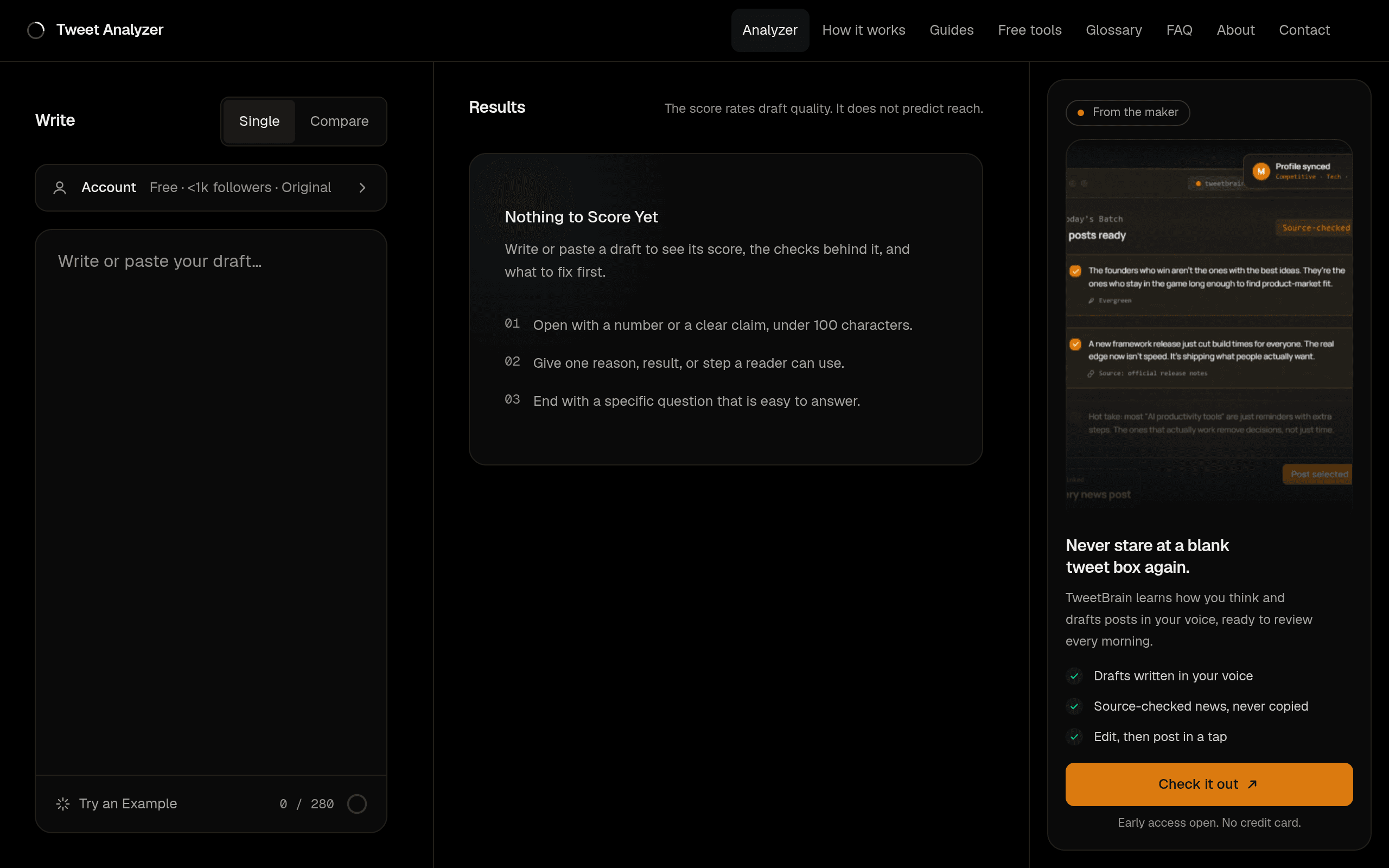
Score your X drafts 0–100 on hook, specificity and answerability — rates draft quality, not virality, no login needed

Tweet Analyzer scores your X (Twitter) drafts 0–100 across dimensions like hook strength, specificity and answerability, then tells you exactly what to fix first. The scoring rules are grounded in X's own open-sourced ranking code (xai-org/x-algorithm) rather than guesswork, and the maker is refreshingly honest about the limits: the score rates draft quality, not reach — "It does not predict reach." The tool needs no login: paste a draft, get a score plus the checks behind it, and compare variants side by side. The author, imranshah10140, wrote on Show HN (2026-10-14): "I built this tool with a lot of help from Claude, for both the code and the research." The site also hosts guides, a glossary and free tools around X writing.

大赏
已上线
办公claude-opus-55

pdf2epub

Turn PDFs into clean, reflowable EPUBs on macOS: Finder Quick Action + CLI, with Apple Vision OCR and on-device proofreading

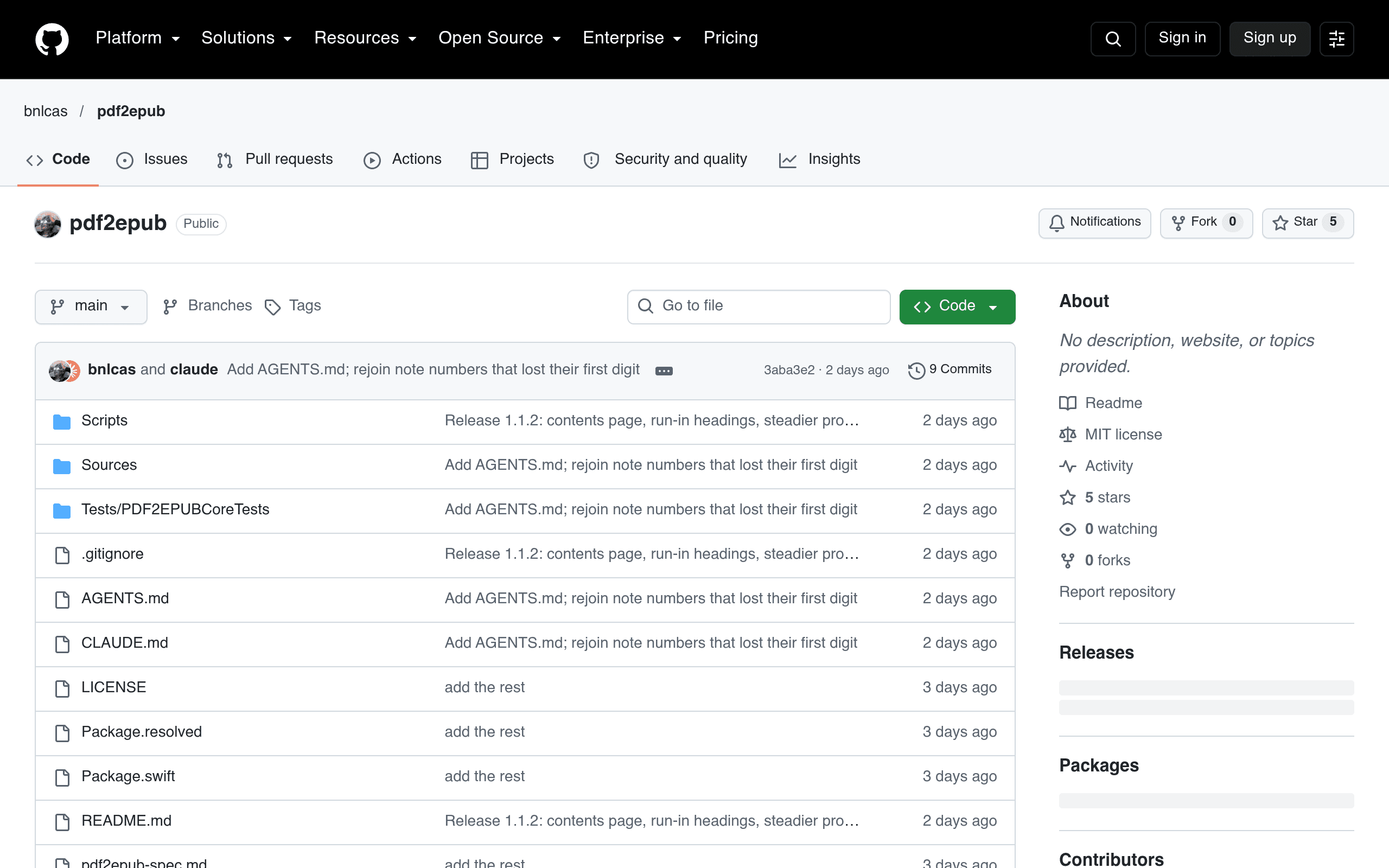
pdf2epub converts PDFs into clean, reflowable EPUBs on macOS. It installs as a Finder Quick Action — right-click any PDF and choose Convert to EPUB — plus a pdf2epub command for Terminal users. Under the hood it combines Apple's PDFKit, Vision OCR and Foundation Models: layout heuristics recover real fonts and structure from the content stream, scanned pages go through Vision OCR, and Apple's on-device foundation model does a narrow proofreading pass (each request asks a single yes/no question; a spelling change is only accepted when it turns a non-word into a word through a typical OCR confusion). Chapters come from the PDF outline, the printed Contents page, or detected headings; footnotes become linked notes; output passes epubcheck with 0 errors. The author is explicit about how it was made — the README's Et Cetera section reads: "Claude Opus 5.5 made all of this. I take no credit beyond the initial desire and some busy work to bundle it up." Created 2026-10-12 and actively maintained (release 1.1.2 within days), MIT licensed. Note: this is a command-line / Quick Action tool with no graphical main window, so the screenshot shows the repository page.

大赏
已上线
效率

Treesum

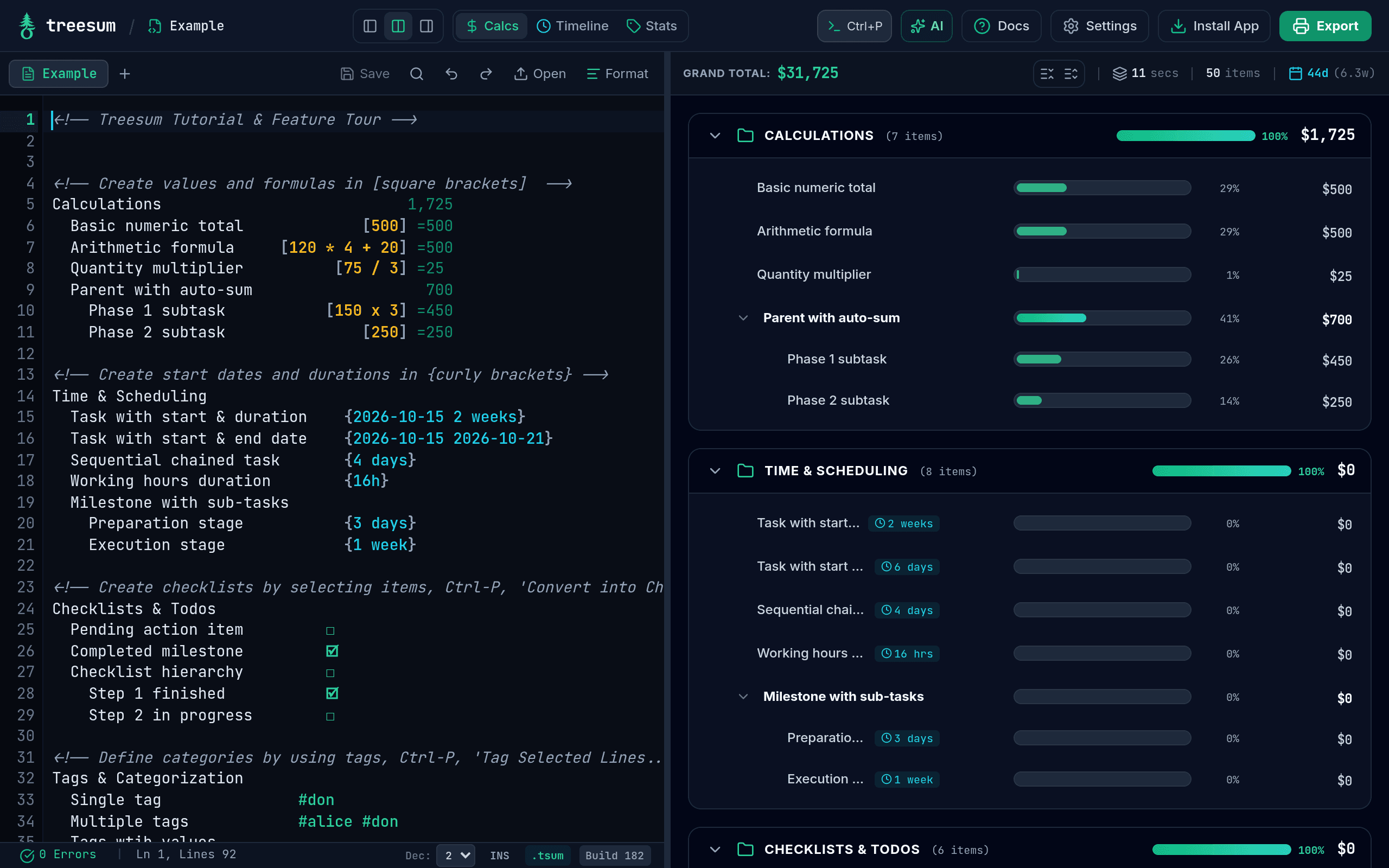
An outline-first planning editor: write your plan as a text tree, sums, timelines and stats compute themselves — no backend, no account

Treesum is an outline-first planning editor that wants to be "the Excalidraw of Excel": you write your plan as a plain-text tree, and the sums, timelines and statistics compute themselves. Values and formulas go in [square brackets] — [500], [120 * 4 + 20] — start dates and durations in {curly braces}, categories via #tags. Three live views — Calcs, Timeline, Stats — aggregate everything automatically: parent rows auto-sum their children, scheduling emerges from date annotations, and pivot-style stats need no formatting effort. Everything runs locally in the browser; a plan is saved permanently by downloading a human- and AI-readable '.tsum' text file, which can be reopened later. No backend, no account. The author, mallahan, is not a full-time developer. He wrote on Show HN (2026-10-13): "This software is entirely vibe-coded. It had to be — none of my developer friends would help me out. The front end JS on this app is too complex for a part time developer like myself." He had the idea for a while and "was only able to bring it to life because of AI", and he is a happy daily user himself. The live demo loads a full interactive tutorial editor, so you can try the concept in seconds.

大赏
已上线
AI Agent

moh

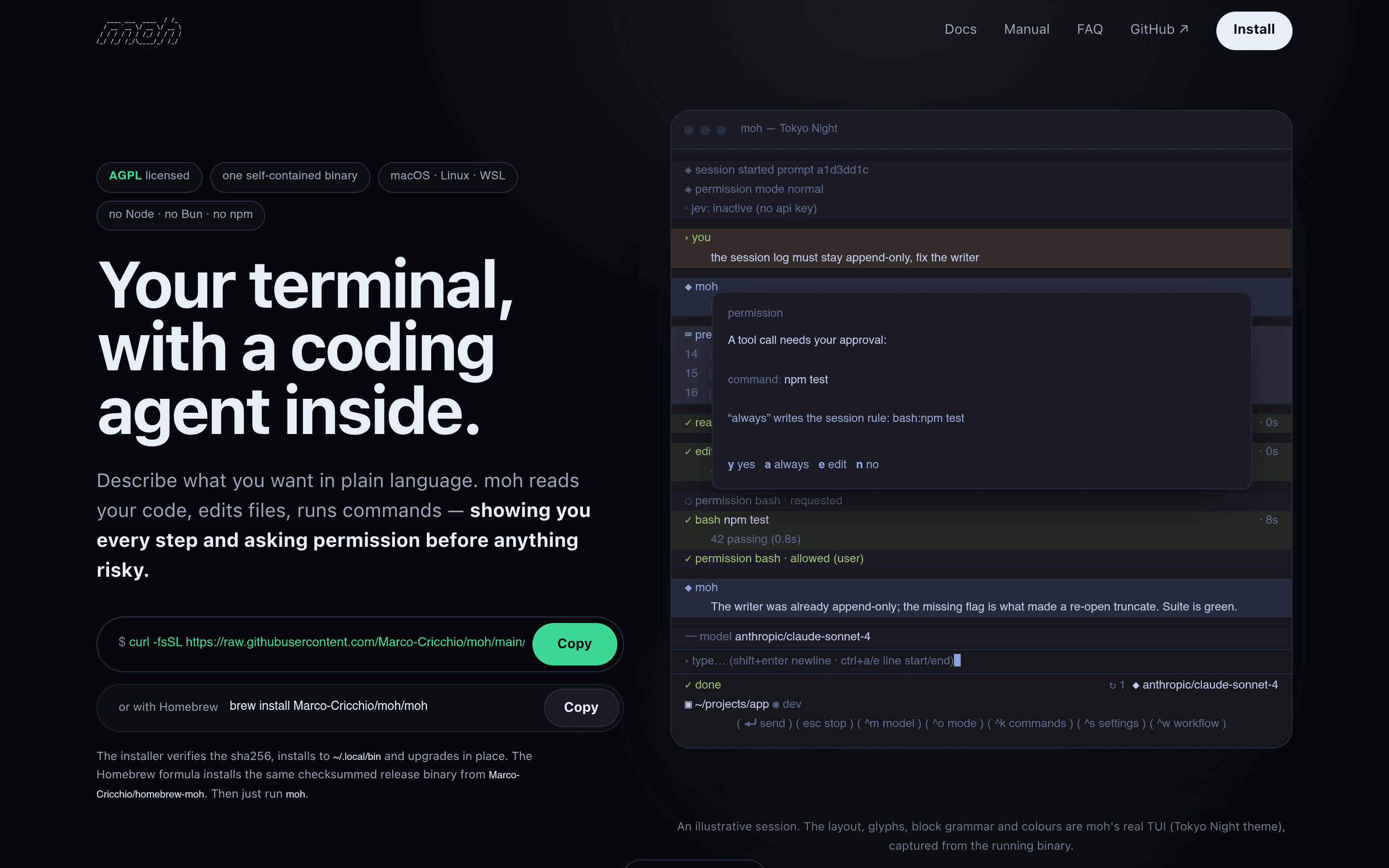
A 100% vibe-coded, AGPL terminal coding agent: plain-language prompts, real TUI, one agent for every LLM backend, no vendor lock-in.

moh is a keyboard-driven terminal TUI coding agent: describe what you want in plain language and it reads your code, edits files and runs commands, showing every step and asking permission before anything risky. Its most distinctive traits are independence and honesty — it is an AGPL-licensed agent you own end to end, with no vendor account in the middle, nothing phoned home, and no lock-in. What stands out most is the project's story. The author states verbatim in the README: "Moh is 100% vibe-coded, with no preference between Western and Eastern LLMs, because AI should be a common good, not a tool of geopolitical power." That philosophy is visible in the product: one agent works with every backend — Anthropic, OpenAI, Google, GitHub Copilot, OpenRouter, Kimi, xAI, plus OpenAI-compatible endpoints and local models through Ollama or LM Studio — and if a provider goes down, moh falls back to the next stop on your own configured list instead of quietly swapping vendor for you. The tool is a single self-contained binary for macOS, Linux and WSL — no Node, no Bun, no npm. Under the hood it pairs a headless core with a thin terminal client: the same engine drives the interactive TUI, scripts and CI (moh run executes a turn with no prompts and fails fast). Sessions, memory and notes live as a plain append-only log under ~/.moh/ on your machine, with a redaction pass at the write seam so secrets never reach the log. Other capabilities include parallel lanes (one git worktree per task), a self-driving browser tool with SSRF protection, subagents with strict tool inheritance, MCP servers, skills and a workflow mode, auditable local usage stats, and a project map that builds a local structural view of your codebase. Development is very active: the repository (Marco-Cricchio/moh) was created on 2026-08-20 and the latest commit landed on 2026-10-14, with 78 open issues and discussions at the time of writing — a project moving fast. Note that its GitHub star count is just 1 as of this writing; it is an early-stage project, not yet widely known, and worth a look if you want an agent that is truly yours. The author does not declare a formal tech stack in the project's documentation (the repository's language field is TypeScript), so none is listed here.
大赏
已上线
开发工具pi

Phi — Pi AI Agent for VS Code

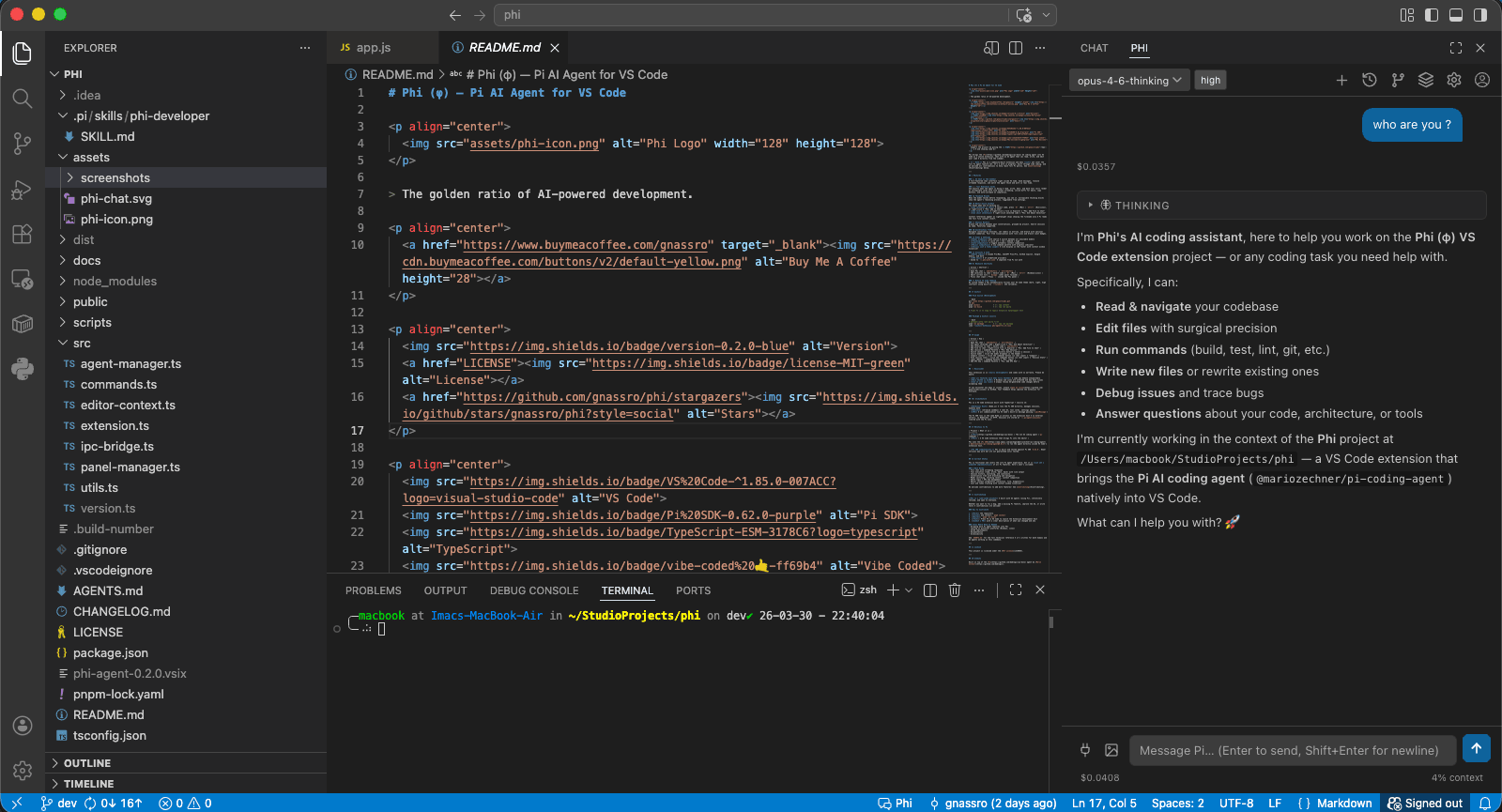
An AI agent extension for VS Code powered by Pi - itself vibe-coded, and iterating fast.

Phi (φ) is an AI agent extension for VS Code, and the author's own description leaves no ambiguity about how it was built: "Phi is a vibe-coded project - built with AI agents (using Pi), iteratively refined, and open to everyone." That statement appears verbatim both in the README and on its Open VSX extension page. The extension is real and installable: Phi is listed on Open VSX as gnassro/phi-agent at version 0.9.1, powered by the Pi coding agent SDK (@earendil-works/pi-coding-agent@1.0.4). Per the README, it is "built with TypeScript + vanilla JS", and the repository (gnassro/phi) was last pushed on 2026-10-11 - days before this writing - so the project is being actively iterated, matching the author's "iteratively refined" claim. A nice meta touch: a coding-agent extension that was itself built by coding agents. If you work in VS Code and want an Open VSX-native AI assistant, Phi is worth a look.

大赏
已上线
娱乐fable-5

World of ClaudeCraft

A classic-style MMORPG that runs entirely in the browser - vibe-coded with Fable 5, 2,302 stars, and still shipping.

World of ClaudeCraft is a classic-style browser MMO you can play instantly - no download required. Explore the world, take on quests, and tackle dungeons with friends, straight from the browser. The team's own words say it best. Posting on r/ClaudeAI (2026-06-12), the Levy Street team wrote: "I vibe coded the first MMORPG with Fable 5". The game is the research project of Levy Street, a New Zealand company working on reinforcement learning - an unusually serious engineering effort behind a fully playable online world. It's also genuinely alive: the GitHub repo levy-street/world-of-claudecraft has 2,302 stars and 732 forks, with 79 releases shipped - the latest, v0.44.6, landed 2026-10-09. The tech stack is stated verbatim on the README badges: TypeScript, Three.js, Vite, and PostgreSQL, built around "one deterministic TypeScript simulation core". If you like persistent online worlds in the browser, this is the one to try.

大赏
已上线
旅行本地claude

HumSafar

An India travel planner site vibe-coded in a 2–3 hour hackathon: UNESCO sites, wishlist, rough trip-cost estimates.

HumSafar (हमसफ़र, "travel companion") is an India travel-planning website built from scratch during a 2–3 hour website-development hackathon. Browse well-loved destinations and UNESCO World Heritage sites, save the ones you like to a "My Trip" wishlist, and see a rough cost estimate for the trip. The team is honest about how it was made: the README says "The whole project was vibe coded: we described the idea to an AI assistant, refined it into a detailed prompt, and used that prompt to generate and iterate on the site," and "Claude was the only AI tool used in this project." Tech stack is deliberately minimal — plain HTML, CSS and JavaScript with no frameworks or build step, hosted on GitHub Pages. A clean, rough-and-real hackathon artifact: the README still carries unfilled placeholder sections from the time crunch, which is exactly what a 2–3 hour AI-assisted build looks like. Live and browsable now.

大赏
已上线
内容媒体gemini-38

智识志 · 全球 AI 科技日报

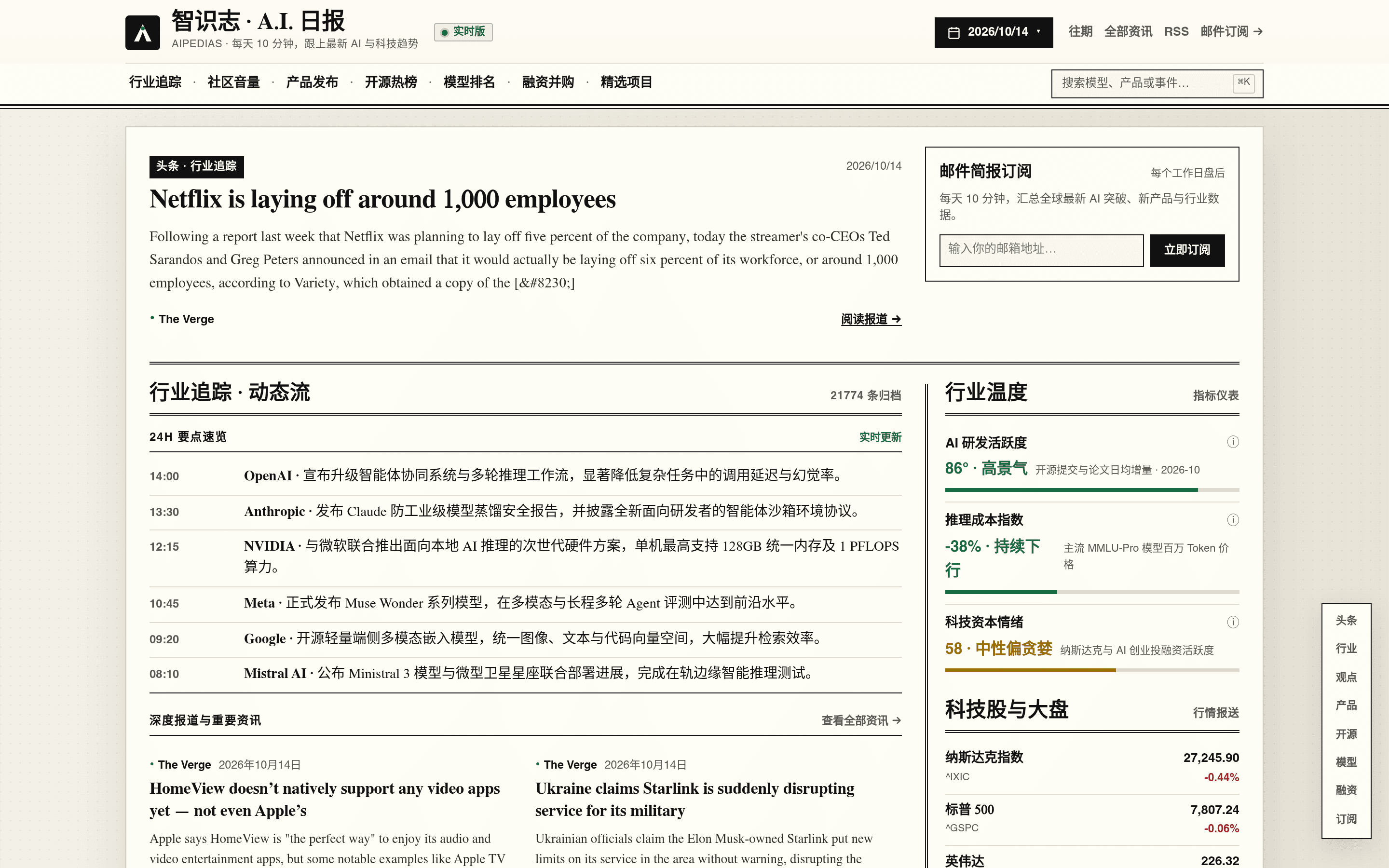
AI 全自动生成的全球 AI 科技日报:24h 要点速览、开源热榜、模型排名、融资并购,实时更新。

智识志(AIPEDIAS)是一座 AI 全自动生成的全球 AI 科技日报站。作者 tianjiyao 原话:"哈,我也让 Gemini 3.8 撸了一个 AI 日报"——从抓取、整理到成稿,全流程由 AI 完成,每天自动更新。站点分行业追踪、社区音量、产品发布、开源热榜、模型排名、融资并购、精选项目等板块:24h 要点速览按小时滚动更新,归档已超 21700 条;另有行业温度指标仪表(AI 研发活跃度、推理成本指数、科技资本情绪、股指行情)和邮件简报订阅。如实说明:日报内容为 AI 自动聚合生成、未经人工逐条核实,个别条目真实性存疑,阅读时请自行交叉验证。这里介绍的是"AI 自动日报站"这个 vibe-coded 项目本身,不为其聚合新闻的真实性背书。

大赏
已上线
教育gemini-38

有声水墨地图 · 62 位先贤时空轨迹

62 位先贤的人生轨迹画在宣纸风 GIS 地图上:AI 双语讲解、行旅运镜,走完生成通关文牒海报。

有声水墨地图是一套给孩子讲历史的交互式时空轨迹工具。作者 haidao2008 教孩子背诗讲苏轼,发现地名一堆、孩子听懵了,于是用 GIS 地图 + AI 给古人做了一套有声的时空轨迹:把苏轼、李白、杜甫、辛弃疾、王阳明、玄奘等 62 位华夏先贤的人生轨迹,画在宣纸风 GIS 底图上,配 AI 生成的中英双语讲解音频。作者把几十万字文人年谱喂给 Gemini 3.8,把古今地名、经纬度、调任贬谪原因抽成结构化数据,用 Edge-TTS 配男女双语原声,还按人生阶段生成了青年/中年/晚年三套立绘。看点很多:宣纸水墨风微地形底图(黄河黄、长江绿)、严格拟合古代驿道与长江水道而非直线瞬移、行江乘舟/走栈道策马的运具拟态、镜头速度自适应语音时长的"声停点落"运镜。走完一位先贤的全程可一键生成 1080P 宣纸风"通关文牒"海报。作者原话:"我把全流程喂给 Gemini 3.8 跑了一遍",Demo 一天跑通、又打磨了一个月。目前 62 位先贤、1165 个站点、85 篇深度 essays 全量上线,纯免费、无广告、无需注册,电脑或平板打开体验最佳。

大赏
已上线
分析image25gpt61-sol

择点 AI|实体店选址分析

开店选址先看 AI 报告:高德周边数据+WorldPop 人口热力+选址 Skill,一键生成带图评估。

择点 AI 是给实体店老板做的 AI 选址分析工具。作者 boxrq 想自己开店,嫌查高德麻烦、想法和实拍照片记不方便,就直接用 AI 做了一套完整的选址系统。输入一个地址,AI 读取高德地图 1/3/5km 周边配套数据,叠加 WorldPop 人口模型的人口热力图(还能看 20–54 岁人群性别比),再按餐饮/零售等不同业态的偏好拉取对应信息,结合交通和人口数据做分析。看中的点位可以一键收藏,附上自己的想法和实地照片;内置的选址 Agent 会按选址策略给点位打分,并用绘图模型生成一张直观的评估报告图,候选点位还能并排对比。每个页面都能调出 AI 助手,内置多种实体店业态的选址 Skill,还有商业分析 Skill 可一键调用。作者原话:"这是一次把一些日常需求流快速用 ai 完成的尝试,整体使用 image2.5 做 ui 设计,gpt6.1-sol 做实现"。官网已上线,注册即可体验,AI 深度分析和报告生成功能完整可用。

大赏
已上线
营销销售

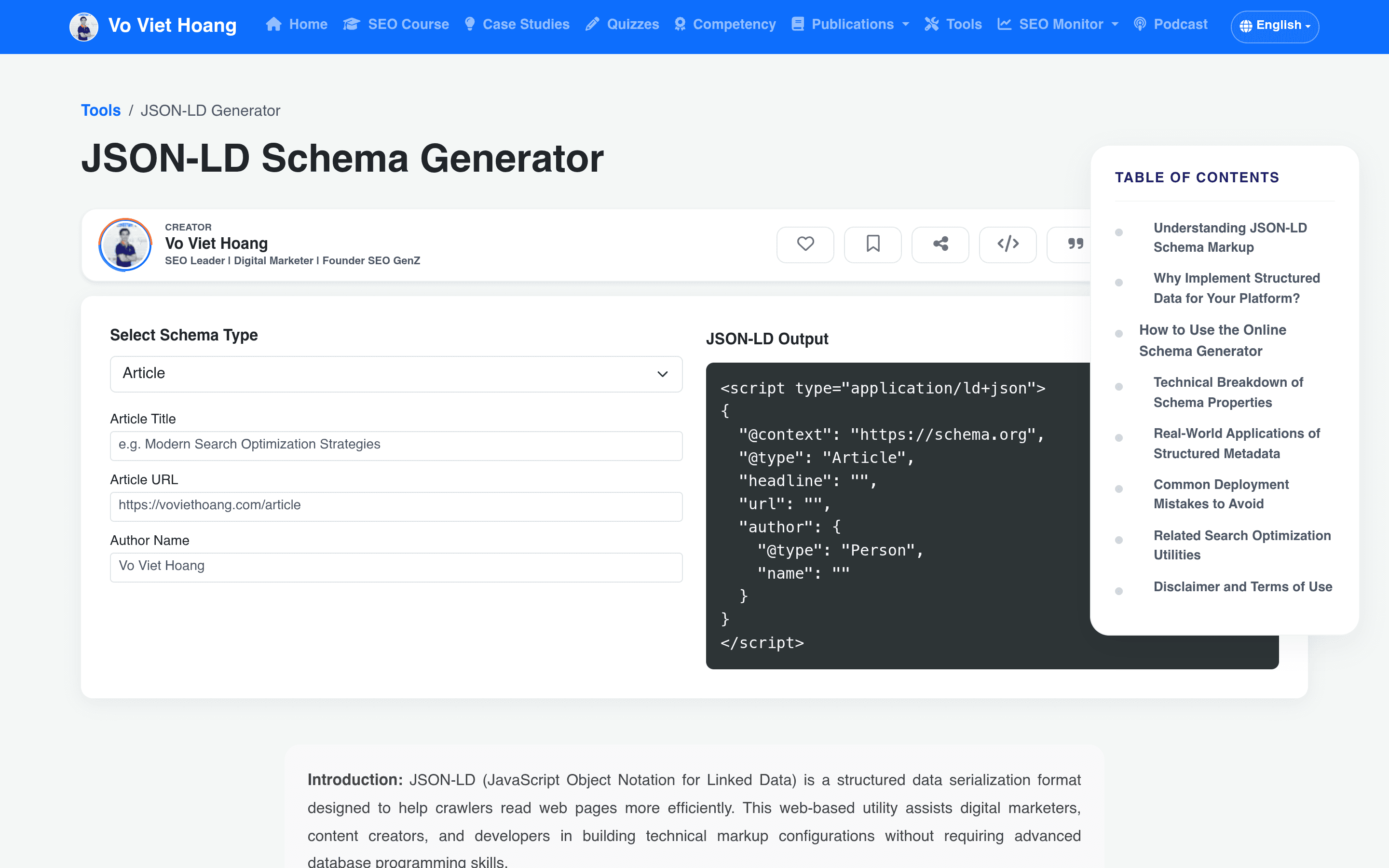
JSON-LD Schema Generator

A 100% client-side JSON-LD schema generator for technical SEO — private, instant, vibe-coded by an SEO specialist.

A lightweight JSON-LD Schema Generator that runs 100% in the browser, vibe-coded by Vietnamese SEO specialist Vo Viet Hoang. It generates clean, ready-to-copy JSON-LD markup for Articles, Local Businesses and WebSites with instant validation and formatting. Because every byte is processed client-side in pure JavaScript, user inputs never touch a server — complete data privacy and zero latency. The author built it via LLM prompting to handle strict schema.org syntax, nested properties like author/publisher/address, and dynamic UI updates. Free to use at the demo link.

大赏
已上线
金融财务claude

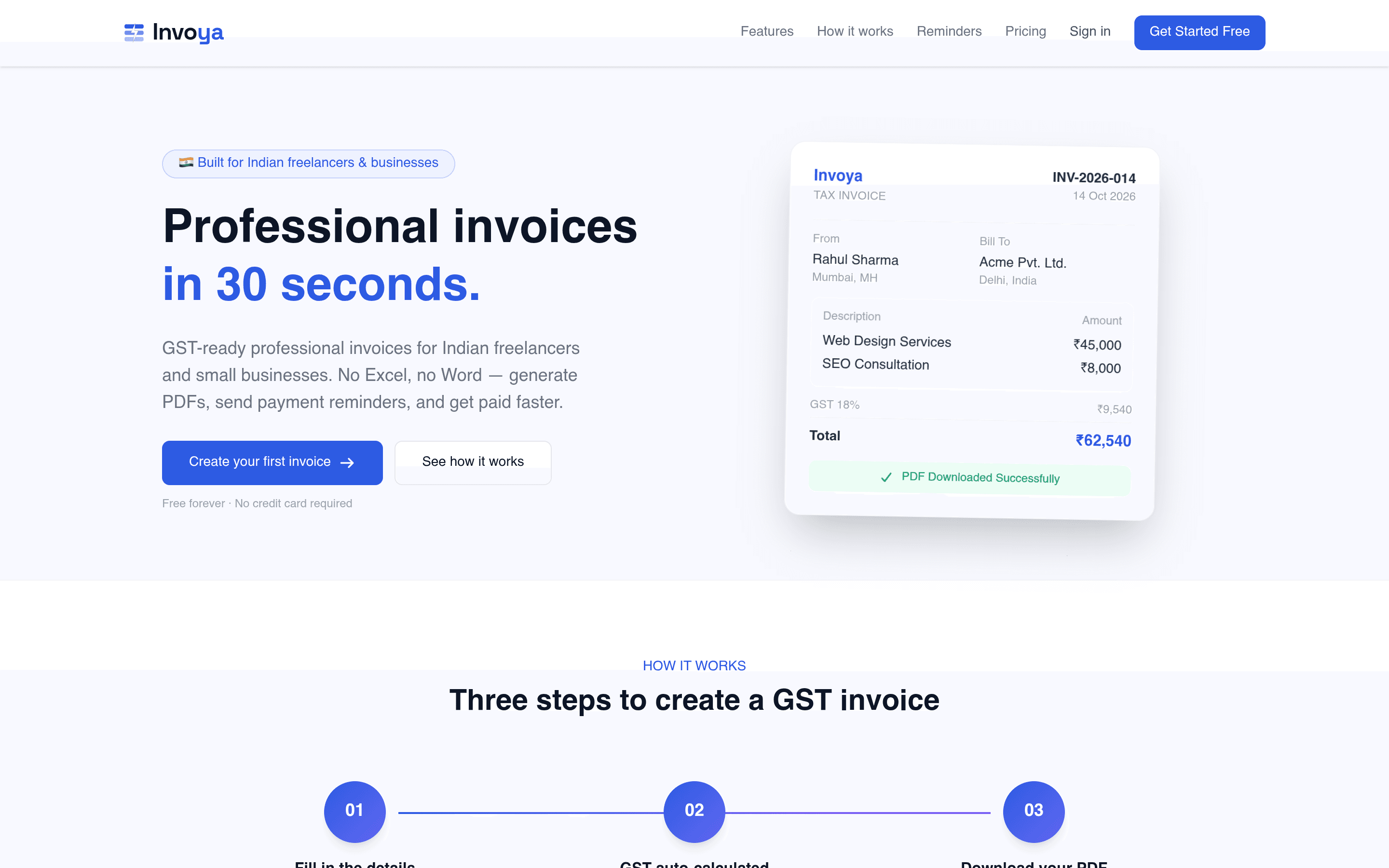
Invoya

A free GST invoice generator for Indian freelancers — GST-ready PDFs in 30 seconds, payment reminders, built solo with Claude.

Invoya is a free GST invoice generator for Indian freelancers and small businesses, and it is a real, launched SaaS with paying users. Fill in business and client details and it generates a professional GST-ready PDF invoice in about 30 seconds — GST rates from 0% to 28% with CGST/SGST/IGST split automatically by state. It also solves the awkward freelancer problem of chasing payments: one-click payment reminders in 5 types and 3 tones (friendly, professional, firm), ready to send over WhatsApp or email. The dashboard has KPI cards, overdue detection, search, sort, and list/grid views. The author built the whole product solo — frontend, payments, PDF generation, deployment — using Claude as a co-developer, on React + Vite + Tailwind with Firebase Auth/Firestore, jsPDF, Razorpay and Vercel. Free to start, live now at invoya.in.

大赏
已上线
自动化claude-code

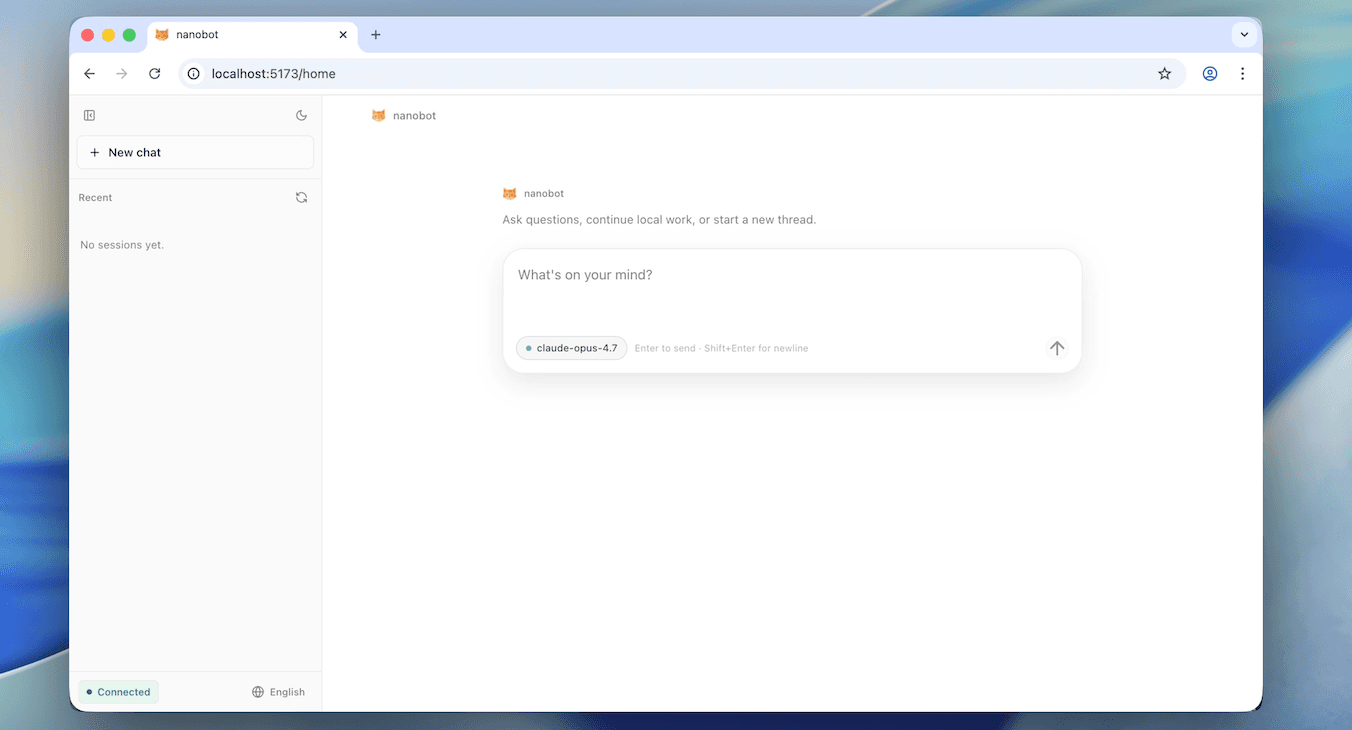
home-stack

An entirely vibe-coded self-hosted smart-home stack: family portal, per-person AI assistants, voice panels, cameras, local LLMs — on one PC.

home-stack is a self-hosted smart-home stack for one household, and the README says it plainly: entirely vibe coded, every line written by AI coding agents (mostly Claude Code) and directed by one person running it for their own family. It ships 21 services, 12 on by default: a family portal (chat, files, chores, shopping list, weekly menu), a personal AI assistant for each household member (a nanobot fork with memory, house skills, reminders) plus a shared room-facing assistant, per-profession spaces (Programmer, Teacher, Designer, Health, Legal), voice panels with local speech-to-text, a camera wall with a local vision model, an MQTT broker, a document archive (Paperless-ngx), own notifications (ntfy), own web search (SearXNG), and backups with verified restore. "Alfred fixes himself" — report a problem in chat and the Programmer agent proposes a fix without committing anything until you approve. Local models run on your own GPUs via Ollama or llama.cpp; the default hosted provider is OpenCode Zen. Everything runs on one PC; it was extracted from a live household that uses it daily. MIT licensed.

大赏
已上线
游戏claude-opus-55elevenlabs

Core Business

A playable-in-browser 2.5D remake of the Flash classic Motherload, vibe-coded with Claude Opus 5.5 — dig, drill, upgrade, chase the core.

Core Business is a 2.5D remake of Motherload (XGen Studios) built with three.js, and it runs right in the browser. The game mechanics are taken 1:1 from the original's ActionScript — physics at 42 fps, world generation, drilling, prices — only the presentation is new. The author states the entire work was vibe-coded with Claude Opus 5.5: game code, tests, textures, all texts and translations, and every 3D model including the Blender scripts that generate them (sounds and music came from ElevenLabs). It even ships dev-mode test scenarios, keyboard and touch controls, English/German i18n, and a localStorage save slot. A non-commercial fan tech demo: no original assets are used, and it's not affiliated with XGen Studios. Play it free at the demo link.

大赏
已上线
工具claude-code

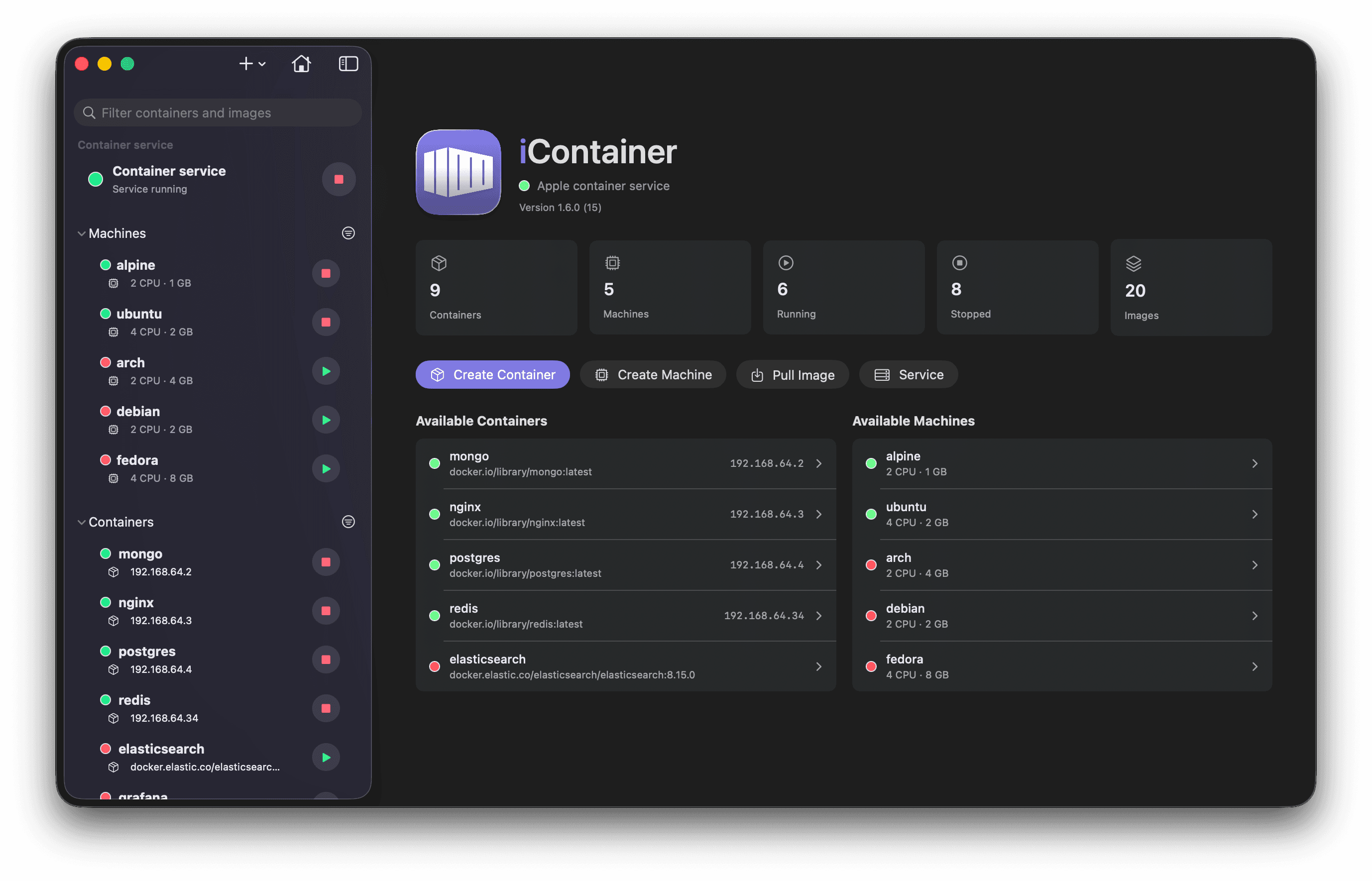
iContainer: native macOS manager for Apple Container workloads

A native macOS app for Apple Container workloads — containers, images, logs, stats and an interactive shell, plus on-device AI log analysis.

What it isiContainer is a native macOS app to manage Apple Container workloads — containers, images, logs, stats, and an interactive shell — built with SwiftUI on top of the official container CLI. It ships as a signed, notarized app with Sparkle auto-updates and a Homebrew tap, so it behaves like real shipping software, not a side project. Built with vibes, full disclosureThe README says it plainly: "Full disclosure: iContainer was vibe-coded — designed and written hand-in-hand with Claude Code." A "Vibe-coded with Claude Code" badge sits right under the title. The ideas, direction, and every "no, not like that" are human; a lot of the typing isn't — and the author is upfront that it's a hobby project on brand-new Apple tech: "read the code, kick the tires, and don't run it anywhere you'd cry about." Standout: on-device AI log analysisOne click on any container's or machine's Logs tab turns raw output into a concise diagnostic — health summary, quoted errors and warnings, likely cause, concrete next steps — streamed live. It runs on Apple's Foundation Models entirely on your Mac, so logs with their secrets and tokens never leave the device: no cloud, no API keys, no subscription. Plus Docker interop (import images, translate docker inspect configs into Apple Container settings) and a Docker Compose MVP. RequirementsmacOS 26 or later on Apple silicon, plus the Apple Container CLI. Apple Intelligence is optional — only needed for the on-device log analysis.

大赏
已上线
健康健身

LET: track your life, discover patterns

A cross-platform habit and life-event tracker — log workouts, sleep, mood and milestones offline, then spot patterns in your days.

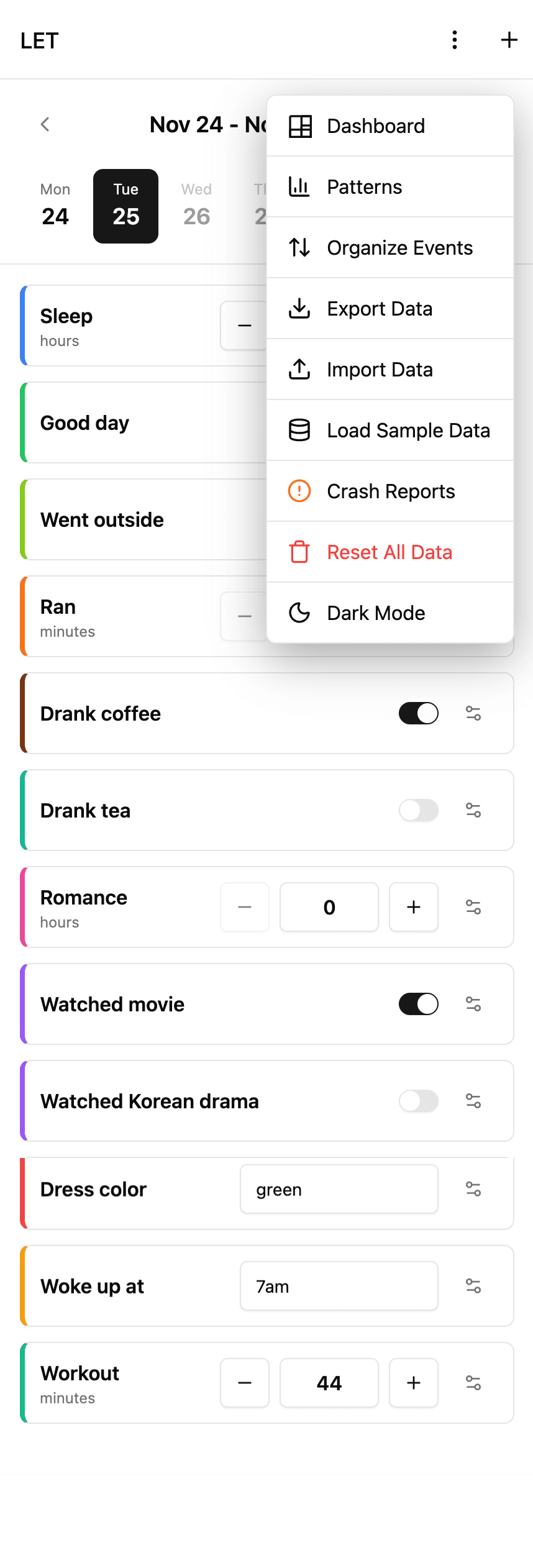
What it isLET (Life Events Tracker) is a simple yet powerful mobile app for tracking daily habits, life events, and discovering patterns in your daily life. Log exercise, meditation, reading, water intake, sleep hours, meals, mood, and important milestones — everything stays in a local SQLite database on your device. No cloud, no account. It runs on iOS, Android, and Web from one React Native + Expo codebase. Vibe-coded — the confessionThe author is refreshingly honest in the README: "I have to be honest with you. I vibe-coded this entire project." The confession goes on: "I didn't write a single line of code manually" — "I just talked to Claude (the AI, not some French guy)" — while mostly drinking tea and approving changes. The author notes this project started as a serious evaluation of whether React Native + Expo could deliver consistent UI across iOS, Android, and Web — and it shipped. Pattern analysis, offlineThe standout feature is the Patterns view: custom SVG charts that surface how your habits correlate over time. Week-based navigation with a calendar picker, dark/light mode, customizable event colors, JSON export/import, swipe gestures — and it all works offline on local SQLite. Who it's forSelf-quantifiers who want their data on-device; Expo developers looking for a real-world cross-platform reference; and skeptics who need one more proof that a full app can be built by describing it to an AI.

大赏
已上线
生活方式claude-code

Ansi: offline-first meal planning for a two-person household

A shared, offline-first recipe and meal-planning app — plan the week you want to eat, and Ansi derives batch-cooking plans and a buy-once shopping list.

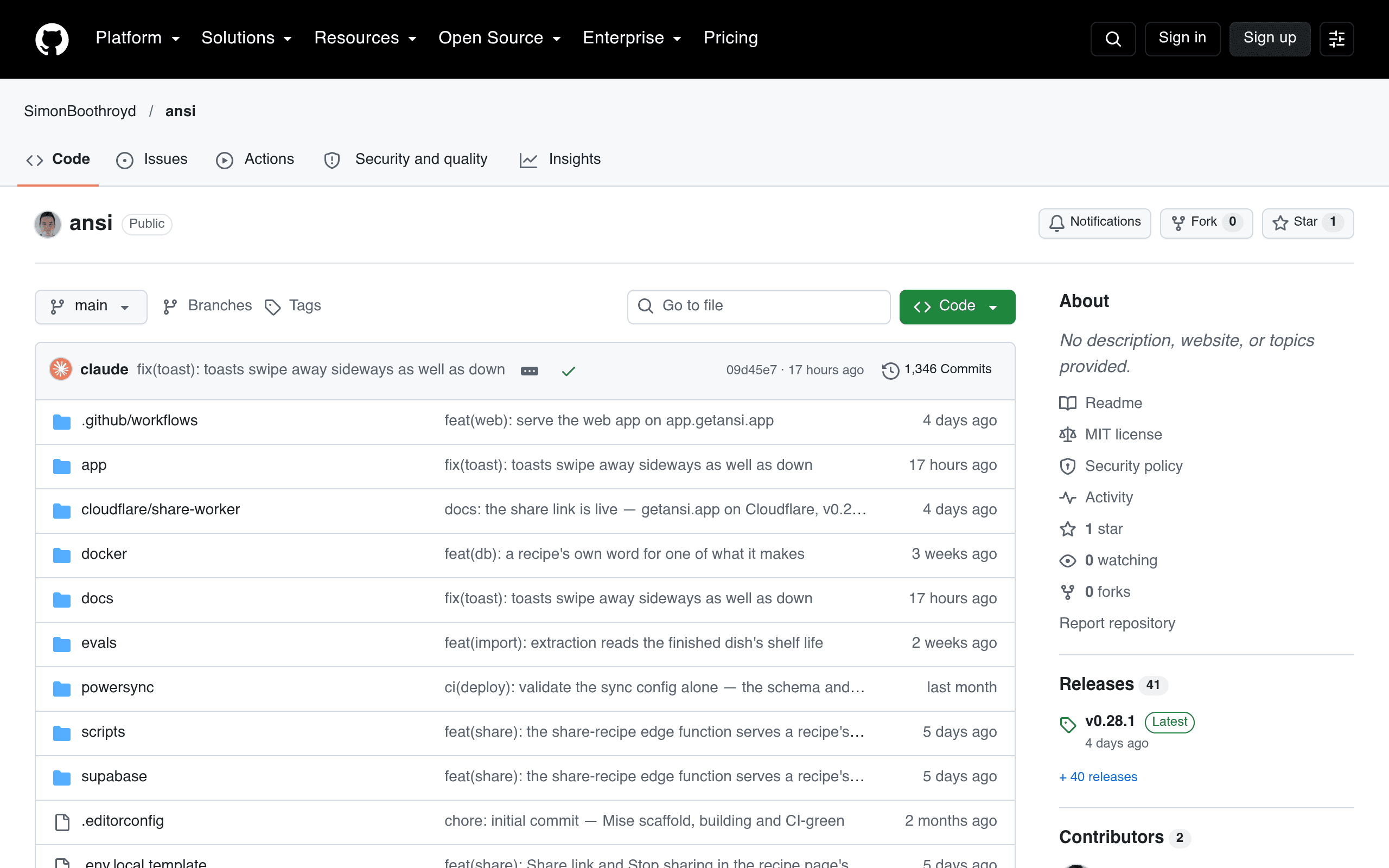
What it isAnsi (formerly Mise) is a shared, offline-first recipe and meal-planning app built for a two-person household — the author's own kitchen. You plan the week you want to eat; Ansi derives what to cook in batches (bounded by each dish's shelf life) and builds a shopping list that buys each ingredient only once. It runs a real household's kitchen every week — not a demo. Entirely vibe-coded, by the author's own accountThe README's "How this is built" section leads with it: "This project is entirely vibe-coded. Every line of application code, every test, migration, edge function and generated seed, and most of the prose under docs/, was written by AI coding agents (Claude Code)." The humans steer — product spec, decision records, execution plans, and design review on a real phone — while conventions like AGENTS.md and structural tests exist to keep agents honest across sessions. Offline-first architectureFlutter client with Forui components, Supabase backend (Postgres + Auth + Storage), and PowerSync for offline sync — the shopping list works even in a basement parking lot. The repo also ships a USDA nutrition seed pipeline, a recipe import/matching pipeline with its own eval harness, and local dev via Docker Compose. Who it's forCouples and small households tired of spreadsheet meal plans; developers curious what a serious spec-driven, agent-first workflow looks like end to end; and anyone who wants proof that vibe coding can run a real kitchen.

大赏
已上线
安全隐私claude-code

CrySence: face-aware webcam presence lock

A webcam presence lock for Windows that knows you from everyone else — soft dim when you leave, no-password return, hard lock on strangers.

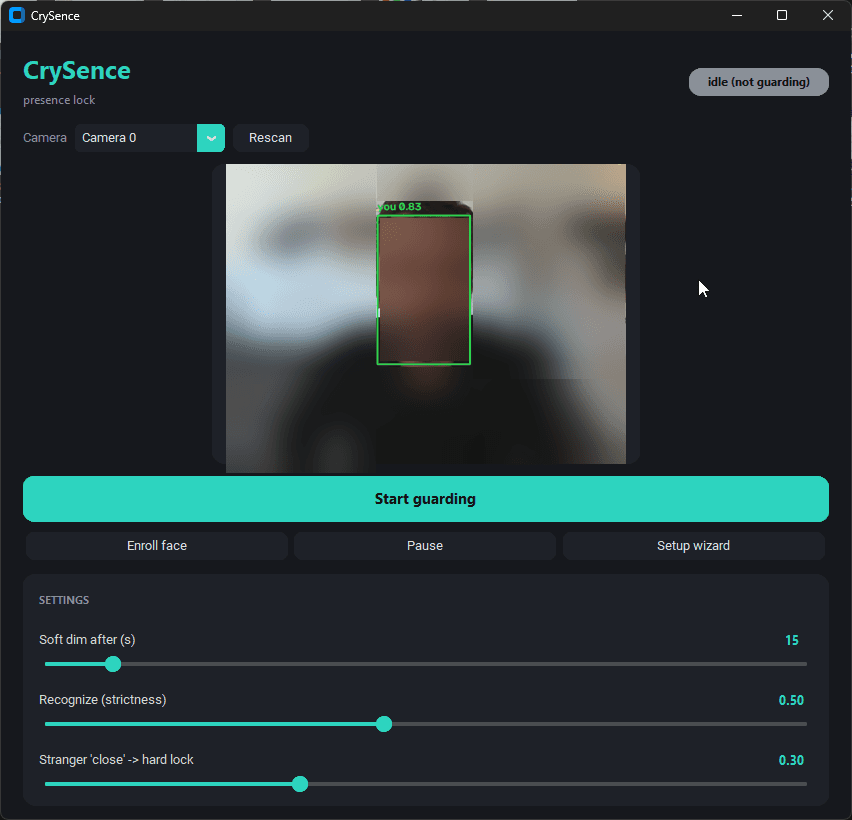
What it isCrySence is a webcam presence lock for Windows that knows you from everyone else. Walk away from your desk and a soft cover drops over the screen; sit back down and it recognizes your face and lifts itself — no password. If a stranger leans close to your screen, it hard-locks Windows, photographs the intruder, and alerts you. And it gets out of the way for video calls: when Teams, Zoom, or a browser call grabs your mic or camera, CrySence pauses and resumes afterwards. 100% local, auditableEverything runs on your machine — face detection (OpenCV YuNet), face recognition (SFace, local ONNX models), and intruder captures never leave your PC. No telemetry, no account, no network calls except the update check to GitHub and the alert channels you configure yourself (Windows toast always on, plus optional ntfy / SMTP / Telegram / Resend). Your face is stored only as a numeric embedding, never as images, and the author invites you to read the ~1,000 lines yourself before trusting the binary. vibe-coded, openlyThe author's own launch copy says it plainly: "I vibe-coded a webcam presence lock that knows me from everyone else" and "So I built one that locks based on whether you're actually there, with Claude Code over a few evenings. ~1,000 lines of Python, open source." Eleven releases through v0.3.7 (2026-09-25) show it wasn't a one-evening throwaway — the changelog reads like a real hardening story: memory leaks in camera drivers, emergency unlock via Ctrl+Alt+Shift+U, hourly update checks. Honest limitationsThe author puts the caveats up front, which we appreciate: the soft cover is privacy not security (Task Manager can kill it — the hard Windows lock is the real lock); no liveness detection yet (a good printed photo could pass 2D recognition); Windows only. Under the hoodTech stack per the author: Python (~1,000 lines), OpenCV YuNet + SFace for detection/recognition, CustomTkinter GUI with a first-run setup wizard, strictness sliders, camera picker and live preview. MIT licensed; run from source or grab the per-user installer from GitHub Releases (unsigned, so SmartScreen will warn — or run from source, which the author recommends). Who it's forAnyone who works in open offices, coworking spaces, or cafes; privacy-minded folks who like local-first software; and a great demo that vibe coding can produce real, working security tooling — with its limitations honestly disclosed.

大赏
已上线
社交社区claude-code

Vibrary: a live pixel library for vibe coders

A live pixel-art library where vibe coders sit together while their AI builds — only activity numbers ever leave your machine.

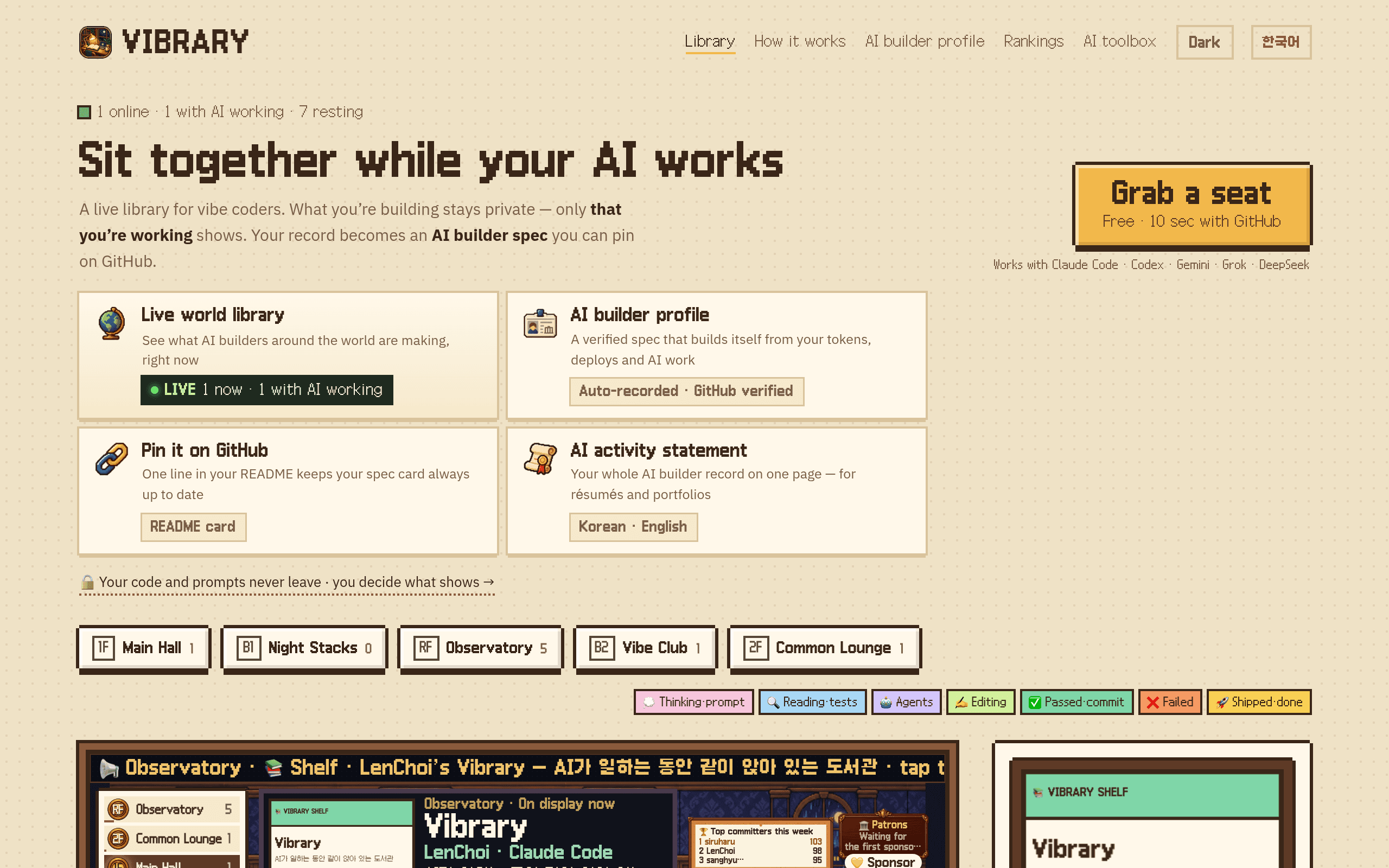
What it isVibrary is a live pixel-art library where vibe coders sit together. You install a small CLI (npm), grab a seat, and your pixel character takes a desk while Claude Code, Codex, Gemini CLI, Grok, or DeepSeek does the actual work on your machine. Speech bubbles over your character show what your AI is doing in real time — thinking through a prompt, editing files, running tests — and when someone deploys, the whole room applauds. It's the cozy coworking feeling of a late-night library, minus the commute. Privacy-first by designThe part that matters most: nothing you build ever leaves your machine. No prompts, no AI replies, no code, no file paths, no commands, no repo names. The CLI counts activity numbers locally (thinking, reading tests, editing, passed commits, shipped) and only those numbers are sent to the server, which you can verify in the CLI source. Your seat's visibility is entirely your choice, and the homepage even shows you exactly which fields go out. Built for buildersVibrary turns your coding activity into an AI builder profile: an automatically recorded, GitHub-verified spec card built from your tokens, deploys, and AI work. One line in your README keeps the card always up to date, and there are weekly leaderboards for the most active builders. It also has an AI toolbox directory and four-language support (including Korean and English). vibe-coded, honestlyThe author's dev.to post (2026-10-12) is the rare kind of evidence we like: "Almost all of the code was written with Claude Code; I did the planning, the pixel art direction and a lot of testing." He also admits upfront that "the real library is still small" — a work in progress growing with its community. When I checked, the room was alive: 1 online, 1 with AI working, 7 resting. Under the hoodTech stack per the author: Next.js, Supabase Realtime for the presence layer, and an ed25519-signed self-updating CLI. Runs on Windows/macOS/Linux via npm; the web library is free with GitHub login. Who it's forSolo developers who miss the energy of coding around other people; anyone curious to see live what AI builders around the world are shipping right now; and vibe coders who want a fun, verifiable record of their AI-assisted work.

大赏
已上线
音乐音频claude-code

Vocafy

A music player for listening to Vocaloid originals by producer, singer, or year — songs, not videos.

Vocafy is a music player built around one idea: listen to Vocaloid songs instead of watching videos. Pick tracks by producer (P主), voicebank singer or release year, and it plays the original YouTube / Niconico uploads — from Hatsune Miku classics to 2024 releases. The home page even has an "On this day" shelf and a Daily Mix. Author piro0919 writes on Show HN: "I built it together with Claude Code." A focused, listen-first player for the Vocaloid catalog, live and browsable right in the browser.