129 GB of Weights, No Launch Event: Ant's Ling-3.2-air Jumps AutomationBench from 15.7% to 61%
On November 23, 2026, Ant's inclusionAI quietly uploaded Ling-3.2-air to Hugging Face: 124B parameters, MIT open weights, no blog post, no launch event — the repo was created at 03:55 UTC. AutomationBench jumped from 15.7% to 61%, and independent testing largely reproduced the vendor's numbers; but the legal all-pass rate after hallucination checks is just 0.8%, so this is not yet a model that signs off on work by itself.
At 03:55 UTC on November 23, 2026, Ant Group's inclusionAI team uploaded a new model to Hugging Face: Ling-3.2-air, a 124-billion-parameter multimodal mixture-of-experts model that activates only 5.5B parameters per token, released under the MIT license. There was no blog post, no launch event, no technical report, not even an announcement post. The first to notice were pull requests in SGLang and vLLM — the two inference frameworks submitted same-day code to support the new model, and engineers following those commits found the freshly created repository. By the time the upload finished, it held 13 safetensors shards, about 129 GB of weights, a model card of roughly 6,000 bytes, and an MIT license. That was the entire release: a model put itself up, and the vendor said nothing.
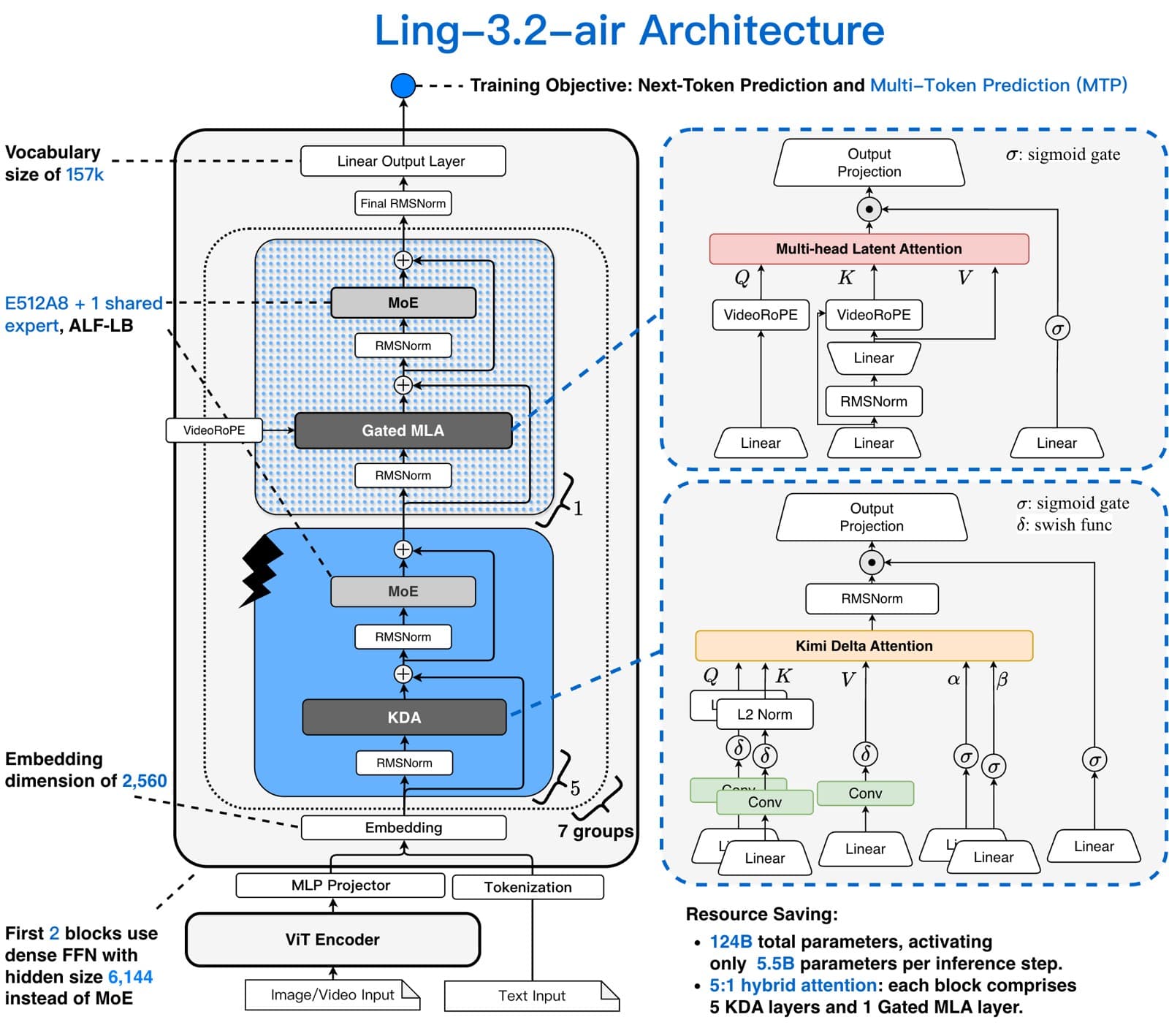
The model itself first. Ling-3.2-air shares the native multimodal architecture of Ling-3.0-flash-VL: text, image, and video go in, text comes out. The architecture is a hybrid-linear MoE: of 42 layers, 35 use KDA linear attention and 7 use gated MLA, roughly a 5:1 ratio, with the first two layers dense rather than MoE. Each MoE block holds 512 routed experts plus one shared expert, activating 8 routed experts per token; hidden size is 2,560, vocabulary 157,184. Native context is 262,144 tokens, extendable to 1,048,576 with YaRN. The weights are FP8 quantized (e4m3, 128×128 blocks), with the vision tower, word embeddings, router gates, and linear projections held out of quantization. The official serving recipe calls for four 141 GB-class GPUs (H200, H20-3e, or a four-GPU Blackwell node) at 256K context, or eight 80 GB cards in parallel. Sampling is opinionated: temperature 1.0, top_p 0.95, top_k 20, with thinking mode on.
Then the numbers. The model card compares the new model against its predecessor, Ling-3.0-flash-VL, and the biggest jump is in office automation: AutomationBench-AA rises from 15.7% to 61%, nearly four times higher. GDP.pdf all-pass on professional documents rises from 8.4% to 16%; AA-Briefcase v1.1 Elo rises from 987 to 1,340, a gain of 353 points; Terminal-Bench 4.0 rises from 0% to 27%. On the composite side, it scores 23 on the Artificial Analysis Intelligence Index v5.0.1. The results table attached to the card adds more: SWE-bench Pro from 26.40 to 58.28, DeepSWE at 42.48, TAU3-Banking at 50.51, OmniDocBench1.5 at 92.30. Read alone, the table looks like a generational leap across the board.
But the same card carries unflattering numbers, and the vendor did not hide them. On the legal benchmark Harvey LAB-AA v1.1, the model passes 87.7% of individual criteria — respectable — but the all-pass rate, requiring a whole legal document to be fully correct, falls to 8.3%, and after a strict factual-hallucination check, to 0.8%. In other words, ask it question by question and it gets nearly nine out of ten right; ask it to produce one error-free legal document on its own, and fewer than one in a hundred passes. Artificial Analysis' independent run draws the same shape: capability sub-scores of 42.1 for strategy and operations, 36.8 for finance and accounting, 31.6 for economics, 29.4 for legal, and 28.7 for engineering — a professional-documents profile — while coding-oriented FrontierCode 2.0 sits at 8.1%, Terminal-Bench Science at 3.8%, Omniscience at −13.4, and the hallucination rate at 49.3%. This is not a generalist; it is a specialist with sharp strengths and sharp weaknesses.
Whether the vendor's numbers can be trusted is the most interesting part of this story. Normally, model-card figures deserve only half your trust: the vendor picks the benchmarks and runs the tests. This time, Artificial Analysis ran the same suites on the day the model went up, and the agreement is unusually tight: AutomationBench 61% vendor versus 60.8% independent (flagged as a partial score); AA-Briefcase Elo 1,340 versus 1,339.45; GDP.pdf all-pass 16% versus 15.8%; Terminal-Bench 27% versus 26.8%; Harvey all-pass 0.8% versus 0.83%; Intelligence Index 23 versus 23.39, a rounding difference. Vendor and independent figures matching to the first decimal place is rare in model launches. It does not prove the model is that good in every setting, but it does prove the card's numbers were not cherry-picked.

The 61% headline still needs to be read honestly. AutomationBench measures office automation workflows: reading documents, filling forms, completing multi-step tasks. 61% means six out of ten workflows complete — and four fail somewhere along the way. For a team considering handing invoice review, expense processing, or contract drafting to the model, that 39% failure rate decides that the human does not leave the loop: the model can do the work first, but someone must still check it. The sharper warning comes from the legal 0.8%: if your workflow has zero tolerance for error, Ling-3.2-air is not yet a model that can sign off on work by itself. Its correct use is as a partner that drafts first and gets reviewed — not as a replacement you can hand work to and forget.
Anyone who wants to use it must also clear the deployment hurdle. Right now there is no hosted endpoint to call and no price: the model card itself says it "isn't deployed by any Inference Provider." The quickstart points at a dev-tagged SGLang image — and the image is still named for the previous model (dev-Ling-3.0-flash-VL). The pull request adding native support to mainline SGLang (#52593) was still open and unmerged at last check; the vLLM path is a fork (inclusionAI/vllm-ling-v3) that you build from source, not an upstream release. In short: it runs today, but it is not yet one ordinary pip install away. And the expensive part is not the 129 GB download — it is the KV cache for a 256K context, which eats more memory than the weights themselves in the four-GPU recipe.
The "no launch" is itself the most interesting part of this story. A major lab uploads a 124B open model at half past three in the morning, attaches a five-section model card, and then goes quiet. The developer documentation still stops at Ling-3.2-flash; the pricing page has no row for anything called air. Independent analyst OrcaRouter's reading: this is not a cancelled launch, it is "shipped, not launched." If a pricing entry, an API endpoint, and a technical report appear in the coming week, treat today's repository as the release and the announcement as the marketing. If they never appear, Ling-3.2-air becomes one of the largest unannounced open-weight releases of the year — and the weights themselves are the only release note you will get.
The 61% is also worth benchmarking sideways. The card's results table lists other models on the same AutomationBench row: Qwen-3.8-Flash-Next at 55.90%, Gemini 3.8 Flash (High) at 59.90%, GPT-5.6 Luna (Max) at 50.20%, Qwen3.8-27B at 48.20%, and Claude Sonnet 5 (Max) at 36.50%. So on the vendor's own table, Ling-3.2-air does not merely beat its predecessor — it leads every comparison model shown, including far larger closed flagships. That "first in the table" claim needs a discount, of course: the vendor chose the comparison set, and independent testing re-ran Ling's scores, not the others'. It proves Ling-3.2-air is genuinely strong on this benchmark; it does not prove it beats every rival in every office scenario. But even discounted, a jump from 15.7% to 61% in one generation remains the largest single-release automation gain from any open-weight lab this year.
The architecture deserves a plain-language unpacking. Of the 42 layers, 35 use KDA linear attention and 7 use gated MLA, interleaved at roughly 5:1. Linear attention is cheap and memory-light, good for carrying long context; MLA (multi-head latent attention) is precise and retentive, good for tasks that need exact alignment. The hybrid means most layers run the cheap kind for volume, with an expensive layer inserted every few layers to protect accuracy. The first two layers skip MoE entirely and use dense feed-forward networks, so inputs get solidly processed before being routed to experts. 512 routed experts with only 8 active per token is the classic "large pantry, small crew on duty" design: the model holds a lot of knowledge, but each token only calls on eight experts, so inference costs look like a 5.5B dense model rather than a 124B one. That trade-off defines its positioning: not a flagship chasing absolute capability, but a working model chasing value for money.
The context window is designed for the same kind of work. 262,144 tokens natively, 1,048,576 with YaRN, means a several-hundred-page contract, a quarter of financial statements, or a medium codebase can be loaded whole into one conversation and reasoned over. For document agents that is a hard requirement: many office tasks fail not because the model cannot understand one page, but because it can only see a few pages at a time and loses the whole picture. A 262K native window at 5.5B active parameters means tackling long documents at the per-step cost of a mid-size model. Long windows are not free, though: attention decay over long contexts and key information getting buried are old problems for every long-window model, and the card carries no dedicated evaluation of that — teams should test it themselves.
The quiet upload also reflects a shift in how big labs do open source. The standard launch ritual of the past year has been four pieces on the same day: blog post, technical report, API, and benchmark tables. Ling-3.2-air does the opposite: weights and a card only. One reading is that inclusionAI treats Hugging Face as the real release channel — code and weights first, articles and marketing later or never. A more practical reading: November is a crowded release window, with GLM-5.4, Inkling 2 Mini, and Hy4 all landing in the same week, and a silent upload lets the model speak through its scores instead. Either way, the result is the same: it was discovered not by marketing accounts but by SGLang and vLLM commit logs — by engineers watching framework updates. "Let the repository speak for itself" is becoming the new normal for open-model releases.
For readers who build AI applications — especially agents — the appeal is not "another 124B" but the combination: 5.5B active, 61% automation, MIT license. Teams building their own document agents struggle with three things: cost, compliance, and control. Closed APIs charge per token and get expensive at volume; data leaving the internal network raises compliance questions; black-box behavior is hard to audit. An open model you can self-host, with only 5.5B active parameters and a strong automation score, answers all three: four cards can run it, data stays inside, and the weights and code are in your hands. Its limits are equally clear — weak at code, high hallucination — so the right shape is "read documents, run workflows, give advice," not "write production code" or "issue legal opinions unsupervised." Used in the right place, it is a cheap and capable clerical assistant; used in the wrong place, it is an intern who fabricates numbers with a straight face.
The risk notes should be complete. Both quickstart commands carry --trust-remote-code, meaning the repository's own modeling code (modeling_bailing_moe_v3_vl.py, 127 KB) executes directly. Read that file before running it — basic practice for any open model shipping remote code, not a special warning about Ant. The MIT license has no usage restrictions, which also means no built-in safety guardrails: the card has no safety-evaluation section, no training-data statement, and no dedicated harmful-content testing. Any team putting this in front of users needs its own safety layer first. Finally, FP8 quantization is what squeezes a 124B model into 129 GB, and quantization costs precision; the vendor's numbers were measured on FP8 weights, so switching to another quantization format may move the scores — re-run the core benchmarks before putting critical work on it.
One more comparison worth keeping: Artificial Analysis' sub-scores show a "professional-documents strong, coding weak" profile — strategy and operations 42.1, finance and accounting 36.8, economics 31.6, legal 29.4, engineering 28.7, all reading-materials, analysis, and judgment work; coding-oriented FrontierCode 2.0 at 8.1% and Terminal-Bench Science at 3.8% show it is not built for writing code or doing scientific computing. That matches its stated goal: the card opens by saying the improvement over its predecessor is in "workflow automation and reasoning over professional documents." No model is good at everything; Ling-3.2-air picked the office-automation lane and posted one of the best open-model scores on it so far. Judge it on the lane it chose, not by making it race coding specialists at writing code.
The download itself is worth a line: 13 shards totaling about 129 GB, with a ModelScope mirror that went up the same morning for users in China. 129 GB sounds large, but for a 124B model it is already the FP8-compressed size; in BF16 it would double. What decides whether it fits in your server room is not download bandwidth but the purchase order for four 141 GB cards — or eight 80 GB ones.
A boundary to draw: this site previously covered Ant's LingGuang, a product that turns one sentence into an app and went viral on its product shape; it also covered Cline's limited-time free Ling 3.1 Flash offer, a reseller promotion. This article is about a new generation of open weights from the Ling family itself — the release, the numbers, and the deployment reality — not the same thing as either of those, and it does not repeat their content.
One thing to watch: whether Ant "buys the ticket after boarding." If a pricing-page entry, an API endpoint, and a technical report show up, the silent upload was just one beat in the launch rhythm. If nothing appears for a long time, Ling-3.2-air becomes a case study in a shift: big-lab open models moving from "launch event and story" to "weights sitting there for the community to find." Either way, the weights are already out, the benchmarks have already been independently run, and the model does not get weaker for lack of a launch event.
Comments (0)
Sources
Related articles

On November 24, 2026, Tencent open-sourced Hy-MT3: 102 languages (up from 38), three sizes from 1.8B to 30B-A3B, and a 1.8B GGUF build of about 1.35 GB that runs on a laptop. The 30B model claims flagship-beating quality at under 1 TFLOP per sample — vendor-tested, with its own TransRubric as the ruler.

On November 24, 2026, SenseTime open-sourced SenseNova U1.6, an 8B unified visual model that proofreads its own pictures: UltraTextBench dense infographics rise from 86.04 to 92.28 with self-correction on. Apache 2.0 weights, ComfyUI support on day one — but 35 GB of weights, 24 GB of VRAM, and vendor-only numbers so far.

On November 24, 2026, OpenAI added nine manuscripts to its public math repository, one claiming the matrix multiplication exponent is exactly 9/4. The October upper bound is real; the new lower bound would close a 56-year gap — but the preprint is unreviewed, the Lean formalization covers only division-free circuits, and no faster program follows from it.