Anthropic pushes ahead with pre-Thanksgiving IPO at a lower $1.25–1.75 trillion valuation
Anthropic is pressing ahead with a pre-Thanksgiving IPO at a $1.25–1.75 trillion valuation, accepting a lower price after the tech selloff rather than delaying. The roadshow starts next week; the filing still has no price range.
Anthropic has decided not to wait. The Financial Times reported on November 6, citing multiple investors, that the Claude developer still plans to go public before Thanksgiving (November 26), raising $80 billion to $100 billion at a valuation of $1.25 trillion to $1.75 trillion. That is well below the roughly $2 trillion the most optimistic investors hoped for a month ago, but comfortably above Anthropic's current private valuation of about $965 billion. The Decoder relayed the report on November 7; Bloomberg reported the same day that prospective buyers were discussing $1.2 trillion to $1.3 trillion.

To be clear about what this piece is and is not: it is not a repeat of our October 26 article on Anthropic's S-1 filing, which covered the formal prospectus and the plan to list on the Nasdaq Global Select Market under the ticker ANT, nor of the mid-October piece on third-quarter revenue of $16.8 billion and two consecutive quarters of adjusted profitability. This one covers what changed on November 6 and 7 — a timetable that is now essentially set, a valuation range reported for the first time, and a company choosing to list at a lower price rather than wait out the worst week of the tech selloff.
How the valuation shrank
The valuation curve is a sketch of this year's AI private-market sentiment. A leaked draft filing in late September discussed roughly $2 trillion; by October 15, when Reuters reported third-quarter revenue, investors were talking about $1.5 trillion; on November 5, Reuters and The Wall Street Journal reported that prospective buyers doubted even $1.5 trillion would hold; and on November 6 the FT's report widened the range to $1.25 trillion to $1.75 trillion. One large investor told the FT bluntly that his view is the company will "price it very conservatively, call it $1.5tn, and go up from there"; other participants in the deal expect a landing point closer to $1.3 trillion.
Measured against the $2 trillion top, even the $1.75 trillion end of the range is a 12.5% cut; at the $1.25 trillion bottom, it is 37.5%. That is a public concession by any standard for a company about to list. What matters is not the number itself but the choice behind it: Anthropic could have delayed, as OpenAI recently did with its own IPO plans, while cutting its private round's valuation target from $1.4 trillion to $1.25 trillion. Anthropic chose the opposite — accept the lower price, keep the timetable.
Why now, and why not wait
The timing looks unfriendly. After Democrats won the US midterms promising to slow data center construction, among other measures, tech stocks sold off this week; the Nasdaq 100 fell 6.4% on Thursday before recovering somewhat on Friday. Rising borrowing costs and the AI industry's heavy spending plans are forcing the market to reprice the sector. The Information reported the roadshow starts next week, the week of November 9, with a listing targeted for the week of November 16; JPMorgan is scheduled to hold an information session for prospective investors on November 13. In other words, Anthropic is going on the road just after the market fell.
What supports the decision is that the revenue numbers keep climbing. The FT put Anthropic's annualized revenue run rate at about $81 billion, up from roughly $65 billion at the end of July, with third-quarter revenue of about $17 billion, up nearly 50%. The Wall Street Journal separately reported cash of $146.6 billion as of September 30. The implication is that Anthropic is not listing because it is short of cash; it is listing because it wants a public-market valuation anchor — and a window that closes before the Thanksgiving holiday. Wait until December and the holidays, earnings season and policy uncertainty all make it harder.
There is also a more concrete consideration: the compute bill. Anthropic's reported compute and infrastructure spending plans run to about $900 billion over the coming years. Whatever the final figure, it explains why a company sitting on $146.6 billion of cash still wants to raise $80 billion to $100 billion now. The burn rate of the model race makes going public a question of when, not whether.
Do not mistake the range for a price
One note of caution: everything reported so far is a discussed target attributed to investors, not filed offering terms. The S-1/A amendment filed on November 2 still contains no price range and no share count. Goldman Sachs and Morgan Stanley lead the offering, the ANT ticker and Nasdaq Global Select Market plan are unchanged, but the final price will only be known after the roadshow. Anthropic declined to comment on the reports.
That makes the next two weeks the real test. Roadshow feedback will decide whether the range drifts toward the $1.75 trillion top, slides toward the $1.25 trillion bottom, or breaks below it. If institutional buyers hold at the $1.2 trillion to $1.3 trillion they have been discussing, Anthropic will have to choose between cutting again and holding firm. The "price it conservatively and go up from there" line sounds reassuring — better a first-day pop than a broken IPO — but a first-day pop also means money left on the table.
What this IPO actually tests
If it goes ahead, Anthropic's listing would be the first frontier AI lab to reach the public markets at this scale. Its significance goes beyond one company: OpenAI has just closed roughly $11 billion in first-tranche funding at a $1.25 trillion valuation — also a revised-down number — and the whole industry is going through the same exercise, with private-market valuations being re-examined by public investors. Anthropic's willingness to be examined first is itself a signal: it believes its revenue growth, an $81 billion annualized run rate, supports a trillion-dollar valuation, even if not $2 trillion.
But a signal is not a conclusion. The question investors have to answer has not changed: at the current pace of spending for growth, when does this become sustainable profit? Third-quarter revenue of $16.8 billion and two straight quarters of adjusted profitability are Anthropic's best cards; a compute spending plan on the order of $900 billion is its heaviest. Listing before Thanksgiving lays both cards on the public market's table at once and asks everyone to price them on the spot. The roadshow will test not just Anthropic's valuation, but whether the AI industry can keep telling its story at the current burn rate.
The roadshow: what to watch over the next two weeks
The deal mechanics are settled: Goldman Sachs and Morgan Stanley lead the offering, JPMorgan handles US retail sales and is scheduled to hold an information session for prospective investors on November 13. The Information reported the roadshow starts the week of November 9, with a listing targeted for the week of November 16. What matters is how roadshow feedback feeds into pricing — the S-1/A filed on November 2 still has no price range or share count, so the final landing point depends entirely on whether institutional buyers show up over the next two weeks.
One older item belongs in the background. The FT reported on October 30 that Blackstone, the anchor investor in the $63 billion financing for Anthropic's chips, told investors it now expects a "high" junk rating for Anthropic after the IPO, in the double-B range, instead of investment grade. A company about to raise $80 billion to $100 billion being rated junk by the bond market is not a contradiction; it captures how split the market's view is. Equity investors are betting on growth; credit investors are looking at leverage and burn. Both answers can be true at once.
The valuation arithmetic
On the FT's figure of about $81 billion in annualized revenue, the math is straightforward: the $965 billion current valuation is roughly 12 times annualized revenue; $1.25 trillion is about 15 times; $1.5 trillion about 18.5 times; $1.75 trillion about 21.6 times; $2 trillion about 25 times. The argument between buyers and sellers comes down to whether 18 to 19 times annualized revenue is a fair price for a company still burning heavily — and that depends on how long the growth lasts. Annualized revenue rose from about $65 billion at the end of July to about $81 billion, roughly 25% in three months. If that pace holds for another year or two, 18 times is not expensive; if growth reverts to normal, even 12 times looks dear.
If the roadshow disappoints, Anthropic's options are thin: cut again, shrink the raise, or delay. OpenAI is the live precedent — it delayed its IPO, cut its round's valuation target from $1.4 trillion to $1.25 trillion, and ended up raising only about a third of the $30 billion it originally sought. Anthropic differs in one important respect: it has already filed a public prospectus, so withdrawing costs more, and once the Thanksgiving window closes, the next good one is not until early 2026. That is the rational core of "accept the lower price and list anyway": a first public valuation, even a low one, beats staying private indefinitely — it gives future financings, employee options and the whole industry's valuation anchor a public number to work from. The gap between $2 trillion and $1.5 trillion is large; the gap between having a public price and not having one is larger.
Comments (0)
Sources
Related articles
On November 6, 2026, Anthropic published new research on agent memory: notes, salience judgment, and offline 'dreaming.' In Pokémon Red, the model that wrote 413 memory files earned one badge; the one that wrote nine earned four. This article breaks down the experiments — and what vibe-coding developers can reuse from them.
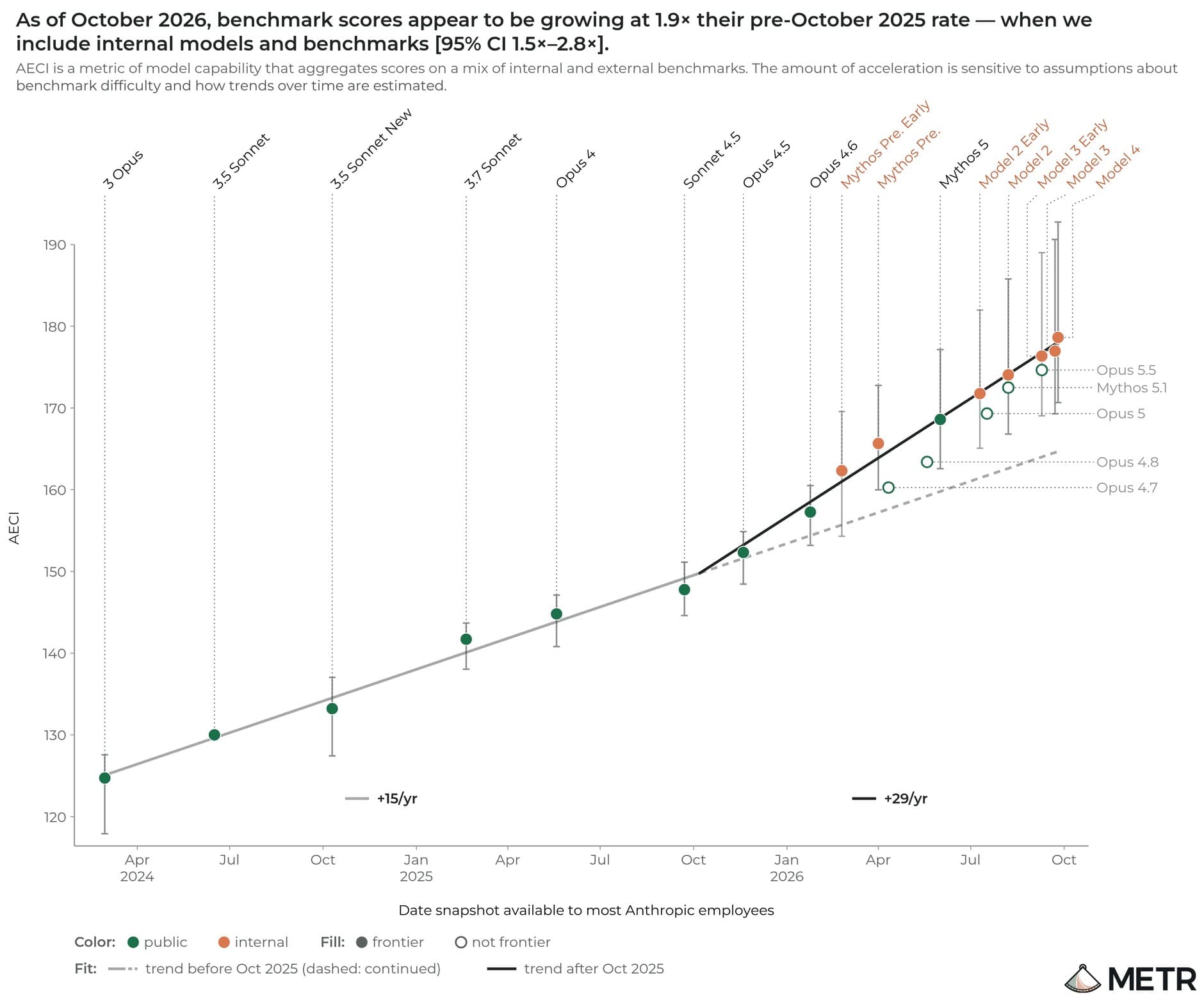
METR spent 11 weeks inside Anthropic and estimates the lab is now improving its models about twice as fast as before, with most of the acceleration coming from AI itself. But most of the key evidence was redacted.

On November 2, 2026, Anthropic put message threads in public beta on the Claude Platform: send the full conversation once, then only the new messages each turn. Median time to first token falls about 35% on 500K–1M token requests — but token usage, pricing, and rate limits do not change. This article explains how it works and where its limits are.