AI Is Making AI Faster — and the Pace Is Quickening: METR Puts Anthropic's R&D Acceleration at About 2x
METR spent 11 weeks inside Anthropic and estimates the lab is now improving its models about twice as fast as before, with most of the acceleration coming from AI itself. But most of the key evidence was redacted.
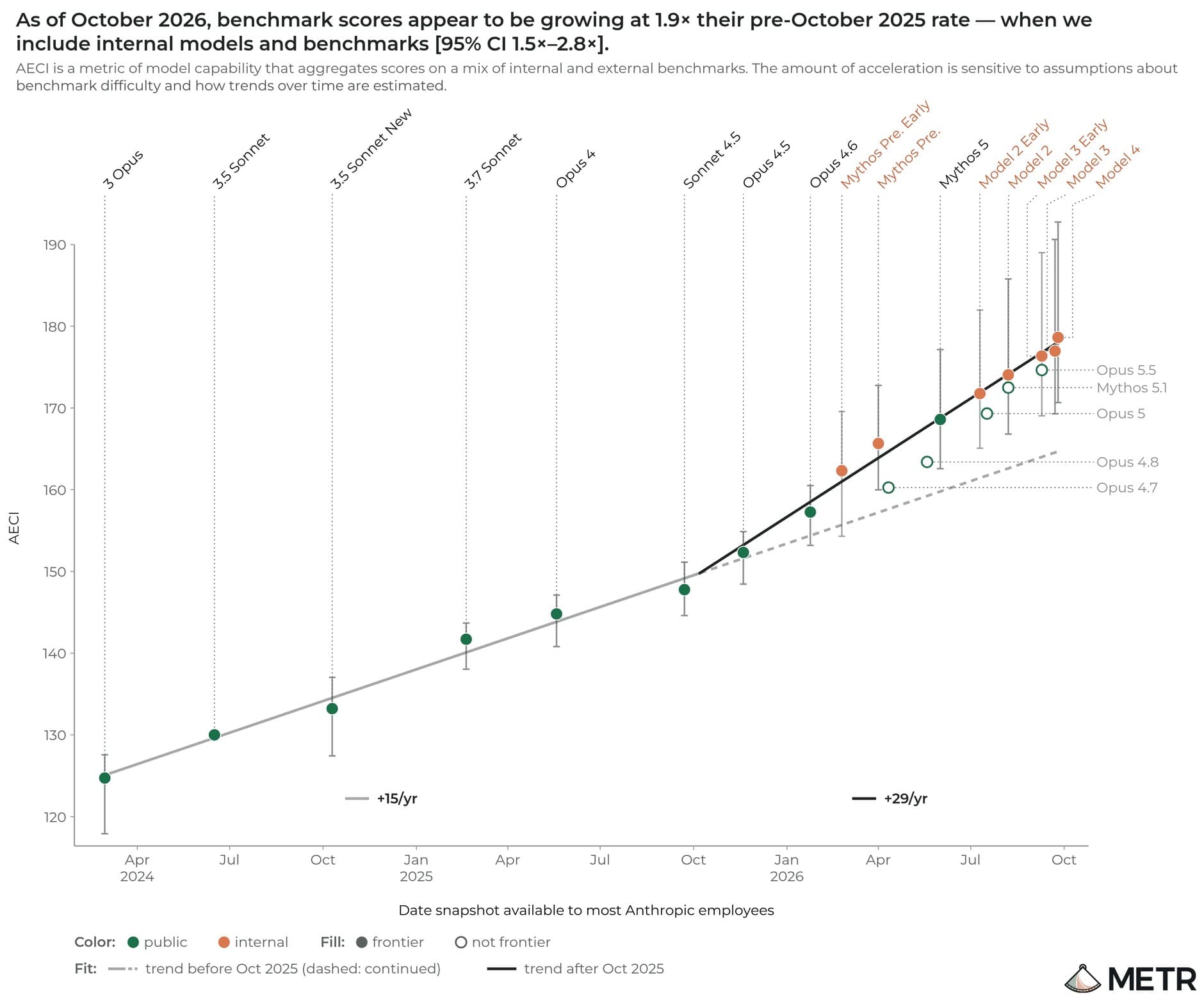
AI is making AI itself stronger, and doing it about twice as fast as a year ago — that is the conclusion of an independent assessment published on November 5 by METR, the nonprofit AI evaluation group. But the most interesting part of the report is not the conclusion. It is the long list of reservations sitting next to it: the most important evidence was redacted, the error bars on the headline number span a factor of two, and the evaluators themselves disagreed on several key questions.

This is not an ordinary industry report. METR's team spent 11 weeks inside Anthropic, working on the company's own devices, reviewing pretraining and reinforcement-learning metrics, compute allocations, benchmark scores for internal models, and speedup analyses, and interviewing about 15 employees. Anthropic did not pay for the work. That level of access is unprecedented in AI safety evaluation — and the result is a report that marks nearly every claim with uncertainty. For people who write code with these models every day, the value of the report is not the answer it gives but the fact that it measures, with internal data, a number everyone has only been guessing at: how much is AI accelerating AI?
How the assessment was done
The methodology matters, because almost all of this report's credibility rests on it. The evaluation ran from August 12 to October 29, 2026 — 11 weeks — carried out by 2.5 full-time-equivalent staff, with about 15 staff interviews, and no payment changed hands. The internal material Anthropic shared included metrics on pretraining and reinforcement learning, training compute in each domain, benchmark scores for internal models, AI speedup analyses, forecasts of a future model's metrics, and interviews with relevant staff.
The core question was a single one: is AI starting to significantly accelerate AI research and development itself, and if so, could that lead to a sudden emergence of extreme and risky capabilities? Anthropic lists AI R&D acceleration as a key risk indicator in its Responsible Scaling Policy, which is why it invited an outside group in to audit the question.
But "invited in to audit" and "free to say anything" are two different things. The engagement was agreed on terms: Anthropic had the right to redact any non-public information, and METR had the right to disclose that redaction had happened and whether its findings depended significantly on redacted material. The published report was written under those terms — the conclusions can be public; most of the evidence behind them cannot. That structure is the precondition for understanding everything that follows.
How the 1.9x was calculated
The central figure is 1.9. METR's yardstick is AECI, Anthropic's version of the Epoch Capabilities Index — a composite of benchmark scores that tracks what its models can do on well-specified tasks. Since October 2025, AECI has been growing at an estimated 1.9 times its pre-October 2025 rate, with a 95% confidence interval of 1.5 to 2.8.
Put plainly: in the past year, Anthropic appears to have made as much progress on benchmarks as it made between October 2023 and October 2025 — roughly the span from Claude 2.1 to Claude Sonnet 4.5. In slope terms, AECI used to grow by about 15 points a year; since October 2025 it has grown by about 29 points a year.
METR's verbal characterization is more cautious than the number. Its words: as of October 2026, Anthropic is "likely" improving the capabilities of its models on well-specified tasks at around twice the rate it did between March 2024 and October 2025 — and it "would not be surprised" if the true acceleration were closer to 1.3x or 3x. So 1.9x is the central estimate, 1.3x to 3x is the range the evaluators consider plausible, and the 95% interval of 1.5x to 2.8x is a statistical statement. The three numbers are not the same thing and should not be read as if they were.
The figure is higher than Anthropic's own public number. The Claude Haiku 5.5 system card reported 1.7x. METR explains the gap mainly by its inclusion of data on unreleased models, including an internal model called "Model 4" that finished training in September–October 2026. Model 4 scores 178.6 on AECI — 179.7 when three suspicious benchmarks are excluded — and scores above 50% on every AECI benchmark on which it was tested. That is a sign that internal benchmarks are starting to saturate, and METR admits it makes the group "somewhat nervous" about whether AECI can keep reliably measuring acceleration in the future.
The robustness checks are equally worth noting. Varying the choice of benchmarks, model dating, model inclusion, and saturation handling moves the estimated acceleration between 1.1x and 2.9x. METR's judgment is that it would be surprised if an improved version of AECI showed no acceleration, or acceleration above 3x. In other words, the acceleration itself is probably real — but nobody can give you the multiple to one decimal place.
Who gets the credit: about 80%, with heavy uncertainty
Acceleration happened. Next comes attribution: how much of it is AI's doing? METR's answer is "we guess that a majority (perhaps ≈80%) of the current acceleration is due to AI" — with the report emphasizing, in language as strong as it gets, that this judgment carries "substantial uncertainty."
Several things the evaluators are relatively sure about. First, they are "confident" the acceleration was not caused by faster growth in training compute — Anthropic did not simply buy its way to a steeper slope. Second, interviews and surveys are consistent with AI use driving a doubling in the pace of capabilities progress: researchers' estimates of AI-attributable acceleration in their own areas varied widely but centered around 2x. Third, staff self-reports of speedup have climbed steadily: internal Slack polls show estimated uplift rising from about 1.2x at Claude 3.7 Sonnet to about 12x by Model 4 in October 2026. But METR itself flags this as "only very loose evidence" — the polls are low-effort reaction votes, not measurements of acceleration rates.
Several things the evaluators explicitly say they do not know. The acceleration in late 2025 was "likely influenced by non-AI factors," but the details of many of those factors were redacted. Anthropic's own staff did not agree among themselves on attribution, and the evaluators "did not find decisive evidence." And there is a key qualifier: AI is "not yet able to make highly significant and fully autonomous contributions to the most important parts of the model training process." Today's acceleration comes mostly from AI helping researchers do their work, not from AI training models by itself. The report adds one sentence that deserves a pause, though: there are already "signs of life" that fully autonomous contributions could play a larger role soon.
For readers, the right way to hold the "≈80%" figure is as a directional guess, not a measurement. Its real information content is twofold: the acceleration was not bought with compute, and people on the research front lines broadly feel AI is making them faster. How much faster, and how the credit splits, the report does not answer in a way anyone can independently verify.
Most of it was redacted
The most newsworthy thing about this report may not be its conclusion but the scale of its redactions. In the "redaction summary" at the top, METR writes that Anthropic redacted "a majority of the evidence we found most informative for these conclusions." Anthropic described the redactions as "aimed at removing confidential information that could accelerate other AI developers."
METR states the consequence plainly: much of the redacted evidence had multiple plausible interpretations, and both METR and Anthropic researchers had significant uncertainty about how to synthesize it; it is hard for the public to judge the evidence itself, reconcile it with evidence from other sources, and come to its own conclusions — "this report does not achieve 'transparency about evidence.'" The result is that the public "has to rely on METR's judgment much more than would be ideal, given the weight of the questions answered here."
Sam McCandlish, Anthropic's co-founder and chief architect, responded on X on November 5, acknowledging that Anthropic "redacted a lot" and that this makes it "harder for others to check METR's work." He added that many of METR's conclusions match his own — a line widely quoted in coverage. Notably, his response supplied no redacted data; it confirmed the fact of the redactions and the independence of the evaluators' judgment.
There is a genuine tension here. Inviting an outside group in is itself a gesture of transparency; redacting most of the key evidence weakens that gesture considerably. METR's approach was to put the tension on the table: it lists, item by item, which important evidence it could and could not discuss, and marks clearly how far its conclusions depend on redacted material. That does not solve the transparency problem, but it at least tells the reader where the problem is — instead of handing over a polished conclusion and pretending all the evidence is on the table.
The second review: the public risk report understated the acceleration
Published the same day was METR's second output: a review of the "Risks from automated R&D" section of Anthropic's August 2026 Risk Report. Its conclusion deserves to be pulled out separately, because it speaks directly to whether what Anthropic says publicly matches what was happening internally.
The review agrees with Anthropic on one point: as of July 15, catastrophic risk from the models was low. It disagrees on another. Anthropic's public report stated that the models had not crossed its own "2x Acceleration Threshold" — an early-warning line. METR holds that this claim rests on "contestable judgment calls," that it is "plausible" the threshold had been crossed at the time, and that the public report "overall understates the level of acceleration that was occurring."
That is restrained language with heavy weight. Its implication is that Anthropic's public risk assessment lagged behind the acceleration actually happening inside the company — partly because of methodological disagreements, and partly because of evidence the public cannot see. One sourcing note: the details of this companion review are drawn from METR's same-day publication and from direct quotations of it in independent coverage; this article's account follows METR's own published text.
No bottlenecks found — what that means
The third major finding is that METR saw no evidence of significant bottlenecks that would prevent further capabilities progress in the next 12 months — whether in algorithmic progress, training compute, experiment compute, or data. But the sentence is followed by a self-undercutting qualifier: the evaluators' understanding of the status of different bottlenecks "changed several times" over the course of the assessment, so they are "not confident in [their] current assessment."
That is an honest but unsettling combination. No bottleneck found does not mean no bottleneck exists; it means that a 2.5-person team, over 11 weeks, with much of the evidence redacted, did not find one. METR's own conclusion is that there is a "significant risk" that further capabilities progress could lead to even faster acceleration over the coming year. The precise meaning for readers: a self-reinforcing cycle of acceleration has not been disproved — not that it has been proved.
There is another detail that often gets missed: during the assessment, Anthropic canceled a planned component that would have verified how its compute is split between capabilities and safety work, saying it wanted to keep the engagement focused on risk assessment for the time being and would revisit compute-allocation verification later. METR recorded the fact without turning it into an accusation. For readers, the point is a reminder: the scope of the assessment was itself negotiated, and what the evaluators could and could not see was adjusted mid-course. The conclusions should be read together with that boundary condition.
One more distinction is worth making. This assessment is not the same thing as the independent-evaluator program Anthropic announced on October 15 — METR states explicitly in its report that the two are distinct. The October program is a standing arrangement giving outside evaluators long-term access; this was a one-off, high-access assessment of R&D acceleration. The two should not be conflated; this site has already covered the October evaluator program, and this article concerns only the November 5 acceleration assessment.
What it means for vibe coding
The report looks remote from the daily work of writing code, but the transmission chain is short. If the pace of model improvement really has doubled, the toolchain you are comfortable with today may be rewritten by the next generation of models tomorrow: stronger coding models, longer autonomous tasks, cheaper inference, arriving faster than they used to. For vibe-coding practitioners, that changes a default assumption — toolchain choices that used to be reviewed quarterly may now need monthly review.
But the report also points in the opposite direction: the measurement of acceleration is itself deeply uncertain. Benchmark saturation, methodological choices, and redacted evidence all mean the "2x" figure could be revised at any time. Betting a career plan on one specific acceleration multiple is the same mistake as betting a toolchain choice on one benchmark ranking: treating an estimate as if it were a measurement.
More worth noting is the report's quiet judgment that AI cannot yet make fully autonomous contributions to the most important parts of model training — but that "signs of life" are already visible. That sentence draws a line: on one side, "AI helps people do research faster"; on the other, "AI does research by itself." METR's assessment is that as of October 2026 we are still on the first side of the line. The subtext is equally clear: the line is being approached, and faster than anyone expected.
How to read this report
Finally, the question of how to read it. The report is easily misread in two directions: as "AI is already copying itself, loss of control is imminent," or as "just a PR exercise staged with the vendor." Neither matches what the report actually says. METR found no AI autonomously training models, and no imminent catastrophic risk; it also gave Anthropic no clean bill of health — it said explicitly that the public report understated the acceleration, that the threshold may already have been crossed, and that it has no confidence in the bottleneck assessment.
The reading closest to the text is actually plain: an independent group was invited inside a frontier lab, spent 11 weeks measuring a number nobody had measured, and concluded that acceleration is probably real, roughly twofold, and mostly connected to AI — but the strongest evidence behind that conclusion is not visible to the public, the error bars are wide, and the evaluators themselves remain unsure on several questions. The report's value is not that it ends the argument, but that it grounds the argument in internal data for the first time — even though most of that data remains locked in a black box.
Three things are worth tracking next: first, whether METR publishes a follow-up with fewer redactions, or whether other labs accept the same kind of assessment; second, whether Anthropic responds to the charge that its public report understated the acceleration, and changes how it discloses risk; third, whether the internal Model 4 shows up in the coming months in the form of a public product — if it does, the AECI score of 178.6 will finally have a public reference point. For developers, those follow-ups matter more than the headlines of November 5.
Sources: METR, "Independent Assessment of AI R&D Acceleration at Anthropic in October 2026"; METR's companion review of the automated R&D section of Anthropic's August 2026 Risk Report, published the same day. The multiples cited are METR's estimates and carry high uncertainty.
Comments (0)
Sources
Related articles

On November 5, 2026, Anthropic added Personal Finance to Claude: link US bank and card accounts through Plaid and ask about your spending, read-only. ChatGPT did the same in May; Claude is six months late, betting the word “read-only” buys trust — but read-only stops theft, not wrong totals.

On November 5, 2026, OpenAI launched GPT-6 Cyber: 48.5% on ExploitGym, 948 working Linux privilege-escalation exploits in one scan, and 81 high-severity Firefox flaws. It is not open to the public — only approved Daybreak Red customers get access.
On November 4, chip-design lab Ricursive released its first public model, Ripple-65B Preview: a 65B dense model scoring 80.52 on Terminal-Bench 2.1, ahead of the 501B Reflection Beam, with a claimed total R&D cost of just $32 million.