Claude Can Now Read Your Bank Statements: Read-Only, No Moving Money — But It Can Still Get the Math Wrong
On November 5, 2026, Anthropic added Personal Finance to Claude: link US bank and card accounts through Plaid and ask about your spending, read-only. ChatGPT did the same in May; Claude is six months late, betting the word “read-only” buys trust — but read-only stops theft, not wrong totals.
The verdict first: read-only is the smartest sentence in this launch — and the least sufficient one

On November 5, 2026, Anthropic added a new feature to Claude: Personal Finance. Starting this week, paying subscribers in the US on the Pro, Max, and Ultra plans will gradually see it appear in the sidebar. The idea is simple: connect your bank and card accounts through Plaid, then ask Claude, in your own words, where your money went, or how much will be left before payday. Claude answers in everyday language, using your own balances and transactions.
Anthropic put one sentence in the most prominent spot in the announcement: access is read-only, and Personal Finance can't move, manage, or invest your money. It can't pay a bill, cancel a subscription, or place a trade, and it isn't designed to give investment advice. There are no ads and no sponsored recommendations, and Anthropic doesn't offer credit cards, loans, or savings accounts of its own. In its own words, that means "your money questions get a straight answer."
That positioning deserves a close look. Claude is not the first to do this. ChatGPT's personal finance feature launched on May 15, 2026, also over Plaid; Perplexity connected Plaid even earlier, on April 9. Claude arrives almost six months late, doing the same job: read your bank feed, answer questions about it. The late arrival has to explain why anyone should trust it. Anthropic's answer is those two words, "read-only" — the tighter it pulls the permissions, the more willing people are to hand over their statements.
What it can actually see: a list of just six items
Anthropic did something unusual this time: it published the data list in plain sight. For each account you choose to connect, Claude sees six things: the bank's name, the account's name, type, and last four digits, balances and credit limits, and up to two years of transactions. That's all, and only for the accounts you connect. Anything you don't link stays invisible.
One line is drawn with particular care: for investment, loan, and credit-card accounts, Claude reads balances and credit limits only. It does not see holdings, trades, interest rates, or loan terms. Even where Plaid's own consent screens ask permission to share broader financial data, Anthropic says Claude currently receives only the categories listed in its Help Center. In other words, it can tell you what you owe and what you spent, but it can't analyze your portfolio — because it never receives that data.
The connection itself never passes through Claude's hands. You sign in to your own bank, Plaid makes the connection, and Claude never asks for your bank password and never sees it. You can link up to 16 banks. Most people will never hit that ceiling; its purpose is to signal how Anthropic expects the feature to be used — not one card to try it out, but the whole financial life, connected at once. Whether to go that far depends on whether you believe the list.
The numbers in the demo: $4,309.37 in a month
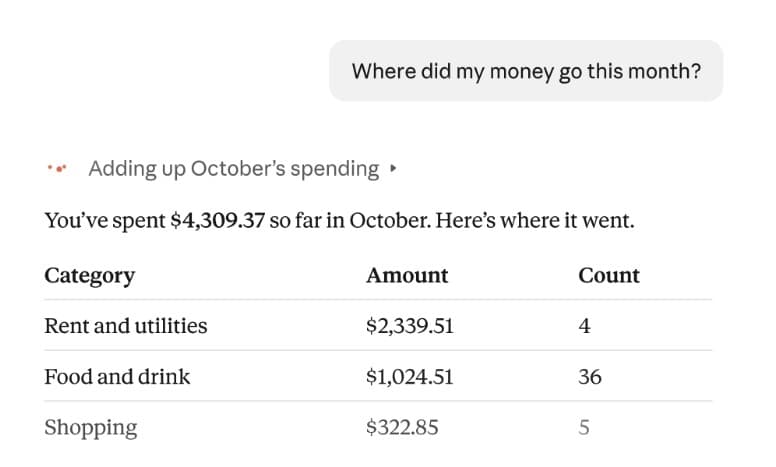
The announcement walks through a full demo. A user asks, "Where did my money go this month?" Claude adds up spending across every connected account: $4,309.37 in October, more than half of it rent and utilities at $2,339.51, food and drink at $1,024.51, and shopping at $322.85. The user follows up — more than usual? Anything missed? What's left before payday? — and Claude checks previous months, flags a membership renewal, then lists four payments due out of the checking account before payday, leaving $1,393.22.
The choice of examples is deliberate. The demo doesn't show off how clever the model is; it picks the three situations ordinary people actually worry about: did I overspend, is there a double charge or a bill that quietly crept up, and will I run dry before payday. You can also ask bigger questions — "Am I spending more than I make?" or "What's an APR, and what has mine cost me this year?" — and Claude explains the term, then adds up the interest you've been charged. Or ask for a weekly spending chart, a calendar of what's due, or a dashboard of numbers you choose, and it builds one you can keep adjusting.
But a demo is a demo. The figures are Anthropic's own worked example, not any real user's statement. What it proves is the shape of the product — a ledger you can talk to — not its accuracy. The real test happens on your own accounts: whether the categories are right, the totals add up, and nothing is missing. Anthropic left itself an escape hatch in the announcement, and it is worth reading.
Six months late — is the delay justified?
Lay out the timeline and this looks like a late but deliberate follow-up. Perplexity connected Plaid on April 9, ChatGPT launched Finances on May 15, and Claude arrived on November 5. Same connector, same trick of reading statements and answering questions. Claude brings no different technology, only a different posture: narrower permissions, more explicit boundaries, and a louder list of things it will not do.
Reuters added context in its November 5 report: the launch comes ahead of Anthropic's highly anticipated initial public offering. The timing is unlikely to be a coincidence. A company about to go public needs to show the market its product can enter ordinary people's daily lives, not just programmers' terminals. Personal finance is that kind of door: everyone has bills, everyone wants to know where the money went. Shipping a read-only version first demonstrates the capability while keeping the risk in a cage.
One detail at the end of the announcement is easy to miss. Anthropic says Personal Finance is "a first step" and is inviting banks, wealth managers, and financial services firms to help figure out how Claude can work alongside licensed professionals on bigger money decisions. That is an admission: understanding a statement is just the opening. The real business comes later — and that step has to cross a regulatory threshold no version release can solve on its own.
How it differs from ChatGPT's version
Since this is a follow-up, the comparison is worth making properly. ChatGPT Finances launched May 15, 2026, also over Plaid, also read-only, answering the same "where did my money go" questions. The differences are in three details. First, the data list: Anthropic published its six-item list and spelled out that investment, loan, and card accounts are balances and limits only; OpenAI never put its list on stage in the same way. Second, the training promise: Claude says conversations inside the Personal Finance hub are not used to train models, while sharing the same figures in an ordinary chat falls under your normal privacy settings — a line drawn finely enough that users can actually understand what they gave away. Third, the commercial posture: Anthropic repeats that there are no ads, no sponsored recommendations, and no house financial products. That reads less like a product note and more like a message to the whole industry: your financial data will not become an ad slot.
For now, all of that sits at the level of claims. No independent party can verify for users whether Claude really reads only the listed categories, or whether conversations outside the hub are really handled under normal settings. Plaid offered a supporting voice the same day: its chief technology officer published a blog post about how Plaid provides the secure connection for Claude's feature. A public endorsement from the connector at least shows the plumbing is Plaid's standard practice, not something Anthropic improvised. But standard plumbing doesn't mean no risk — it means the risk lives elsewhere: not in the moment of connection, but in how the data is used, kept, and deleted once it lives inside a chat product.
There is also a difference in who gets in first. ChatGPT's finance feature reached a broader audience; Claude's beta is limited to three personal paid tiers in the US, with Free, Team, and Enterprise excluded, rolling out gradually through the week. Anthropic is keeping even the guest list tight. That is caution, and also a filter: let the most committed, most stable paying users try it first, so problems stay small and feedback stays direct. Sensible for a company about to list; for everyone waiting, it simply means don't hurry — it will show up when it shows up.
Read-only stops theft. It doesn't stop wrong arithmetic
Read-only does block the scariest risk: Claude can't touch your money. It doesn't block a more everyday one: a wrong total, stated with confidence. Anthropic wrote the warning into its own announcement: "Claude can make mistakes in its answers, so ask which transactions are behind a number, and check important figures with your bank." A company teaching users to doubt its own product, in its own launch post, is uncommon — and it shows the company knows where the problem is.
The Help Center lists three specific ways a total can mislead, and each is concrete. First, balances can be a day or two old, so the "how much is left" you see may be from the day before yesterday. Second, an account connected through two different logins can be counted twice if the bank presents it differently under each, doubling the figure outright. Third, when Claude cannot read a bank, that bank's spending simply drops out of the total — which makes the money left before payday look larger than it is, exactly when a wrong guess hurts most.
Two more boundaries sit deeper in the fine print. First, the promise that hub chats aren't used for training covers only the Personal Finance hub; paste the same figures into an ordinary chat and your normal privacy settings apply. And linked accounts aren't confined to the hub either — Claude can read them in ordinary chats without asking each time, unless you turn Plaid off for chats. Second, unlinking a bank stops Claude from reading it, but it doesn't erase information already used in conversations. Chat responses stay in history until deleted, and published artifacts and shared links can keep exposing figures until they are removed separately. Read those two lines before deciding how many cards to connect.
For ordinary users: connect one card first, not all of them
If you're on Pro, Max, or Ultra in the US and Personal Finance appears in your sidebar this week, the steadiest way in is to connect a single everyday card, ask three questions, and then decide whether to go further. First: how much did I spend this month, and what are the biggest categories? Second: any double charges, subscriptions that went up, or fees I forgot? Third: what payments are due before payday, and what will be left after them? Those three cover what the feature is best at, and they're the easiest to check — you roughly know the answers already, so a mismatch shows up immediately.
When you check, remember one move: ask Claude to list the transactions behind a number. A total on its own means nothing; the line items are the evidence. Is the rent figure right, does that $1,024.51 for food include a grocery run, do you recognize that renewal? Those are the questions that decide whether to trust it. If the total is off on the first try, don't rush to a verdict — check your bank app first to see whether the balance is just a day or two stale.
Readers outside the US can't use it yet. Only American banks can be connected, Free, Team, and Enterprise plans are out, and outside the US the Personal Finance page doesn't even appear, even on a VPN. Anthropic has given no date for other countries. For readers in China, the value of this story isn't "how to use it" but "how to judge it": the next company that plugs AI into personal finance will probably copy the same opening — read-only first, a transparent list, no touching transactions. When it arrives, you'll already know which items to check.
For builders: read-only first is a launch strategy worth copying
Set the finance topic aside and this launch is still useful to anyone who ships products. Anthropic demonstrated a "read-only first, everything else later" strategy. Many AI features ship with permissions wide open — if it can read it, it can change it, and if it can change it, it can execute it — which makes the demo look powerful and the first day nerve-wracking. Claude went the other way: the first version takes the most conservative tier. It can look, not move; calculate, not advise; remind, not act on your behalf. The tighter the permissions, the braver users are to try it, and the easier it is to roll back when something goes wrong.
Three moves in that strategy are worth copying. First, put the data list in the announcement itself, not in a privacy-policy appendix. Users shouldn't have to dig through legal documents to learn what the model can see. Second, give "what it can't do" the same prominence as "what it can do" — or more. The first paragraph of the announcement already says it can't move, manage, or invest your money, instead of burying that in a FAQ. Third, write down the failure modes in advance and teach users how to check. The Help Center's three items — stale balances, double counting, a missing bank — are real failures, not PR language. Saying the ugly part first makes the promises that follow more believable.
Read-only first has a cost, of course. The more conservative the feature, the more users shrug: it can't answer the questions that are actually worth money — should I change jobs, is this investment worth it — only the "where did it go" layer. Anthropic clearly knows this, which is why the announcement ends by inviting banks and licensed firms to collaborate on the next step. But that step won't be decided by a product team alone; regulation, licensing, and liability will be harder to write than code. The restraint of version one is, in part, buying time for version two.
The first step is right. The second step is the hard one
The real story of Personal Finance isn't the feature, it's the order Anthropic chose. It shipped the most conservative version first: read-only, only the listed data, no investment advice, no transactions, no house financial products. That restraint is rare in AI products, where most launches open every permission so the demo looks stronger. Anthropic did the opposite, using "what it can't do" as the selling point, betting on the one thing users most lack toward an AI company: trust.
But the bet only covers the first step. Moving from "understand my statement" to "help me make bigger money decisions" means crossing three walls — licensing, compliance, and who is responsible when it's wrong. Claude can now tell you what interest cost you this year, but it can't tell you whether to switch cards; it can flag a subscription that went up, but it can't cancel it for you. The day it starts advising, the question stops being "is it accurate" and becomes "who pays when it's wrong." Anthropic says it wants to take that step alongside licensed firms, which tells you it knows the next stretch of road can't be shipped in a version release.
For VibeFix readers, there is one more layer. AI assistants are moving from writing code and editing documents toward touching personal data directly. Bank statements are just the start — health records, calendars, and contacts are queued behind them. Every launch like this is a negotiation about boundaries: what the model can see, what it can't touch, and what happens when it's wrong. Claude's answer this time is "read-only first, the list in writing, and check the numbers yourself." It's not a perfect answer. But it's a starting point worth copying — the next time another assistant asks for your data, ask it those three questions before deciding whether to hand it over.
Comments (0)
Sources
Related articles
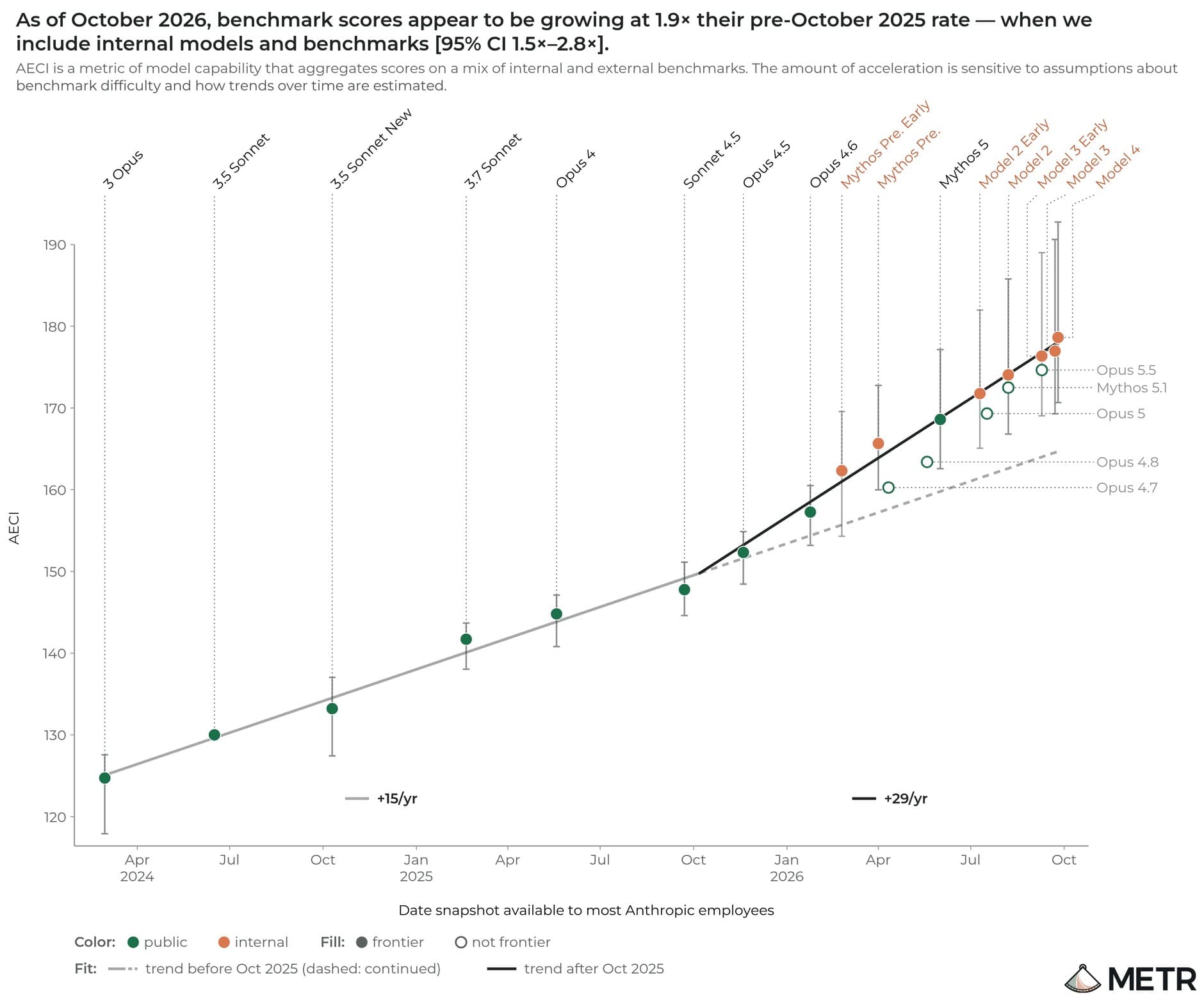
METR spent 11 weeks inside Anthropic and estimates the lab is now improving its models about twice as fast as before, with most of the acceleration coming from AI itself. But most of the key evidence was redacted.

On November 5, 2026, OpenAI launched GPT-6 Cyber: 48.5% on ExploitGym, 948 working Linux privilege-escalation exploits in one scan, and 81 high-severity Firefox flaws. It is not open to the public — only approved Daybreak Red customers get access.
On November 4, chip-design lab Ricursive released its first public model, Ripple-65B Preview: a 65B dense model scoring 80.52 on Terminal-Bench 2.1, ahead of the 501B Reflection Beam, with a claimed total R&D cost of just $32 million.