AI Coding Enters Government: Anthropic Opens Singapore Office, Signs MOU as 1,500 GovTech Engineers Modernize Systems with Claude Code
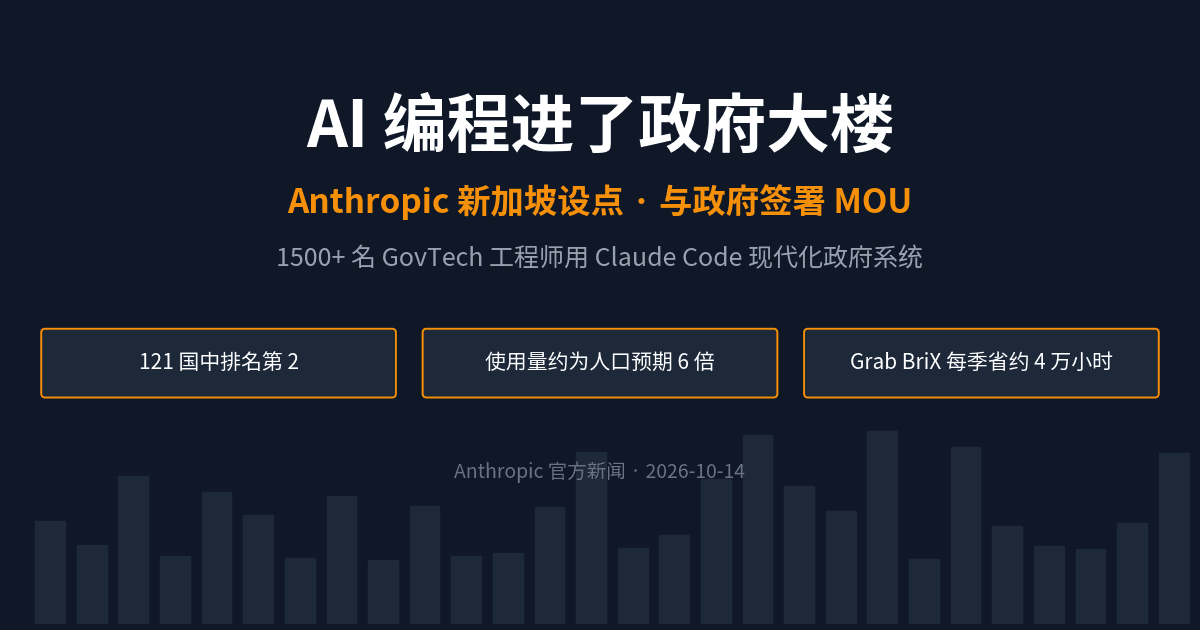
On October 14, Anthropic announced its fifth Asia-Pacific office in Singapore and an MOU with the Ministry of Digital Development and Information. Over 1,500 GovTech engineers already use Claude Code to modernize government systems, and Singapore ranks 2nd of 121 countries in per-capita Claude.ai usage.
An Office in Singapore, a Contract with the Government
On October 14, 2026, Anthropic published a seemingly routine corporate announcement on its website: a new office in Singapore — its fifth in the Asia-Pacific region. On the same day, it signed a Memorandum of Understanding (MOU) with Singapore's Ministry of Digital Development and Information.
Announcing both on the same day sends a clear message: Anthropic isn't setting up a sales outpost with a few customer success managers in Singapore. It's packaging the "office" and the "government partnership" into a single calling card. In the official wording, Singapore is "one of our most active markets anywhere in the world" — Claude already powers services used by millions of Singaporeans every day, from GovTech to Grab to DBS. The office is the effect; deep adoption by government and enterprises is the cause.
For the vibe coding community, the real weight of this news isn't the office opening. It's what's on the other side of the MOU: more than 1,500 government engineers using Claude Code to rewrite a country's government systems.
What the MOU Actually Says
Start with the signing itself. It took place on the sidelines of Singapore International Cyber Week: Anthropic co-founder Ben Mann and Kai Fong Chng, Permanent Secretary of the Ministry of Digital Development and Information, put pen to paper, witnessed by Minister Josephine Teo and Anthropic's Head of APAC Policy Michael Sellitto. That's a serious protocol level — a minister witnessing in person means this isn't market PR, it's a partnership on the government's agenda.
The MOU lists three areas of cooperation: AI safety and model evaluation, research on AI adoption and its impact, and responsible adoption across the public and private sectors. Concrete actions include technical exchanges with Singapore's AI safety, security, and assurance institutions on model evaluation, testing standards, and incident response; helping small and medium-sized businesses adopt AI responsibly; supporting the government's goal of building AI capability among public officers; sharing research and data with the government, including data from the Anthropic Economic Index; and offering technical and policy expertise as Singapore develops its AI rules.
Notably, this partnership didn't start from zero. Anthropic's work with Singapore goes back to 2023, when it joined the Generative AI Evaluation Sandbox run by the Infocomm Media Development Authority (IMDA) and the AI Verify Foundation, followed by a red-teaming project covering English, Mandarin, Malay, and Tamil. That four-language red-teaming detail is quintessentially Singaporean — a country with four official languages naturally needs multi-language coverage in model safety evaluation, and that's exactly the kind of real-world testing ground Anthropic needs.
Read between the lines of the MOU: Singapore doesn't want to "buy APIs." It wants to "co-define how to use AI safely." For a model company, co-developing evaluation standards with a government famous for governance capability is itself a globally portable credential.
How Deeply One Country Has Adopted AI Coding
The most eye-catching number in the announcement comes from the Anthropic Economic Index: relative to its population, Singapore ranks second of 121 countries in Claude.ai usage — nearly six times what its population size alone would predict.
What does 6x mean? A city-state of roughly six million people outranks most populous nations in per-capita intensity of AI coding tool usage. This isn't dabbling; it's dense, productive use — bank staff, government engineers, startup developers using it to get work done every day. Anthropic's ASEAN General Manager Dale Finlay puts it this way: customers in Singapore hold AI to an extremely high standard, especially on reliability and security. Reaching 6x intensity in a market known for being demanding is itself proof of product maturity.
 Figure 1: Key Singapore Claude adoption figures disclosed by Anthropic (Source: Anthropic official news page, 2026-10-14)
1,500 Government Engineers: The Hardest Endorsement
But the line that makes this news travel is this one: more than 1,500 engineers and technical staff at GovTech Singapore have adopted Claude Code to modernize government systems and speed up software delivery.
Consider the weight of that scenario. Government systems are the code the world is least willing to get wrong: when they break, it's not an app's retention that suffers, it's the public services citizens rely on every day. 1,500 engineers is the entire engineering org of a mid-size tech company — and an AI coding tool is now embedded in their daily workflow, tasked with "modernizing government systems." The official line is that this has helped GovTech teams build, maintain, and enhance digital services more efficiently at national scale.
There's another easily overlooked line in the same paragraph: Singapore's Cyber Security Agency (CSA) is exploring how Claude could help strengthen the country's cyber defense. Note the framing — not "piloting," but "exploring how to strengthen cyber defense." When a nation's cyber defense apparatus starts seriously evaluating an AI coding assistant, that says more than any benchmark score: AI-written code has entered the conversation about "work we can entrust with critical missions."
This is why I say the debate is over. For two years, the Chinese-language internet has never stopped arguing about whether "AI-written code can be trusted": some post products built overnight by AI, others post disaster code AI generated. But most of those arguments stayed at the level of personal experience. The production practice of 1,500 government engineers is an institutional answer, validated under real delivery pressure — when even government systems dare to use Claude Code for modernization, the question of "can AI write production code" already has its practical answer.
The Enterprise Side: Banks, a Sovereign Wealth Fund, and Southeast Asia's Internet Giants
Beyond government, the enterprise roster is equally heavyweight. In financial services: DBS — Southeast Asia's largest bank — works with Claude across software development and day-to-day productivity, explicitly operating within the bank's strict security and governance framework; GIC, Singapore's sovereign wealth fund, is rolling out Claude across its investment and corporate services teams. The announcement pointedly adds that organizations in regulated sectors can now run Claude with in-region inference on Amazon Bedrock, meeting strict data processing requirements. That line is written for every financial institution's compliance officer: data stays in-region, regulators stay calm.
On the internet giants' side: Grab powers BriX, its sales assistant, with Claude — saving sales teams approximately 40,000 hours every quarter while surfacing new sales opportunities. That's 40,000 hours: at 500 hours per person per quarter, roughly the workload of 80 full-time salespeople. Sea (the company behind Shopee, Garena, and Monee) works with Claude to help Shopee's customer service chatbot respond faster and more accurately, and thousands of its employees write and debug code with Claude. And Supabase — the developer platform with deep Singapore roots — is building with Claude Code.
Connect the dots: a bank, a sovereign wealth fund, one of Southeast Asia's largest internet companies, and an open-source infrastructure company used by developers worldwide. This isn't a "pilot." It's a complete, cross-industry production adoption map.
 Figure 2: From office to MOU — Anthropic's Singapore landing landscape (Source: Anthropic official news page, 2026-10-14)
Opinion: Three Layers of Meaning for Chinese Readers
First, a closing verdict on "AI coding skepticism." The skeptics' most common argument is "AI-written code can't go to production." But Singapore's case flips the argument: it is precisely the most risk-averse government systems and the most tightly regulated banks that became the firmest adopters. This shows the AI coding tool maturity curve has crossed the "toy" and "productivity toy" stages and entered the "mission-critical tool" stage. The next time someone argues about whether AI code is trustworthy, this news can be the answer: 1,500 government engineers, 6x population-predicted usage intensity — hard enough?
Second, a signal for Chinese founders expanding into Southeast Asia. Singapore is the first stop for Chinese expansion into the region, and DBS, Grab, Sea, and Supabase are all familiar landmarks for Chinese entrepreneurs. The tool stack these companies use is the competitive baseline you'll face abroad — when your Southeast Asian competitors' engineers each have Claude Code and their sales teams have an AI assistant saving 40,000 hours a quarter, "whether to use AI coding" is no longer a choice. More practically, Anthropic opening an office in Singapore and hosting a Builder Summit (300+ developers) plus a community meetup (700+ local builders) means Chinese developers in Singapore can plug directly into this ecosystem.
Third, "capability and safety moving together" is becoming the government-endorsed playbook. The MOU puts "model evaluation, testing standards, incident response" at the top of the cooperation list, and Singapore's long-standing approach is to push hard on both "enabling innovation" and "managing risk." For vibe coders, this means "security and compliance" is no longer optional in the product narrative for going abroad. Whether your AI product can clearly explain how data is handled, how models are evaluated, and how incidents are answered will increasingly decide whether you make it onto government and enterprise procurement lists.
Two Unanswered Questions
The announcement is information-dense, but two key questions remain unanswered — worth noting for follow-ups.
First, what did the 1,500 engineers' "modernization" actually produce? The announcement gives headcount and direction — "modernize government systems and speed up software delivery" — but no cases: which systems were rewritten? How much faster is delivery? What quality gates and code review processes back it up? For AI-assisted development in government systems, the most valuable thing to see isn't "how much was written" but "how the AI is kept from writing it wrong." If Anthropic or GovTech ever publishes a technical retrospective, it will be worth more than this news itself.
Second, could the MOU's "model evaluation and technical exchange" evolve into a gatekeeping-style evaluation bar? The announcement's wording is cooperation and exchange, but Singapore's governance style has always been "research the standards together first, then turn the standards into requirements." If Singapore eventually makes "passing some AI safety evaluation" a precondition for government procurement or regulated industries, then today's first-mover advantage in "defining the standards" with Anthropic becomes tomorrow's bar every AI vendor must clear. For Chinese AI companies expanding into Singapore, that's both an opportunity and an exam.
Closing: API Vendors Are Becoming "National-Grade Vendors"
Back to the two opening moves: opening an office, signing an MOU. Anthropic also sent senior leaders to Singapore this week, hosted the Builder Summit, its community ambassadors held a 700-person meetup, and the office is "now open and hiring." The posture is unmistakable.
My read: when an AI company packages its "fifth office" and a "government MOU" into the same day's announcement, it's no longer selling API calls — it's selling a new identity: national-grade digital infrastructure provider. From the 2023 evaluation sandbox to four-language red-teaming to today's MOU and 1,500 engineers, Anthropic's path in Singapore has been "prove safety first, then land at scale." Once that path works, it will be replicated in more countries. And for those of us who write code, the most direct takeaway is a single sentence: stop arguing about whether AI can write code — go study how the people already using it to rewrite national systems actually do it.
Comments (0)
Sources
Related articles
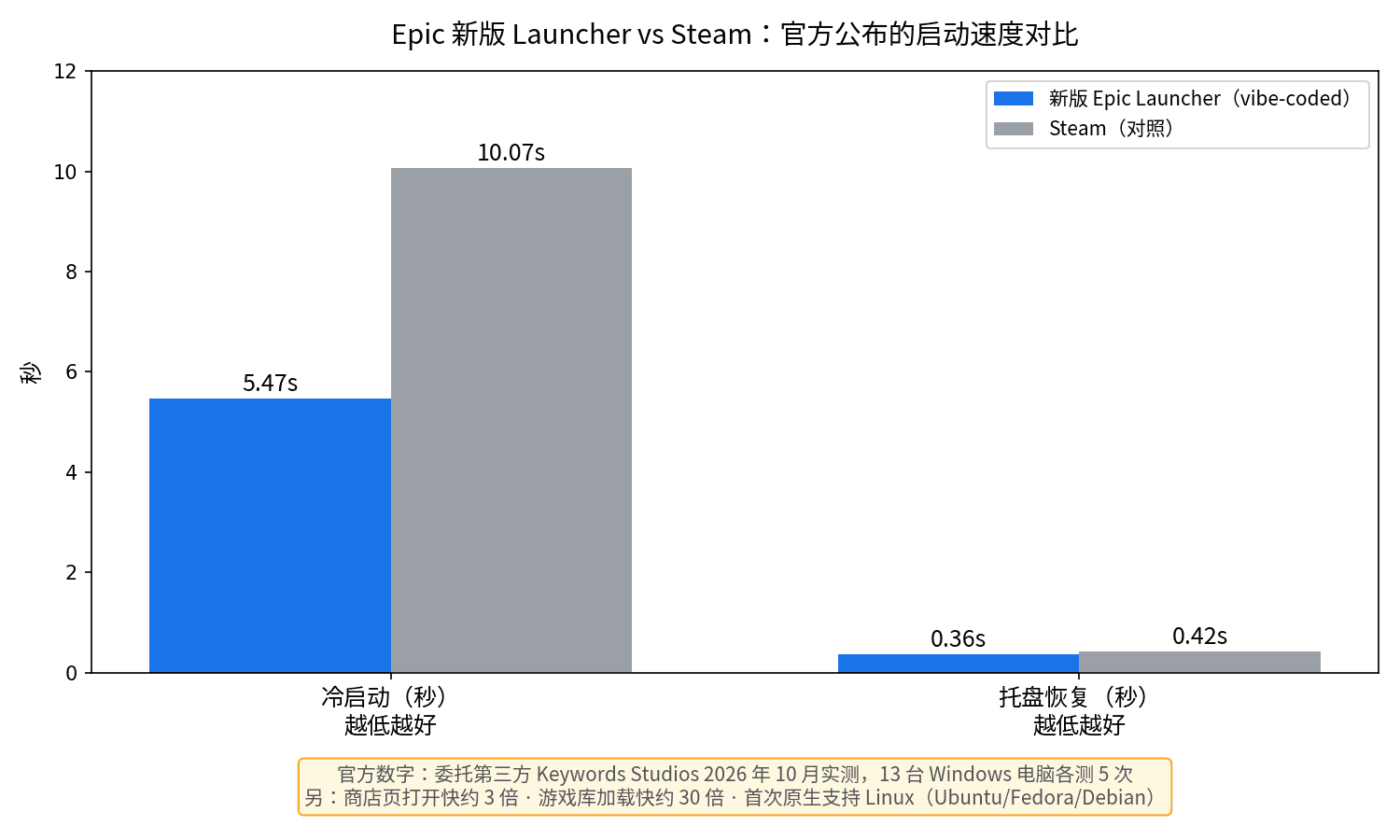
On October 14, Epic Games launched a rewritten Launcher preview and admitted it was vibe coded: 5.47s cold start vs Steam's 10.07s, tested by third-party Keywords Studios, with first-ever native Linux support. A landmark moment for vibe coding going to production.

On October 15, Ant Ling officially open-sourced Ling-3.1-flash: ~560B total parameters with ~25B activated per token, 1M context, a Hybrid-linear MoE architecture, benchmarks aimed at Terminal-Bench 4.0 and SWE-bench Pro, plus a long-horizon task harness called LingCode.
At the Oct 11 '2026 Wonderful Night' gala, Mediastorm's Pan Tianhong demoed a world model: text-generated roamable 3D scenes, modifiable with continued instructions. ByteDance hasn't confirmed it's the reported real-time spatial video model — 'suspected' is the keyword.