Bluesky Attie's 'Social Vibe Coding': Build a Mini-Game for Your Fans Without Writing a Line of Code
On October 15, 2026, Bluesky upgraded Attie at TechCrunch Disrupt 2026: from AI-generated custom feeds to one-sentence websites, quizzes, games, and polls — each on its own attie.site domain, on AT Protocol, reaching Bluesky's 47M registered users. CEO Toni Schneider calls it 'social vibe coding'. Our take: the second half of vibe coding is distribution, not the editor. Four honest caveats and action items included.
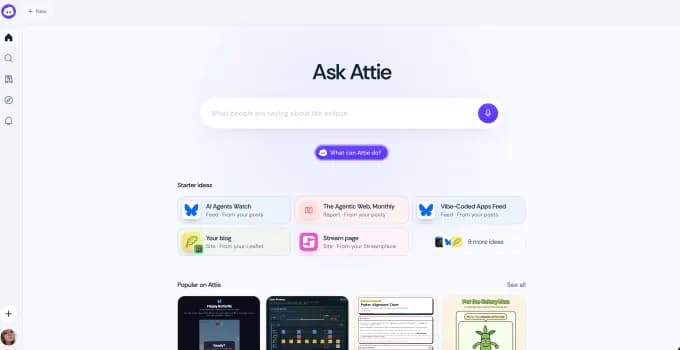
On October 15, 2026, at TechCrunch Disrupt 2026 in San Francisco, Bluesky announced a major upgrade to Attie, its experimental AI product: from "describe it in a sentence and AI generates a personalized feed" to "describe it in a sentence and AI generates websites, quizzes, games, polls, and all kinds of interactive mini-experiences." CEO Toni Schneider defined it on stage: "social vibe coding or vibe coding for your community." This is the first time in 2026's vibe coding race that someone has put "social" and "distribution" front and center — TechCrunch headlined it plainly: "Bluesky expands its AI-powered Attie app to let anyone build websites, games, and more."
What makes this story worth reading isn't "yet another AI site builder." It's a thesis: the second half of vibe coding may not be fought in the editor, but in distribution. "Getting it built" has been solved by AI; "getting it used" is the new scarcity.
What happened: Attie, then and now
Attie is not new. In March 2026, then-CEO Jay Graber launched it as an invite-only closed beta, calling it the "first agentic social app on atproto." Its original job was narrow: users described in natural language what they wanted to see, and Attie generated custom feeds. On October 15, it leapt from "building feeds" to "building mini-apps."
The key facts of this upgrade all come from TechCrunch's on-the-ground report from October 15 (updated October 16; the URL path and Disrupt's schedule corroborate the date):
- What you can generate: websites, quizzes, games, polls, and other interactive experiences — the pitch being that everyday users can now create things previously only software developers could build.
- How you generate: a plain text prompt. A Verge reporter tested it: a "Pokémon Red vs. Blue" poll took just a few minutes. Per the Attie homepage (consistently cited across multiple outlets), the site builder ships with starter templates — polls, events, guestbooks, games, AMA pages, leaderboards, journals, surveys, landing pages, dashboards, even an "explain the joke" template — and friends can sign in with Bluesky to vote, RSVP, or sign.
- Where creations live: each one is published as a standalone site on the attie.site domain, with the creator credited at the bottom. Sites aren't confined to Bluesky; they can be shared anywhere.
- Which models power it: users can bring their own AI model or use open-weight options.
- What protocol it runs on: like Bluesky itself, creations live on the decentralized AT Protocol (ATProto) and are tied to the creator's ATProto identity. Attie also suggests things to make based on your public Bluesky profile — Techdirt founder Mike Masnick (a Bluesky board member) posted that Attie knew he'd moved to Oakland and liked walking, so it built him a walk-tracking site.
The official showcase reveals Attie's intended tone: Flappy Butterfly, a Flappy Bird clone where you dodge bad takes, collect likes, and try not to get ratioed — complete with a leaderboard; a drum machine; a "celery man" idle clicker; and a "poster alignment quiz" that analyzes your last 100 posts to compare self-perception against actual posting behavior. The bet is clear: lightweight, playful, social-by-design mini-experiences, not serious productivity tools.
Two quotes are worth memorizing verbatim. CEO Toni Schneider: "Vibe coding today is kind of a single-user, solo experience… And what I want to be able to do is build together or build for a group of people, and that's what this product does." COO Rose Wang named the business logic: "Who's using the thing you're building, because we haven't solved that problem with distribution… What makes Attie so interesting is that it comes with the Bluesky distribution, so it doesn't stand alone."
Context: TechCrunch, citing bsky.jazco.dev, puts Bluesky at 47 million registered users — while noting in the same article that engagement is declining and some users who tried it have returned to X. The launch is explicitly framed as part of Bluesky's push to reinvigorate activity, with private-data support now in alpha testing and a rollout planned by year's end — which Schneider called developers' biggest request.
Why it matters: the second half of vibe coding is distribution
The thesis, stated plainly: "getting it built" has been solved; "getting it used" is the new scarcity. Lovable, v0, Replit Agent and their peers have driven the cost of "one sentence to a working app" close to zero. The result: 2026 has no shortage of working demos, but a severe shortage of opened links. Attie's upgrade is the first attempt to productize that problem — generation is just the entry point; distribution is the actual product.
Wang's question — "Who's using the thing you're building?" — stings because it names the collective blind spot of the entire vibe coding scene. Over the past year, countless people AI-built personal sites, productivity widgets, and game demos that now sit quietly in browser bookmarks: many builders, few visitors. Attie's answer welds generation to distribution: a poll you make for your fans lives where your fans already are; creations carry your ATProto identity, so authorship travels with them; attie.site gives every creation its own shareable domain. This isn't feature stacking — it's writing "who it's for" into the architecture.
That is also why Schneider keeps hammering "social." Traditional vibe coding runs: you prompt, AI generates, you use it yourself or paste the link around. Attie's loop runs: you prompt, AI generates, your friends use it directly. From "solo act" to "built for a community" — what changed isn't generation quality, it's the default audience of the artifact.
An instructive contrast is Google: around the same time, Google shipped "personal apps" on Google Play — letting you vibe-code an Android app that runs only on your own phone. That is the extreme end of the "for yourself" road: a fully closed loop, one person self-sufficient. Attie stands at the opposite end of the spectrum: from the first line of generated code, it assumes the artifact is for someone else. One converges inward, the other radiates outward; one optimizes "my productivity," the other "our fun." Neither is superior — but the 2026 reality is that "for yourself" tooling is a red ocean (Lovable, v0, Replit, Google all compete there), while social building "for others" is nearly empty. Bluesky picked the lane with the least competition and its own biggest distribution advantage — a shrewder move than many give it credit for.
Three takeaways for indie developers. First, distribution is becoming the new moat: as generation commoditizes, whoever holds the users holds the pricing power. Bluesky spending its 47 million registered users as Attie's launch distribution follows the same logic as WeChat mini-programs riding WeChat or TikTok mini-programs riding TikTok. Second, "small" might be right: Flappy Butterfly, a poll, a walk tracker — none of these impress under the traditional product lens, yet they're exactly the minimum viable shape of "built for a group." Third, protocol-level identity is a hidden dividend: creations living on ATProto, bound to decentralized identity, means a creator's work and reputation aren't locked to one platform — a real draw for indie developers tired of platform dependence.
The comparison below makes the two paths concrete: same input ("one sentence"), all the difference in the second half — where the artifact lives, how it's distributed, and who the default user is.

Honest caveats: don't go all-in yet
Before declaring Attie a "vibe coding revolution," four cold showers are in order.
First, 47 million is registered users, not active users. TechCrunch states the 47M figure in the same paragraph that notes declining engagement and users drifting back to X. "Built-in distribution" is an edge over Lovable-style tools, but Bluesky's own distribution pool is leaking. The dividend is real — just don't do math with 47 million.
Second, the capability boundary is clear: it's a mini-experience generator, not a dev platform. The Verge's hands-on verdict: beyond the official showcase, early creations were closer to novelties than serious tools. Ukrainian tech outlet Mezha was blunter, saying the first batch looked a lot like AI slop. Expecting Attie to produce a SaaS product is unrealistic — its sweet spot is lightweight "make it and share it" scenarios: polls, quizzes, mini-games, event pages.
Third, it's not a Lovable/v0 replacement. Attie and Lovable aren't even in the same race: Lovable-class tools solve "turning an idea into a complete product"; Attie solves "conjuring something playable for your community in minutes." The former competes on generation quality and engineering completeness; the latter on social context and distribution. Which to pick depends on whether you want to "ship a product" or "make some noise."
Fourth, a transparency note. The attie.site details, the template list, and the Flappy Butterfly examples in this article come from the Attie homepage and multiple secondary reports (The Verge, webpronews, madrobot.blog, and others) whose accounts are mutually consistent — but TechCrunch's original on-site report doesn't spell out each item, and we've labeled that accordingly. Also note TechCrunch's own framing: Attie is Bluesky's "playground" — experimental, so features and policies can shift substantially, and private-data support is still in alpha. Treat it as an object of study and a source of inspiration rather than a productivity dependency.
What to do: for indie developers and creators
- Play first, judge later. Bluesky's official X account posted on October 15: "Starting today you can use Attie to make sites." If you have a Bluesky account, browse attie.site — the point isn't how polished the creations are, but what "built for a community" looks like: the ideas come from real social scenarios (fan polls, event sign-ups, meme quizzes), a source of prompts no traditional AI site builder can give you.
- If you're an indie developer: rethink your distribution assumptions. Could your next side project natively live inside a community? Could "who it's for" be true on day one? Attie's answer is "ride Bluesky's social graph"; yours might be a Discord server, a group chat, or a follower base. Same logic: generation is free now; distribution is what costs.
- If you're a creator: treat Attie as a new interaction format. Polls, quizzes, leaderboards, AMA pages — these are already high-frequency creator-fan interactions. What used to need an engineer now takes one sentence. The early movers eat the novelty dividend: the first person to run a "poster alignment quiz" for their fans gets very different reach than the tenth.
- Watch, don't bet. Whether Attie can pull Bluesky's engagement back up, what the private-data alpha unlocks, and whether it opens to non-Bluesky users — the answers to these three questions decide whether this is "an interesting product experiment" or a new category. Add the attie.site showcase to your biweekly reading list and check what new creation formats appear.
Back to Schneider's line: "We don't all have to go communicate with the entire world all the time." The first wave of vibe coding let everyone build for themselves; Attie wants to open a second wave where everyone can build for the people around them. The barrier to building has fallen. The next one to fall might be the curse of "nobody uses it" — at least, Bluesky is seriously trying.
Comments (0)
Sources
Related articles
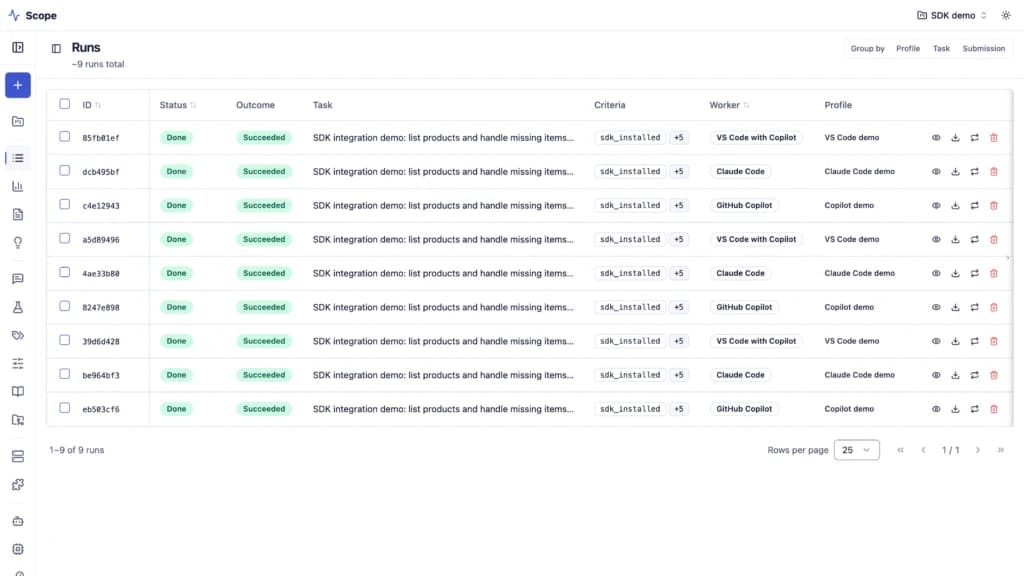
Microsoft's DevRel team open-sourced Scope (MIT), its year-plus-old agent evaluation platform. It doesn't benchmark models — it exams your product: the same task across Copilot, Claude Code and more, scored against DAG criteria by an LLM Judge, with full logs and workspace snapshots. Cosmos DB fixed 20 Agent Kit issues and 27 doc issues with it. Our take: as agents become software's users, DevEx must grow into DevAx — diagnosis before prescription.

Simon Willison's Oct 20 post: Battle Drones, a browser RTS with 321 commits written almost entirely by coding agents. The turning point was one prompt — 'Make it a LOT more fun' — plus an overnight Ultracode run in which Claude played 1,200 AI-vs-AI matches to rebalance the game. Now it has 3D graphics, audio-based multiplayer, and LLM-vs-LLM battles.

Daytona raised a $60M Series B at a $1B valuation to build 'computers for AI agents': isolated sandboxes launched via one API in 60 milliseconds. While models think on GPUs, agents work on CPUs. This piece unpacks the round, the thesis, the 25x revenue curve, and what it means for vibe coders.