Payroll Software Friday Ships MCP Server: Claude Code and Cursor Get Direct Access to Official API Docs
On Oct 14 Friday opened its integrations program: a self-serve Partner API, webhooks, and an MCP server letting AI coding tools read official API docs instead of hallucinating endpoints. Even payroll software now treats AI as a first-class citizen — MCP is becoming SaaS's new API.
Why a payroll company opened a door for Claude Code
On October 14, 2026, Friday, a small-business payroll software company based in Brooklyn, announced an expanded integrations program: a self-serve Partner API, webhooks, and an MCP server. The press release is written in restrained language, but one sentence deserves a second read from anyone who writes integration code: once the MCP server is configured, AI assistants in Claude Code and Cursor can look up Friday's API documentation directly — checking endpoint behavior, explaining request and response shapes, and helping debug API calls "using Friday's own docs rather than guessing from memory."
This is not another "AI-powered" marketing slogan. It is the first time a heavily regulated piece of software (payroll, tax filing, insurance) has treated AI coding tools as first-class citizens: it no longer assumes developers will read the docs. It assumes they won't — and that the AI will.
First, the facts. Friday's launch is a full integration package: completed payrolls sync to QuickBooks Online as journal entries (wages, employer taxes, deductions, and contributions mapped to the company's chart of accounts); from the Insurance page in the admin portal, owners can compare quotes across 30+ carriers, buy a policy, and download a certificate of insurance; SmartPay reports real wage data each pay period so workers' comp premiums are calculated on actual wages instead of annual estimates; Human Interest 401(k) deferrals and employer match are computed with every payroll run, with no census-file uploads. On the developer side: a self-serve Partner API covering employees, time records, customers and projects, PTO, departments, payrolls, and reports — generate a key in the developer portal, build against a sandbox, move to production with no manual approval; webhooks replace polling.
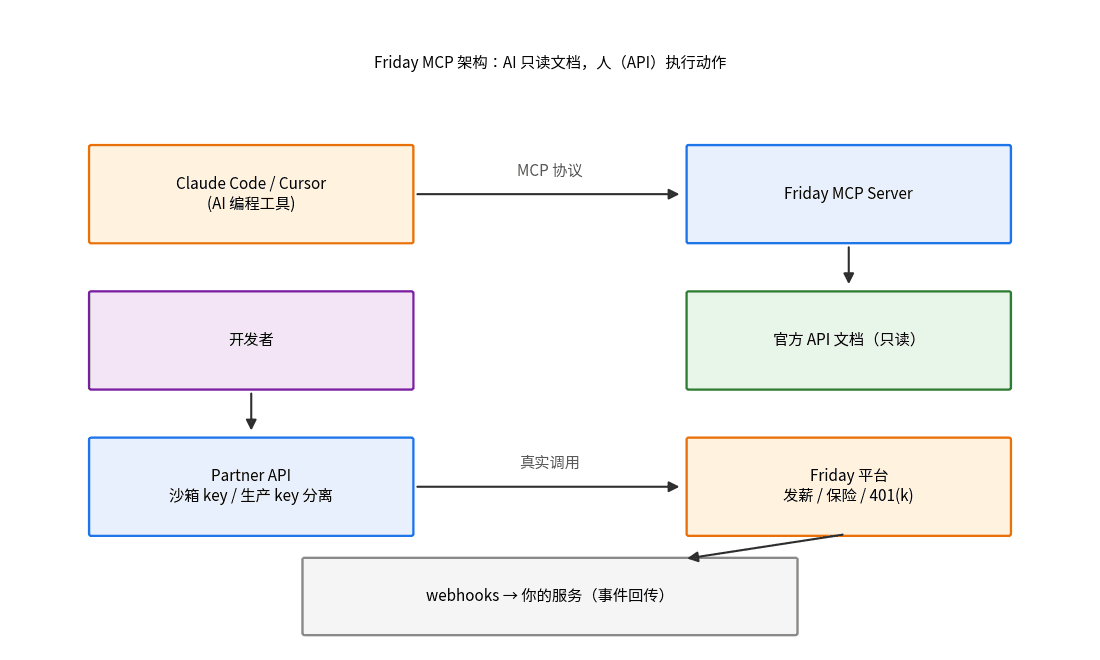
And the MCP server is the most signal-rich piece of the package. It does not run payroll — note this carefully, because it is easy to misread. The release is precise: the MCP server gives AI coding tools "direct access to Friday's API documentation." What the AI can do is look up docs, explain structures, and help debug — not press the "run payroll" button. Sandbox and production keys are kept separate. This is the honest shape of first-generation SaaS MCP: read-only docs, never touching money.
 Friday MCP architecture: AI coding tools read official docs over MCP while the Partner API executes real calls
Figure 1: Friday's MCP architecture. The AI coding tool reads official API docs over MCP (read-only); developers still execute real calls through the Partner API with separate sandbox/production keys, while webhooks push events back.
"MCP is becoming the new API for SaaS"
Put this on October's timeline and the pattern emerges. On October 6, Shopify handed the checkout for one billion products to any agent (with per-order buyer approval) — agent-ification on the execution side, where agents can actually place orders. On October 14, Friday shipped an MCP server — agent-ification on the documentation side, where agents first learn to read. Eight days apart, same direction: SaaS vendors are starting to treat "being correctly callable by AI coding tools" as a product requirement, not something left for developers to figure out on Stack Overflow.
Why is this good news for vibe coders? Because the worst disease of AI-written integration code isn't logic — it's hallucinated endpoints. Anyone who has had AI integrate a third-party API knows the drill: the model invents a path or parameter that looks plausible from training memory, doesn't exist in the docs, and costs you an afternoon of debugging. Friday's fix goes for the root cause — stop making the AI memorize docs; give it a documentation lookup machine. With official docs exposed as MCP tools, "what does the POST /payrolls body look like" turns from a fallible act of recall into a deterministic tool call.
Behind this sits a bigger paradigm shift: the reader of API documentation is changing from human to agent. For the past decade, SaaS vendors competed on how beautiful their docs were (Stripe won a generation of developers that way). For the next decade, the competition may be about how machine-readable the docs are — whether there's a structured MCP entry point, whether endpoint descriptions parse unambiguously for agents, whether error codes carry machine-friendly semantics. Friday has only wrapped "human docs" in an MCP layer for now, but the direction is set: docs are the interface, and the interface is the docs.
 Friday MCP architecture: AI coding tools read official docs over MCP while the Partner API executes real calls
Figure 2: October 2026's one-two punch of "SaaS agent-ification" — Shopify opened agentic checkout on Oct 6 (execution side); Friday shipped an MCP docs server on Oct 14 (documentation side).
Three sober judgments
First, don't confuse a "docs MCP" with an "action MCP." Friday's MCP server is read-only documentation. It doesn't run your payroll or buy your insurance. That boundary is exactly what it gets right: payroll is a high-compliance domain where the cost of an AI acting directly on money is unbounded. The TV4 agent-erasure incident (covered on this site on October 15) already demonstrated the price of over-permissioned agents. Friday's choice — "AI reads docs, humans (or explicitly authorized API calls) execute" — is currently the safest division of labor. Before cheering any "X launches MCP" headline, ask one question: does this MCP read, or write?
Second, the playbook for integration contractors changes. The old flow was: you read the docs → you write the code → AI fills in the blanks. Flip it: let the AI read the official docs through MCP first, then have it generate the integration code, while you review only the critical paths (money math, tax mapping, idempotency). Friday's sandbox-key mechanism makes this safer: the AI experiments freely in the sandbox, and the production key never enters the conversation. One iron rule still holds: production keys don't go in prompts, repos, or chat logs — no matter how convenient MCP gets.
Third, Zapier and Make are still "in development, waitlist open" — Friday knows that MCP is for developers while no-code connectors are for small-business owners. Agent-ified SaaS will end up with two layers: machine interfaces for agents (MCP/API) and visual orchestration for humans. Build only one layer and you serve only half your users.
The next stop for docs MCP: what lies between "read-only" and "executable"
Friday's move is honest but conservative: a read-only docs MCP. The natural next step is an "action MCP" — AI looking up your payslip, adjusting insurance for you. Between read-only and executable lie three gates every vibe project building agent features must pass. First, authorization granularity: OAuth scopes must separate "read payroll" from "run payroll" as two permissions, with AI holding read-only by default. Second, approval UX: anything touching money needs a human tap (this site's human-approval-workflows guide grades money moves at the top tier). Third, audit: every AI-initiated action logged — who authorized, when, with what parameters. Friday has only taken step one, but its architecture (Partner API + dual keys + webhooks) already leaves hooks for the other two. To tell whether a SaaS's agent-ification is real, check whether it reserved room for these three gates — MCP without approval and audit is a half-built product.
The takeaway for vibe projects
If you're building a service that AI should call — even a side project exposing a few endpoints — Friday just handed you a minimum viable template: 1) wrap your OpenAPI docs in a read-only MCP server. It's cheap, and the payoff is that everyone using Claude Code or Cursor can call your API correctly; 2) strictly separate sandbox from production — the AI only ever touches the sandbox; 3) docs MCP first, action MCP later — teach the agent to read before letting it act. That ordering is precisely the principle of least privilege, translated for the agent era.
Why Friday opened this door first
What's telling is that the door was opened not by Gusto or Rippling, the payroll incumbents, but by a small Brooklyn company. Founder Hershy Goldstein's line in the release is refreshingly plain: most small-business owners don't want another system; they want payroll to stop being the place where the same numbers get re-entered. Small companies have the advantage of small baggage: no decade-old API legacy, no giant compliance committee — when a new channel like MCP appears, they can ship in weeks. While big vendors' API-docs teams are still in review cycles, Friday already fed its docs to the AI.
That's a lesson for solo developers: agent-friendly interfaces are becoming a differentiation weapon for small SaaS. While giants treat "AI integration" as a roadmap someday-item, a small team can claim the "first correctly callable by AI coding tools" niche with one read-only MCP server. The axis of API competition has shifted — from "how beautiful are the docs" to "can the AI get it right on the first call."
Operationally, wiring Friday's approach into your workflow takes three steps: 1) add the MCP server config in Claude Code (one JSON line pointing at Friday's MCP endpoint); 2) make the AI read docs before writing code — add one sentence to your prompt: "look up this endpoint's request shape with the Friday MCP first, don't write from memory"; 3) experiment only with sandbox keys, switching to production keys for final integration. The easiest step to skip is #2: people configure MCP and forget to explicitly ask the AI to consult it, so the AI falls back to inventing from memory. Good tools still need good prompts.
One sentence: Friday didn't let AI run your payroll. It just finally got AI to read the docs. And that may matter more — because 90% of integration bugs die from unread documentation.
Comments (0)
Sources
Related articles
AI-generated tables are written for demo-sized data: full fetches that freeze the page, fake pagination, frontend sorting that silently misorders. This guide covers the interaction engineering of one table — offset vs. cursor pagination, sort whitelists, URL-synced filters, column preferences in JSONB, cross-page bulk selection, virtual scrolling test methods, and a 12-item launch checklist.

On October 5, OpenAI announced textGrain watermarking: EU ChatGPT and Codex get it by default within weeks, API developers worldwide can opt in (off by default), and the detector stays with approved researchers only. Detection hits 80% at 200 tokens and 95% at 400, but falls to 17% after 25% synonym swaps. It catches copy-pasters, not rewriters.
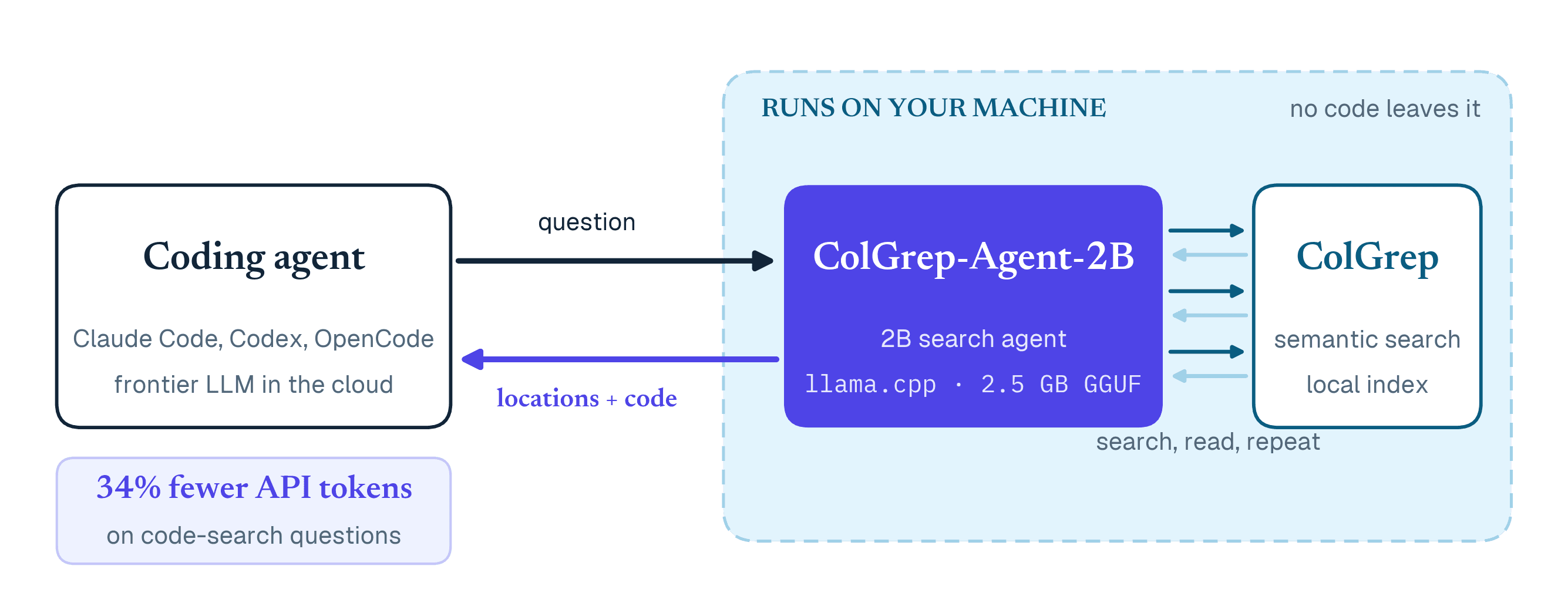
On October 12, LightOn published ColGrep-Agent-2B on the Hugging Face blog: an open 2B-parameter code-search agent that runs locally. Across 624 sessions (Claude Code + Sonnet 5.5, 52 questions × 13 repos created in 2026), delegating search to the local small model cut API tokens 34.3% and cache-aware cost 40%, with no statistically significant accuracy change. The first hard ledger of small-model division-of-labor economics.