GitHub Copilot Brings Cross-Repo Chat to Slack and Teams: One Conversation Sweeps Every Repo's PRs and Issues
On October 15, GitHub gave Copilot in Slack and Teams multi-repo support: one conversation now sweeps open PRs, weekly merges, and issues across all your repositories. @GitHub works anywhere in a message, shared threads become context — while cloud agent code changes stay locked to one repo, one branch, one PR.
First, the combo play: GitHub published two changelogs on October 15, 2026 — at 6:49 AM Pacific, the general availability of Agentic autofix for code scanning (covered in our companion piece in this same batch, GitHub's agentic autofix goes GA, slug: github-agentic-autofix-ga-code-scanning-october-2026); at 7:16 PM, this story: Copilot in Slack and Teams went multi-repo. One lets the agent see across repositories from chat; the other lets the agent fix vulnerabilities in the security flow. In a single day, GitHub pushed Copilot's read surface and write surface each one step forward. Read the two together.
On October 15, 2026, GitHub published a new entry in its official changelog: Multi-repo support and other improvements for GitHub Copilot in Slack and Microsoft Teams (Additional Details on the page show Published: 2026-10-15T19:16:35-07:00 — the morning of October 16 in Beijing). In one sentence: chatting with Copilot in Slack and Teams now works across all your repositories in a single conversation — open PRs everywhere, what got merged this week, issues spanning frontend and backend repos, team digests — no more switching conversations or naming a repository every time.
This is not "one more small feature". Copilot in Slack/Teams originally solved "ask about code without opening the IDE"; multi-repo solves the next problem: real-world code never lives in one repository. Frontend in one repo, backend in another, infra in a third, issues and PRs scattered everywhere. The agent's context boundary just expanded from repo to org.
A note on the timeline: Copilot in Slack/Teams isn't new — single-repository Q&A existed before. The changelog title is refreshingly literal: "Multi-repo support and other improvements". The main course is multi-repo; the sides are four interaction improvements. GitHub's changelog style is "deltas only", so reading this one is simple: diff against the previous version, and the diff is multi-repo plus four improvements. Nothing else.
What actually shipped: one conversation across every repository
The changelog gives four example questions, which double as the feature's spec sheet:
- Open PRs across repos: "Show me all open pull requests across my repositories" — no more clicking through each repo's PR list.
- What merged this week: "What was merged this week?" — standup and status-report material in one sentence.
- Issues across frontend and backend repos: related issues living in different repos, investigated together in one conversation.
- Digests: activity across multiple repositories composed into one summary — a morning scan.
The key change is the single conversation: Copilot in Slack/Teams used to bind its context to one repository; now a conversation flows naturally across repos without "leave this repo's chat, enter another's". For teams that live in Slack/Teams, code Q&A finally matches the rhythm of chat — chat is cross-topic by nature, so code Q&A should be cross-repo too.
Four questions, four real workflows
Each example question maps to a concrete workflow worth spelling out:
- "Open PRs across repos" → the 5 minutes before standup. A tech lead used to click through every repo's PR list each morning; now one sentence pulls them all. That frequency makes multi-repo Q&A a daily tool, not a nice-to-have.
- "What merged this week" → status reports and retros. Merge records across repos used to depend on memory or stitching together release notes. Now the agent hands you a cross-repo merge digest. Note: it answers "what happened", not "why" — judgment in retros is still human work.
- "Issues across frontend and backend repos" → debugging across service boundaries. The most painful scenario: the frontend reports a bug whose root cause is in the backend; the backend issue references an infra change. Humans connect these with memory and frantic clicking; the agent can now connect them in one conversation. "Which repo is the problem in" often eats half of debugging time — multi-repo Q&A deletes that half.
- "Digests" → noise reduction. With many repos, notifications are a disaster: PRs, issues, and comments from every repo raining on you. Having the agent summarize first and reading only the digest turns "push" into "pull".
All four share one trait: they're information aggregation tasks, not code generation tasks. Aggregation is precisely where agents were most reliable in 2026 — they don't misremember, don't skip, don't get bored. GitHub giving multi-repo to Q&A (aggregation) before code changes (generation) is exactly the right priority order.
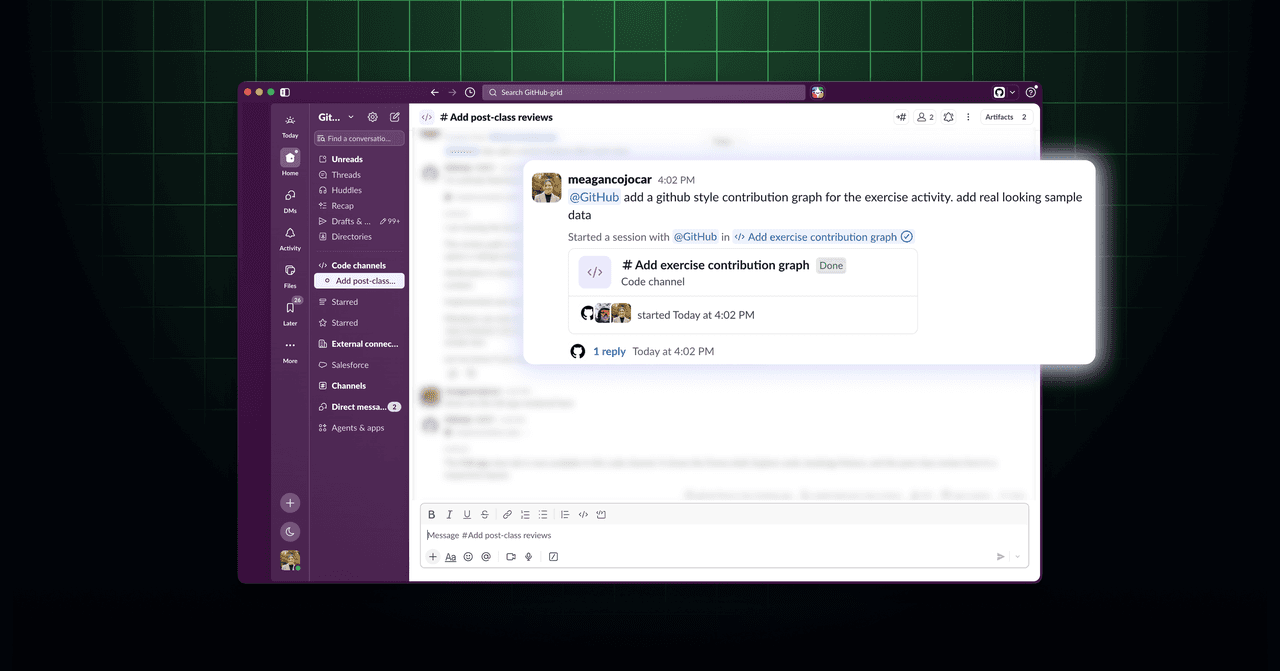
 Official GitHub changelog screenshot: @GitHub mentioned mid-message in a Slack conversation
Four improvements: the last mile of moving dev collaboration into chat
Beyond multi-repo, the changelog lists four interaction improvements. Each looks small; together they're the last mile of moving development collaboration into the chat tool:
- 1. @GitHub can appear anywhere in a message. Mentions used to belong at the start of a sentence (the old bot disease); now you can @GitHub mid-sentence and it still catches it. Don't underestimate this: it turns Copilot from a "command bot" into a "conversation participant" — you talk normally and tap it on the shoulder mid-thought.
- 2. Smoother switching between repositories. Paired with multi-repo, hopping repos inside a conversation no longer restarts context.
- 3. Shared Slack messages and threads work directly as context. The most productized of the four: you and colleagues debated a bug for an hour in a thread; now you throw the thread at Copilot and ask "so what's actually going on" — it reads it. The discussion context never needs re-summarizing by a human.
- 4. Reliability: fewer errors, task initiation, recovering from interruptions. The changelog's words: fewer errors, task initiation, recovering from interruptions. Chat-based agents die most often "mid-conversation", and this one patches the weak spot.
Item 3 deserves more. A thread as context turns "information humans already discussed" into agent input. The old flow: humans discuss → a human summarizes → the summary gets fed to AI. The new flow: humans discuss → the thread goes straight to AI. The deleted step — "human summarizes" — is exactly where information bleeds out. Good agent integrations work like this: never add a step for the human, only remove one.
Item 1 (@GitHub anywhere) deserves unpacking too: it's the "de-commanding" of bot design. Early chat bots were imperative — @bot at the start, then an instruction — because parsers only matched from the head. Now @GitHub mid-sentence works, which means Copilot's message understanding no longer needs "command format"; it reads the whole sentence. That's the watershed between bot-as-tool and bot-as-participant: tools require you to speak their format; participants understand you speaking normally. If you're building your own bots or workflows: stop designing "!command args" syntax. Let the agent read natural language.
Item 4 (reliability) sounds the most boring and matters the most. Chat agents have a native defect: conversation is asynchronous and fragmented — someone chats twice, goes to a meeting, comes back. The agent must "resume from interruption": remember where the chat was, where the task was. The changelog calling this out explicitly means GitHub got enough "it died mid-chat" feedback. Agent reliability is 50% model, 50% this kind of resume-engineering.
Three levels: a short history of the agent's expanding context boundary
Put this release on a timeline and the agent's context boundary expanded in three levels:
- Level 1: single file/project inside the IDE. Early Copilot completions — context was "the code around the cursor". The agent saw what you were typing.
- Level 2: single repository. Copilot Chat and agent mode — context covered the whole repo: its issues, PRs, code. Step outside that repo and it went amnesiac.
- Level 3: cross-repository (org level). This release: one Slack/Teams conversation sweeping every repository. The agent's "working memory" covers your entire GitHub footprint for the first time.
Each level unlocked a new task class: level 1 unlocked "write faster", level 2 "ask completely", level 3 "connect the dots". Level 3's connecting is what the first two couldn't do: understanding issues, PRs, and code across multiple repos simultaneously and composing a cross-repo answer. That used to belong to "the veteran who's been here three years" — the person with a mental map of "which thing lives in which repo". Now the agent has one too.
What's level 4? Probably "cross-system": code repos plus project management (Linear/Jira) plus docs (Notion) plus monitoring (Sentry/Datadog), all stitched together. Ask "what was the root cause of last week's incident" and the agent connects the Sentry error, the GitHub PR, the Linear issue, and the Notion retro. Today GitHub only reached "cross-repo", but the direction is clear: the agent's context boundary ends at "every digital trace of your work".
 Official GitHub changelog screenshot: @GitHub mentioned mid-message in a Slack conversation
The boundary: Q&A may cross repos; code changes may not
A boundary must be drawn here, in the official documentation's wording (cross-checked via NeoTeo's October 16 coverage): what crosses repositories is the Q&A session; cloud agent code changes remain limited to "the repository designated when the task started — one branch at a time, one PR at a time".
In other words: Copilot in Slack/Teams is now an omniscient mouth, but its writing hand still moves one repository at a time. Want it to change code across three repos and open three PRs? No — one at a time.
The boundary is sensible, and deliberate. Reads are reversible and low-risk: a wrong answer costs one more question. Writes are irreversible and high-risk: a wrong change breaks three repos at once. GitHub widened the read surface to org level first and kept the write surface locked at repo/branch/PR level — the oldest rule in agent permission design: widen reads, narrow writes.
"One branch, one PR at a time" also protects review: the PR is humanity's last checkpoint. A PR touching one repo is reviewable; a PR spanning three repos explodes the reviewer's cognitive load — effectively hollowing out the human-in-the-loop. GitHub would rather the agent open several PRs than one mega-PR; it's defending the effectiveness of review. The core tension of agent-era review design is exactly this: the more capable the agent, the less humans can review; the fix isn't trying harder, it's keeping agent output at a reviewable grain.
For vibe developers: this boundary is homework worth copying when you design your own agent workflows — let the agent see as widely as possible (many repos, many systems), and let it write as narrowly as possible (one change point at a time, reviewable, rollbackable). GitHub's official design is exactly that shape.
A hands-on checklist for indie developers: three things to use today
Multi-repo Q&A needs no waiting — put it to work now:
- 1. Hand it the daily PR sweep. If you maintain 3+ repos, ask in Slack each morning for "open PRs across all repositories" — 10 seconds replacing 10 minutes of clicking. Highest ROI usage there is.
- 2. Ask about connections first when debugging. On a cross-repo bug, don't start by digging through repos one by one — ask Copilot "which issues/PRs across these repos relate to this problem". Let it aggregate; you judge.
- 3. Throw finished threads at it. After you (or you and colleagues) finish debating a technical approach in a thread, toss the thread to Copilot: "summarize what we decided and what risks we haven't considered". Discussion history is the best context — don't waste it.
Judgment calls: the agent's work surface is moving from the IDE to collaboration tools
Judgment zone below; facts and opinions marked separately.
Call one: "coding assistants leaving the editor" is one of late-2026's most certain trends. Our cycle47 piece covered Cursor's iOS remote control (agents on your computer, overseers in your pocket); this one is GitHub pushing Copilot into Slack/Teams multi-repo. Same direction: the agent's work surface is no longer the IDE but "where you already are" — phones, chat tools. The IDE is where code gets written, but discussing, reviewing, and looking up code half-happens in chat. Copilot follows the user instead of making the user come to Copilot.
Call two: the context boundary moving from repo to org is a qualitative leap in agent capability. Single-repo Q&A answers "what does this function do"; cross-repo Q&A answers "how many repos does this requirement touch". The latter is the genuinely brain-burning part of real development: requirements scattered across repos, frontend and backend issues referencing each other, cross-repo PR dependencies. Humans handled it with memory and clicking; agents now have an official answer for the first time. It matters most for solo teams and indie developers: your "many repos, bad memory" pain finally has an official fix — no more maintaining a mental map of "which requirement lives in which repo" yourself. Just ask.
Call three: GitHub is playing "reads first". Put October 15's two changelogs together: the morning's agentic autofix GA is the write surface (fixing vulnerabilities, opening PRs, metered by AI Credits, enterprise-gated); the evening's is the read surface (cross-repo Q&A in chat). The wider the read surface, the bigger the conversion funnel for the write surface — once you're used to asking Copilot "what merged this week" in Slack, "have it fix that vulnerability while it's at it" is one step away. Free, wide reads are the acquisition channel for paid, narrow writes. GitHub's commercial design runs deep.
Call four: Slack/Teams are becoming the "second IDE". Note GitHub shipped Slack and Teams together — not Slack alone. Enterprise developers' collaboration battlefield is half Slack (internet companies) and half Teams (traditional enterprises plus the Microsoft ecosystem). Shipping both says the goal isn't "a toy for Slack users" but "making the collaboration tool a first-class entrance to code work". When checking PRs, issues, and digests all happen in chat, developers open the IDE less — not writing less code, but moving "collaboration around code" elsewhere. The IDE keeps the "writing" part; "looking, asking, summarizing" are moving to chat. That's a signal to every developer-tool vendor: your user interface may not live in your app anymore — it may live in a Slack thread.
What's unsaid
What the changelog doesn't say: how multi-repo Q&A tokens are metered (what does the bill look like for sweeping open PRs across 50 repos?); whether Copilot Q&A in Slack/Teams has its own permission model (does its visible repo scope match "what I can see" or "what the app is authorized for" — enterprise security teams will absolutely ask); whether colleagues' thread messages used as context get used for training (the privacy line is unaddressed). The first two are "enterprise procurement will ask", the third is "compliance will ask" — GitHub will likely have to fill these in follow-up docs.
One more to watch: when does the cloud agent's "one repository at a time" limit loosen? Today's boundary is "wide reads, narrow writes", but the agent's end state is surely "wide reads and wide writes" — cross-repo refactors, cross-repo dependency upgrades, the work humans least want to do. GitHub didn't loosen it today — maybe the tech isn't ready, more likely "let reads run for a year while the security model gets figured out". If a future changelog moves that boundary, that's big news.
One cross-verification detail: NeoTeo's October 16 coverage retold this changelog while cross-checking the official docs' cloud-agent limits (single repo, single branch, single PR), confirming "Q&A crosses repos" vs. "code changes stay single-repo" is deliberate design, not incomplete documentation. That cross-check matters: it shows GitHub plans "reading" and "writing" as two separate capability tracks — the answering agent and the coding agent ride different roadmaps. When reading future GitHub agent updates, first ask: did this move the mouth, or the hand?
Related reading: our companion piece in this batch, GitHub agentic autofix goes GA: the free one-click fix is replaced, AI Credits billing begins (the other half of October 15's double release: the write surface); Cursor's iOS remote control for local agents (the same "agents leaving the IDE" trendline). This piece plus those two: three threads composing the complete October 2026 agent-landing picture.
One-line summary: Copilot in Slack/Teams graduated from single-repo Q&A to cross-repo single sessions — the agent's context boundary moved from repo to org for the first time; Q&A may cross repositories while code changes stay one-at-a-time — widen reads, narrow writes is the template GitHub is setting for every agent workflow. And October 15's other changelog (agentic autofix GA) is exactly the "writing" half: the two together are GitHub's complete October 2026 coordinates for Copilot — a wide mouth, steady hands.
Comments (0)
Sources
Related articles
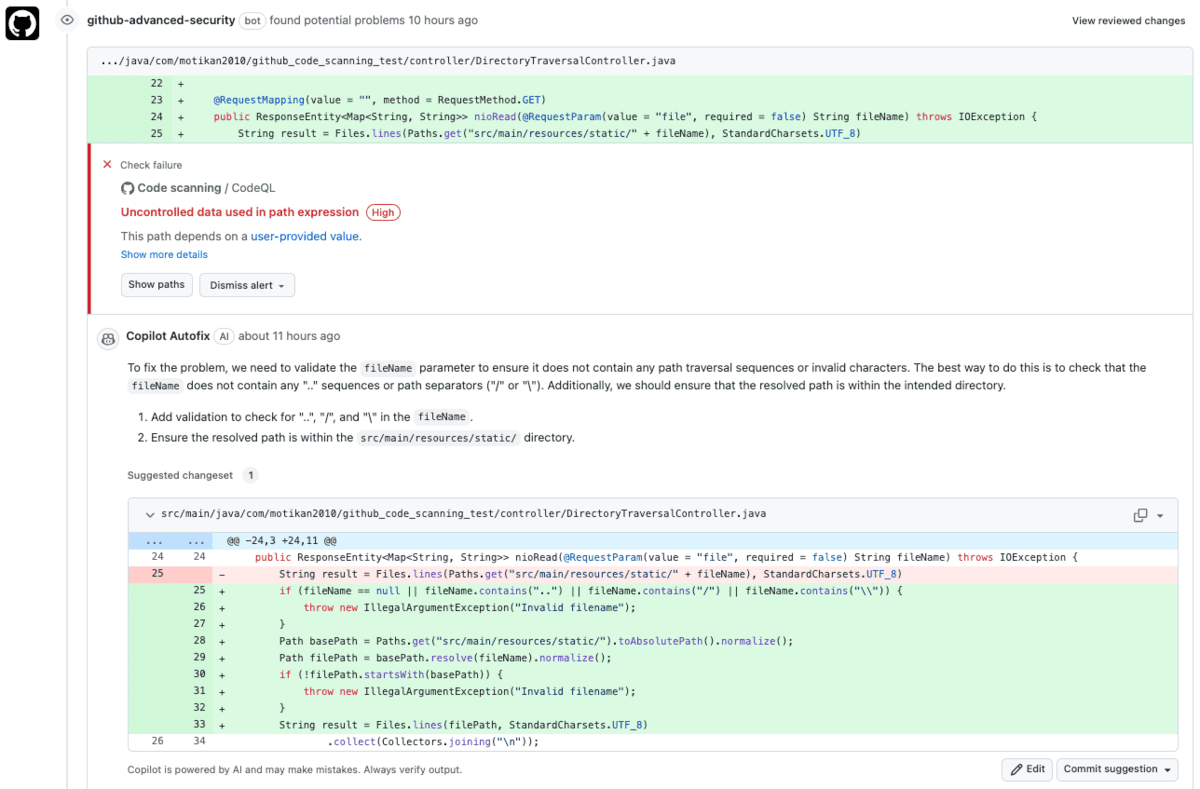
On October 15, GitHub's agentic autofix for code scanning went GA: alerts get assigned to Copilot, which explores the codebase, generates fixes, re-runs CodeQL to verify, and opens a draft PR. The free Generate Fix button is replaced by Assign to Copilot — billed in AI Credits plus Actions minutes, with an Advanced Security line on the enterprise bill.
On October 13, Ramp launched Glass, its internal vibe coding platform, as a public AI workspace product: 323 employees produced 6,500+ edits of reusable Skills — one account manager's prompt took feature-request intake from 300 to 20,000 a month — and after the CEO admitted burning $1.5M in tokens in one week, every project now ships with a taxi-style meter plus a Router that picks the cheapest adequate model.
On October 13, Cursor launched an app marketplace for Origin, its agent-era code hosting platform: 21 launch integrations across deployments, CI, code review, security, monitoring, and project management, with public submissions now open to all developer-tool teams. Two months ago Origin shipped with just 3 integrations — the forge wars have officially entered the ecosystem phase.