Mention @GitHub in Teams and a Bug Becomes a PR: Copilot Moves Into the Chat Window
GitHub has merged notifications and Copilot into one Teams app: after a bug report arrives in a channel, @GitHub can investigate and open a fix PR. The legacy app retires on November 16, so audit first, then pilot.


A bug usually appears in chat first, then becomes a ticket, then gets copied by someone into an editor, and only then becomes a fix. Every copy-and-paste along that chain is a chance for context to be lost and for delay to creep in. On 23 October 2026, GitHub's new Teams app tries to shorten that chain: notifications and Copilot now live in a single Teams app, so a team can turn a bug report into a pull request without leaving the conversation.
This is not a new model, nor a pricing change. In GitHub's own Changelog wording, the new app combines notifications and Copilot to help teams "turn issues into fixes and ship code faster without leaving the conversation". The boundary of that promise matters: it promises a shorter handoff, not a smarter fix. The quality of the fix still depends on the review, testing, and merging that come afterwards.
What the new app actually is
GitHub describes this release as a consolidation, not two parallel entry points. The new GitHub app in Teams was previously called GitHub notifications — the notification app. Teams that already have it installed should update it to the latest version, and GitHub says their existing notification capabilities will continue to work. For existing users, that is the gentlest path: no new notification rules to learn, and no sudden break in the alerts they already rely on.
The real change is on the other track: the legacy GitHub app will be renamed "GitHub (deprecated)" and retired on 16 November 2026. Teams still using the old app must install the consolidated app to keep using Copilot in Teams. In other words, 16 November is not a suggested date but a migration deadline. Teams should check right now which app is pinned in each channel — the new app, the notifications app, or the soon-to-retire legacy app — because the next step is completely different for each.
Inside the consolidated app, the workflow is deliberately short: after receiving a notification in a channel, group chat, or private chat, a user mentions @GitHub to turn the update into action. GitHub's three steps are: first, a bug report arrives in Teams; second, @github investigates the issue, fixes the bug, and creates a pull request; third, the team reviews, tests, and merges the fix. The first and third steps already existed. What is new is that the starting point of the second step has moved from the editor into the chat window.
Why the chat window, and not the editor
For many teams, chat is already where bugs first appear. A user pastes a screenshot of an error in a group, a colleague asks for reproduction steps in a channel, and the person on call confirms the impact in a private message. In the past, all of that had to be carried into the codebase by hand: copy the error, paste the link, write the ticket, open a branch. With every move, the original context got thinner — the version number in the screenshot might be dropped, the reproduction steps might be rewritten, and who first spotted the problem might be lost.
Putting the Copilot entry point next to the notification amounts to accepting a fact: the starting point of a fix is often not a code file but a message. Summoning the assistant in the same context at least preserves one layer of information — which channel raised the issue, and in response to which update. That is especially valuable for small fixes: a typo, a wrong label, a misconfigured value, a missed edge case. Those problems never needed a long design document; they needed fast localisation, a fast change, and a fast human check.
But the other side deserves equal weight. Chat history is a poor requirements document: it is colloquial, fragmented, and often mixes three or four topics at once. A one-line bug report such as "login is broken again" forces any agent to guess — which login entry, which version, which kind of account, which step failed. A correct guess looks like efficiency; a wrong guess is wasted work, or worse, a wrong change. The value of this new entry point therefore depends on whether the team has described the problem clearly before summoning, not on how smooth the summoning itself feels.
A usable checklist before summoning
If your team plans to try this workflow, set four rules first and talk about efficiency second. First, a report must contain the minimum reproducible information: what happened, which entry point, which version or environment, the reproduction steps, and the expected result. Without those, gather the information first and summon second. Second, be explicit about the repository: in the consolidated app, follow the prompts to connect a GitHub account and select a repository. That step is not a formality — a fix aimed at the wrong repository is wrong no matter how fast it arrives.
Third, drop the idea that "a PR was generated" means "the fix is done". GitHub's third step says it plainly: the team reviews, tests, and merges. A pull request only puts a proposal somewhere it can be inspected; before merging, a human still needs to read the diff, run the tests, and confirm that no unrelated files were touched along the way. For vibe coding projects, this point is especially important: the faster an agent generates code, the heavier the human review responsibility becomes, not lighter.
Fourth, give chat-initiated fixes their own review lane. Fixes that start in chat often come from a non-code context, and reviewers are tempted to approve them from the title alone. A better practice is to note the source channel in the title, keep a link to the original report in the description, and check at least three things in review — whether the change addresses only the reported problem, whether it introduces a new dependency or permission, and whether tests cover the reproduction path in the report. If those three checks fail, the speed advantage of the chat entry point will be eaten by rework.
How this differs from the 15 October item
Readers familiar with this site may ask whether this is the same story as the 15 October GitHub update about Copilot in Slack and Teams conversations. It is not. The 15 October item concerned how a Copilot agent works across repositories in a conversational context, with the emphasis on the agent handling multi-repository tasks. The 23 October item concerns the Teams app itself: the upgrade of the notifications app, the retirement of the legacy app, and the ability to trigger a fix from a notification with @GitHub. One is a capability; the other is an entry point plus a deadline. Conflating them creates a dangerous misunderstanding — that the legacy app can keep being used indefinitely, when in fact it has less than a month left.
The distinction also matters for scheduling. A capability update can be evaluated slowly and piloted gradually; a migration update requires an inventory first: which channels have the legacy app pinned, which groups still receive notifications through it, and who owns replacing it before 16 November. Do the migration inventory first, then pilot the new workflow. The order must not be reversed.
Who benefits first, and who should wait
The first beneficiaries are teams that already treat Teams as their on-call and collaboration home: bug reports already flow through channels, on-call rotation already exists, and code review already follows a fixed process. For them, the new app simply compresses a round trip — see a notification, switch elsewhere, come back to sync progress — into summoning in place, seeing the PR link in place, and reviewing under the existing process. The gain is not a stronger model but fewer round trips.
Teams with unstable report quality should wait. If a channel is full of messages like "looks down again" or "can you take a look", with no reproduction information and no statement of impact, connecting a fix entry point now will only turn vague requirements into vague pull requests faster. A steadier sequence is to establish a bug report template first — symptom, reproduction, impact, expectation — run it for two weeks, and only then connect the Copilot entry point. The template is not bureaucracy; it is the minimum guarantee that an agent can understand the problem correctly.
One more group should be especially careful: teams with compliance or confidentiality requirements for chat history. The Changelog post does not expand on permission and data boundaries in detail, and this article does not invent them on its behalf. Before rolling this into a production workflow, a team should verify for itself who can summon in which channels, which repositories the agent can reach after being summoned, and which checks a generated PR passes by default. Those questions are not answered in a short Changelog post, but they decide whether this entry point can enter a production process at all.
Judgement: a win for the entry point is not the end of review
Seen against GitHub's broader October 2026 rhythm, the direction is consistent: Copilot is moving from "an assistant inside the editor" to "a step inside the team's workflow". Notifications, chat, repositories, and pull requests — previously belonging to different tools — are being connected into a shorter line. For developers, that means the starting point of a fix is becoming less fixed: it may be in the editor, in the terminal, and now also in a chat window.
But more starting points do not mean fewer finishing lines. Wherever a PR is initiated, the gates before merging — a human reading the diff, tests passing, the impact confirmed — cannot be skipped. The biggest risk of the chat entry point is precisely that it is too convenient: convenient enough to make people forget that the diff under the PR title still needs to be read line by line by someone who actually understands the business.
So the most practical reading of this news is to treat it as a migration notice plus a process experiment. The migration part has a deadline: replace the legacy app before 16 November. The experiment part has acceptance criteria: only expand the use of chat-initiated PRs if their first-pass review rate and rework rate are no worse than those of ordinary PRs. The entry point can get faster; the standard must not get looser.
Three checks before rollout
The first check is an app inventory. Open Teams app management and confirm, channel by channel, which GitHub app is installed: the consolidated new app, the app previously called GitHub notifications, or the legacy app that is about to retire. The notifications app can continue in use after an update, according to GitHub; the legacy app must be replaced. While inventorying, note what each channel is for: which channels carry on-call alerts, which carry feature discussion, and which merely sync notifications. Not every channel suits a fix entry point — an alert channel does, a casual chat channel does not. Connecting the entry point everywhere will flood reviewers with low-quality proposals.
The second check is repository and branch policy. Decide before summoning: which repositories may receive chat-initiated fixes, and which must follow the ordinary process; which branch a fix PR opens against by default, whether CI is required, and whether at least one designated reviewer is required. If those rules are only added afterwards, the team will scramble when the first batch of chat PRs arrives. A safer approach is to start from one low-risk repository: a documentation repository, a marketing-site copy repository, or an internal-tools repository are all suitable starting points. Core payment, permission, and data-migration repositories should come last, or stay permanently outside the chat entry point.
The third check is an honest assessment of review capacity. A chat entry point makes PR creation faster, but it does not automatically make review faster. If the team already has a backlog of unreviewed PRs, adding a new entry point will only deepen it. Before piloting, look at two weeks of data: average review waiting time, first-pass rate, and rework rate. If those three are already unhealthy, fix the review process first and connect the new entry point second; otherwise the new tool brings not efficiency but a new source of backlog.
A one-week pilot plan for vibe projects
For a solo developer or a small vibe coding team, a pilot can be compressed into one week and needs no extra purchase. Day one: complete the app inventory and repository selection, keeping a single pilot repository. Day two: write a one-page bug report template and pin it in the channel — symptom, reproduction steps, impact, expected result — and do not summon if any item is missing. Days three to five: use the chat entry point only for three kinds of small fixes — copy errors, configuration errors, and single-point logic errors; anything beyond those three follows the ordinary process, without cutting corners for convenience.
Day six is a review of three metrics: what share of chat-initiated PRs passed on the first attempt, what share needed rework, and how much time reviewers spent on average. Day seven is the decision: expand to a second repository, or stop and fix the template. If the first-pass rate is clearly below that of ordinary PRs, the problem is probably not the tool but report quality — whatever item the template is missing is the item to add next week. The point of this pilot is not "to use it" but "to measure it": only with comparative data can a team know whether the entry point is worth keeping.
One detail is easily missed: during the pilot, keep a link to the original report and channel information in the PR description. Without that link, a retrospective cannot tell whether a rework happened because the report was poorly written, because the agent misunderstood, or because the review standard itself was inconsistent. Keeping the link costs almost nothing, but it decides whether the retrospective conclusion is trustworthy.
What happens if 16 November passes without migration
According to GitHub's own wording, the legacy app will be renamed and retired, and the way to keep using Copilot in Teams is to install the consolidated app. This article does not exaggerate what happens after retirement in detail — the Changelog post does not enumerate the behaviour of every button in the old app after that date — but one thing is clear: without migrating, there is no officially supported path to keep using it. Delaying migration past the deadline turns a replacement that could have been done calmly into a replacement forced during an on-call shift.
The more realistic risk is not "it suddenly stops working one day" but "the team believes it still works". The legacy app stays pinned in a channel, notifications keep flowing, everyone is used to checking updates there — until the moment Copilot is actually needed and the entry point is no longer in a supported state. That failure mode — unnoticed in normal times, painful at the critical moment — is exactly the most common trap of migration updates. The only way to avoid it is to inventory now, replace now, and verify once that notifications and summoning work in the new app, rather than verifying after 16 November.
Verification itself is simple: in the pilot repository, deliberately summon once with a fully formatted bug report, walk the whole flow — investigation, PR generation, review, testing, merging — and write the conclusion into the team documentation. One complete verification beats ten assumptions of "it should be fine".
How reviewers should read a chat-initiated PR
Reviewing a chat-initiated PR follows a slightly different order from reviewing an ordinary PR. First, check whether the problem itself was understood correctly: do the symptom, reproduction steps, and impact in the PR description match the original report; if the PR solves a different problem, or mixes two problems into one change, send it back before judging how well the code is written. If the problem is misunderstood, however elegant the code, the change is wrong. Second, check the scope of the change: does it touch only the files and logic mentioned in the report, or does it also refactor neighbouring code, upgrade a dependency, or change configuration along the way. Incidental changes might be acceptable in an ordinary PR, but in a chat-initiated PR they should be refused by default — because the initiating context did not authorise them, and reviewers should not have to accept three unrelated items in one fast review. Only then look at implementation details: edge cases, error handling, test coverage, and above all whether the reproduction path in the report has a corresponding test case. Reviewed in this order, review time does not grow, but the chance of something slipping through falls noticeably. Reviewers need not approach every summoning with hostility: small fixes are supposed to be fast, and the reviewer's job is not to slow them down but to make sure the fast part has not quietly gone out of bounds.
Comments (0)
Sources
Related articles
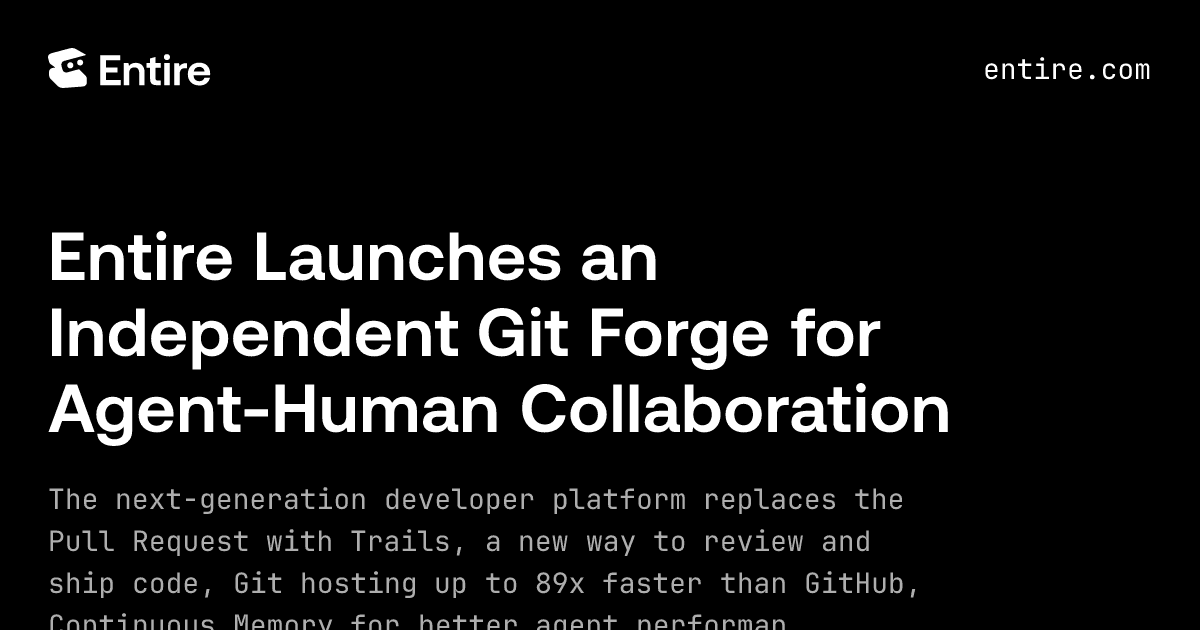
On October 26, 2026, Entire, founded by former GitHub CEO Thomas Dohmke, went public: the first Git forge built for agents and humans to work together. Its target is not one button but the whole pull request model — every push scored by multiple agents in sandboxes before it can merge.

An AI-generated repo rarely lacks code; it lacks people willing to stay. This guide gives four maps, a seven-day onboarding plan, a three-level task ladder, a PR template with a review checklist, and three rules for AI-generated code, so a newcomer lands a first merged PR within seven days.

Bubble's October AMA ties three threads together: the rebuilt Agent 2, the Bubble MCP (beta) that works inside Claude and ChatGPT, and universal import turning Lovable, v0, and Replit apps into Bubble apps you can keep editing visually. Who maintains version one finally has a third answer.