GitLab's "Governed Software Factory": Goal-Driven Flows, Artifact Central, and a Security Standard for Agentic Development
On October 6, GitLab announced its "governed software factory": /goal-driven flows in Duo Agent Platform carry one intent from code to deploy; Artifact Central, Dependency Firewall, and Secrets Manager guard assembly, entry, and keys; Orbit and Impact Analytics put the token ledger on the table. We break down the five highlights and read the three-way split between GitHub, Microsoft, and GitLab.
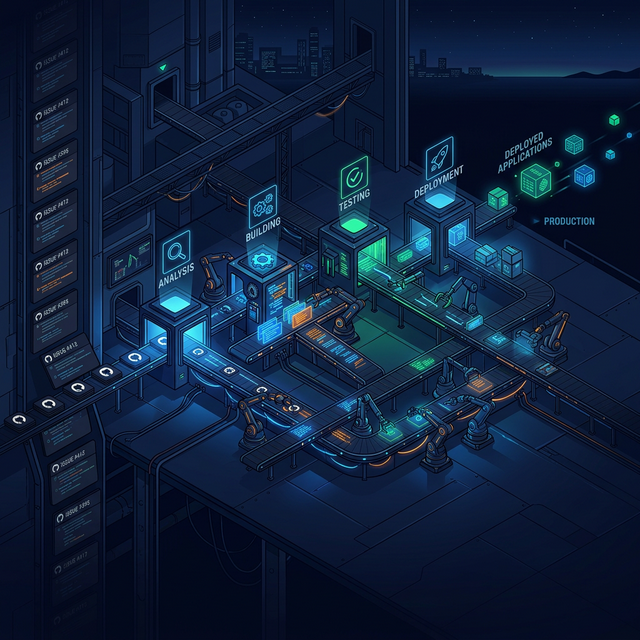
In one sentence: GitLab wants to turn the "software factory" from a metaphor into a product
GitLab's official press release on October 6 introduced a new phrase: the governed software factory — "a connected system for moving software from idea to production under an organization's own policy and standards." The goal is stated without hedging: ship more AI-generated software to production without taking on more risk or cost.
The release opens with numbers meant to impress: 70 million developers and more than 10,000 enterprises on GitLab; over the last three months, active users of agentic software development grew 200% year over year, secure repositories grew 100%, user namespaces grew 80%, and CI/CD pipelines grew 40%. The message behind the numbers: AI-written code is no longer an experiment — it's a production migration already underway, and governance hasn't caught up.
GitLab gave the status quo an ugly but accurate name: the shadow software factory. Most companies run separate tools for coding, issue tracking, source code management, CI/CD, security, artifact management, and deployment — with no shared identity, no common policy, and no record of how a change was made. Fragmentation costs three things: slower handoffs, broken context between stages, and engineering leaders who can neither trace a change from plan to production nor measure the real return on their AI investments.
Picture a concrete example and you'll get it: at 3 a.m., your coding agent, rushing a feature, pulls a package published three days ago from some obscure registry, publishes an internal image to the company registry, and CI deploys it. In the morning all you see is "build succeeded" — but nobody can answer three questions: who approved that package? What's actually inside that image? If it's compromised, which services are exposed? That's the daily life of a shadow factory: everything runs, nothing is explainable. Every weapon in this GitLab release is aimed at "unexplainable."
So the opposite of a governed software factory isn't "no factory" — it's a feral one. GitLab's answer is to connect those steps so agents work within an organization's context, workflows, and guardrails, while producing an evidence chain that records how each change traveled from intent to production. It sounds like compliance-speak, but in the agent era the design hits a real nerve: when humans write code, audits run on code review; when agents generate code at machine speed, audits can only run on machine-generated evidence.
/goal: commanding the whole pipeline from code to deploy in one sentence
The most "vibe coding" part of this release is the goal-driven flows in the GitLab Duo Agent Platform. The pain point is real: agentic development often stalls right after the code is written — reviews, tests, security checks, approvals, deployments each demand handoffs between people, tools, and stages, and the faster the agent writes, the more glaring the wait at every handoff becomes.
GitLab's answer is /goal: describe the goal in one sentence in Duo CLI, and the same flow can be started and followed in headless mode, in Duo Agentic Chat, or even in the GitLab for Slack app — code → review → test → security → approval → deploy in one continuous run, with no more "waiting for a human to pick it up" in between. Paired with Custom Flows and flow triggers, teams can automate multi-step work where every step runs under the same identity, the same policy, and the same evidence chain.
Interestingly, GitHub has been pushing its own dynamic workflows in the same news cycle (we covered them earlier this month). Both companies are really answering the same question — after the agent finishes writing code, who runs the remaining 80%? — but they take different paths: GitHub's bet is the "workflow engine," automation as composable building blocks; GitLab's bet is "platform integration," flows welded into the DevSecOps identity and policy system. The former is flexible; the latter is reassuring — reassuring to the point that when the auditor shows up, you don't have to assemble evidence on the spot.
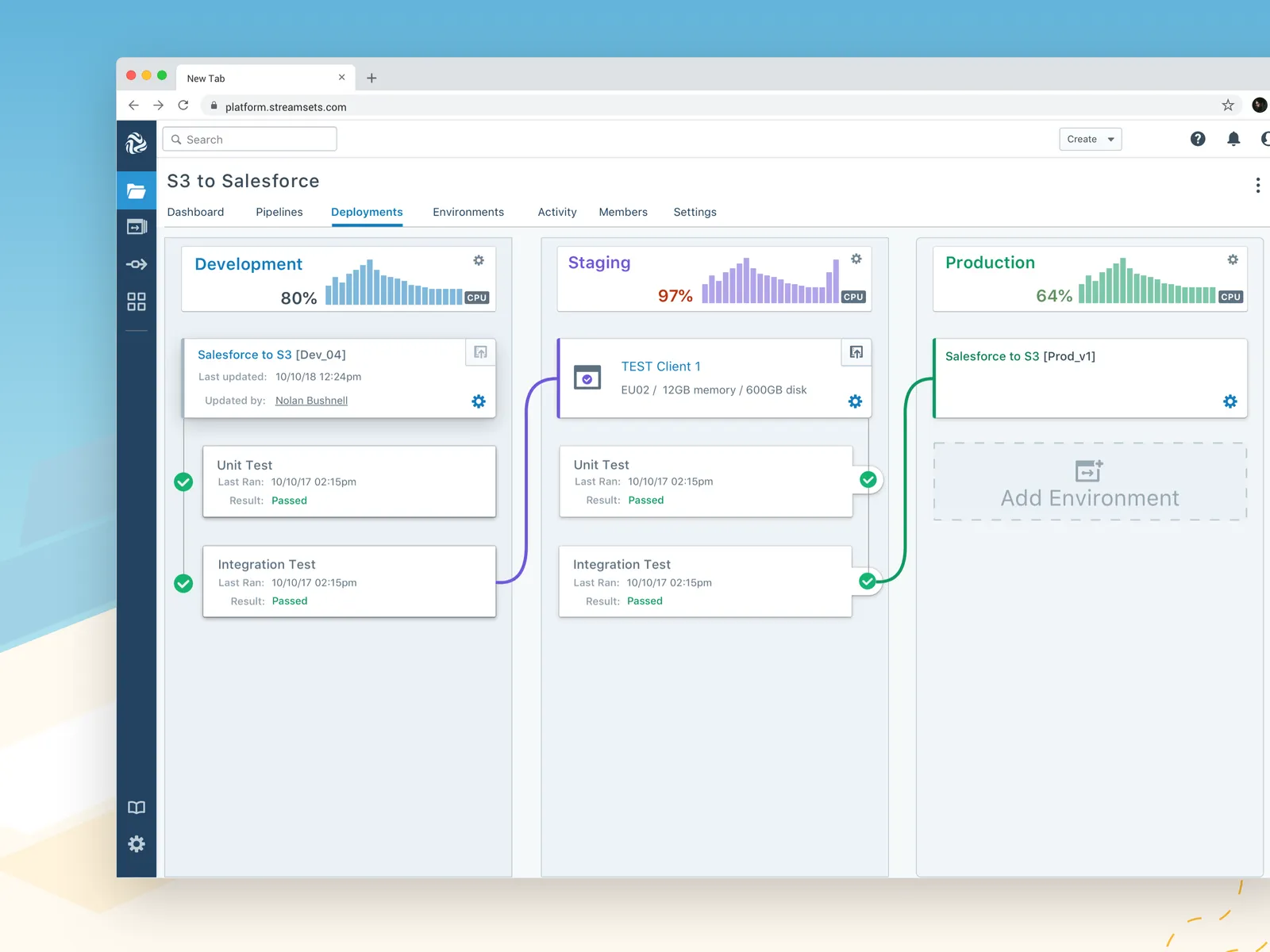 Goal-driven flows 贯穿软件交付全生命周期
The security trio: guarding the "door," the "assembly line," and the "keys"
The toughest paragraph in the release is about the supply chain. Paraphrased: in the agent era, more code, packages, and credentials flow through the software supply chain than security teams can review; agents pull unvetted packages into builds and reuse credentials scattered across local environments; every vulnerability left open longer increases the risk of exploitation.
Built around that line, GitLab laid out three weapons, each guarding one gate before software leaves the factory. Paraphrased, the line reads:
At machine speed, agents need a foundation they can prove before they earn more autonomy.
It reframes governance from a compliance burden into the precondition for agents earning greater freedom of action.
1. Dependency Firewall: the door check (early access)
Every package gets checked against organizational policy before entering a build, across four dimensions: package age, vulnerability severity, malicious package detection, and license compliance. Violations are handled per rule as warn, block, or quarantine. ADTmag's independent report on October 7 highlighted a thoughtful detail: teams can start in warning-only observation mode, see what their rules would actually catch, and only then enforce across builds — a well-judged on-ramp for platform teams that don't dare block builds on day one. More importantly, one control plane spans source, build, and registry, so when something goes wrong, exposed projects can be traced in minutes instead of weeks of spreadsheet archaeology.
2. Artifact Central: the assembly floor (beta on GitLab.com, Self-Managed later this month)
Containers and packages move into the same control plane, sitting alongside source code management and CI pipelines. Platform teams set policy once at the organization level and it applies company-wide; when auditors ask "who published this package," the answer is a lookup away. GitLab claims up to 50% lower total cost of ownership versus standalone artifact tooling. The ambition is unmistakable: JFrog Artifactory and Sonatype Nexus territory is now contested ground.
3. Secrets Manager: the key cabinet (GA on GitLab.com and Self-Managed 19.5)
Build-time secrets live in one managed place, each secret scoped to only the job that needs it, reusing the existing group/project permission model, with every event recorded in the audit trail. A leaked credential gets revoked in one click; GitLab claims up to 50% savings versus hosting a separate vault. OneTrust's software architect appears in the release as a design partner: no more standing up separate vaults and integration points for CI/CD, Kubernetes, and infrastructure as code.
Two more items deserve to be called out separately. First, the cadence: notice that only Secrets Manager is GA in this release — Artifact Central is in beta, Dependency Firewall and Impact Analytics are in early access, and the Claude Mythos integration plus Orbit GA are both "next month." That's not a weakness; it's GitLab playing it smart — establish the foundation (the governance narrative and the standard) first, then release the ammunition month by month on a GA cadence, with something newsworthy in every cycle. Compared with vendors that dump the whole roadmap at once, this rhythm fits enterprise procurement cycles better: the CISO approves budget this year, GA lands next year, the timing lines up.
- Claude Mythos 5 / 5.1 joins Duo Agent Platform security flows next month: Anthropic's Head of Applied AI frames it as defenders finding vulnerabilities and verifying fixes faster than attackers can discover and exploit them, inside already-approved environments. It's a subtle but significant signal — frontier model vendors are starting to treat "security flows" as a standalone product surface.
- The GitLab Security Standard: five controls for the agentic era aimed at security and engineering leaders, with exactly one core metric — time from detection to verified remediation. Note the wording: not "how many vulnerabilities were fixed," but "how long after detection until the fix is verified." In an era when agents can mass-produce vulnerabilities, that's a precisely chosen metric.
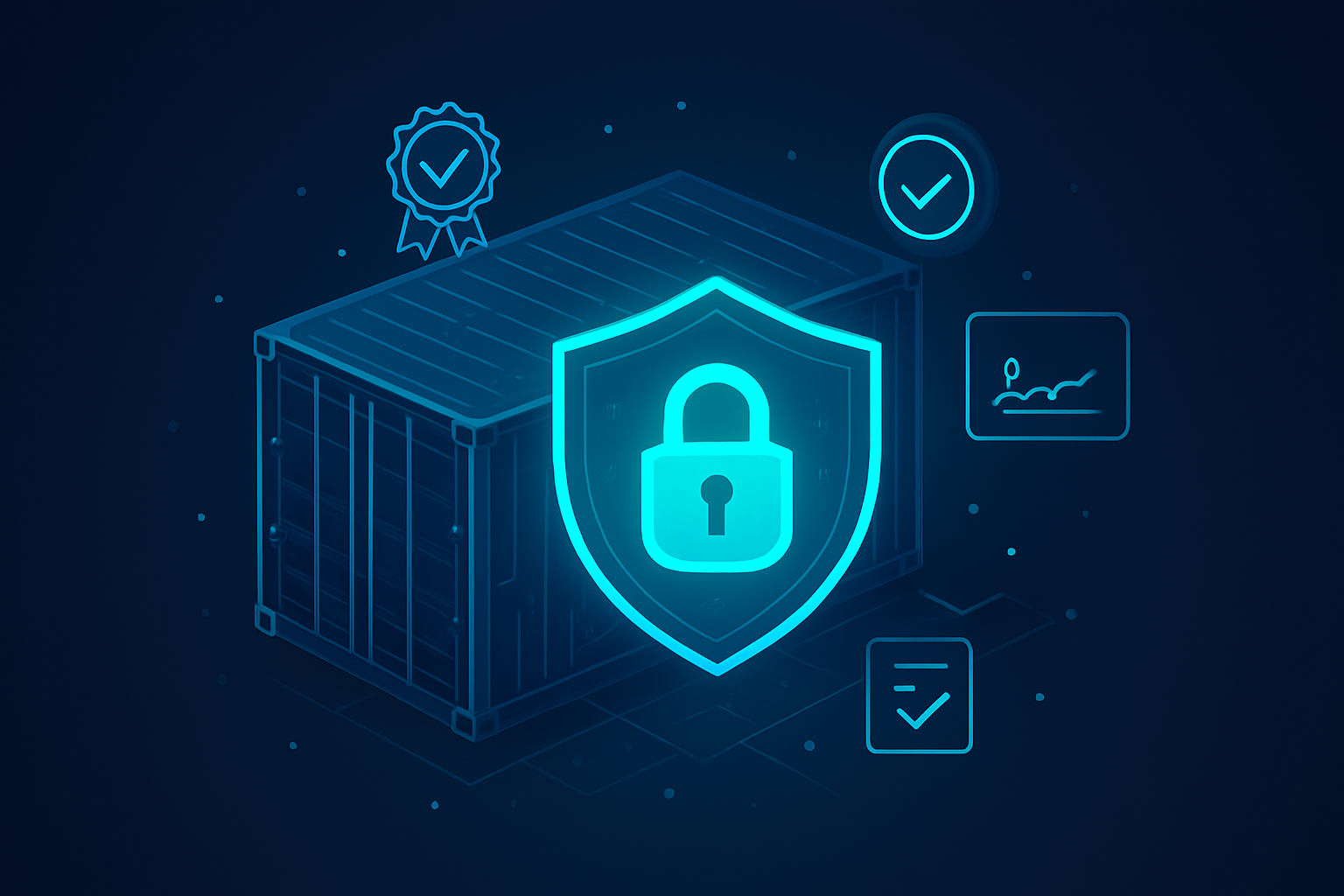 供应链安全三件套:依赖防火墙、产物中心、密钥管理
The cost ledger: finally, numbers for whether your tokens were worth it
The other meaty part of the release is cost. GitLab states the AI-investment management problem plainly: when leaders can't connect credits consumed to outcomes delivered, prioritizing use cases and setting budgets is guesswork; and agents starved of lifecycle context compensate with retries and token-stuffing — retries and tokens are the two hidden taxes of the agent era.
The fix comes in two layers. The first is GitLab Orbit: since its beta in June, it has been used by more than 3,500 organizations and served over 280,000 agent queries. It maps the entire software lifecycle into real-time knowledge that agents can act on — with tasks completing at up to 45x fewer retries and 4.5x fewer tokens, reaching GA next month across all deployment options. That number deserves a pause: a 45x drop in retries says most agents aren't dumb because the model is dumb — they're dumb because they're context-poor.
The second layer is Duo Agent Platform Impact Analytics (early access): cost and impact of AI investment broken down by team, task, and model. Combined with the previously introduced AI usage caps — spending ceilings settable at the subscription, group, or user level — the ledger closes: how much was spent, what it produced, who spent it, all on one screen. And the observability is model-agnostic: GitLab-managed frontier models, open-weight models, and self-hosted models all get counted the same way, even in a mix.
There's a lesson here for solo vibe coders too: you may never touch Impact Analytics, but the habit — every dollar your agent spends should have a ledger — is worth building now. Orbit's 4.5x token reduction is really the same story: context is the cheapest token optimizer there is. Feeding your agent real repository knowledge beats upgrading to a bigger model, at a fraction of the price.
Opinion: three roads diverge — how should developers pick a side?
Zoom out on the October 2026 timeline and the big players are clearly playing different games:
| Player | Bet | In one line |
|---|---|---|
| GitHub | Workflows | Automation as composable blocks; the developer workflow is the center of the universe |
| Microsoft | Agent OS | Agent capabilities at the operating-system layer; infrastructure eats everything |
| GitLab | Factory governance | One identity, one policy, one evidence chain; the integrated platform does it all |
My read: the real moat of the agent era isn't "who generates more code" — it's "who can make machine-speed output provable, auditable, and rollback-able." Code generation is commoditizing fast — today's leading model is tomorrow's runner-up; but an intent-to-production evidence chain is something a platform accumulates over a decade. That's GitLab's bet: when the board starts asking "who is actually responsible for all this AI-generated code," the platform holding a complete evidence chain wins by default.
But integration cuts both ways. For companies already all-in on GitLab, this is overwhelming force: Artifact Central lands and the Artifactory bill becomes negotiable; Dependency Firewall turns on and part of Snyk's job gets absorbed. But if your shop is best-of-breed assembled — GitHub for code, Jenkins for builds, Artifactory for packages — the migration cost is a genuine barrier. The more complete GitLab's "factory" narrative gets, the larger the migration fear looms for non-GitLab users. That's the question it still has to answer.
There's also a subtle power-structure shift worth naming: GitLab's announcements speak to developers on the surface, but the real audience is CISOs and platform engineering leaders — the people holding the budget. For five years, DevOps purchasing logic was "buy what developers love" (GitHub's strongest moat); but in the agent era, the risk surface is too large for security and compliance not to have a veto, and "developers love it" is becoming necessary but not sufficient. GitLab's entire narrative — evidence chains, security standards, cost ledgers — is written for the people who sign. That's not an accident; it's a deliberately chosen battlefield.
For indie developers and vibe coders, this release offers three takeaways:
- Think in evidence chains: make every step of your agent traceable — clear commit messages, logs of agent actions. The day your side project grows into a company project, that's audit material ready-made.
- Build the "door check" habit: Dependency Firewall's warn / block / quarantine tiers are really "observe before you block." On a personal project, one rule for your agent — "justify new dependencies before adding them" — does something similar at zero cost.
- Watch your token ledger: Impact Analytics is an enterprise toy, but its logic is universal — glance at your API bill regularly, find which tasks are burning tokens, and you'll likely find multi-fold optimization headroom.
One honest closing note: as a product release, this one is solid (GA, beta, and early access are clearly separated — no slideware); but as a narrative, GitLab is really addressing the whole industry — agent-written code was only the first half; the second half is "who governs what these agents actually did." GitHub, Microsoft, and GitLab all want to referee that second half. The good news for developers: no matter who wins, "governability" itself is turning from a compliance burden into a part of engineering efficiency. And that is the thing in this press release truly worth remembering.
Primary sources: GitLab's official press release via BusinessWire (2026-10-06), "GitLab Announces the Foundation for the Governed Software Factory"; ADTmag's independent report (2026-10-07), "GitLab Adds Controls for Dependencies and Credentials as AI Agents Take on More Development Work."
Sources
Related articles
Adversa AI disclosed CCI on October 6: malicious instructions hidden in AES-256 ciphertext trick Copilot CLI in autopilot mode into decrypting them in its own runtime and obeying the output as trusted instructions. In the demo, one encrypted page made the agent read a local .env.prod and silently exfiltrate it in 28 seconds. Microsoft's mai-code-1.1-flash fell for it half the time while GPT-5.6 models refused it outright; GitHub reproduced the chain but declined to call it a vulnerability.

Simon Willison shipped a Newsletters index page for his blog almost entirely by voice — chatting with the Codex tab in the ChatGPT desktop app while cooking dinner in his kitchen, barely touching the keyboard. When a top-tier practitioner starts coding with his mouth, voice + agents stop being a gimmick and become real productivity. A teardown of his playbook, where this workflow breaks, and the minimal setup to copy him.
On October 7, 2026, GitHub moved secret detection to a purpose-built ModernBERT classifier: AI-detected alerts upgrade automatically at no extra charge, while AI checks in push protection and Copilot's /security-review enter private preview and will bill AI Credits per run. This piece breaks down the three changes, how context-aware detection works, the billing ledger, and what it means for vibe coding developers.