Agents Are Spending Their Own Money: LangChain's Two-Track Payments Push and the x402 Settlement Layer
On October 8 LangChain open-sourced Restock, an agent that shops in Slack and pays with Stripe's Link wallet (real $22.18 order, real refund) — while its August 18 AgentCore Payments middleware wired the x402 protocol into the LangChain toolchain for autonomous micropayments. This piece breaks down the two payment tracks, an x402 vs. Stripe decision framework, budget guardrails for one-person teams, and the security red lines.
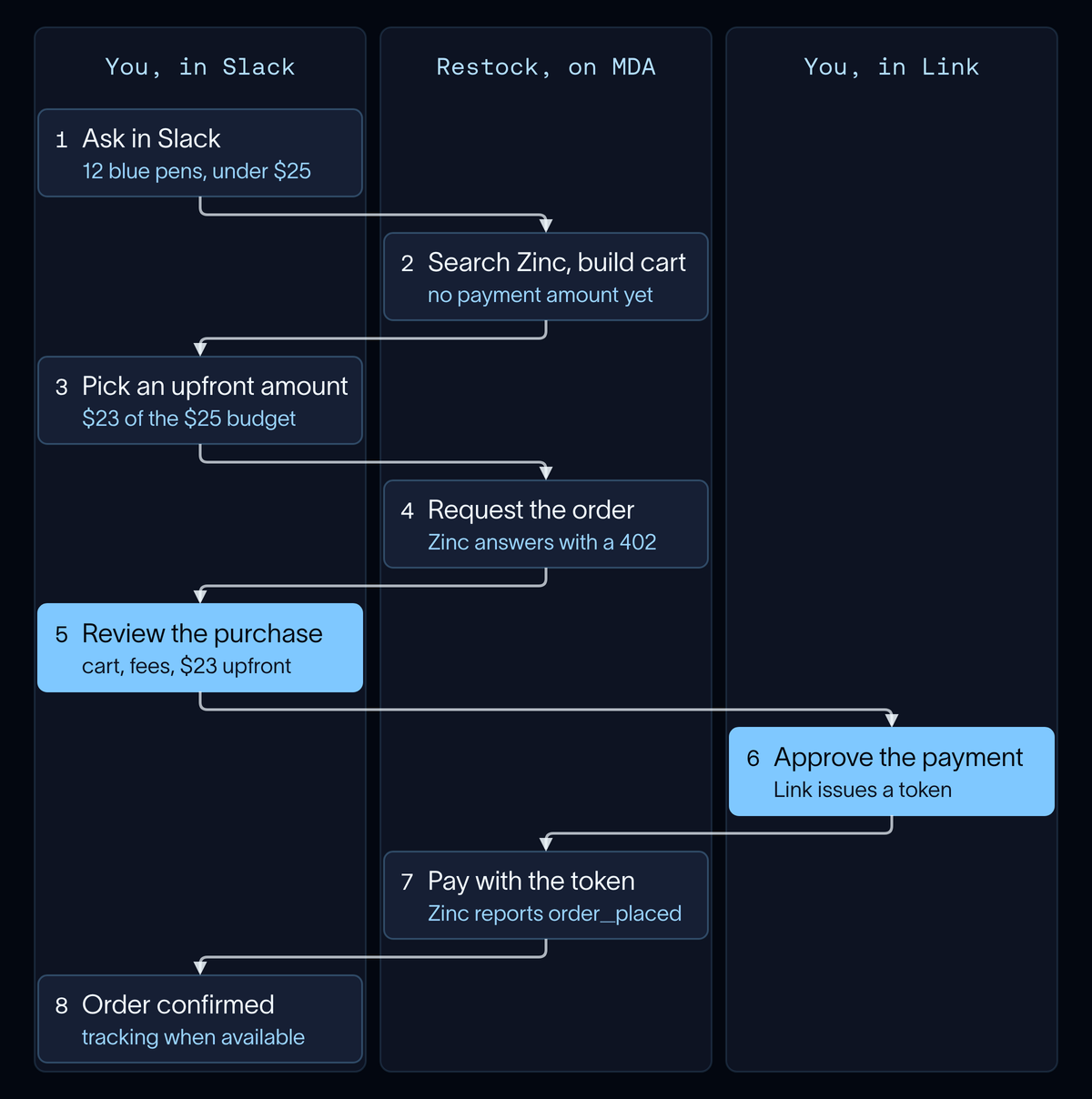
On October 8, the LangChain blog published Agents that can pay and open-sourced a sample agent called Restock: it lives in Slack, searches real products, builds a cart, and pays with Stripe's Link wallet — a 12-pack of blue pens, $25 budget, $22.18 actually paid, $0.82 refunded, the whole flow run end to end on official hosted infrastructure until the order reached order_placed. Note: this was not play money in a demo. Real money, real order, real refund.
But that was only the first half. Two months earlier, on August 18, LangChain published another official post, AgentCore Payments middleware for LangChain agents — wiring the x402 payment protocol directly into the LangChain agent toolchain: when an agent's tool hits a paid API that returns HTTP 402, middleware automatically validates the budget, signs the payment, and retries the request with payment credentials attached. The agent gets its data as if the API had returned 200 the first time, the entire process transparent to it.
Read together, the picture is clear: in two months LangChain laid both tracks of agent payments — x402 micropayments for machine-to-machine commerce, and Stripe wallet payments for consumer spending. AI agents have started spending their own money on APIs and services. This is no longer an "agent economy" concept slide. It is the settlement layer.
Date transparency note: our scout initially logged the October 8 post as an "x402 payments" article. After personally opening both official blog posts in a browser to verify, I am correcting the record: the October 8 Agents that can pay post is about Stripe Link + MPP (Machine Payments Protocol); the full x402 integration is the August 18 AgentCore Payments middleware post. Date evidence: the former is explicitly labeled October 8, 2026 under "Recent stories" on the official langchain.com/blog archive (cross-confirmed on an on-site related-reading page showing the same date); the latter is cross-verified as 2026-08-18 via a third-party archive mirror's metadata. Every fact below follows the two original posts; third-party ecosystem data is attributed separately.
x402: an HTTP-native cash register for machine-to-machine trade
Start with x402, because it is the key to the whole story. x402 is an open payment protocol named after the HTTP status code 402 Payment Required — a code that sat unused in the HTTP spec for decades, now repurposed as the cash register for machine-to-machine transactions. Created by Coinbase in May 2025 and now stewarded by the Linux Foundation, it is an open standard, not one company's proprietary rail.
The flow is minimal and fully HTTP-native: an agent's tool requests a paid endpoint, the server replies 402 with a price; the agent pays in stablecoins and retries with the payment credential; the server releases the data. Quoting, payment, and retrieval happen inside a single request-response cycle — no pre-registration, no contracts, no saved cards, no human approval in the middle.
LangChain's August 18 post states plainly why legacy payment rails cannot carry agents: card-processing fees make per-call API pricing in cents economically impossible — the fee costs more than the call itself; monthly subscriptions assume a human deciding in advance what to buy, while agent calls are on-demand, dynamic, and unknowable ahead of time. Stablecoin micropayments settle in seconds at fractions of a cent per transaction, which is what makes per-call pricing viable for agent workloads. Note where this argument points: it is not "crypto payments are cool," it is the agent transaction pattern is natively incompatible with both dominant human-era pricing models.
One confusion worth clearing up: the MPP (Machine Payments Protocol, Stripe's machine-payments protocol) in the October 8 post follows the same "402 challenge — retry with credential" pattern, but it lives inside the Stripe ecosystem; x402 is the open, cross-wallet, cross-chain protocol. LangChain's AgentCore Payments middleware is protocol-agnostic — the post explicitly says it handles x402 v1, v2, and other machine-to-machine protocols. The framework layer does not pick your side; it abstracts "paying" away.
The middleware: taking "spending money" out of the prompt
The genuinely important x402 integration is not "give the agent a payment tool" but the middleware design in LangChain's August post. LangChain's middleware system lets you inject logic at each step of an agent's execution without modifying the agent itself, and AgentCore Payments middleware sits exactly at the tool-call layer:
- Detect: a tool hits a paid API that returns HTTP 402 with an x402 payload;
- Validate: the middleware checks the quoted amount against your session budget — over the limit, the request is rejected and nothing is signed;
- Sign: within budget, the payment is signed via the AgentCore PaymentManager;
- Retry: the original request is retried with the payment credential attached, and the API returns the data;
- Continue: the agent receives the content as if the first request had succeeded.
The config is one budget line at its core:
config = AgentCorePaymentsConfig(
    payment_manager_arn="arn:aws:bedrock-agentcore:us-east-1:...:payment-manager/pm-abc123",
    user_id="user-123",
    payment_instrument_id="instrument-456",
    region="us-east-1",
    auto_session=True,           # session auto-created on the first 402
    auto_session_budget="5.00",  # hard ceiling for this session: $5
)
agent = create_agent(
    model=model,
    tools=[],
    middleware=[AgentCorePaymentsMiddleware(config)],
)
That one line, auto_session_budget="5.00", is the design most worth stealing for indie developers: the spending cap lives in the infrastructure layer, not in the prompt. A "don't spend more than $5" in the prompt is merely a request to the model — it can be misunderstood, rewritten by injection, or "forgotten" in a long context. A budget in middleware is deterministically enforced: over the limit, the payment-signing step never happens. This is the correct answer to "budget guardrails," and the starting point for the practical section below.
Auditing matters just as much. The official post is refreshingly honest about it: the blockchain ledger only records that "some payment instrument sent $0.02 to some address at 14:03:11" — it does not record that the agent was three steps into a research task, holding a one-dollar limit, and picked that endpoint because a tool description mentioned court filings. Decision context exists only in the agent's trace. So the middleware attaches each payment's amount, network, recipient, triggering tool, session, and user as metadata into the LangSmith trace; payments refused for exceeding budget land in the trace too — a refusal is itself an audit event, not "no money spent, nothing to log." The post also gives an eval methodology: single-step evals test "give the agent a task worth pennies, return a 402 asking for fifty dollars, and check whether it pays anyway"; full-turn evals score both "stayed within budget" and "did the purchased data actually answer the question" — because "spent money on useless data" looks perfectly fine on an invoice.
The other track: Restock + Stripe Link, human-approved spending for consumers
If the x402 track solves "machines buying from machines' APIs," the October 8 Restock post solves "agents spending on behalf of humans." Its design philosophy is the exact opposite of the middleware track: every payment must be human-approved.
Restock's payment chain is four pieces: Link (Stripe's consumer wallet, holding the user's payment methods and asking the user to approve payments), MPP (the Machine Payments Protocol defining the payment exchange over HTTP: the merchant replies 402 + payment instructions, the client retries with a payment credential), Zinc (retail product search and an MPP ordering API), and Managed Deep Agents (hosting the agent run, handling Slack, human review, credentials, and durable state). A user says in Slack "buy a 12-pack of blue pens, $25 budget"; Restock searches via Zinc, builds the cart, then does two critical things:
- Treat the budget as a ceiling, not an amount. Tax and shipping are unknown before the order is placed, so Restock first asks the user "of this $25, how much are you willing to pre-pay" — the user picked $23. Zinc takes the $23, pays the retailer, and refunds the difference — $22.18 actually paid (including Zinc's $1 base fee), $0.82 refunded. Note the ordering: before asking the user to review, Restock sends Zinc an order request without payment and reads the real fees out of Zinc's
402 Payment Requiredchallenge. The price is not made up by the model; it is read from the merchant's challenge. - The user approves twice. First, review the cart, fees, and pre-pay amount in Slack (Restock raises an interrupt here — the run stays paused until the user clicks Approve or Reject — and the post stresses that nothing the model writes into a tool call can approve it); then approve the payment on Link's own website. After payment, the payment tool reads Link's shared payment token from a private sandbox file, deletes it after use, and returns only a public summary to the model — the model never sees any payment credential from start to finish.
Credential isolation is the most copy-worthy engineering detail in this post: the Link session lives in a user-owned MDA Connection, the delivery address, notification email, and Zinc API key live in agent-owned Connections, and the Link CLI login runs inside MDA's managed sandbox. A helper places the session into the sandbox only for the seconds a command runs. And connecting Link does not approve any purchase; later conversations reuse the session without re-login.
Restock ships three modes, and the ordering is telling: rehearsal (fictional products + simulated approval, pure dry run), link-test (real Zinc search + real Link approval, no purchase), live (real payment, real order). The official advice is to try them in order — which is effectively the launch checklist for "agents that spend money": run the full search → cart → approve → pay → confirm loop on fictional goods first, then dry-run with real money but no purchase to validate the approval chain and refund path, and only then go live. Skipping any stage is gambling real money on process.
The core call: once the settlement layer clears, API pricing logic changes
Put the two tracks together and you see something bigger than "LangChain shipped two features." This is the key step of the agent economy moving from concept to settlement layer.
Agent toolboxes used to have an invisible ceiling: only free or pre-paid tools. The highest-value data — court filings, real-time market feeds, medical literature, premium APIs — all sat behind paywalls. Getting agents to use them meant hand-writing 30 to 50 lines of payment wrapper code per service, breaking the flow to ask a human, or downgrading to worse free data. The official post rules all three "not scalable." When payment becomes one config line in middleware, the ceiling is gone: an agent that can only call free tools and an agent that can procure on its own are two different species, a full generation apart in capability.
The deeper impact is on the supply side. When the buyer is an agent rather than a human, API pricing logic shifts from "per-seat, sold to humans" to "per-call, sold to agents." Seat pricing assumes a human making purchase decisions in advance; agent purchases are on-demand, fragmented, and unknowable ahead of time — they need "hit a paywall, pay a few cents on the spot." x402 turning the long-ignored 402 status code into a cash register is, technically, paving the road for exactly this pricing. LangChain CEO Harrison Chase's point in the August post, paraphrased: agents are evolving from systems that generate answers into systems that take action, and an increasing share of those actions will involve economic transactions — what developers need is not a smarter model but infrastructure that can evaluate behavior, understand decisions, and enforce boundaries.
The ecosystem is confirming the direction (third-party reporting, attributed separately): on September 24, Block announced it was joining the x402 Foundation and contributing Bitcoin Lightning support to the protocol; crypto press citing official x402 figures put recent 30-day volume at roughly 75.41 million transactions and $24.24 million; on October 7, x402 batch settlement went live in production on Solana, letting agents sign USDC vouchers per request without settling each one on-chain while merchants claim them all at once — model-routing service BlockRunAI says it saves them over $20,000 a month in network fees. Settlement cost is being compressed toward "negligible," while who gets to decide to spend is the real scarce resource.
Practice 1: x402 vs. Stripe Link — how to choose
For vibe coders and indie developers, the most practical question is: I want to give my agent paid capabilities — which track? The answer depends on whose money your agent spends, how much, and how often.
- Small amounts, high frequency, fully autonomous — take the x402 side. Canonical cases: research agents buying court filings, market data, papers on demand; workflow agents calling paid MCP tools in sequence; browser agents crossing paywalls to extract content. A few cents a call, hundreds or thousands of calls a day — no human can approve each one; only a session budget as a deterministic backstop works. Card fees are pure loss at this granularity; stablecoin micropayments are the only rail where the math works.
- Large amounts, low frequency, spending for humans — take the Stripe Link + MPP side. Canonical cases: shopping agents, ticketing agents, office-procurement agents. Tens of dollars per order, users extremely sensitive about "where the money went" — compliance and explainability outrank autonomy. The "double approval + credential isolation + delete-after-use" human-approval chain is not overhead here; it is what makes the product viable at all. The card networks' compliance, risk, and fraud-liability frameworks are equally unavoidable in this lane — that is the traditional financial rails' real moat.
- The gray zone is decided by who owns the decision. If the purchase decision needs human backing (large amount, irreversible, real-world fulfillment), go Link; if the decision can be fully algorithmic (buying data, calling APIs, retryable), go x402. They are not mutually exclusive: a mature agent product can absolutely do "buy data over x402 automatically, place orders for the user over Link with approval."
One-line judgment: if you sell APIs to agents, start preparing per-call pricing and x402 compatibility now; if you build consumer spending agents, copy "human approves every payment + credential isolation" as your standard operating procedure. Don't leave your agent on the "free tier only" plan at the end of 2026 — your competitor's agent can already spend its own money on better data sources.
Practice 2: budget guardrails for a one-person team letting agents spend
"Don't let the agent burn a month's budget overnight" — everyone's first reaction to agent payments. The two official posts already contain a directly copyable guardrail design, ordered hardest to softest:
- Hard caps live in code, not in prompts. Copy the
auto_session_budgetidea: the session-level budget is enforced by middleware, and an over-limit payment is never even signed. "Don't spend too much" in a prompt is a suggestion; a budget in code is law. Minimum bar for a solo team: one session budget per task; the task halts when the budget is exhausted. - Layered budgets: session-level + per-transaction + per-task. Session budgets stop runaway loops; per-transaction caps stop the "$50 402 for a pennies task" (exactly what the official eval's fifty-dollar test is designed for); per-task budgets let you answer "what does agent procurement cost per month for this feature" — a prerequisite for pricing and PMF math.
- Ship in three stages: rehearsal → link-test → live. Restock's three modes are a ready-made SOP: first run the full search → cart → approve → pay → confirm loop on fictional goods; then dry-run with real money but no purchase to validate the approval chain and refund path; only then go live. Skipping any stage is betting real money on process.
- Audit the trace, not the invoice. The invoice tells you how much was spent; only the trace tells you why it was bought. Attach every payment's amount, recipient, triggering tool, session, and user to your observability system (LangSmith or your own logs) — and keep records of budget refusals too. Money not spent is also audit evidence.
- Online evals as sentries. Run scheduled rules against production traces: alert on a single session crossing a threshold, alert on payments to never-before-seen endpoints, alert on sudden cost-per-task spikes. Agent behavior drifts as prompts and toolsets change — "the agent that was frugal last week started spending freely this week" is the norm; without online watching, you're flying blind.
Practice 3: security red lines
An agent that can spend is an agent with an amplified attack surface. The risks explicitly named in the two official posts are each a red line:
- Payment credentials never enter model context. The hardest rule from the Restock post: tokens live in a private sandbox file, are deleted after use, and only public summaries reach the model. Once a credential enters context, it can surface in logs, traces, or even the model's next output. Credential isolation is not "best practice" — it is "don't ship without it."
- Guard against tool-description poisoning. The August post names the attack explicitly: an agent redirected by a malicious tool description to an endpoint nobody asked for, then "legitimately" paying it. Budget guardrails stop "spending too much," not "paying the wrong party." Countermeasures: allowlisted payment destination addresses/domains, trusted review of MCP tool sources, and online evals that alert directly on "payment to an unexpected endpoint."
- Guard against data-exfiltration purchases. An agent's paid request can carry data that should never leave your systems (e.g., sending user private data to a per-call external API). A payment action is inherently a "data leaves the building" event — in sensitive scenarios, run data-classification checks before payment, not just amount checks.
- The approval chain itself must be un-bypassable by the model. Restock's interrupt design is the benchmark: the run pauses before the human clicks, and "nothing the model writes into a tool call can approve it." Any design where "the agent can approve its own spending," however small the budget, is an architectural defect — unless you're on the x402 "fully autonomous within budget" track, in which case the autonomy boundary must be nailed down in code.
Closing: first answer "whose money"
Back to that $22.18 pen order. What actually matters is not "the agent can shop now," but that LangChain used two official blog posts and two open-source implementations to turn agent spending from a "hackathon demo" into an engineering problem with budgets, audits, and approval chains. x402 handles high-frequency machine micropayments, Stripe Link + MPP handles human-approved consumer payments, middleware nails the caps into code, and LangSmith answers "why was this money spent." The puzzle pieces are all on the table.
For indie developers, my advice converges to two steps. First, honestly answer "whose money is your agent spending" — its own (buying data, calling APIs) or the user's (buying things, booking services); that alone decides x402 vs. Link. Second, start with the hardest guardrail: session budgets in code, credentials never leaving the sandbox, an approval chain the model cannot touch. Only then talk about "full autonomy." The agent economy's settlement layer is live. What gets compared next is whose guardrails hold — not whose agent dares to spend more.
Primary sources: LangChain Blog: Agents that can pay: building Restock with Stripe's Link and Managed Deep Agents (2026-10-08); LangChain Blog: AgentCore Payments middleware for LangChain agents (2026-08-18). See the transparency note at the top for date evidence.
Sources
Related articles
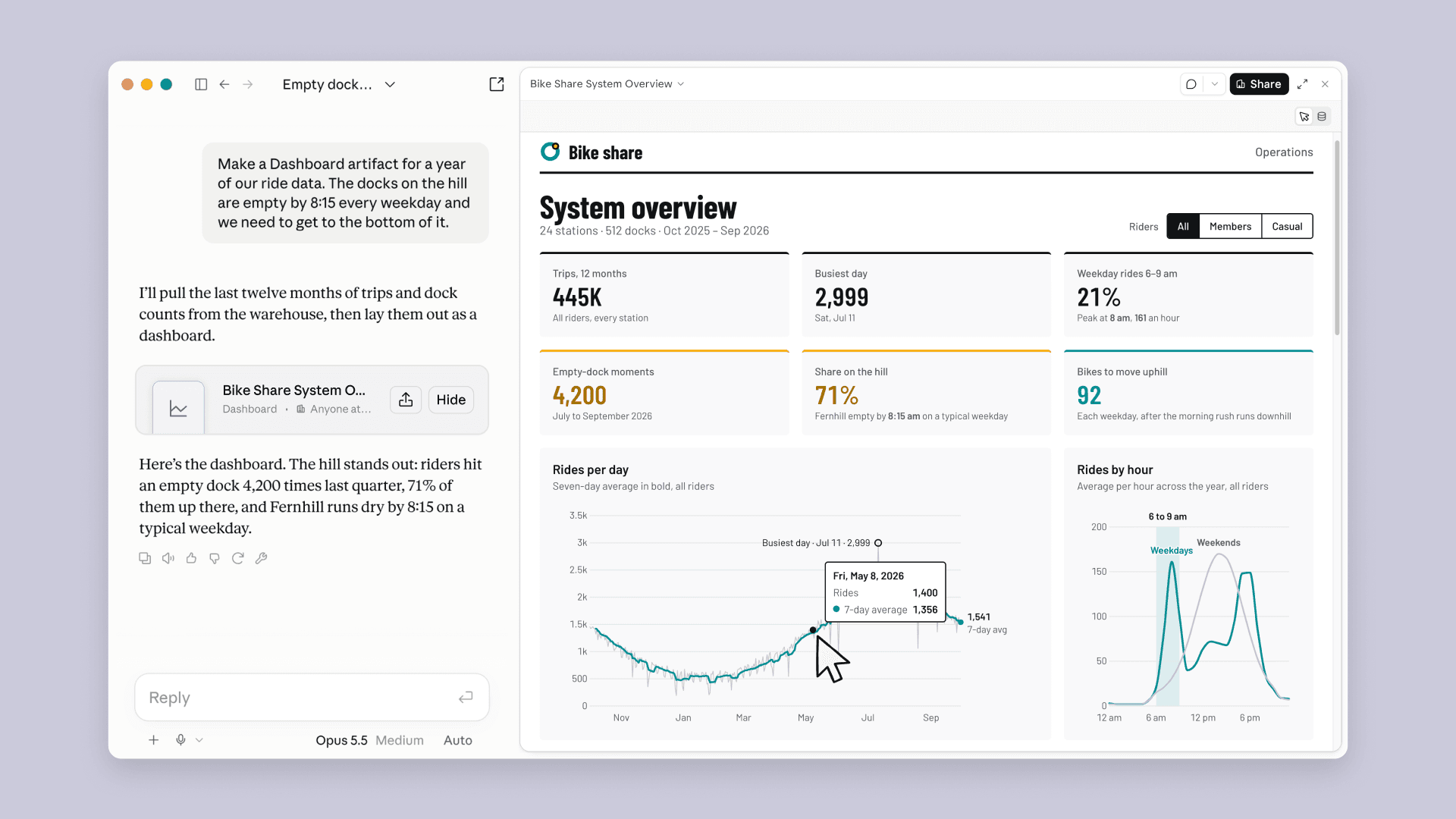
On October 8, 2026, Anthropic put Claude Dashboards and Claude Motion into beta: dashboards built from plain-language questions on live company data, and animations generated as editable code rather than video-model footage. Docs, Slides, and Design went GA on all plans, with 45M+ artifacts created to date.
Adversa AI disclosed CCI on October 6: malicious instructions hidden in AES-256 ciphertext trick Copilot CLI in autopilot mode into decrypting them in its own runtime and obeying the output as trusted instructions. In the demo, one encrypted page made the agent read a local .env.prod and silently exfiltrate it in 28 seconds. Microsoft's mai-code-1.1-flash fell for it half the time while GPT-5.6 models refused it outright; GitHub reproduced the chain but declined to call it a vulnerability.

Google, Google DeepMind, UMD and UVA propose RRSI: don't lock down what agents can change about themselves — regularize how they search. Unregularized evolution hit 92.8 evolve score but only 40.3 OOD; RRSI reached 90.5/43.6 with fewer tokens. The data-backed case that self-improvement itself needs regularization.