AI Made Coding Fast and Shipping the Bottleneck: LaunchDarkly Hands Releases to Agents Too
On November 5, 2026, LaunchDarkly introduced Release Autopilot, generally available November 16: it scores PR risk, adds flags, rolls out progressively, rolls back automatically when metrics breach, and cleans up afterward. AI already touches over 80% of its PRs, with merges up 2.1x.
The verdict first: code is being written faster than ever, and shipping has become the bottleneck — now someone is automating the release itself

On November 5, 2026, LaunchDarkly formally introduced Release Autopilot, with general availability on November 16 and some features arriving in beta. What it does can be said in one sentence: after an agent writes the code and the pull request is merged, the remaining release work — deciding whether the change needs a flag, rolling it out to a growing share of users, watching the metrics, rolling it back immediately if something degrades, and cleaning up the flag and the old code when the release succeeds — is all handed to automation. People set the rules and decide how much autonomy to grant.
This story is worth writing not because it adds one more feature, but because it marks where the bottleneck has moved. For the past year, the whole industry's attention has been on "how code gets written": agents write faster, pull requests pile up. But writing code is only the first half. The second half is "how it safely reaches users." LaunchDarkly's own numbers state the mismatch plainly: inside the company, AI now assists on over 80% of pull requests, and merged pull requests have grown 2.1x with roughly the same number of engineers. At the same time, 94% of surveyed engineering leaders said AI increased code velocity, 91% said it made them more cautious about pushing to production, and 82% admitted shipping changes with unresolved risk in the past six months. Fast to write, afraid to ship — that is the real situation for software teams at the end of 2026.
My judgment: the real selling point of Release Autopilot is not any single feature like automatic rollback — progressive delivery and automatic rollback are not new ideas. The selling point is packaging everything a correct release involves into a default flow, so every change goes through it, instead of depending on whether an engineer had the time or remembered. For solo developers and small teams, the enterprise platform itself may be out of reach, but the trend is worth remembering: in the age of agent-written code, the release step is moving from "human on watch" to "rules plus automation," and whichever link fails to upgrade will become the next bottleneck.
What it actually does: five steps for every change
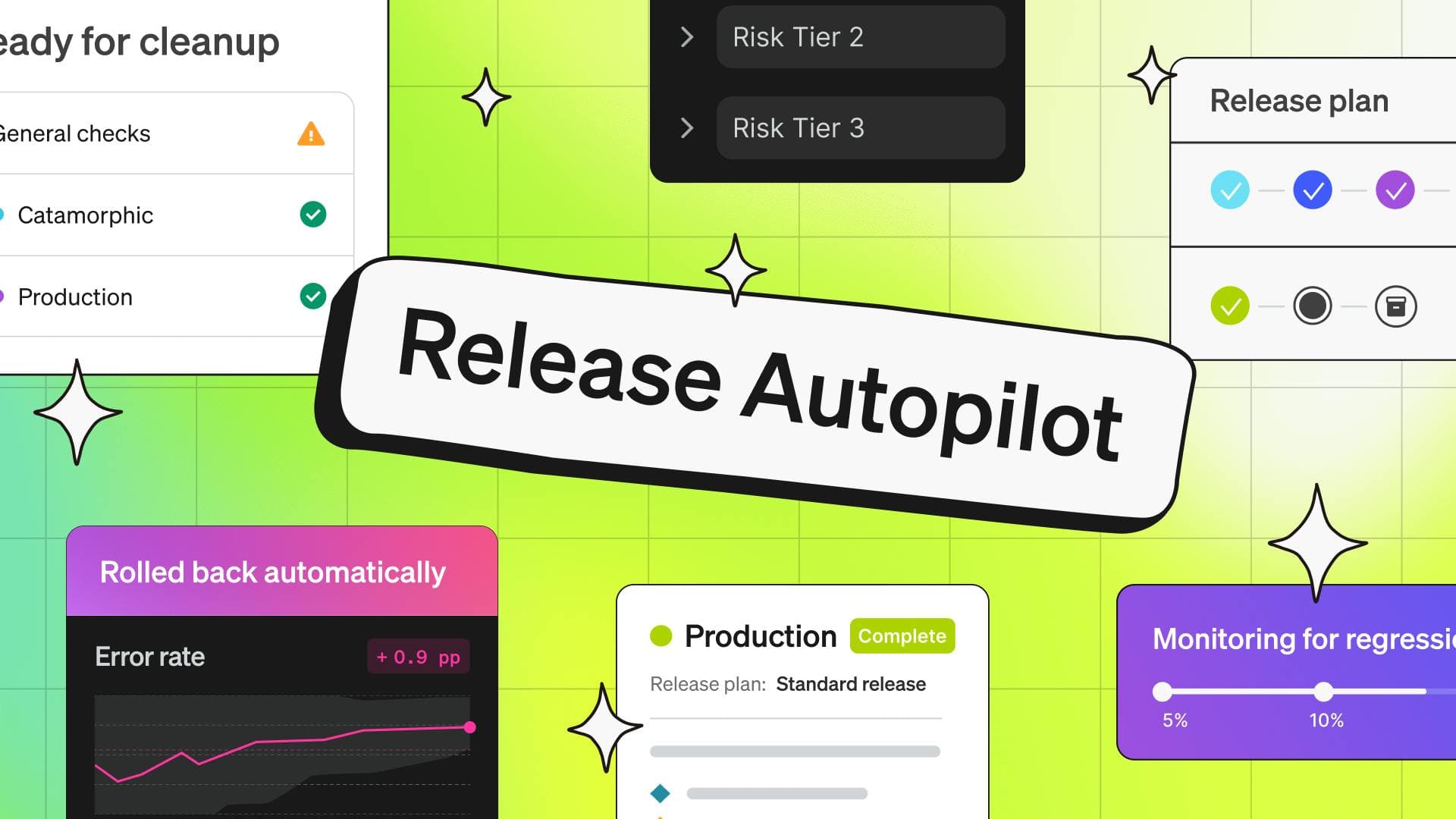
According to LaunchDarkly's official blog and press release, Release Autopilot takes over the full journey of a change from merge to completed release. First, it agentically assesses the pull request and classifies its risk. Second, it decides whether the change needs a feature flag, and if so, adds the flag to the pull request directly — the step engineers most often skip because it feels like a chore. The official blog admits that even inside LaunchDarkly, a company built on feature management, many changes used to ship without a flag because the cost-benefit did not seem worth it, until an incident showed that particular change was exactly the one that needed it. Third, it rolls the change out progressively while watching the guardrail metrics you define, such as error rates and latency. Fourth, if a metric moves the wrong way, it automatically pauses the rollout or returns the change to its last good state, without a redeploy. Fifth, once the release succeeds, it automatically cleans up temporary release flags and submits a pull request removing the old code.
Two concepts that are easy to confuse are worth separating here. CI/CD automates how code gets deployed. Release Autopilot automates how a deployed change reaches your users. It is not a code review tool and it does not replace your CI/CD pipeline; it works on the stretch after deployment and before users. It runs on the LaunchDarkly platform, which evaluates about 70 trillion feature flags a day. It can also run as a plug-and-play GitHub app, teams can bring their own key to run it on their own AI inference, or take the published skills into their own tooling.
How much autonomy it gets is the team's decision, and that matters. Teams can start with recommendations and human approval, then expand automation as trust builds; or fully automate low-risk changes while engineers review higher-risk ones. LaunchDarkly does the latter itself. The official blog also shares a striking number: inside LaunchDarkly, agents already ship over 20% of pull requests directly to production, with engineers setting the guardrails and agents handling the rest.
The numbers, with sources attached: they are their own first test subject
The easiest objection to a launch like this is "the vendor says so," so here are the numbers with their provenance separated. The first set comes from LaunchDarkly's own operations over the past year, not from a third-party audit: with roughly the same number of engineers, monthly merged pull requests more than doubled, feature flag creation nearly quadrupled, automation now handles 42% of flag removals, and time spent on Major and Critical incidents has fallen about 70%. Tiama Hanson-Drury, chief product and technology officer of Opus 2, a legal technology company, said in the press release that by separating deployment from release, her team now delivers 3.9 times more work to customers, with escaped defects down from 64 per release to virtually zero.
The second set comes from the LaunchDarkly 2026 AI Control Gap Report, a survey of 767 senior engineering and DevOps professionals: 94% said AI has increased code velocity, 91% said it has made them more cautious about pushing to production, and 82% reported shipping changes with unresolved risk in the past six months. This is vendor-commissioned research — the vendor controls the sample and the questionnaire, so read it with a discount applied — but the anxiety behind the 91% figure is real: fast to write does not mean safe to ship, and safe to ship does not mean it ships steadily.
Rachel Stephens, Research Director at RedMonk, supplied the industry-level framing in the press release: generative AI is accelerating code output, but for many organizations it has just moved the bottleneck later in the software development lifecycle, and release is the last mile of the delivery pipeline, often still running on bespoke, manual workflows. She called Release Autopilot a clear step toward making progressive delivery a repeatable, low-friction default rather than an occasional risk-mitigation tactic. Jonathan Nolen, LaunchDarkly's chief product officer, put it more directly: "Human attention is among the scarcest resources in the software factory, and it belongs on the highest-value work" — not on deciding what needs a flag, configuring rollouts, watching dashboards, and jumping in when something goes wrong.
Do not confuse it with October's feature-flag guide: that was method, this is product
VibeFix published a guide in October (cycle 150) on gradual rollouts with feature flags: when to use a flag, how to set the rollout steps, what signals justify a rollback. That was methodology. This Release Autopilot story is product news: LaunchDarkly has encoded those best practices into automation, so an agent executes them by rule. The guide teaches you "what you should do"; the product means "you no longer have to do it by hand every time." They complement each other and do not overlap. If you are a solo developer or a small team, the guide is more immediately useful; if you lead a team being buried under agent-generated pull requests, this product news is the one to watch.
It is equally worth separating what Release Autopilot is not: it does not write your tests and it does not review your code. The official blog says so plainly: quality is only half of the equation — better harnesses, more context, more tests, and agentic review are all things LaunchDarkly is doing. The other half is production risk. Tests cover the scenarios you anticipate, and code review catches the problems you can identify; production is where real customers show up with edge cases and traffic patterns nobody fully anticipated. Being able to control who sees a change, measure it on its own, and turn it off instantly when something is wrong is what lets you move at agent speed with confidence.
Staying sober: it is too early to call this one
First, the timeline: announced November 5, generally available November 16, with some features still in beta at launch. That means the full version is not usable today; what exists now is the official blog, the launch event recording, and statements from early test customers. Pricing has not been disclosed; there is a free trial, but enterprise pricing is a conversation. For a solo developer, the direct value is limited — your release process may be "merge, deploy, glance at the logs," which hardly needs risk tiers and automatic rollback.
Second, the credibility of the numbers. The 2.1x pull requests, the roughly 70% drop in incident time, the 64 escaped defects down to near zero — all of it comes from the vendor or its customers, with no third-party audit and no control group. Treat them as directional evidence — automated releases genuinely let a team process more changes with the same headcount — not as a promise your own team can reproduce. The 91% and 82% survey figures come from vendor-led research too; wording and sampling shape results.
There is also a more practical question: handing releases to automation means handing over the judgment of "when to roll back." Thresholds set too loose mean no protection at all; set too tight, and normal fluctuation triggers rollbacks that interrupt releases for nothing. LaunchDarkly's answer is to let teams define their own guardrail metrics and autonomy levels, starting from "recommendations plus human approval." That is the right design — but it also means this is not magic you plug in and forget. Defining what counts as "a metric moving the wrong way" and which changes count as "low risk" is itself real work that has to be done carefully. For a small team, that upfront work may cost more time than the automation saves.
But the trend itself deserves to be taken seriously. Agent-written code has already made "writing code" stop being the bottleneck; the bottleneck is walking downstream along the pipeline — first review (Microsoft's PDD Kit, announced the same day, is one answer to review), then release (LaunchDarkly's Release Autopilot), and next probably monitoring, post-rollback review, and incident accountability. Each step, when it gets automated, goes through this same phase: the vendor announces first, the numbers are self-reported, the full version arrives weeks later, and independent verification takes months. When reading this kind of news, keeping "what was announced" separate from "what has been verified" is the most basic discipline.
One line for vibe coders
You probably will not buy LaunchDarkly today — a solo project's release process does not need this machinery. But the problem behind it will reach you eventually: when your agent can hand you ten pull requests a day, what guarantees that every release is safe? The answer will not be "be more careful." It will be "write the carefulness down as rules, and let machines execute them." Even with the simplest tools, you can steal three of its habits today: have a rollback plan for every change before you ship it, roll out to a small share of users first, and watch the error rate after release instead of only checking that "the deploy succeeded." Those three cost nothing — and they are the entire content of what Release Autopilot automates, except it turns them into the default flow for large teams.
Comments (0)
Sources
Related articles

Cognition released SWE-2 Flash on November 4: three times faster at one-fifth the price of SWE-2, free through November 30. The real story is the new mid-training stage — and the decision to keep the weights private.

OpenAI released Images 2.6 on November 4: GIFs in ChatGPT and Codex, reusable reference images, and two API models — Flare for speed, Sunburst for consistency. Speed is the least interesting part; memory and motion are what change the workflow.

Preview is the first gate for any file product: confirm in three seconds that this is the right file. Rendering choices per file type, security boundaries, mobile, and performance — in that order.