Lovable Crosses $600M Annual Revenue as Two-Thirds of the Fortune 500 Vibe-Code
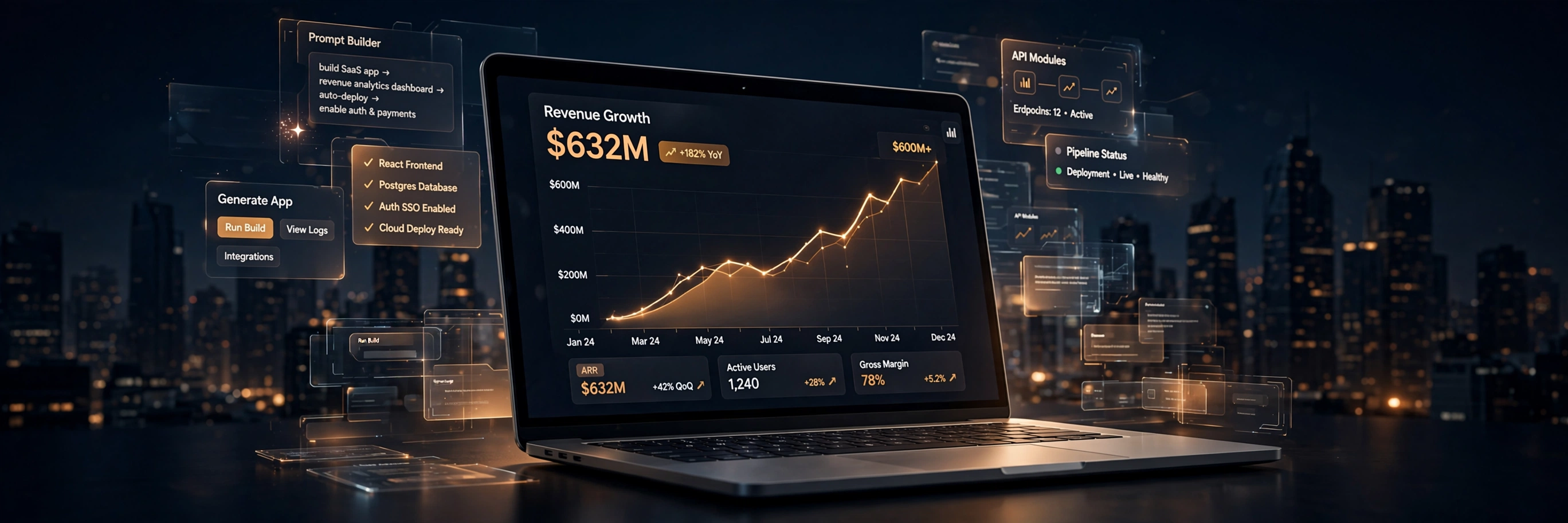
At the HumanX summit in Amsterdam on September 24, Lovable co-founder Fabian Hedin announced $600 million in annualized revenue — up from $500 million in June. Two-thirds of the Fortune 500 use it; user-built apps draw nearly a billion monthly visits. In August the startup raised $400 million at a $13.3 billion valuation.
One hundred million in three months
Sweden's vibe-coding platform Lovable has crossed $600 million in annualized revenue. Co-founder Fabian Hedin announced the figure on stage at the HumanX summit in Amsterdam on September 24. Three months ago, in June, that number was around $500 million. TechCrunch reported the news first.
That makes Lovable one of Europe's fastest-growing AI companies — and the first to reach $600 million in ARR on the strength of "software written in natural language."
The difference isn't code, it's the product
Hedin shared more numbers at the summit: people at roughly two-thirds of Fortune 500 companies now use Lovable, with Microsoft, Nvidia, and Deutsche Telekom among its customers. Apps built by users on the platform are pulling in close to one billion visits per month — an order of magnitude more than Lovable's own site.
"You can use tools like Codex or Claude Code to output code. The difference is that Lovable does not output code. The output is a product, and increasingly so, a business. We do a lot of things around hosting, deployment, and scaling apps." — Fabian Hedin, HumanX 2026
$700 million in eight months
The growth curve is backed by serious capital. Lovable raised more than $700 million across two rounds in eight months: $300 million last December from Menlo Ventures and CapitalG at a $6.6 billion valuation, then $400 million in August from Menlo Ventures and the Scaleup Europe Fund at $13.3 billion — double in eight months.
Since launching last November, users have created over 60 million projects on the platform. The moment vibe coding crossed from hackathon toy to enterprise productivity tool may be right now.

Sources
Related articles
On October 8, 2026, Google Cloud launched the Gemini agent at Gemini at Work 2026: a universal agent for work that takes objectives, plans by itself, auto-selects between Gemini and Claude models per task, and introduces 'coworker agents' with their own email, calendar, and directory seat. Four judgments on why the second half of the agent race is about 'agents that feel like colleagues.'
On October 1, 2026, Microsoft AI shipped three voice models at once: MAI-Transcribe-2-Streaming (streaming transcription, #1 on Artificial Analysis for streaming accuracy at 2.5% WER, final transcript 0.13s after end of speech), MAI-Voice-2.1 (23 languages, one consistent voice across languages), and 2.1-Flash (45s of audio at ~150ms end-to-end). With listening and speaking covered, a voice agent on a pure-Microsoft stack can now complete a turn in under a second.

Gergely Orosz visited OpenAI, Anthropic, Cursor, and Ramp and wrote up the 2026 state of the industry: near-100% AI-generated code, agent PRs up ~10x in eight months, code review degrading into theater, the IDE declared legacy. Key takeaways plus three verdicts and four actions for vibe coders.