Meta Pauses Muse Sharing After 6,800 GhostShares Found via Passive DNS
Meta paused Muse AI's conversation sharing on Oct 20 after Claroc researchers enumerated 6,800+ share links via passive DNS — Muse put readable chat titles in subdomains. A lesson in share-link design every vibe project should read.
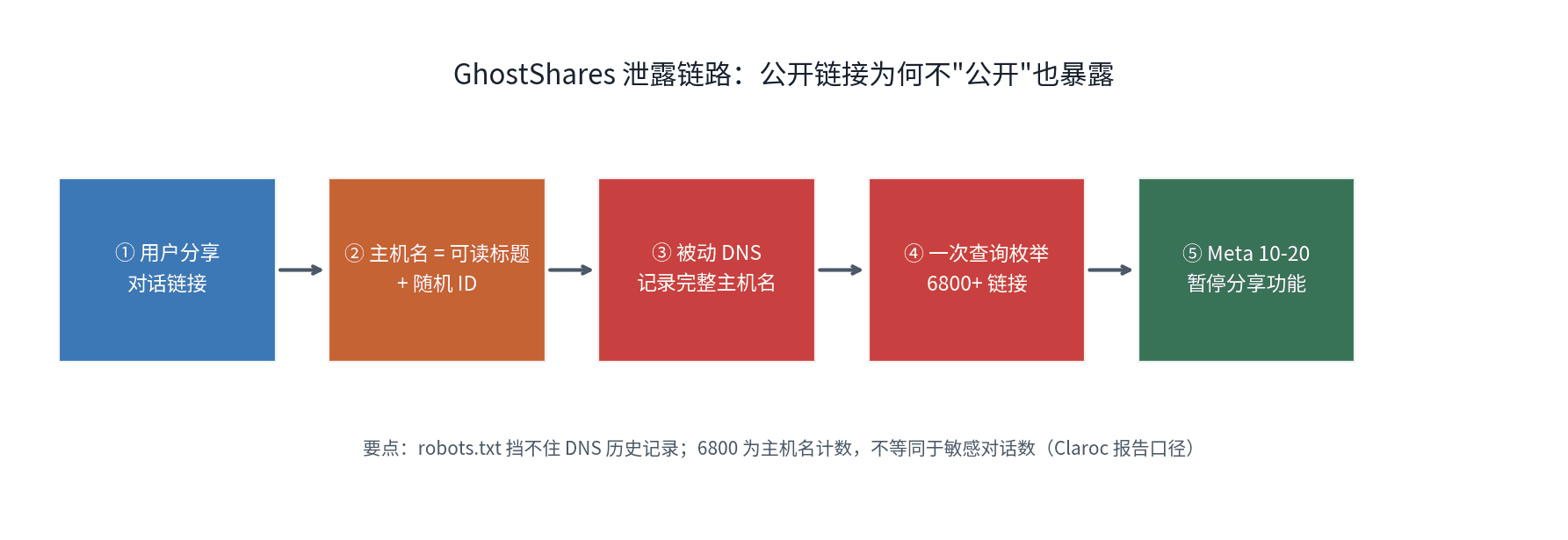
Shared AI Chats, Seen by DNS
On October 20, Meta paused conversation sharing in Muse AI. The trigger was a report from security firm Claroc: researchers enumerated more than 6,800 Muse share links with a single passive-DNS query, many containing business and personal information never meant to be public. Ars Technica reported first; The Verge obtained Meta's confirmation.
Scope first: the flaw affected pages users chose to share, not all private Muse conversations. Sharing generates a public link — designed so that "only people with the link can view it." Claroc showed that assumption never held.
The Mistake: Putting Titles in the Hostname
The technical detail deserves every share-feature developer's attention. Muse hosted shared content under cf.metaaiusercontent.com, with each share's hostname combining a readable conversation title and a random ID, for example:
home-sale-budget-9f21c8a3.cf.metaaiusercontent.comloan-application-draft-a4c9e2.cf.metaaiusercontent.com
The random ID made brute-force guessing impractical. But DNS lookup records are publicly queryable. Passive-DNS services log the domain resolutions they observe — including the full hostname. So when anyone (the sharer, the recipient, any middlebox) resolved one of these links, the complete hostname — title and secret ID alike — landed in public DNS history. Claroc needed just one passive-DNS query to pull back thousands of entries, listed by title like a table of contents.
Claroc named these discoverable-but-unintended exposures GhostShares. Researchers opened several hundred pages to verify and found: a marketing company's CEO-level revenue review, a small-business loan application (with the requested amount), a property investor's full financial report (with addresses and exact return figures), a bank fraud alert with partial account details, a company's full-year staff vacation calendar, and confidential prep notes for an executive-search call with a frontier AI lab (naming the internal contact and meeting time).
An honest footnote, from Claroc itself: 6,800 is the count of deduplicated share hostnames, not 6,800 confirmed sensitive conversations — only a few hundred were opened, most pages were ordinary, there is no evidence of malicious misuse, and affected names and figures were withheld.
robots.txt Can't Stop DNS
The sharpest technical lesson: Muse's robots.txt asked search and AI crawlers to avoid share paths — and it was useless. Because robots.txt governs crawlers; DNS records govern resolution history. Different layers. Crawlers staying away doesn't erase lookup records.
Nor is this an isolated case. ChatGPT's shared conversations were previously exposed via search-engine indexing; Grok's shared chats had similar problems. AI products are re-stepping on Web 2.0's rakes — except this time, users feed agents more sensitive, less structured data: financial records, personnel schedules, trade secrets.
Claroc found a second discovery path too: 75+ archived scans of Muse share pages on urlscan.io. Even if DNS records were scrubbed, third-party archives keep copies. After Meta paused the feature, researchers rechecked 40 previously accessible links — all dead. But the titles in DNS history don't go away.
Zuckerberg's Promise, One Month Earlier
The irony: just a month earlier, Zuckerberg had called Muse "built from the ground up for privacy and security." Meta spokesperson Tracy Clayton's statement to The Verge was restrained: "we've paused this functionality while we review this report and consider changes to how these links can be discovered." Meta also said it opened a Muse bug bounty for researchers to probe more scenarios.
Claroc submitted the report through the bug bounty on October 8 (pages verified October 7–8). Twelve days from submission to pause — not slow, but the 6,800 links had been sitting in DNS history far longer.
5 Rules for Share Features in Vibe Projects
Share links are standard kit for vibe projects (sharing an AI-generated page, report, or conversation). GhostShares is a lesson for every indie developer:
- 1. Never put readable information in the hostname or any enumerable part of the URL. No titles, usernames, or project names. Use purely random, long-enough tokens (e.g., 128-bit), in the path or query — never the subdomain.
- 2. "Unguessable" is not "undiscoverable." In threat modeling, ask: which logging systems will this link pass through? DNS, CDN logs, browser history sync, archival services like urlscan — all are discovery surface.
- 3. robots.txt is not access control. It's a request to well-behaved crawlers. Real protection needs auth: share links should require login, be single-use or expiring, or at minimum be revocable by the creator.
- 4. Give share links expiry and revocation. One Muse lesson: once a link is out, you can't take it back. Default 7-day expiry plus one-click revocation shrinks the exposure window dramatically.
- 5. Warn before sharing sensitive content. When a user hits share and the conversation contains likely-sensitive patterns (amounts, account numbers, ID formats), show one confirmation. This is alignment at the product layer: users rarely realize "share" means "publish."
Claroc's enterprise advice is blunter: treat "employee creates an AI share link" as a data exfiltration event to monitor; where controls are inadequate, block muse.ai and metaaiusercontent.com at the proxy or DNS layer. For individuals, the conclusion is simpler: assume anything you typed into an AI chat has already left your computer — a share link just sends it further.
Passive DNS: The Internet's Call Log
To understand GhostShares, understand passive DNS. Normal DNS is "asking directions": you type a domain, a server returns its IP. Passive DNS is "bookkeeping": sensors deployed worldwide silently log every observed lookup — who asked for which domain, when.
These records exist for good reasons: tracking botnets, finding phishing domains, threat intel. But Claroc showed the flip side: if your "secret" was ever resolved as a domain name, it's in the public ledger. Muse share links were exactly that shape: title in the subdomain → sharer/recipient/middlebox resolves it → full hostname logged by sensors → anyone retrieves it with one query.
The key word is "passive": no scanning, no guessing, no breaching Meta's servers — just querying history. Claroc described "one passive-DNS query bringing back thousands, listed by title like a table of contents." That's why random IDs couldn't save it — random IDs defeat guessing, not bookkeeping.
The developer lesson is blunt: treat any string that appears in DNS queries as public. Subdomains, and in some cases plaintext SNI (the domain in TLS handshakes), must never carry secrets. Secrets belong in path/query/body inside encrypted channels.
How Claroc Investigated: Method and Boundaries
- Enumeration: queried passive-DNS sources for
*.cf.metaaiusercontent.com, filtered wildcard-scan noise, got 6,800+ share hostnames; - Sampled verification: opened only a few hundred pages — "enough to prove the problem" vs "reading everyone," they chose the former;
- Stop lines: stopped at the first password-gated page; didn't contact affected people/businesses (couldn't confirm intent); withheld all identifying details;
- Disclosure path: submitted via Meta's bug bounty on Oct 8 instead of blogging for traffic; published only after Meta paused the feature on Oct 20.
A model process for researchers — and a reminder for product teams: bug bounties aren't decoration. Meta's channel drove a feature-level takedown in 12 days. If your vibe project has real users, publish a security.txt and a vuln-report inbox. Researchers like Claroc may be your best free QA.
Full Timeline
- Earlier: Muse launches with the sharing feature;
- Oct 7–8: Claroc verifies pages enumerable and openable via passive DNS;
- Oct 8: Claroc submits via Meta's bug bounty;
- Oct 20: Claroc publishes; Meta confirms the pause to The Verge; researchers recheck 40 historic links — all dead;
- Oct 21: Ars Technica, Cyber Security News, TechBriefly, Digit and others follow.
Twelve days from report to pause — fast by industry standards (Samsung took 3 weeks to ban ChatGPT after its code leak in 2023). But titles in DNS history can't be deleted: response speed never recovers data already in the ledger.
History Rhymes: Three AI Share-Link Failures
- ChatGPT (2023–2024): shared conversations indexed by search engines, Googleable. Cause: share pages allowed crawler indexing. Meta learned this lesson — its robots.txt disallowed — but the root moved;
- Grok (2025–2026): shared chats visible beyond intent. Cause: insufficient link discoverability design;
- Muse (2026-10): robots.txt stopped crawlers, not DNS. Cause escalated from "application-layer discoverable" to "infrastructure-layer discoverable."
The shared root cause: PMs read "share" as "send a link"; security reads "share = publish." Every incident is a gap between users' assumed "point-to-point" and actual "network-discoverable." The first line of your share-feature spec should state the link's discoverability radius.
Enterprise Playbook
- 1. Inventory: which AI products' sharing features are employees using? Muse, ChatGPT, Claude, Grok… list them. You'd be surprised who's already sharing quotes via AI;
- 2. Classify: what may be shared (public materials, sanitized demos) vs never (customer data, finance, HR). One page in the handbook;
- 3. Technical controls: proxy/DNS-layer policy on share domains like
muse.aiandmetaaiusercontent.com— block or audit-log. Claroc's words: "monitor share creation as outbound data transfer"; - 4. Drill once: passive-DNS your own domains for subdomains that shouldn't exist. Most companies are startled by their first lookup.
For individuals, one rule: before sharing, assume a stranger will open the link. If that bothers you, don't share — or scrub first.
Threat-Modeling Your Share Links: A Self-Check Table
- Readable info in the link? Titles/usernames/project names → remove all, use purely random tokens;
- Token length? ≥128-bit from a cryptographic RNG — no auto-increment IDs, timestamps, or MD5(title);
- Which "bookkeeping" systems will the link pass? DNS (subdomains!), CDN logs, email gateways, archival sites like urlscan, browser history sync — ask "what if it logs this" for each;
- Discoverable by default? noindex meta tags; robots.txt is a start, not the finish — consider DNS layer and archives;
- Revocable? Can creators kill a link with one click? Default expiry? Meta paused the whole feature — suggesting per-link revocation wasn't even designed;
- Auth required? "Link = access" is the weakest tier; at least offer login-gated or burn-after-reading for sensitive shares;
- Do users know they're "publishing"? Does the UI plainly state "this link is forwardable; content will be publicly accessible"? Muse's users clearly didn't know titles entered DNS.
Tape this table to your spec. It prevents ~80% of GhostShares-class incidents. The remaining 20% is unknown attack surface — that's what bounties and external researchers are for. Leave them a channel (security.txt); it matters more than anything.
Why VibeFix Covers This: AI-Generated Sharing Is the Hot Zone
"Share what the AI made" is standard vibe-product kit: share an agent-generated report, an AI conversation, an AI-built page. v0, Lovable, Bolt made "one-click shareable deploy links" a core selling point. GhostShares proves a product's security level is its share feature's security level.
Vibe scenarios amplify risk three ways. First, more sensitive content: users feed agents work documents, data reports, code — an order of magnitude more sensitive than chitchat. Muse's leaked loan applications and financial reports prove it. Second, less savvy users: many vibe users are non-technical; "share link" means "show a friend" to them — DNS and archival sites aren't in their mental model. Third, lazier developers: share features are often "have the agent whip one up," and agent-written share links will likely be "title in URL + auto-increment ID" — GhostShares verbatim.
So if AI is writing your product's share feature, check its link format now: readable titles in the URL? Random or sequential IDs? Expiry? Three questions, five minutes. Meta's 6,800 leaked links teach the price of skipping them: the whole feature goes down.
One open question: Meta chose to pause the entire feature rather than fix the URL scheme. VectorWire's read: the fix isn't just a URL-format swap — it likely needs architectural rework (auth systems, historic link migration, the un-erasability of DNS history). The lesson for vibe teams: design share features revocable, expirable, and auditable from v1. Retrofitting costs a rewrite. Don't repay GhostShares' tuition.
One more overlooked detail: Claroc found Muse share pages "returned the title first, loading conversation content via JavaScript." Simple curl saw titles only — but researchers used ordinary browser sessions and content loaded fine. The defensive lesson: never treat "frontend rendering" as access control. Sensitive content needs server-side auth, not the illusion that "JS-loaded means crawlers can't see it." Leaked titles were bad enough; one weaker auth tier and it's full text.
Closing line: a share link encodes access capability into a string, and strings flow through DNS, logs, archives, chat histories — every handler a potential "publisher." Design share features by first assuming the string appears in a public GitHub repo tomorrow, then deriving what may and may not go inside. Designs that survive that thought experiment deserve the name "sharing."
Glossary
Passive DNS: a historical database of "who resolved which domain when." Built for threat intel; this time the key to enumerating share links. It logs resolution behavior, not page content — but Muse put titles in hostnames, hand-delivering content summaries into behavior logs.
SNI (Server Name Indication): the domain sent in plaintext during TLS handshakes. Even on full HTTPS, middleboxes may see it. Same principle: domain-layer information is public by default.
urlscan.io: a public website-scan archive; submitted URLs are publicly viewable. Claroc found 75+ archived Muse share scans there — "a user pasted the link into a scanner" is itself a leak path. Someone in your user base has definitely done this.
 GhostShares exposure chain: share link, subdomain, passive DNS, 6,800+ enumerable
Comments (0)
Sources
Related articles

A New Mexico judge ordered Meta to pay $25 billion over the Cambridge Analytica privacy case after a jury found 43.9 million violations of state consumer-protection law. Single-state litigation dwarfs federal settlements — and state AGs have a new playbook.
Bloomberg reported on Oct 22 that DeepSeek is closing a ~¥100B ($14.98B) round led by CATL and Tencent at a ~¥500B pre-money valuation — two days after the US DHS ordered federal agencies to remove DeepSeek. We unpack the investor map, the two capital logics of China vs. the US, and what it means for the open-source vibe coding ecosystem.
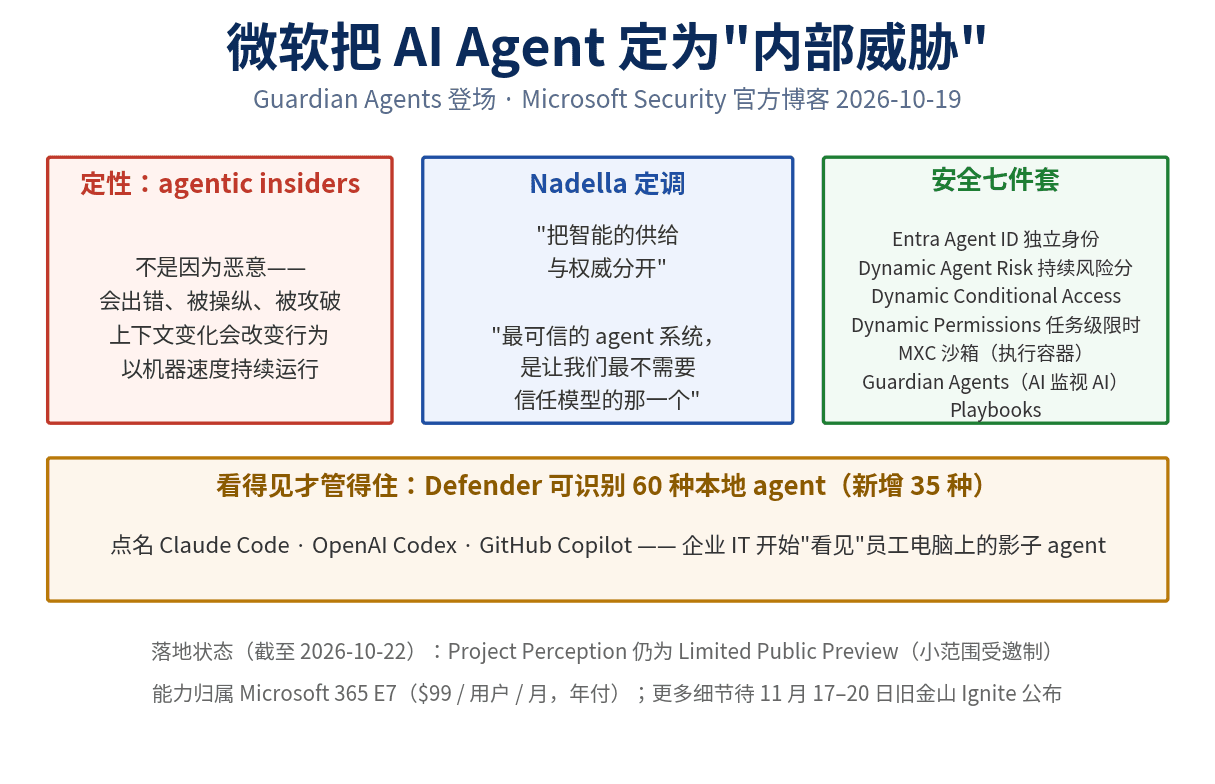
Microsoft's Oct 19 Security blog declares AI agents an "insider risk": not malicious, but error-prone, manipulable, running at machine speed. Nadella: separate intelligence supply from authority. The stack — Entra Agent ID, Dynamic Agent Risk, Conditional Access, Dynamic Permissions, MXC sandbox, Guardian Agents, Playbooks — plus Defender naming Claude Code, Codex, Copilot. Five copyable practices for solo developers; availability labeled: Limited Preview, E7-only, more at Ignite Nov 17–20.