Microsoft Squeezes Its 137B Coding Model Onto Your PC: MAI-Code-1.1-Flash Goes Local, Zero Inference Fees, 120GB+ RAM Required
Microsoft's homegrown coding model MAI-Code-1.1-Flash now runs on-device: 3-bit quantization, full 256K context, zero inference charges for local calls — but Microsoft recommends 120GB+ RAM. Third-party measurements put the quantized build at 70.80% on SWE-Bench Verified versus 72.6% full precision. What "zero inference fees" really means for indie developers, and why Copilot's router is the actual moat.
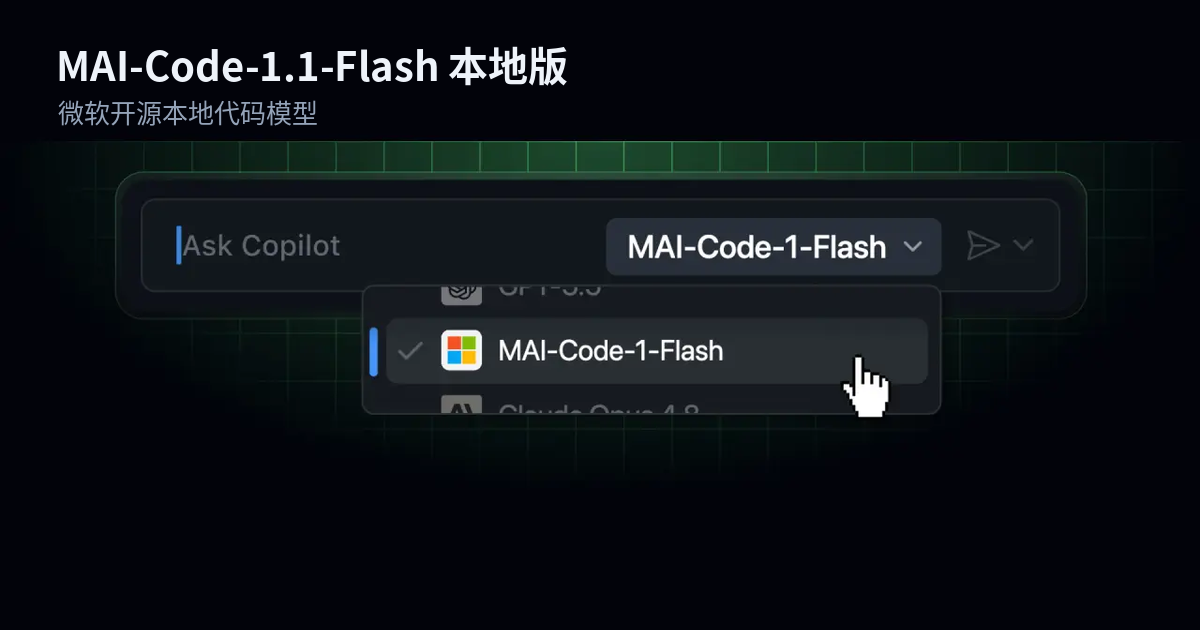
On October 7, Microsoft held an event in San Francisco with Satya Nadella on stage and a single theme: moving AI off the cloud and onto your PC. The star wasn't Windows or Surface — it was a model. MAI-Code-1.1-Flash, the on-device edition of Microsoft's homegrown coding model: 3-bit quantization, full 256K context retained, officially described as "comparable" to its full-precision counterpart, with zero inference charges for local calls.
Before you celebrate, read the fine print in the same official blog post: devices with more than 120GB of RAM are recommended. Zero inference fees are real — and so is the bar. This article unpacks the official claims, third-party measurements, and the product logic to answer three questions: how much performance does the quantized version actually lose? What does "zero inference charges" really mean for an independent developer? And what is Microsoft's router really up to?
1. What Microsoft actually announced: a 137B model on two fronts
The primary source is the Microsoft AI blog post from October 7, MAI-Code-1.1-Flash: Better, faster, at a quarter of the cost. The announcement was really two things bundled together: an upgrade to the cloud-hosted 1.1, and the debut of the on-device edition.
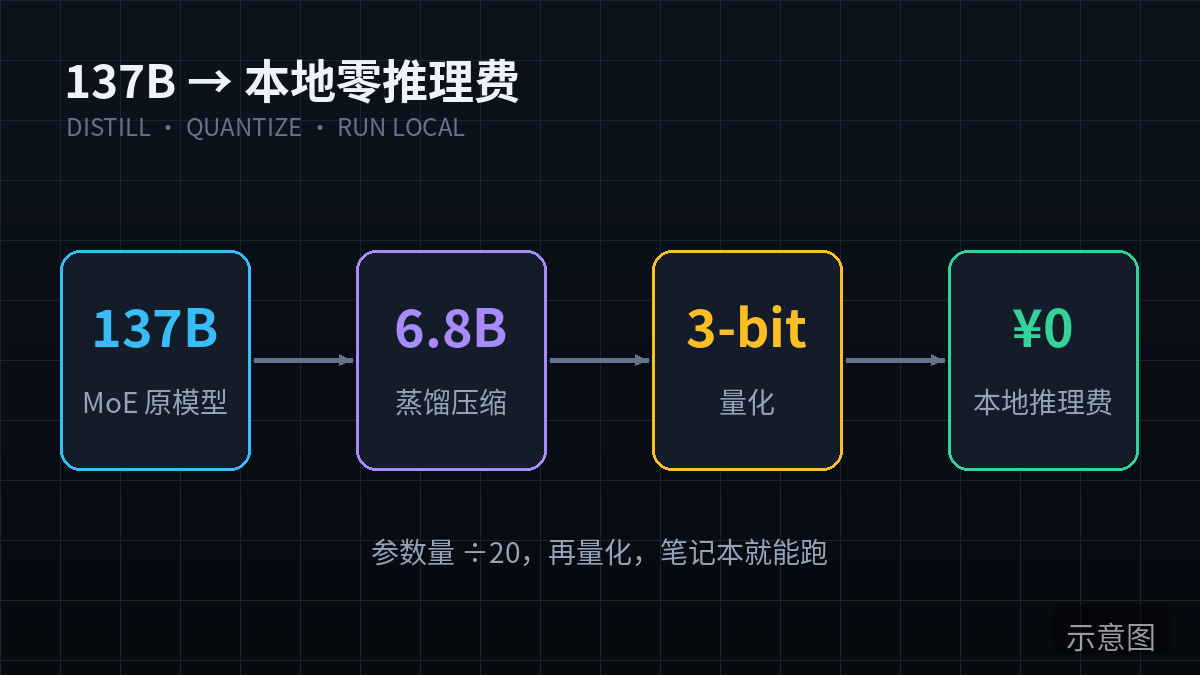
The cloud numbers first. MAI-Code-1.1-Flash is a mixture-of-experts model: 137B total parameters, only 6.8B active per inference step. Compared to the 1.0 version launched at Build in June, token efficiency is up 25% and cost is down to a quarter — that's where "quarter of the cost" in the headline comes from. Terminal-Bench 2.1 in GitHub Copilot CLI improved 22%, .NET-related tasks improved 15%. Microsoft also gave two production metrics: code survival +4% and return visits +9%, adding pointedly that "benchmarks are useful guides but production is where the rubber meets the road." Tokens stream 25% faster and each task consumes 25% fewer tokens.
The on-device edition was the real headline, and the official post really only says three things:
- 3-bit quantization drastically cuts memory requirements while retaining the full 256K context window, with coding performance "comparable" to its full-precision counterpart on SWE-Bench Verified and Terminal-Bench 2.1. Note the word "comparable" — no hard numbers from Microsoft.
- "On-device coding, with zero inference charges for local model calls." MAI-Code-1.1-Flash gives Copilot's router an on-device option, letting eligible coding work run on your own hardware while cloud models complement it for tasks that need more capability.
- The model is available to download and run locally — "for best performance, we recommend devices with more than 120GB of RAM."
Experimental access is planned for the GitHub Copilot app, Copilot CLI, and VS Code by the end of October. In other words: you can download the model now, but the smooth in-Copilot integration is still weeks away. Here's the official picture in one table:
| Dimension | 1.0 (launched at Build, June) | 1.1 cloud edition | 1.1 on-device edition |
|---|---|---|---|
| Scale | — | 137B total / 6.8B active params | Same, 3-bit quantized |
| Context window | — | 256K | Full 256K retained |
| Token efficiency | Baseline | +25% | — |
| Inference cost | Baseline | Down to one quarter | Zero inference charges for local calls |
| Terminal-Bench 2.1 (CLI) | Baseline | +22% | "Comparable" to full precision |
| .NET tasks | Baseline | +15% | — |
| Production metrics | Baseline | Code survival +4%, return visits +9% | — |
| Hardware | Cloud | Cloud | 120GB+ RAM recommended |
2. "Zero inference charges" — whose money does it actually save?
The short answer: it's real, but it doesn't save the money you think it saves.
The official phrase is "zero inference charges for local model calls" — the keyword is inference charges, not "free." Third-party outlet NeoTeo punctured it plainly: zero inference charges means no per-call model fee, but the computer, the electricity, and your setup time are all still on you. Explainx added a sharper footnote: Microsoft still hasn't published full commercial terms for local use — Nadella talks about "no cloud token spend," but the fine print for local deployment hasn't been revealed.
Here's how the math actually works. "More than 120GB of RAM" — what does that mean in practice? Count today's consumer devices that can run this model on your fingers: a maxed-out Apple Mac Studio (128GB unified memory), or Microsoft's own just-announced Surface Laptop Ultra top spec (128GB unified memory, NVIDIA RTX Spark platform). Neowin called out the "coincidence": Microsoft announced the local model on the same day it announced a 128GB top-spec Surface Laptop Ultra — just above its own recommended line. That's not a coincidence; that's a product combo.
Put bluntly, the ticket to "zero inference charges" is a multi-thousand-dollar workstation. Let's Data Science put it in the headline: Microsoft's coding model runs on a laptop that costs $5,900. A rough ledger:
| Cost item | Cloud API route | Local route |
|---|---|---|
| Model inference fees | Pay per token (1.1 already costs 1/4 of 1.0) | Zero inference charges |
| Upfront hardware | 0 — your current machine works | ~$5,900-class workstation (128GB unified memory) |
| Electricity & depreciation | Negligible | Real cost of running it long-term |
| Who it's for | Everyone | People who already own a high-end workstation |
What does this mean for an independent developer? If you're already doing development on a 128GB unified-memory Mac Studio, the local edition is a free gift: high-frequency completions, refactors, and scripting tasks with the token bill going straight to zero. But if you're on a 16GB MacBook Air hoping "zero inference charges" will save you money, you'd have to spend car money on a new machine first — the math never works out. Microsoft's "zero inference charges" isn't charity; it's a filter. It rewards people who are already inside the hardware gate.
One overlooked detail: unified memory is shared between CPU and GPU, and the OS, apps, inference runtime, and KV cache all draw from the same pool. NeoTeo notes that a device's advertised 128GB is not 128GB available to the model. That's why Microsoft asks for "more than 120GB" rather than "just enough" — the ~53GB model footprint is only the cover charge; peak memory hits about 75.5GB with the full 256K context (third-party figure, detailed next section), plus system overhead. 120GB is a conservative recommendation with headroom baked in.
3. What the quantized version actually loses: third-party measurements
Microsoft said "comparable" and gave no numbers. The numbers were cross-compiled by third-party media from test details disclosed in Microsoft's technical blog posts — and the sourcing tier must be stated honestly: the granular figures below come from cross-reporting by explainx, NeoTeo, Let's Data Science and others; the tests themselves were run by Microsoft on October 5 (Windows ARM64 build of llama.cpp with a CUDA runtime), and the official blog only offered qualitative language.
The benchmark table (Microsoft's own tests, synthetic code-generation workload):
| Benchmark | On-device quantized | Full-precision cloud | Delta |
|---|---|---|---|
| SWE-Bench Verified (500 tasks) | 70.80% | 72.6% | -1.8 points |
| Terminal-Bench 2.1 (89 tasks) | 66.29% | 62.9% | +3.4 points |
Both numbers deserve a second look. Losing just 1.8 points on SWE-Bench — with 3-bit quantization shrinking the model 80% (53GB versus the bfloat16 cloud build) — is a trade-off that would have been unthinkable two years ago. The bigger surprise is Terminal-Bench 2.1: the quantized build beat full precision by 3.4 points. For reference, GPT OSS 120B scores 32.0% and 23.6% on the two benchmarks — the on-device MAI-Code-1.1-Flash more than doubles both.
But hold off on the "quantization is lossless" victory lap — three honest footnotes are required. First, Microsoft ran these tests itself: the dataset, prompts, and decoding parameters were its own choices. Second, Let's Data Science flags this explicitly as a "synthetic code-generation workload," and Microsoft itself cautions that results may vary by device. Third, SWE-Bench and Terminal-Bench measure "solving," not "taste" — the production code-survival metric (that +4% figure for the cloud edition) has no on-device counterpart yet.
The memory figures come from the same third-party cross-reporting: roughly 53GB on-device footprint (an 80% reduction from the bfloat16 cloud build), about 75.5GB peak memory at the full 256K context, mixed-precision quantization at around 3.3 bits per weight. On speed: 923.5 tokens/sec prompt processing at 64K context, 769.8 at 128K, with speculative decoding for responsiveness. The picture is clear: this is a model tailor-made for big-unified-memory architectures (Apple Silicon, NVIDIA RTX Spark class). The VRAM wall of traditional discrete-GPU PCs (24GB class) isn't even in its target range.
4. The router: Microsoft's real play
The most important sentence in this launch is also the easiest to miss, buried in the official blog: "MAI-Code-1.1-Flash gives Copilot's router an on-device option."
Note the subject: not "gives developers a local model" — "gives the router an option." The decision of local versus cloud isn't yours; it's Copilot's Auto orchestration. Techaeris's event coverage confirms two modes: let Copilot's Auto route work between local and cloud inference, or manually select a local model. The automatic-routing experimental preview is slated for late October.
This is Microsoft's real play. Models keep getting cheaper and smaller — 1.1 already costs a quarter of 1.0, and the local edition takes inference fees to zero. But the power to decide which model a task deserves stays firmly in Microsoft's hands. The router is the moat; the model is a commodity. Today the router holds MAI; tomorrow it can hold anything, users won't feel the switch, and what they can't leave isn't any particular model — it's the Copilot that always picks the right one.
One commonly confused pairing needs untangling: local inference is not sandbox isolation. Microsoft Execution Containers (MXC) went GA the same day, and plenty of coverage blurred "running locally" with "running safely." RohitAI's analysis draws the line cleanly: sandbox controls must be configured separately; local inference alone imposes no boundaries on file and network activity. A model running on your PC doesn't automatically get to touch less. Microsoft's architecture is really three knobs: where the model lives (local/cloud), who decides the routing (Copilot Auto), and who enforces the boundaries (MXC) — three separate things, don't merge them into one.
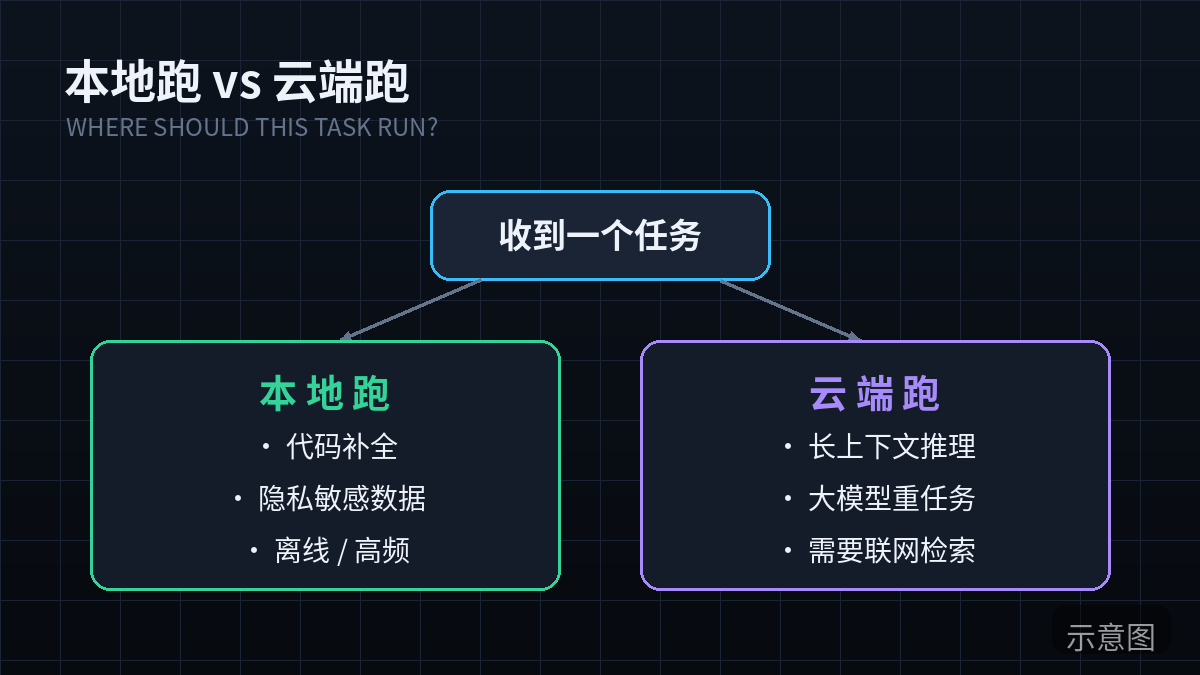
So which tasks are worth running locally? My call, in table form:
| Task type | Verdict | Why |
|---|---|---|
| High-frequency completion, renames, simple refactors | Run local | High volume, low difficulty, burns the most tokens — biggest win from zero inference fees |
| Shell scripts, system diagnostics (CLI scenarios) | Run local | Quantized build beats full precision on Terminal-Bench; CLI is 1.1's focus area |
| Confidential code, offline environments | Run local | The airplane-mode demo at the event — offline capability is hard value |
| Complex multi-step reasoning, long agent chains | Cloud | Per Microsoft: cloud models complement for tasks needing more capability |
| Tasks needing fresh knowledge or web retrieval | Cloud | Local model knowledge is frozen; connectivity lives on the cloud side |
The core logic in one sentence: the local model eats "high-frequency, low-difficulty, latency-sensitive" tasks — exactly the slice where developers burn the most tokens every day. Microsoft erases that cost on both sides at once (its own cloud inference and your API bill) and gets deep lock-in to Copilot's router in return. Microsoft doesn't lose on this trade.
5. The other track: official models moving down vs. third-party models moving in
Here's the interesting part: around the same time, Copilot CLI did something else — it started discovering and loading third-party local models via Ollama, a story this site has covered before. The two tracks form a neat mirror image:
- One track is the official model moving down: Microsoft's homegrown MAI-Code-1.1-Flash descends from the cloud into your machine, reaching Copilot through the Windows ML provider.
- The other track is third-party models moving in: community open models on Ollama — Llama, Qwen, DeepSeek — come in from the outside, and Copilot CLI accepts them all, including OpenAI-compatible local endpoints.
One descends, one is admitted; opposite directions, same entrance: Copilot. That's Microsoft's open strategy — the model layer stays fully open and fully competitive, the more cutthroat the better, because whatever you run, Microsoft's or the community's, it's Copilot's router doing the calling. The MAI program is Microsoft's strategic move to reduce dependence on OpenAI, but Copilot doesn't put all its eggs in one basket: the official model guarantees the floor, the third-party ecosystem guarantees the ceiling, and the router guarantees you can't leave.
The practical takeaway for independent developers: once experimental access lands in late October, your Copilot CLI may offer three options at once — cloud MAI (strong, pay-per-use), local MAI (zero inference fees, 120GB RAM required), and local Ollama open models (free, runs on your existing hardware). Choose using the task table above. If your hardware falls short of 120GB, the likely combo is "cloud MAI + small Ollama models"; if it clears the bar, add local MAI as the workhorse.
6. My verdict, in three layers
Short term (next 3 months): don't buy a computer for this
Experimental access only starts in late October, and the rollout across the Copilot app, CLI, and VS Code takes time; the 120GB RAM bar excludes ~95% of developers; the third-party figures are Microsoft's own synthetic-workload tests, and real production behavior awaits large-scale community testing. If you already own a 128GB unified-memory workstation, flip on the experimental option in late October — free token savings are free token savings. If not, stay on cloud: 1.1 is already a quarter the price of 1.0, and everyone shares the cloud discount.
Medium term (6–12 months): the variable isn't the model, it's the router
Once Auto routing matures, "localizing the easy tasks" becomes the industry's cost architecture: cloud API pricing will be forced further down, because the most token-hungry slice of demand is settling onto local hardware. This move is Microsoft rewriting the cost structure of coding assistants — carving a chunk out of the "pay-per-token" pool and converting it into "one-time hardware spend." Bad news for API startups; good news for developers.
Long term: the local model's killer feature isn't cheap — it's offline
That airplane-mode demo at the event was more honest than every benchmark number: with the model on your machine, Copilot works on a plane, inside a client intranet, in a server room with no internet. Code-never-leaves-the-building is a compliance must-have for finance, healthcare, and defense customers. Zero inference charges is marketing copy; offline availability is what changes workflows. The day you refactor a module with Copilot on a high-speed train without ever going online, you'll come back and thank this verdict.
Back to the opening question: what does it mean that Microsoft squeezed a 137B model onto your PC? It means AI coding assistants have officially entered the hybrid era — the cloud does the thinking, local hardware does the labor, and the router does the scheduling. Models themselves will keep getting cheaper; what holds value is the hand doing the scheduling. Microsoft has already extended that hand. It's called Copilot.
Sources: Microsoft AI official blog, October 7, 2026, MAI-Code-1.1-Flash: Better, faster, at a quarter of the cost; granular figures on the quantized edition (benchmarks, memory, throughput) from cross-reporting by explainx, NeoTeo, Let's Data Science, Neowin and others — tests were Microsoft's own synthetic workload from October 5, and the official blog only made qualitative claims; "zero inference charges" translates the official phrase "zero inference charges for local model calls."
Comments (0)
Sources
Related articles

Lenovo Tianxi AI's in-house code-agent framework TianxiCode, paired with DeepSeek-v4.1-Flash, topped the SWE-bench-Live Lite leaderboard at a 71% solve rate with official Verified certification. We unpack why this "real engineering" benchmark is harder, what "framework > model" really means, and three takeaways for vibe coding practitioners.
Frank Michael Smith built the sports quiz game GeoSports in 12 hours with Claude Code: 79 players on day one, a million within a month, 15M+ plays and ~$47K ARR five months on. Why sports trivia won — plus five replicable judgments for indie developers, and three honest caveats.

Rails creator DHH announced at Rails World that 37signals is 'done writing code by hand.' This piece unpacks the November 2025 inflection point, the move to native apps and Rust, the counter-evidence from the same newsletter — and what vibe coders should actually take away.