The Bunny Revealed: MiniMax M3.1 Flash Unmasks "Space Bunny," Cuts Agent Task Costs 70%
MiniMax's October 19 launch of M3.1 Flash unmasked Space Bunny, the anonymous model that processed 200 trillion tokens on leaderboards. With 73.7% on DeepSWE, 61.7 on OSWorld V2, 200+ tok/s output and agent-task costs cut 70% to ~$0.22, it fires the loudest shot yet in the Flash-class price war — and proves the best model launch of 2026 might not have a launch event at all.
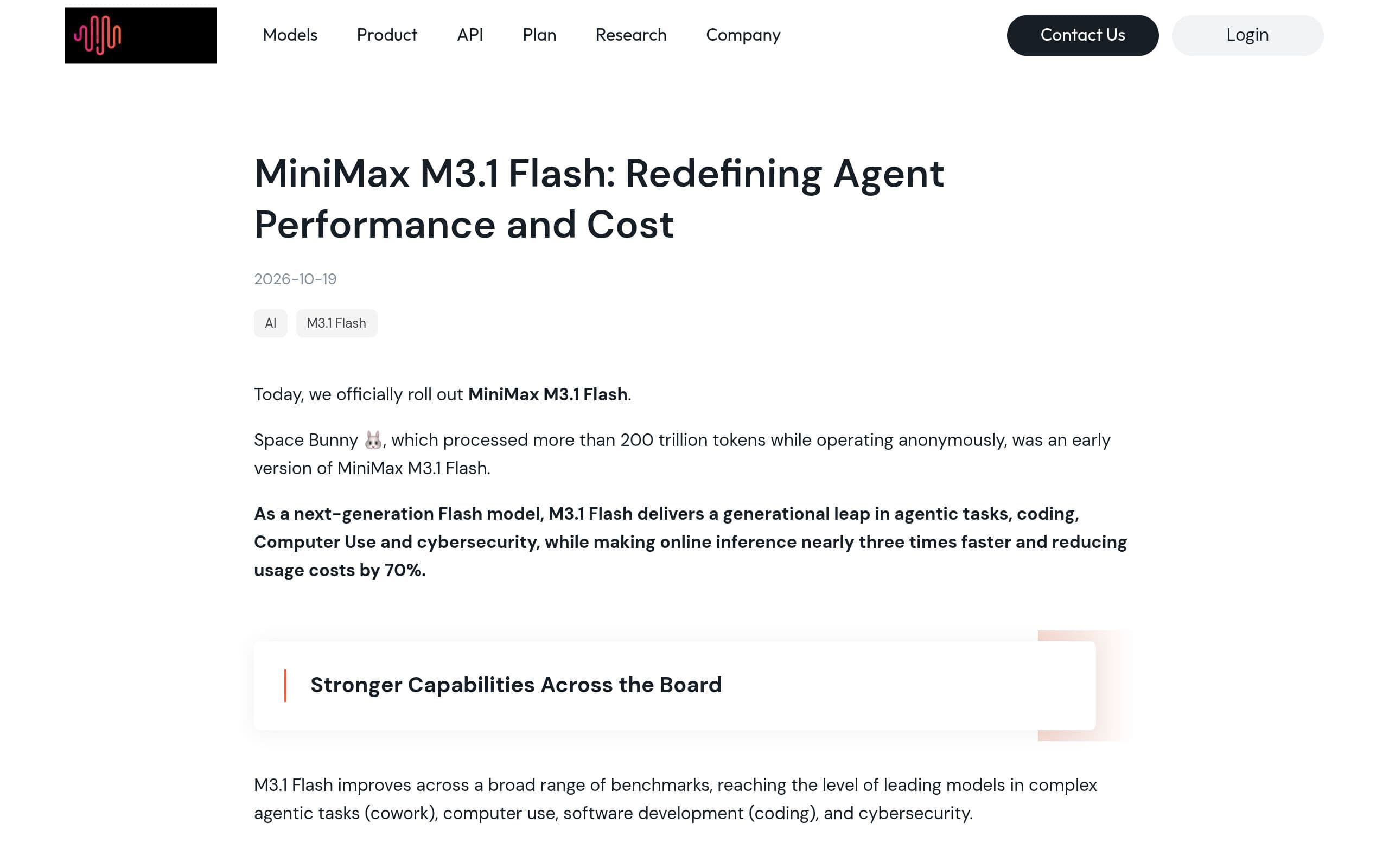
On October 19, MiniMax dropped a bombshell on its official blog: the mysterious model that had been anonymously topping leaderboards for over a month — known to developers only as Space Bunny — is the newly launched MiniMax M3.1 Flash. In the company's own words: "Space Bunny 🐰, which processed more than 200 trillion tokens while operating anonymously, was an early version of MiniMax M3.1 Flash."
An anonymous model quietly processed 200 trillion tokens — MiniMax's own figure. For reference, OpenRouter said in its reveal post that Space Bunny held its #1 spot for 10 straight days and processed 56.7 trillion tokens, the most of any stealth model it has ever run. Chart-topping, zero marketing, not even a name — the developer community spent a month guessing: a secret weapon from some big lab, a distilled knockoff, take your pick. On October 19 the mystery was solved: the bunny belonged to MiniMax all along.
But the real story here isn't the guessing game. It's that MiniMax has put a new release playbook on the table: go anonymous first, let real traffic be your public beta, then announce. OpenRouter's reveal post is blunt — user feedback during the stealth period helped MiniMax fix bugs and ship upgrades: time to first token improved 38% (1.95s → 1.22s), throughput rose 45% (70 → 100 tok/s), and the error rate fell from 1.4% to 0.7%. In other words, Space Bunny's 200 trillion tokens weren't a marketing gimmick; they were a free public test at unprecedented scale. The old way was "internal evals + launch event." MiniMax's way is "anonymity + leaderboards + real users." Expect more of this — leaderboard traffic is free, and launch events keep getting more expensive.
The hard numbers: 70% cheaper, 3x faster, coding and agents all in
First the core data, all from MiniMax's official October 19 blog post (page-stamped 2026-10-19):
- Agentic tasks (cowork): among the top performers on AutomationBench-AA, completing real enterprise workflows end-to-end across SaaS systems — sales, marketing, operations, customer service, finance, HR. Scores 76.2 on BankerToolBench, covering multi-step planning, cross-document consistency, financial compliance, and chained tool calls.
- Coding: 73.7% on DeepSWE v1.1 — a benchmark of full software-engineering capability (understanding code independently, building features, fixing bugs, validating with tests). MiniMax says that places it "alongside top models."
- Computer Use: 61.7 on OSWorld V2, 29.6 on Agents' Last Exam (ALE, real professional work) — #1 among Chinese models on both.
- Cybersecurity: 82% on CyberGym, spanning code auditing, vulnerability patching, penetration testing, malware analysis, and reverse engineering.
- Speed: 200+ tokens/sec output in everyday use, median (P50) consistently above 170 tok/s; online inference nearly 3x faster than its predecessor.
- Pricing: $0.15 per million input tokens, $0.60 output, $0.015 cached input; overall agent-task costs 70% lower than the previous generation.

The interesting detail is in the pricing logic. MiniMax isn't playing the old "bigger model, bigger price" game — it's anchoring on cost per agent task. Oossa did the math: about $0.22 per agent task for M3.1 Flash, roughly a third of the older M3. That framing shift matters: developers don't care about "dollars per million tokens," they care about "dollars to have an agent refactor this module." Per-token pricing is infrastructure thinking; per-task pricing is product thinking.
The official blog's performance-vs-cost chart (Automation-Bench, DeepSWE, Agents' Last Exam) tells the same story: top-tier performance at commodity prices. A frame-by-frame teardown by a Japanese AI channel noted MiniMax's claim of beating Opus 5.5 on Automation-Bench (62.2 points) at roughly one-twentieth the cost. "One-twentieth" is a read-off-the-graph estimate and cost structures vary by task — but the direction is right: the performance-per-dollar curve for Flash-class models is steepening while flagship models show diminishing marginal returns.
For indie developers, do the math with caching included. A typical agent workflow's token mix is: system prompt + conversation history (the bulk) + tool returns + fresh generation. M3.1 Flash prices cached input at $0.015/1M — one-tenth of standard input. That means long-context, multi-turn agent tasks bill far below sticker price in practice. Fifty rounds of tool calls used to be scary; with caching, everything after round two is nearly free. This isn't charity — it's MiniMax using pricing to shape developer habits toward multi-turn, long-context, tool-heavy usage. Which is, of course, the native shape of agents.
One more technical detail worth isolating: MiniMax credits "more aggressive sparsity" for the inference efficiency gains. Sparsity + Flash pricing + adjustable thinking depth — that trio defines M3.1 Flash's positioning clearly: it's built for high-frequency, short-burst, tool-dense agent calls, not for "write the perfect paper in one shot." That's complementary to flagships, not a replacement. Smart teams will start routing models the way they route cloud instances: simple tasks to Flash on low reasoning, hard tasks to flagships on high reasoning. Which is exactly why MiniMax teased a Pro version — two product lines, one ledger.
Stealth launches: MiniMax's lesson for the industry
Space Bunny deserves its own section, because this may be becoming an industry norm.
The traditional model launch is event-driven: pick a date, publish a blog, buy media, spike the charts — all the noise at once. The problem is the eternal gap between benchmark scores and real-world experience: vendor evals are open-book exams; users' hands are the closed-book ones. Space Bunny inverted it: closed-book exam first, publish the grades after. Across 200 trillion tokens of real usage — developers writing code, running agents, doing evals — bugs and weaknesses got flushed out by genuine traffic while anonymous. OpenRouter says TTFT dropped from 1.95s to 1.22s and error rates halved before the announcement. So every number in the October 19 blog had already been battle-tested. That's harder than any launch-day rhetoric.
There is a cost, of course: zero brand equity during the anonymous period — all the traffic accrued to the leaderboard platforms (OpenRouter, LMArena). But MiniMax clearly did the math: a month-long "who is Space Bunny?" mystery is the marketing. The October 19 reveal video showed a carrot-shaped rocket lifting off with the caption "Welcome back, Space Bunny" — a month of speculation converted instantly into brand equity. 305 points on Hacker News within 5 hours and 510,000 views on the X announcement in about two hours are the returns on that suspense.
The takeaway for vibe developers and indie hackers: pay attention to anonymous models on leaderboards. They might be someone's next flagship sitting a closed-book exam. And if you're building AI products yourself, Space Bunny proves something valuable: real user traffic validates more than any choreographed demo. Let anonymous users beat up your product first, then announce with dignity — especially friendly advice for indies who never had a launch-event budget anyway.
MiniMax's bigger board: more than a model
The M3.1 Flash launch belongs inside MiniMax's larger game. The company listed on the Hong Kong Stock Exchange (0100.HK) in 2026; the stock gained 1.45% to close at HK$182.1 on launch day — the market voting with real money that the "lightweight agent model" lane is real, and that MiniMax's three-layer play (model + app + subscription) makes sense. Alongside the model: the M Plan subscription and the MiniMax Code desktop app — API for developers, subscription for heavy users, desktop for everyone. Three funnels, one model base, each feeding the others.
MiniMax Code deserves vibe developers' attention specifically. It's a desktop agent app with M3.1 Flash as its default engine — meaning MiniMax isn't just selling tokens, it's dogfooding its own model: the Computer Use capabilities shown on OSWorld V2 (61.7) and ALE (29.6) flow directly into the product experience. Model and app sharpen each other — the flywheel OpenAI (ChatGPT + API) and Anthropic (Claude + API) already validated. MiniMax is replicating it.
And the planned open-weights release on October 23 is another move: handing M3.1 Flash to the community. Open weights mean local deployment, private fine-tuning, and community distillation — all greenlit. For the Chinese developer ecosystem, another strong "runs locally, commercially usable" base; for MiniMax, community fine-tuning is free R&D. The stealth phase harvested online traffic; open weights harvest community intelligence. MiniMax wants both dividends.
The Flash-class arms race: 2026's bloodiest battlefield isn't flagships, it's "good enough"
Zoom out and the bigger picture emerges: in October 2026, the fiercest battlefield in models isn't the GPT-6/Claude Opus flagship duel — it's Flash-class: cheap, fast, good enough. Flagships compete on "who's smarter"; Flash competes on "who's cheaper," and that's the fight that decides developer ecosystems. Indie developers, small teams, agent startups spend their own money and vote with their wallets for value.
Look at October's "Flash month" timeline: on October 17, DeepSeek shipped V4.1-Flash-1017 with better coding and agent chops — plus its own search API (Search + Fetch, ¥5 per 1,000 successful requests, free until November 1), clearly moving to own the "online access" loop in-house. On October 19, MiniMax's M3.1 Flash followed, calling out Opus 5.5 on Automation-Bench. The same week, Qwen3.8 Flash, MiMo V2.6 Flash, and GLM-5.3-Flash were brawling on the same leaderboards. EmpirioLabs' real-world coding test is the most honest cross-section of this war: four programming tasks, MiMo takes two, MiniMax and Qwen one each — no winner-takes-all, just trench warfare.
That shape is great news for developers. Flash-class competition has different logic from flagships: flagships compete on spectacle, with vendors happy to burn cash for mindshare; Flash competes for actual bills, so vendors must genuinely cut costs, raise speed, and build ecosystems. M3.1 Flash's $0.15/$0.60 pricing, 200+ tok/s output, 1M context, and five reasoning tiers are all aimed at one thing: getting developers to move production traffic over. DeepSeek's search API and MiniMax's open-weights tease are ecosystem land grabs. When vendors start fighting over your bill, you know the market has matured.
One level deeper: Flash-class rise is reshaping agent architecture itself. Agent frameworks used to default to "the strongest model" because task success rate came first. Now Flash models reach 80–90% of flagship scores on hard benchmarks like DeepSWE and OSWorld at a tenth or even a twentieth of the price — the rational choice becomes tiered routing: Flash on low reasoning for simple tasks, flagships on high reasoning for hard ones. M3.1 Flash's five thinking tiers and DeepSeek's search loop are both paving that layered architecture. Model selection for agent systems will become as routine as cloud instance sizing: on demand, by tier, by bill. Today's M3.1 Flash launch is another milestone in that "agent infrastructure commoditization" movement.
Practical advice for vibe developers
A few concrete things to do after this launch:
- Put model routing on your roadmap: simple tasks (formatting, translation, summarization) on Flash with low reasoning; hard tasks (architecture, nasty bugs) on high reasoning or flagships. M3.1 Flash's five thinking tiers were designed for exactly this layering.
- Re-run your agent bill math: if your agent workflows currently run on flagships, benchmark them on M3.1 Flash — a 70% cost cut is real money, and the savings can fund more iterations and more experiments.
- Watch the October 23 open weights: runnable locally means new options for privacy-sensitive and private-codebase scenarios. Try it free on OpenRouter (72 hours free after launch) before committing to deep integration.
- Steal MiniMax's "anonymous validation" playbook: building an AI product? Don't rush the launch event. Get a small group of real users (even anonymously), let real traffic beat it up, announce when the numbers look good.
One-line summary: M3.1 Flash isn't "yet another model" — it's a repricing of agent economics. When a single agent task costs on the order of $0.22, "let the agent do it for me" stops being an occasional luxury and becomes the default. And Space Bunny's story reminds us: the best model launch of 2026 might not have a launch event at all. Three things to watch next: community reaction to the October 23 open weights, the real positioning of the Pro version, and DeepSeek and Qwen's next cards — the Flash war is just getting started.
Transparency note
All benchmark scores, prices, and speed figures are from MiniMax's official October 19, 2026 blog post (page-stamped Published: 2026-10-19) — vendor-reported and not yet independently reproduced. OpenRouter's stealth data (56.7T tokens, 10 days at #1, TTFT/throughput/error-rate improvements) comes from its reveal post; DeepSeek V4.1-Flash-1017 comparisons from third-party tests and vendor announcements. Open weights are planned for October 23 and were not yet out at publication time. The HK$182.1 close (+1.45%) for MiniMax (0100.HK) is per third-party reports citing Cailian Press.
Comments (0)
Sources
Related articles
Inception's October 19 Mercury 3 is the strongest diffusion LLM ever released: 1,068 tokens/sec, 1M context, benchmark quality on par with GPT-6 Luna and Claude Haiku 5.5 at 4-8x the speed. At 40x the size of Mercury 1 with speed intact, it answers the field's biggest question — diffusion can scale. For agent developers, speed is becoming the new intelligence.
IBM open-sources Granite Switch 4.1 on the Hugging Face blog: a frozen base plus hot-swappable aLoRA adapters, packing chat, general decisions, safety review, and speech transcription into one model and one endpoint — base-model VRAM, shared KV cache. For local agent builders: one model covers four scenarios, and judgment graduates from a prompt to a part.

Monday.com launched Harmony, a voice AI platform for enterprise sales calls built on task-specific small models instead of one giant LLM — claiming ~200ms latency and up to 70% contact rates. The real story: in voice AI, controllability beats cleverness.