Acting Before You Ask: Mistlabs' Ambi Raises $26M to Let Agents Negotiate for You
Mistlabs' Ambi exited beta on October 12 with $26M in Pre-A funding: an ambient intelligence system for Apple devices that acts 'before the user even thinks to ask' — and plans agent-to-agent negotiation within months, where your agent haggles with mine in real time. The tech is 40% of the story; privacy and trust are 60%.
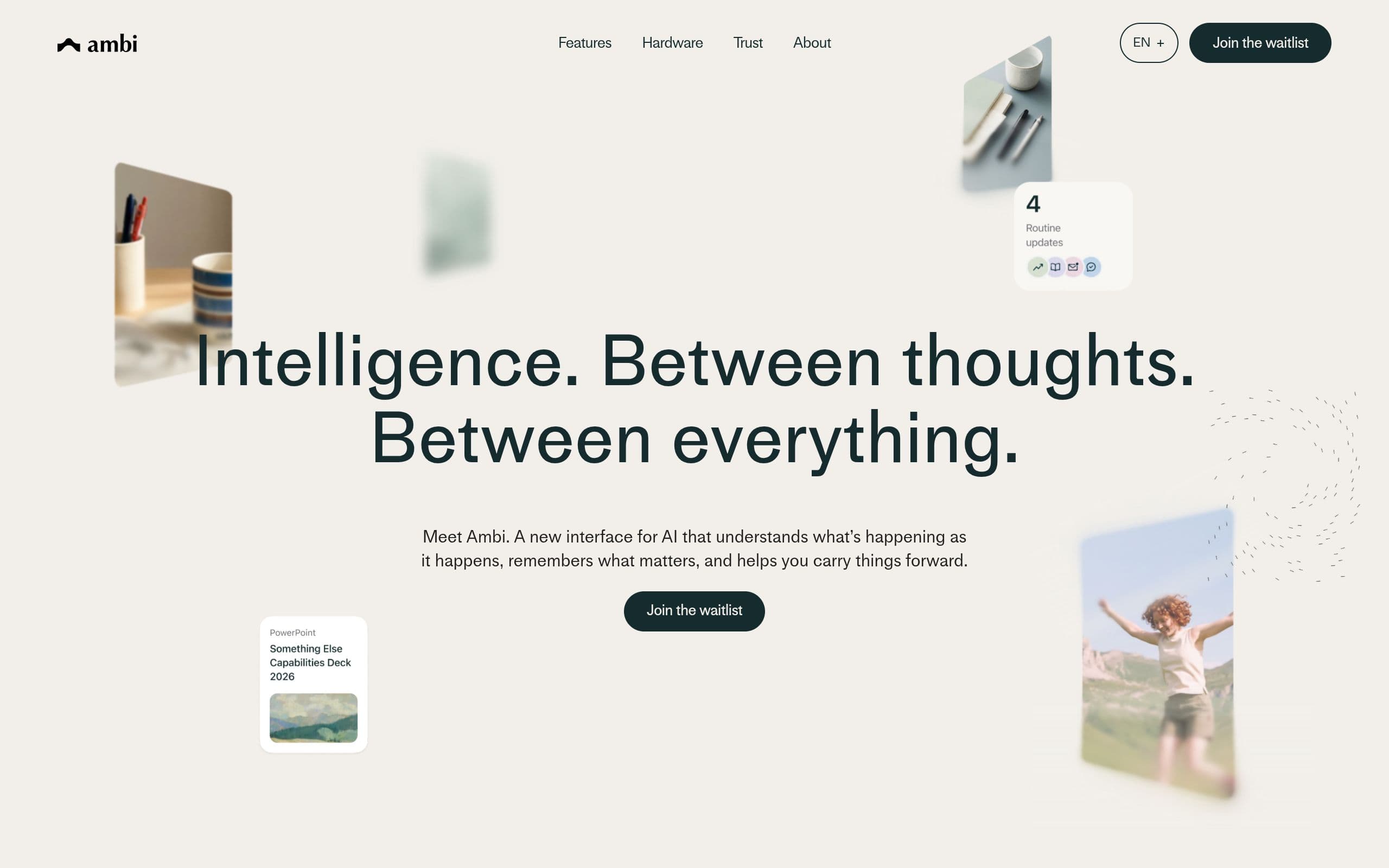
On October 12, a San Francisco company announced something that sounds like science fiction via PR Newswire: Mistlabs' Ambi is out of beta and officially launching on iPhone, Apple Watch, and Mac — alongside a disclosed $26 million Pre-A round led by Luminous Ventures and Huaqin. But this isn't another "AI assistant" launch. Ambi's ambition is right there in the release headline: "a New Type of AI that Thinks Ahead" — and the even wilder second act: letting your agent negotiate directly with mine.
Start with CEO Peter Mo's line, the thesis of the entire release: "We're moving beyond AI that simply waits for a prompt. Ambi introduces real-time reasoning and actions that can happen sometimes before the user even thinks to ask."
"Acting before you even think to ask" — those words are how Ambi draws its line against Siri, ChatGPT, and every assistant before it. They wait for you to speak. Ambi doesn't have to.
What Ambi actually is: not an assistant, a "real-time counsel in your pocket"
Per the official release, Ambi is an ambient intelligence system: it continuously builds an understanding of you across devices — your preferences, priorities, communication style, work habits — and uses it to spot "opportunities to proactively deliver an outcome" before you've asked.
The release gives a concrete example worth reading closely. Ambi's Routine feature dispatches multiple agents at once to handle a recurring task. Say you're in a meeting about competitors: Ambi will analyze and fact-check the conversation in real time while, in parallel, cross-referencing competing products — and have a draft proposal organized on your MacBook before the meeting even ends. After the meeting it keeps going: spotting information gaps and new developments, proactively flagging them. In the release's words: "Even if the user is no longer actively thinking about the project, the same intelligence can continue working beyond the meeting."

Three design choices matter: first, cross-device — the Ambi on your iPhone, Watch, and Mac is the same "you," with memory and Routines flowing seamlessly between devices; second, persistent memory — its understanding of you accumulates; "it gets you better over time" is architecture, not ad copy; third, proactivity — shifting from "waiting for instructions" to "finding opportunities" is a fundamental product-philosophy change.
Peter Mo is a former Plaud executive (the AI-recording-hardware company) — a telling background. Plaud played "hardware capture"; Mo is now playing "software first, hardware later": Ambi runs on Apple devices today, with a self-developed AI wearable following later this year, and a good chunk of the $26M is aimed at that hardware. The logic is clean: ambient intelligence's ceiling is set by "how much the AI can see and hear." Phones and watches are just the starting point; a purpose-built wearable is the full form.
The most radical part: agents negotiating on your behalf
If "acting ahead" is Ambi's present, agent-to-agent communication is its future — and one of the boldest product bets in AI in 2026.
The release's description deserves full quotation: "When two independent users with Ambi-compatible devices are in the same meeting, their respective agents can communicate with one another, each drawing on its understanding of its own user. This enables the agents to identify where priorities align, surface potential points of disagreement and suggest outcomes that better account for the needs of both sides."
In scene terms: you're in a meeting negotiating a contract, and your Ambi agent is "DMing" the other party's Ambi agent in the background — yours knows your bottom lines and priorities, theirs knows theirs; the two exchange information in real time, find the overlap, flag the disagreements, and negotiate while the meeting is still going. The release's phrasing: "help negotiate toward mutually acceptable outcomes as the conversation unfolds automatically and in real-time." "Within the guideline of user-granted permissions" — a deliberate safety word tucked into the release.
The feature ships "in the coming months." But its significance can be discussed now: this is the first time an agent gets a genuinely social role as "your representative." Earlier agents were tools — they did what you told them. Negotiating agents are representatives — they exercise judgment, make tradeoffs, and compromise within your authorization. From tool to representative, the gap isn't just technical; it's an entire framework of trust, law, and ethics. Ambi just dragged that question from papers onto a product roadmap.
The price of always-on: privacy is Ambi's Achilles' heel
Time for necessary cold water. Ambi's whole product logic rests on always-on listening: to "continuously build an understanding of you," it must continuously hear what you say and see what you do. The release's privacy commitments are exactly two sentences: "audio not stored by default" and "ambient capture is off by default."
Particle's reporting filled in the critical gap: the encryption's technical details haven't been published, nor has how third-party disclosure gets enforced. A promise of "audio not stored by default," without an end-to-end-encryption whitepaper, amounts to "trust me." And the team's footprint (50+ staff across San Francisco, Beijing, Shanghai, and Shenzhen) means data-residency and jurisdictional compliance are questions it will face head-on sooner or later.
The bigger issue is legal: an always-listening agent records not just you, but everyone around you. When Ambi fact-checks your meeting, it hears the whole room — including people who never installed Ambi and never consented to being "understood." US state recording-consent laws (one-party vs. two-party consent) were already complicated; Ambi-style "continuous ambient capture" raises the complexity another order of magnitude. Particle put it plainly: Ambi faces "potential legal and regulatory scrutiny tied to always-listening assistants and disclosure practices." That's not alarmism — it's day-one reality for this product.
My read: Ambi's fate is 40% technology, 60% privacy and trust. The ambient-intelligence category has a graveyard of pioneers (remember the Humane AI Pin and the Rabbit R1?) — and the cause of death was less "bad tech" than "users wouldn't hand their lives to it." To survive, Ambi must ship hardcore privacy architecture in the coming months: end-to-end encryption, verifiable on-device processing, third-party audits — all of them, no exceptions. Otherwise, the cooler "acting before you ask" sounds, the more afraid users get.
Lessons from the fallen: why ambient intelligence keeps dying of "wouldn't dare use it"
Ambi isn't the first to attempt "ambient intelligence." In 2024–2025, the Humane AI Pin and Rabbit R1 proved with real money how brutal this category is: slick concept videos, dead products. Replaying the causes of death, "bad tech" was only part of it — the real killer was "users wouldn't hand their lives to it." A device that constantly listens and watches naturally triggers human defenses. No laser projection, however cool, survives "is it recording me?"
Lesson one Ambi absorbed: software first, not hardware first. The AI Pin and Rabbit's mistake was "sell a $699 box first, then tell you what it does." Ambi inverts it — get comfortable with "being understood" on the iPhone/Mac you already own, for free, and the dedicated wearable sells itself later. Customer-acquisition cost, trust-building, hardware iteration — all smoother. Huaqin (an ODM manufacturer) co-leading the $26M round is telling: the hardware supply chain is already in place, waiting on software PMF.
Lesson two: don't try to replace the phone; augment it. The AI Pin tried to kill the phone and couldn't even nail battery life and thermals; Ambi is content being a "plugin" for the Apple ecosystem — the iPhone, Watch, and Mac are already on you; Ambi just makes them understand you better. No market re-education, no habit change, minimal friction. Once users can't live without "being understood," the wearable market opens itself.
But Ambi must answer the question the fallen never answered well: where's the boundary of "continuously understanding" me? The release says "ambient capture is off by default" — so what exactly is on by default? How selective? Can users see "Ambi's memory of me," and can they delete it? The answers decide whether Ambi is "a thoughtful counsel" or "a polished wiretap." The line between them is entirely in product details.
Under the hood: ambient intelligence's three-piece stack
Strip the marketing and Ambi's stack breaks into three pieces, each a hard problem in 2026 agent tech.
Piece one: real-time reasoning. Traditional agents are batch — you ask, it thinks forever, it answers. Ambi wants streaming — while the meeting runs, analysis, fact-checking, research, and drafting all go in parallel. That demands low latency, high concurrency, long context. The release doesn't disclose Ambi's models, but "real-time" almost certainly means Flash-class fast models for the perception layer, escalating to bigger ones for hard tasks — the same "tiered routing" idea from this cycle's N1 and N3. Ambient intelligence's "real-time" is, at bottom, a model-selection problem.
Piece two: cross-device memory. The most underestimated piece. Ambi's memory must sync, deduplicate, and distill across iPhone, Watch, and Mac — you mention something offhand on your watch in the morning; it remembers on your Mac in the afternoon. Behind that is memory-systems engineering: what to keep, what to forget, what syncs across devices, how conflicts resolve. Agent memory in 2026 is still half-baked territory (everyone's racing), and Ambi making "consistent cross-device memory" a selling point means eating the first-mover dividend.
Piece three: multi-agent orchestration (Routine). Routine "calls on multiple agents to conduct a recurring task" — multi-agent orchestration, productized. In a meeting, one agent fact-checks, one researches competitors, one drafts — three agents in parallel, results merged. In 2025 that was demo-grade; Ambi packaged it as "one-click Routine." For vibe developers, Routine's UX (how tasks get defined, how progress is shown, how you intervene) is the homework most worth copying.
Together, Ambi's technical portrait is clear: it's not "a smarter model" but "a more complete agent system." Models are bought or tuned; the moat is systems engineering — memory, orchestration, real-time performance, cross-device. The lesson for indie developers: in H2 2026, agent competition has moved down the stack from "model" to "system." No single strong model beats a well-honed system.
Opportunities for indie developers: ambient's whitespace is wide open
Ambi defined the "ambient intelligence" category, but the category just opened — whitespace everywhere. A few directions worth thinking about:
Vertical Ambi. Ambi is a general-purpose "life counsel," but doctors on rounds, lawyers in court, salespeople with clients — vertical "ambient" needs are sharper and willingness to pay is higher. A "purpose-built ambient counsel for clinic doctors" (real-time visit notes, auto-generated records, medication-conflict alerts) has an order of magnitude more value density than the general version. Ambi eats the meat; vertical players drink the soup — and the soup is delicious.
Agent-to-agent protocol tooling. As noted, the agent-to-agent protocol layer is blank. Whoever ships the open-source toolchain for "agent handshakes, identity verification, negotiation auditing" first becomes this lane's Stripe. That's how MCP rose — protocol first, ecosystem after. If Ambi's private protocol succeeds, it will eventually open up or get cloned; those positioned early on the protocol layer eat the biggest dividend.
Privacy infrastructure. Ambi's biggest soft spot (always-listening privacy) is someone else's startup idea: "verifiable privacy." End-to-end-encrypted agent memory, local-first inference, third-party-auditable data flows — all blank infrastructure today. Ambi needs them; the whole ambient category needs them. Shovel sellers always outlast gold miners.
One honest word: it's too early to call whether Ambi succeeds. $26M is real money, but ambient intelligence is a bottomless furnace (model inference + hardware + compliance, three gold-eaters). But Ambi got one thing right: it dragged the "ultimate form of agents" question from the lab to the App Store. We used to discuss "will agents negotiate for people" as sci-fi; now it's "Ambi says it's shipping in the coming months." That courage to "ship the future early" alone deserves a download, a teardown, and a 4,000-character report.
Why vibe developers must pay attention to Ambi
First, always-on agents are the next product form, and Ambi is the first scaled player eating the crab. OpenAI showed always-on agent "dots" at DevDay; Google and Meta are circling — but Ambi is the first complete player "out of beta, funded, with a hardware roadmap." Its wins and losses will define the category's product grammar: Routine-style "multi-agent concurrent recurring tasks," cross-device memory architecture — all reference implementations for followers. If you build agent products, download Ambi and tear it down now.
Second, the agent-to-agent protocol is blank, and blank means opportunity. For two agents to negotiate, they must first "speak the same language": how to exchange intent, express bottom lines, verify identity, audit the negotiation? All blank today. MCP solved the "agent calls tools" protocol; nobody has written the "agent talks to agent" protocol yet. Ambi says agent-to-agent comms land "in the coming months" — does it run a private protocol first, or co-build an open standard? That choice shapes the ecosystem. Indie developers can start now: reserve an "talk to other agents" interface in your agent product.
Third, the permission model is the core design problem of the agent era. The release's "within the guideline of user-granted permissions" is breezy, but it's the hardest part of the whole product: how does a user authorize an agent that "acts ahead and negotiates for you"? What's the granularity? Can you take it back? Who's liable when the agent oversteps? Ambi must answer these in product — and its answers become the industry's reference. That's the part vibe developers should watch closest: Ambi's permission design is the template for the agent era's "terms of service."
A bigger question: when agents start "living for you," who are you
Ambi's ultimate proposition is really a philosophical one. The release's line — "acts less like a summarizer and more like an always available live counsel" — draws the distinction: a counsel has initiative, and initiative means "it made decisions you didn't explicitly ask for." Today it's "having the proposal ready before you ask"; tomorrow it's "replied to your email before you ask"; the day after?
That's not alarmism; it's product evolution's logic. The deeper an agent's understanding of you, the larger its autonomy; the larger the autonomy, the blurrier your sense of "is it me." Ambi's agent-to-agent negotiation pushes this to the extreme: terms negotiated by two agents in the background — did you negotiate them, or did it? If the deal collapses, whose fault is it? Legally, "agent" has centuries of case law in common-law systems — but all of it was written for humans. The AI version is still being written.
So Ambi's real value may not be the product it ships, but that it put these questions on millions of users' phones first. Technical questions can be pondered in labs; trust, law, and ethics questions must collide with the real world. Ambi volunteered to be the first to collide — win or lose, the industry learns from its dents. And for us vibe developers, the best seat isn't the audience: it's participant. Use it, tear it down, ask "if it were me, how would I design permissions, where would I draw the line." Because the wall Ambi hits today is the foundation of the building you'll construct tomorrow.
One-line summary: Ambi is betting that "the ultimate form of agents isn't waiting for your instructions, but living for you." That bet is huge — technology, privacy, law, and ethics all need rewriting. But if it wins, "acting before you ask" goes from slogan to the next computing platform's admission ticket. And those of us who build agents had better decide which side we're on before it wins.
Transparency note
Core facts (October 12 launch, out of beta, Apple devices, $26M Pre-A, Luminous Ventures and Huaqin leading, self-developed wearable later this year, Routine description, agent-to-agent "in the coming months," audio not stored by default / ambient capture off by default) are all from Mistlabs' official PR Newswire release, read in full (via Morningstar; datelined SAN FRANCISCO, Oct. 12, 2026). SiliconANGLE (October 12) cross-confirms funding and product details; Particle (October 12) adds the privacy caveats (undisclosed encryption details, 50+ staff across four cities, legal/regulatory risk). CEO Peter Mo's Plaud background per Particle. Agent-negotiation mechanics undisclosed by the company; "coming months" is the official line, actual ship date unverified. OpenAI's "dots" launched October 1 at DevDay (outside the window), cited only as a form-factor reference.
Comments (0)
Sources
Related articles

Redact found 102 hidden AI instruction blocks in WhatsApp's help page source — including 'don't recommend contacting any data protection authority.' WIRED verified, Meta deleted them, calling it a bug. The real story: system prompts are becoming an opaque governance layer.

Monday.com launched Harmony, a voice AI platform for enterprise sales calls built on task-specific small models instead of one giant LLM — claiming ~200ms latency and up to 70% contact rates. The real story: in voice AI, controllability beats cleverness.
MiniMax's October 19 launch of M3.1 Flash unmasked Space Bunny, the anonymous model that processed 200 trillion tokens on leaderboards. With 73.7% on DeepSWE, 61.7 on OSWorld V2, 200+ tok/s output and agent-task costs cut 70% to ~$0.22, it fires the loudest shot yet in the Flash-class price war — and proves the best model launch of 2026 might not have a launch event at all.