NVIDIA Open-Sources Nemotron 3.5 Bolt 74B: A 74B Agent Model in 24GB
NVIDIA's Oct 13 blog announces Nemotron 3.5 Bolt 74B-A9B 24GB, releasing Oct 15: a 74B-parameter MoE agent model (~9B active) packed into 24GB via 2-bit quantization, with weights, training data, and recipes fully open source. Day-one support spans llama.cpp, vLLM, Ollama, Unsloth, LM Studio, plus direct hooks into Hermes and OpenClaw — timed with RTX Spark laptops going on sale Oct 16.
Three years ago, "running a 74B agent model on a laptop" sounded like a joke. On October 13, NVIDIA turned the joke into a launch announcement: Nemotron 3.5 Bolt 74B-A9B 24GB, releasing October 15 — a 74B-parameter LLM purpose-built for agents, packed into 24GB of VRAM, living on your laptop full-time. The kicker: weights, training data, and training recipes are all open source.
This isn't an isolated model release. It's the heaviest punch in a full combination NVIDIA is throwing the night before RTX Spark laptops go on sale October 16: new models, new agent apps, new security sandboxing, new routing, new tools — all pointing at one narrative: your next laptop is a personal AI supercomputer, and your next agent doesn't live in the cloud, it lives on your machine, on standby 24/7.
For vibe coders who pair-program with agents every day, this story's value isn't "yet another open model." It marks an inflection point: local agents are graduating from geek toys to serious productivity tools.
Three numbers: 74B total parameters, 9B active, 24GB
Let's get Bolt 74B's specs straight, because every number answers "how does it fit on a laptop":
- 74B total parameters, MoE architecture, ~9B active per token. Mixture-of-experts means the model keeps a crowd of "experts" and only wakes the few actually needed for each token — large total capacity, small per-step compute. The classic route to "big model, small VRAM."
- 2-bit quantization plus quantization-aware training, packed into 24GB. 2-bit is an aggressive compression ratio (4-bit/8-bit being the norm), and brute-forcing it usually costs intelligence — hence NVIDIA's emphasis on advanced quantization-aware training to preserve quality. 24GB isn't arbitrary: it's exactly the VRAM sweet spot for high-end consumer GPUs and the new generation of AI PCs.
- Positioning: faster than most popular dense models, smarter than popular MoE models with a similar memory footprint. NVIDIA's official line is the "optimal balance between speed and intelligence." Translation: this isn't a leaderboard showpiece, it's a workhorse tuned for long-running, high-concurrency, low-latency agent workloads.
But what makes this story worth a full article is the phrase "fully open source." Like other Nemotron models, Bolt 74B ships the full trio: weights, training data, and recipes. In the category of "big-lab agent models," that's rare generosity — it means developers don't just get to use it, they get to change it: fine-tune a local specialist that knows your codebase and your agent harness. No cloud API can offer that freedom.
Ready on day one: the ecosystem ships with the model
NVIDIA learned the smart lesson: launch day is ecosystem-ready day. On October 15, Bolt 74B runs through llama.cpp, vLLM, Ollama, Unsloth, and LM Studio — inference tools probably already on your disk. Agents like Hermes and OpenClaw can hook into it directly. No "paper now, quantized weights in six months" waiting game.
The timeline is choreographed: model on October 15, RTX Spark laptops on sale Friday, October 16. Bolt is officially "purpose-built for running local agents on RTX Spark." What is RTX Spark? In NVIDIA's words, "a new beginning for the PC": gaming PC, creative studio, and personal AI supercomputer in one, with up to 128GB of unified memory and 1 petaflop of AI compute. Note that 128GB — on such machines, a 24GB Bolt is just the appetizer; there's room for much bigger things in memory.
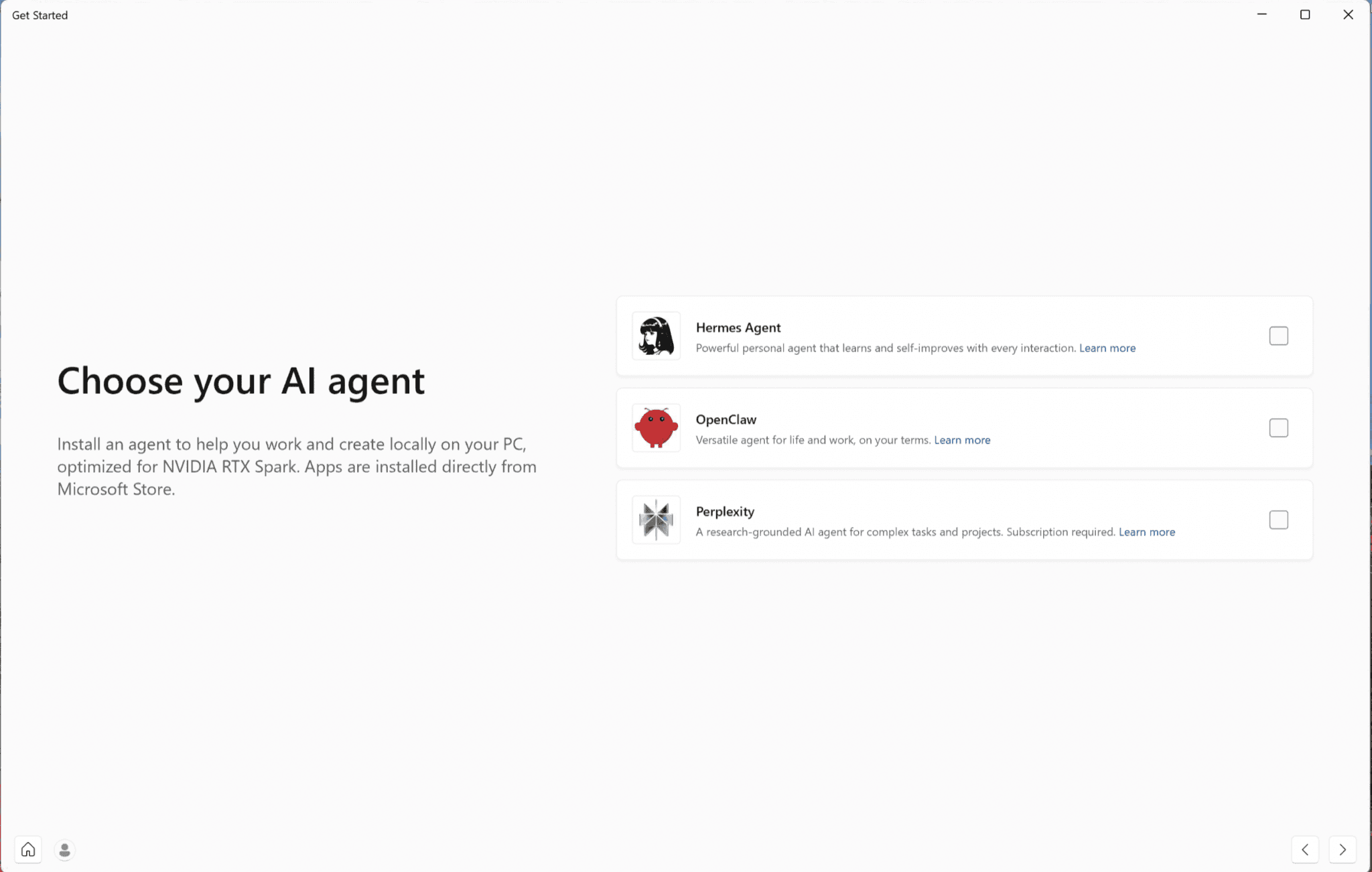
 RTX Spark's first boot greets users with an agent picker — one-click installs for Hermes, OpenClaw, Perplexity and other local agents. Image: NVIDIA official blog.
The out-of-box experience got redesigned too. First boot of RTX Spark shows a Getting Started screen for installing agent apps — GitHub Copilot, Hermes Agent, OpenClaw, Perplexity, Pi, WorkBuddy — set up in a few clicks, with apps auto-recommending RTX Spark-optimized local models and settings. On security, NVIDIA OpenShell plus Microsoft's MXC (execution containers) provide sandboxing: MXC delivers OS-level isolation, OpenShell makes MXC easier for agents to adopt and adds credential protection and security monitoring — Hermes integrates by month's end; OpenClaw and GitHub Copilot already support it.
One easily overlooked but critical piece: Switchyard, an open-source model router library. Its logic is blunt — local models for free iteration, cloud models for frontier intelligence, and the router splits traffic intelligently: "minimize cloud spend, get close to pure-cloud results." Hermes adds Switchyard later in October; Perplexity Computer and GitHub Copilot use their own routing. Its existence shows NVIDIA is clear-eyed: local models' enemy isn't cloud models — local-plus-cloud hybrid is the endgame.
More than one model: PAIR, E4B, and the local-AI puzzle
Bolt 74B is the headliner, but the same blog post hides several other puzzle pieces worth noting.
First, PAIR, NVIDIA's "personal AI router," officially moving out of beta. It's a free, open-source tool with a sexy job: auto-discover compatible PCs on your local network, install models and inference engines, and distribute AI workloads across every available machine — stitching the idle compute in your home or office into one fabric. The official release adds llama.cpp support, direct model downloads from Hugging Face, customizable inference engine settings, and RTX Spark support, across Windows, Linux, and macOS. Community traction looks healthy: one month after the initial release, contributors have already added 10+ features and fixes.
Second, Nemotron 3.5 Bolt E4B 4GB, releasing October 23. A third-generation small language model built for NVIDIA ACE AI game characters' dialogue — it runs in 4GB. The big-cup/small-cup pairing is deliberate: 74B handles heavyweight "personal agent" work, E4B handles lightweight game-NPC duty; the Nemotron 3.5 family is sliced finely by scenario.
Third, the background numbers: NVIDIA says local LLM downloads are already 5x higher than all of last year, and local models like Qwen 3.8-Flash-Next have caught up to frontier cloud models released just months ago. "Local models crossing the agent-usability threshold" isn't a prediction — it's a download curve already in motion.
The rest of the puzzle deserves a scan too. On the creative side: Adobe's suite (Photoshop, Premiere, Substance 3D) optimized for RTX Spark with up to 2x gains claimed; Broadcast 2.3 with video super-resolution, frame generation, and MCP controls letting agents tweak its settings directly; ComfyUI gaining RTX Video frame-generation and HDR nodes. On the dev side: Windows on Arm gets its first PyTorch-CUDA build, a native-by-default Python 3.15, a native Conda installer (2,000+ packages), with 97% of the top 15,000 Python wheels ready. GitHub Copilot's HydraFusion router adds local-model support, llama.cpp adds "decision model" support (claimed 200x faster near-instant agent decisions) plus a native Windows app. And on October 16, a 2x-faster DLSS 5 AI model lands alongside hundreds of launch-day games.
 llama.cpp's new native Windows companion app, Llama Windows: lives in the system tray, one click to download and run local models from Hugging Face. Image: NVIDIA official blog.
What it means for vibe coders: from "cloud tool" to "resident colleague"
Back to the practical question: what does this have to do with your daily coding? Three layers, each more concrete than the last.
Layer one is privacy and cost. A local agent's biggest selling point was never "smarter" — it's "code never leaves the network" and "iteration is free." Plenty of companies' codebases can't be fed to cloud models; a local 74B makes "refactoring legacy code with agents" compliant for the first time. The cost math is blunter: iterate free locally, send only genuinely hard problems to the cloud — routers like Switchyard are this calculation turned into product.
Layer two is the "always-on personal agent" concept. NVIDIA's positioning word for Bolt is resident. Consider the difference: today your agent is a tool you open in a browser tab and close when done; tomorrow it's a colleague living in your laptop on standby 24/7 — fixing the CI tests that broke overnight before you've had coffee, running impact analysis in the background while you code. That needs a model resident in memory and instantly responsive; the 24GB footprint is designed exactly for that scenario. Hermes-class agents plus a local 74B are aimed squarely at the "personal chief of staff" — NVIDIA literally lists "build an AI chief of staff" among RTX Spark's AI playbooks.
Layer three is fine-tuning power moving downstream. Weights plus data plus recipes means you can fine-tune a local model that knows your project: your naming habits, your architecture patterns, your gotchas. Cloud APIs give you "the smartest general model"; local open weights give you "the model that knows you best." For vibe coders, the latter may actually feel better in daily work — it doesn't need to re-learn your project from zero every time.
Cold water, of course. 24GB isn't for everyone: it targets 4090/5090-class GPUs and new devices like RTX Spark; most thin-and-lights can't reach it today. Real-world 2-bit quality awaits community testing after October 15 — "smarter than same-footprint MoE" is vendor framing; long-context, multi-step reasoning in agent scenarios is the real test. But the direction is clear: hardware and models are lifting each other, the bar for local large models keeps rising while tools like PAIR ("stitch idle compute together") keep lowering the threshold.
Late 2026 is quite possibly the inflection where "local agents" graduate from geek toys to serious productivity tools. Cloud handles frontier intelligence, local handles daily concurrency — hybrid routing becomes the default, just as "cloud plus edge" became the mobile-dev default years ago. NVIDIA didn't just ship a model this time; it stocked the full narrative of "the laptop as AI supercomputer": models (Bolt 74B/E4B), machines (RTX Spark), distribution (PAIR), routing (Switchyard), security (OpenShell+MXC), tooling (Llama Windows). When a company completes the puzzle to this degree, the rest is just a matter of time.
One suggestion for vibe coders: after October 15, pull Bolt 74B's quantized build from Hugging Face and let it run overnight in your Ollama or LM Studio. Have it read your project and answer a few questions about your codebase. You'll feel firsthand that between "local 74B" and "local 7B" lies not parameter count, but a qualitative leap — the difference between a demo and a colleague.
Comments (0)
Sources
Related articles
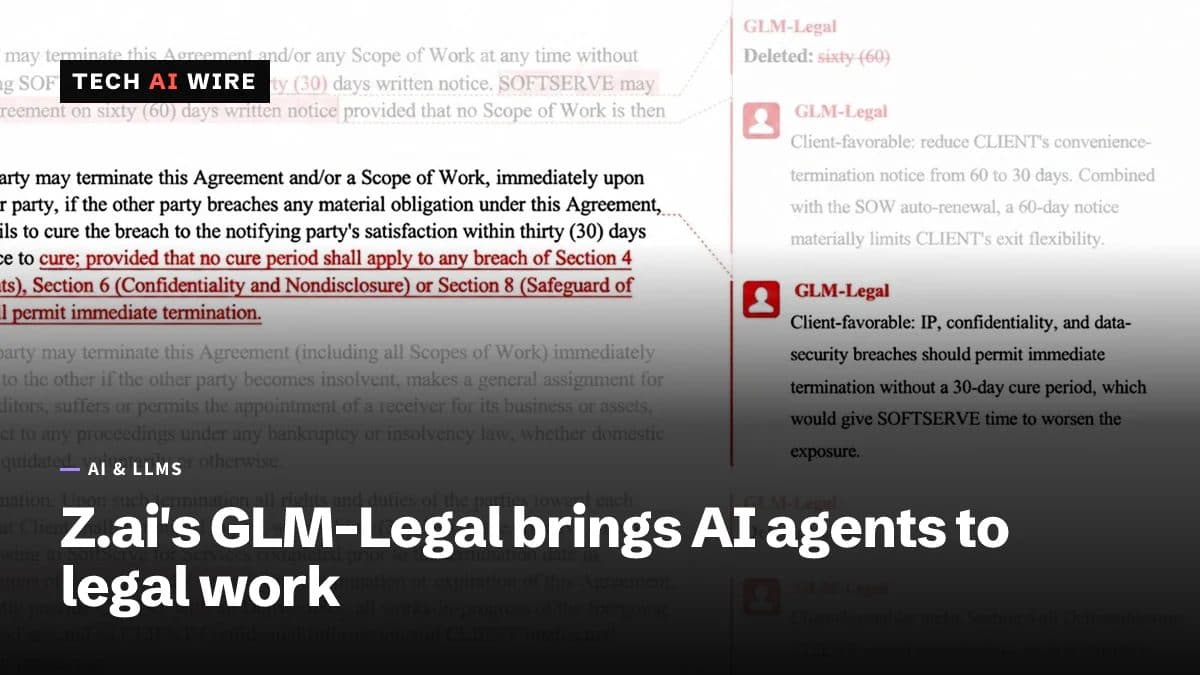
Z.ai launched GLM-Legal, a legal-domain agent model scoring 19.2% all-pass on Harvey LAB — nearly 3x its base model — at just $0.15 per test. But its official chart selectively omits the 6 higher-ranked models, led by Muse Spark 1.2 at 25.42%. We strip the makeup: how the score was earned, what it cost, and what it means for builders.
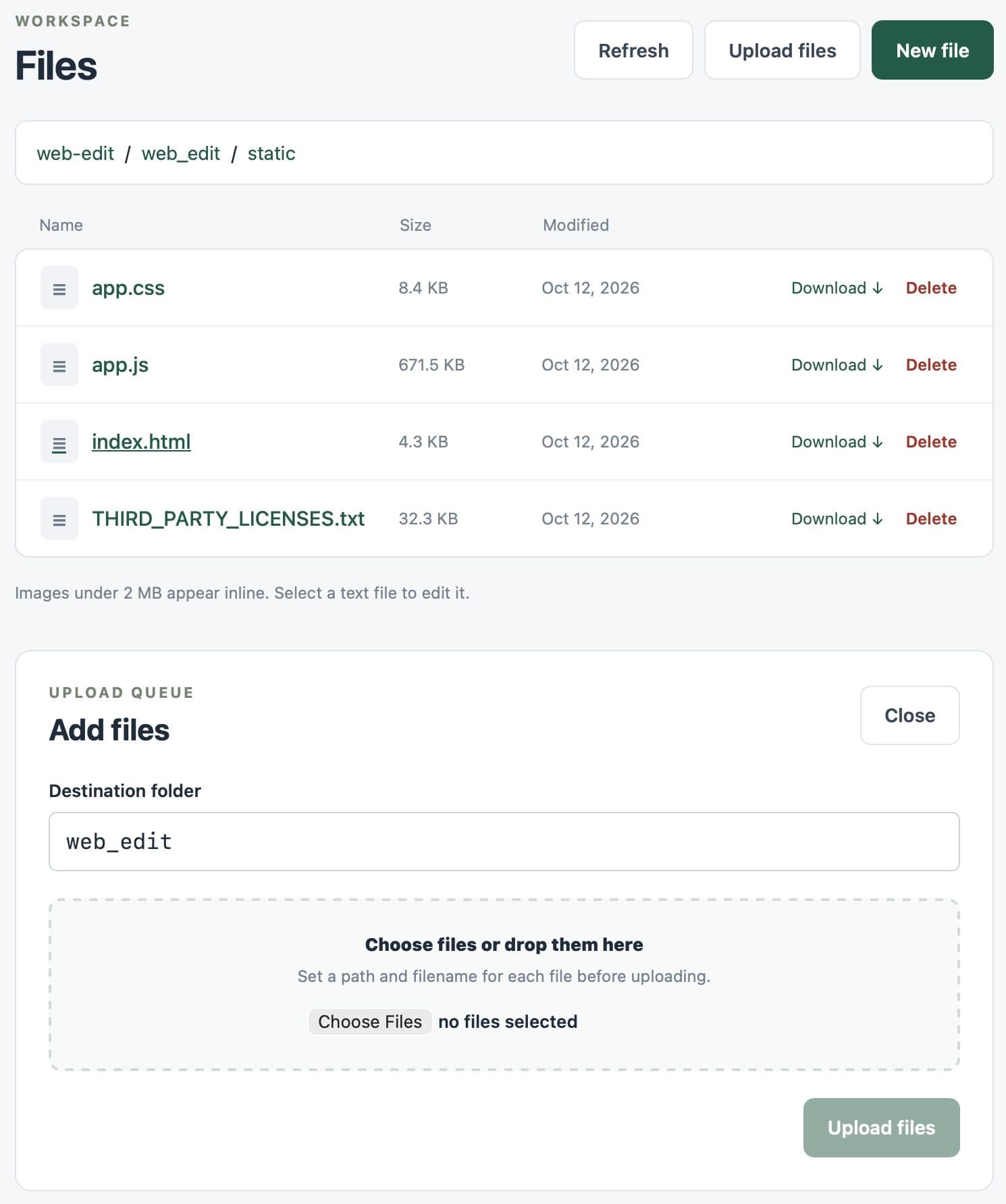
Simon Willison shipped web-edit 0.1a0, a tiny Python tool: the agent runs the web UI remotely, and he edits files directly from his phone over Tailscale — so credentials files never round-trip through the LLM's context. The tool itself was built with Willison directing Codex Remote from his phone, GPT-6 Astra Extra High doing the writing.

Cognitum One released Ruflo, an open-source agent orchestration platform turning one mission into a 100+ agent end-to-end workflow — 74K stars, MIT licensed. Competition is sinking from models to harnesses.