Tencent Hy4 Full Release: Vision and Computer Use Arrive, but the Weights Are Not Out Yet
Tencent released the full version of Hy4 on November 4, adding visual understanding and computer-use capabilities at unchanged pricing. The weights, however, have not been released for download yet, so Hy4 today is first a hosted service, not a locally deployable open model.
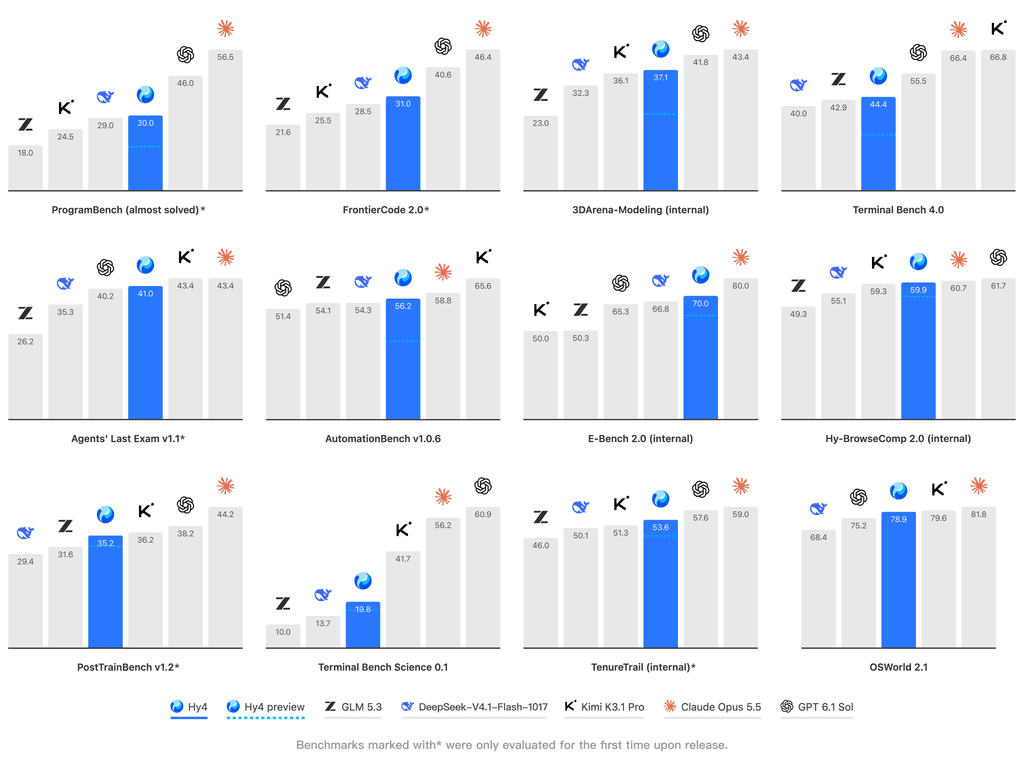
On November 4, 2026, Tencent Hunyuan formally released the full version of Hy4. The timing itself is worth noting: this was not a quiet model swap, but a new flagship announced in an official post on Tencent's own site. Less than three months after the Hy4 preview of August 28, the full version fills the preview's two most obvious gaps — the ability to see images and the ability to operate a computer. Tencent's claim is blunt: Hy4 now ranks among the world's leading open-source models for the first time. But that sentence needs an immediate qualifier: on the day of the announcement, the full version's weights had not yet been released for download, and the weights that could actually be downloaded were still the August preview. A more accurate description, then, is that the full Hy4 can already be used through Tencent's services, but it is not yet an open model that anyone can freely download and run locally. Keeping "released" and "open-sourced" apart is the first step to understanding this launch.

Start with what is actually new. The preview was a text-only model: it could write code and handle office tasks, but it could not see pictures or touch a computer. The full version adds visual understanding for the first time, and combines vision, reasoning and tool calling. Tencent lists fine-grained image processing, complex chart analysis and mathematical reasoning involving images among the concrete capabilities. In other words, the model is not merely able to describe a picture; it is supposed to turn what is in the picture into the basis for the next step. That distinction matters. Many models can caption an image, but far fewer can use the numbers or structure in an image to complete a multi-step task. Hy4's selling point is the latter: the kind of "look, calculate, then act" chain that shows up constantly in real work.
The second new capability is computer use. For the first time, Hy4 can interact with both command-line interfaces and graphical user interfaces to carry out a wide range of work and everyday tasks. Tencent adds that the model received specialized training on professional software such as Blender and CAD, with the aim of improving its ability to plan and execute long-horizon, sophisticated tasks. For an ordinary user, that sounds impressive; for a developer, the real questions are about reliability — at which step it will fail, whether it can notice and correct its own mistakes, and where its permission boundaries lie. Tencent's announcement gives no failure rates at that operational level; it only states the direction of the capability. Anyone trying it should treat it as an assistant that needs supervision, not as an autonomous employee that can be left alone.
Between the preview and the full version, Tencent also stresses a scale-up of both pre-training and post-training, alongside improvements in instruction following, long-context comprehension and long-horizon agent tasks. That description is fairly general, but several specific numbers in the announcement can be used to cross-check it. On office work, Tencent says Hy4 scored an average of 83.18 on WorkBuddy evaluations, with a pass rate of 96.15 percent, ranking first in nine out of twelve scenarios in the mainland Chinese market. Those figures come from Tencent's own evaluation system, not from independent reproduction, so they should be read with a discount. At minimum, though, they show where Tencent is pushing: not just conversational ability in the abstract, but performance inside its own office products.
Finance is the area Tencent describes in the most detail, and the one most worth reading closely. Tencent says its Hy team, together with Tencent Financial Technology, ran a blind evaluation involving 213 financial professionals, including 153 experts from leading external institutions, about 70 percent of whom had more than five years of experience, covering 579 real-world financial tasks. Hy4 came out on top with a score of 3.04, ahead of DeepSeek-V4.1-Flash-1017 at 2.97, and Kimi K3.1 Pro and GLM-5.3 both at 2.68. Judged on the gap alone, Hy4's lead over second place is small — just 0.07 points. The value of this data is not in the margin but in the method: it uses real tasks and experienced reviewers rather than public benchmarks alone. Another internal figure points in the same direction: Hy4 improved by 12.03 percentage points over the Hy4 preview on the internal Investment Research Agent Benchmark. Taken together, Tencent's message is clear: Hy4 is tuned for high-stakes settings such as finance and office work, not just presented as a laboratory model.
The improvement in hallucination rate also comes from Tencent's internal evaluations and deserves the same caution. According to the announcement, targeted search optimisation cut Hy4's hallucination rate from 12.95 percent in the preview to 7.2 percent, while errors caused by unsupported assumptions fell from 23.1 percent to 5.6 percent. If those numbers hold, they matter for tasks that require checking up-to-date information and combining multiple sources. But hallucination is defined and measured differently across vendors, so comparing the numbers directly across companies is not meaningful. What is more interesting is the method itself: Tencent says it optimised retrieving up-to-date information, integrating multiple information sources and verifying factual consistency. That suggests Hy4's progress is not only about a larger model, but about how it uses external information. For users who regularly work with earnings reports, research notes and market data, that direction matters more than raw parameter count.
Front-end and game development is another product line worth noting. Tencent says Hy4 is optimised for high-complexity tasks, including intricate business logic, state management and front-end and back-end orchestration, so that generated interfaces are not only visually polished but fully functional. Through collaboration with professional developers at Tencent Interactive Entertainment Group, Hy4 deeply integrates with major engines such as Unreal Engine, Unity and Godot, and supports complex game logic and multiplayer implementations. Compared with the preview, Hy4 improved by 19.1 percent on GameDev and 9.8 percent on GameLogic benchmarks. Those are again vendor-reported numbers, but they reveal a judgement about positioning: Tencent does not see Hy4 only as a chat or office model, but as a model that can enter game development, where state, logic and long-run consistency are demanding. Such tasks are good at exposing a model's weaknesses, because a single logic error may only surface dozens of steps later.
The research narrative leans more toward a long-term bet. Tencent says Hy4 combines advanced reasoning, scientific programming and long-horizon task execution to support end-to-end research workflows, and that it was validated on TenureTrail across 123 executable tasks in seven disciplines, showing strong performance in mathematical construction, physical modeling, environmental and earth sciences, systems engineering and socio-economic decision-making. Tencent also says Hy4 is moving into the next stage of Recursive Self-Improvement, that the Hyra 2.0 harness was used to optimise pre-training infrastructure for smaller models sharing the same architecture, and that two foundation models built with Hy4 and Hyra 2.0 have been open-sourced, for single-cell representations and for physics fields. For ordinary users, the direct significance is limited, but it shows Tencent treating Hy4 as a platform rather than a one-off product. The value of a research model often lies less in its launch-day benchmark scores than in whether the research community actually picks it up and keeps improving it.
Safety is the section of the announcement written with the most restraint, and the most creditable for it. Tencent states clearly that Hy4's cybersecurity training data is limited to defensive content, prioritising proof-of-concept development and vulnerability remediation, and that reverse engineering and penetration testing are included for analysis purposes, while offensive material related to exploitation is explicitly excluded from the training dataset. Security assessments by Tencent's Xuanwu Lab and Keen Security Lab covered cryptographic reverse engineering, binary deobfuscation, vulnerability exploitation and more, and found no significant concerns regarding Hy4's offensive cybersecurity capabilities in the areas evaluated. On biosafety, Tencent's internal expert reviews found strong foundational biological knowledge, but more limited capability in open-ended experimental design compared with frontier models. That wording neither exaggerates nor hides the shortcoming. At a time when vendors are competing over the language of "safest model," such item-by-item disclosure carries more information than a blanket claim of safety.
Pricing and access are the most practical parts of the launch. The full Hy4 keeps the preview's pricing: approximately US$0.90 per million input tokens, US$2.70 per million output tokens and US$0.045 per million cached input tokens. Tencent also announced that WorkBuddy and CodeBuddy will be free to use within a quota from November 4 to 15, and that Hy4 on Tencent Cloud TokenHub will be offered at 50 percent off its standard pricing through December 31, 2026. The model is already available across Tencent Cloud TokenHub, WorkBuddy, CodeBuddy, Yuanbao, WeCom's AI Assistant (Dayuan), ima and more, and its API is being made available through third-party platforms such as OpenRouter, Hermes and OpenCode. Integration is under way for other Tencent products and platforms, including QQ, Honor of Kings, Game of Peace, WeRead and Tencent News. Unchanged pricing with added capability is a genuine benefit for existing users; for new users, the real calculation is not the unit price but the total cost of completing a task, including retries, corrections and human review time.
That brings us back to the most important qualifier: the weights have not been released yet. Tencent's own wording is that it plans to release the model weights and system cards in the coming days, reinforcing its commitment to responsible open-source development. Third-party listings confirm the point: as of November 4, Tencent's public repositories still held only the August preview weights. Today's full Hy4, in other words, is a hosted service, not a model that can be downloaded. Tencent also previews a Hy4 Flash version coming soon, aimed at greater cost-efficiency for users who prioritise high-value applications. Put together, the full-version launch reads more like a phased roadmap: make the service available and gather real feedback first, then release weights and a system card, then cover cost-sensitive use with a Flash version. Readers making a decision should judge it on that rhythm: the vision and computer-use capabilities can already be tried through Tencent's products and APIs, but if the requirement is local deployment, offline use or deep customisation, it is better to wait until the weights and system card actually land.
Taken together, the significance of the full Hy4 is not that it claims a place "among the world's leading open-source models," but that it makes Tencent Hunyuan's product direction explicit: from text-only to vision plus computer use, from general chat to concrete settings such as office work, finance, games and research, and from a single model to a family that will include a Flash version and research foundation models. Its shortcomings are equally clear: the headline numbers all come from the vendor's own evaluations, the weights are not yet public, and the reliability of computer use has not been independently verified. For developers and enterprise users, the rational approach is to use the free quota and discount period to run their own real tasks, and to verify vision understanding, long-task execution and hallucination control on their own data, rather than relying on the rankings in the announcement. Launch-day slogans fade; what remains is whether the model can reliably finish the job inside your own workflow.
Looking one step further, the contrast between the full version and the preview tells a product story, not just a capability upgrade. The preview answered whether the model could produce stable output in office and coding settings; the full version must answer whether it can read real-world information and finish tasks inside software. Vision lets it handle inputs with pictures and tables, computer use lets it turn reasoning into concrete actions, and front-end orchestration and game-engine integration let it handle longer chains of state. The benefit is that scenarios become more concrete; the cost is that verification becomes harder. It is easy to see whether a chat answer is good, but a long task that fails only at step ten usually needs a full rerun to diagnose. Tencent has not published long-task success rates, average step counts or self-correction ability, and those are exactly the gaps future evaluations should fill.
For developers, the path to trying the full Hy4 is fairly clear today. Teams already on Tencent Cloud TokenHub can call the new version directly at unchanged pricing — in effect, the same cost for vision and computer-use capabilities. Users of WorkBuddy and CodeBuddy can run real tasks during the free-quota period before deciding on long-term use, and users coming through OpenRouter and other third-party platforms can place it in an existing multi-model comparison and test it on the same tasks as other models. That "try it where you already are" arrangement is friendlier than forcing a migration to a brand-new platform. One detail deserves care, though: version, rate limits and feature support may not be identical across entry points, so pre-launch testing should use the exact entry point you plan to ship with, not the generic description in the announcement.
The timing also matters competitively. Hy4 arrives in a dense window of model and capability releases, where parameter counts and benchmarks alone rarely create differentiation. Tencent's chosen differentiation is depth in specific scenarios: office collaboration, financial analysis, game development and research workflows, each with its own evaluations and product landing points. The advantage is proximity to paying users; the risk is that each scenario needs sustained investment to stay ahead, and if an independent reproduction in one scenario disappoints, the reputational cost follows quickly. By contrast, a very narrow positioning such as Sarvam Prism's "judgement layer only" is easier to verify, because speed, calibration and order stability can all be re-measured directly. Hy4's long-task ability is harder to verify in a single sentence, and that is where trial users should pay extra attention.
Finally, a trial checklist for anyone who actually wants to try it. First, run head-to-head experiments on your own tasks: the same illustrated document, the same complex chart, the same multi-step software task, on the full Hy4 and on the model you use today, recording success rates, where errors occur and how often a human must intervene. Second, stress-test hallucination control: feed it conflicting or outdated information and see whether it presents assumptions as facts. Third, test the boundaries of computer use: tell it explicitly which actions are not allowed and check whether it crosses the line, and watch whether, on error, it stops and asks for help or keeps going down the wrong path. Fourth, do not write "open-source" into procurement or compliance documents until the weights and system card actually appear. Fifth, watch for the Hy4 Flash release: if cost and latency matter more than peak capability for your scenario, Flash may be the better fit. The checklist boils down to one sentence: do not judge it only by launch-day rankings, but by how it performs on your tasks, your data and your permission boundaries.
One more point deserves separate emphasis: do not treat "Tencent says" as "the industry agrees." Hy4's leads in the financial blind evaluation, the office evaluations and the game benchmarks were all obtained inside evaluation frameworks built by Tencent itself, and frameworks built by different vendors are inherently hard to compare head to head. The most convincing verification usually comes from independent reproduction, real usage feedback from the open-source community, and failure rates and cost data from production deployments. Until that evidence appears, the safest way to read Tencent's announcement is as a list of vendor claims to be checked one by one, not as a settled report card. That attitude is not distrust of Tencent specifically; it is the basic caution that should apply to every model launch.
Comments (0)
Sources
Related articles

Sarvam AI released Prism on November 3: a decision model that does not generate long text but scores given options, averaging 71.8 at 44 milliseconds, with weights open under Apache 2.0. Its real selling point is not being the smartest, but being calibrated, order-stable, and fit to serve as the judgement layer inside automated workflows.

On 3 November 2026 Google announced Guided Learning for a US Search pilot and globally in Classroom, while Gemini, Gemini Notebook, Gemini in Classroom and Search go off by default for K-12 student accounts until administrators opt in. The catch: rejecting AI also means losing student Search, because the two are deeply integrated.

Anthropic has released FlashProve, an open-source prototype that uses zkSNARKs to prove a reply came from a committed set of model weights without revealing them. It reaches about 110 tokens per second on one H100 with 19 MB proofs, but proving costs 70 to 95 times plain inference and contexts are capped at 1,024 tokens.