Tencent Cloud Open-Sources TeamAI: Team Skills in Git, Configure Once, Reuse Everywhere
On Oct 10 Tencent Cloud open-sourced its internal TeamAI: team skills, rules, MCP, env vars and knowledge bases live in a Git repo, distributed via push → review → pull — configure once, reuse everywhere, across 16 agents. Timeline note: the repo was created Apr 27; Oct 10 was the official announcement. Tencent's claimed '76% cost cut' is a vendor claim; the product thinking matters more than the marketing numbers.

The timeline first: the repo dates to April; October 10 was "announcement day"
On October 10, Tencent Cloud announced the open-sourcing of its internally used TeamAI tool, which supports sharing skills across AI agents. FX168 covered it on October 12 at 09:53, and the English-language China AI Wire reported it on October 10 as well. But one timeline detail has to be stated upfront to avoid misleading anyone: the TeamAI GitHub repository (Tencent/teamai-cli) was created on April 27, 2026 — a matter of public record on the GitHub API. October 10 was the day Tencent Cloud officially announced the open-sourcing, not the day the project started from zero. The repo has been iterating since April (1,047 commits, 71 releases); October 10 is when it went from "internal tool" to "public open-source project." The news event in this story is that announcement.
Why does the distinction matter? Because Chinese media has previously burned itself by treating "repo creation date" as "news date." Under VibeFix's freshness rule, the news event must fall within the last two weeks — for TeamAI, that's the October 10 announcement, not the April 27 repo creation. Stating this first keeps everything that follows honest.
The timeline also reveals the product's evolution. TSNMedia's fact-check dug up a README revision from August 25 whose slogan was still "The team harness for AI agents," leading with "Git-native management of skills, rules, MCP, env vars, and knowledge base." Today's headline reads "Make Every Team AI Native" — upgraded from a tool description to a vision statement. A slogan change says the team figured out its narrative between August and October: don't sell features, sell the outcome of "team AI transformation." In the two months before the announcement, the work wasn't just code — it was figuring out how to tell the story. That's a useful reference for indie developers planning their own launches.
What TeamAI is, in one sentence: "your team's AI setup, managed in Git too"
FX168's report defines it crisply: a Git-based team AI collaboration tool that puts the team's skills, working norms, tool configurations, and project knowledge into a Git repository, managing them like code — reviewed, updated, versioned — then syncing them into each member's own agent. The payoff line: "one person configures, everyone reuses."
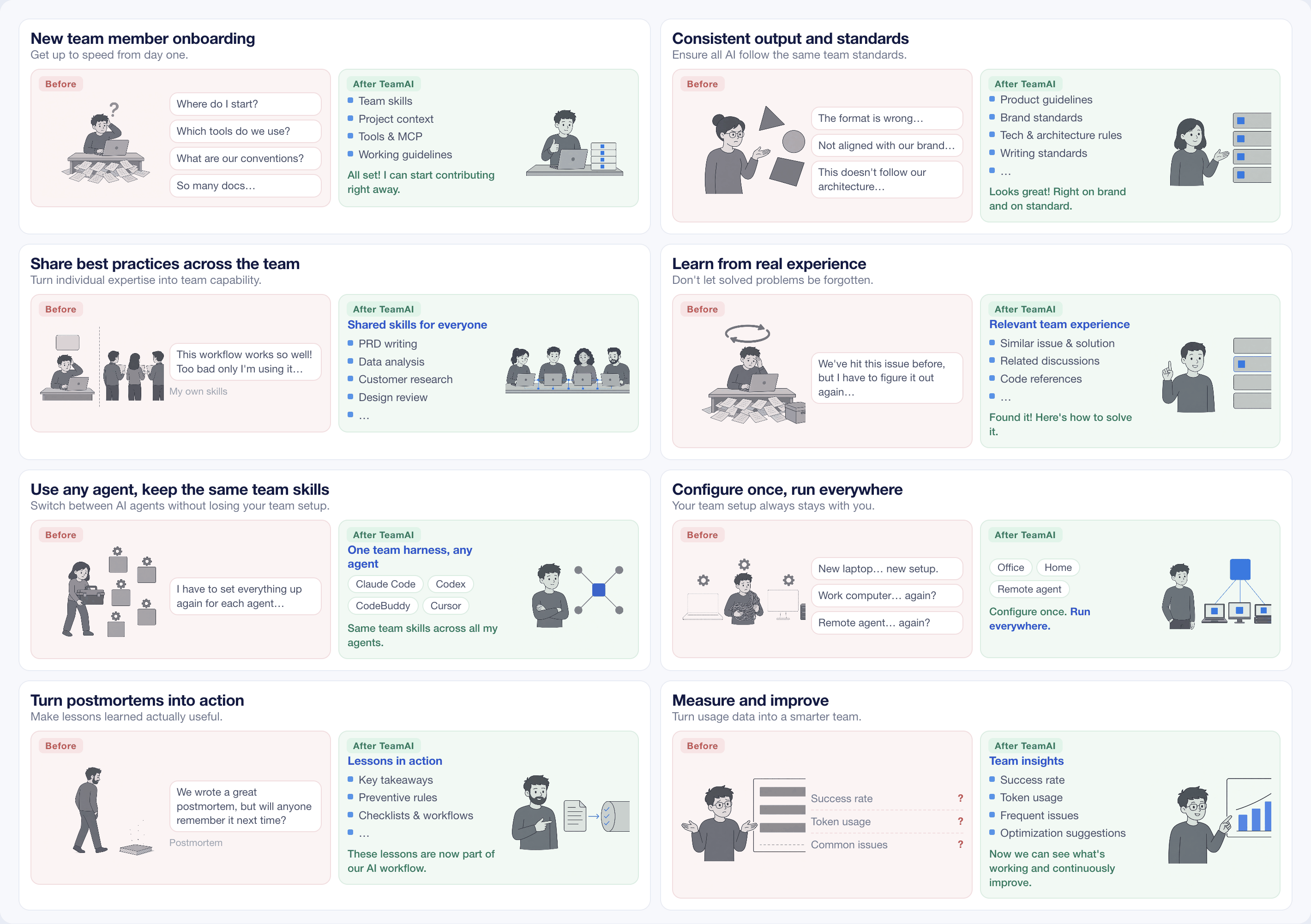
In vibe-coder language: all those "AI assets" scattered across ~/.claude/skills, per-project .cursor/rules, and MCP config files finally get one home — a Git repository. One teammate sets up skills and rules, pushes to the repo, gets them reviewed and merged, and everyone else pulls; each person's preferred agent then has the lot. No more configuring the same thing N times, no more config files passed around in chat groups, no more "you're on the three-month-old skill version." A new hire's first day: run teamai init once, and they're on the same AI setup as the veterans. "Environment consistency" — an old backend concept — applied to the AI toolchain for the first time.
TeamAI currently supports 16 agents, including Tencent's own WorkBuddy and CodeBuddy plus mainstream tools like Claude Code, Codex, and Cursor — members just do a simple setup and the team's shared skills and experience work inside whichever agent they already use. The README's compatibility table lists 19 entries (including regional variants) across skills, rules, env vars, MCP, and more. Two entry points: the CLI (npm install -g teamai-cli) and an agent skill (send one line to your AI tool to install it, then manage everything conversationally via /teamai: set up a team, join one, share a skill, open the dashboard).
The onboarding flow is officially minimal. In plain terms: an admin creates a shared repo on a Git host (default branch protected, members granted branch-push rights) and runs teamai init with the repo address. Members choose: cd into a project directory and run teamai init for project scope, or add --scope user for personal-global scope. After that, every AI session automatically pulls the latest skills and rules the admins published — no manual sync. Sharing a skill is even simpler: tell the AI "/teamai share my xxx skill with the team" and it handles the rest.
That "install by sending one sentence" design is worth noting. TeamAI is itself a skill (the skills/teamai directory): you have the AI load that skill, and it turns around and manages all your skills for you — fighting magic with magic. This "bootstrapping" pattern is common in 2026's agent tooling, but TeamAI is the first to apply it to team governance: admins need no new tool to learn; typing in the AI chat box suffices. The bar couldn't be lower.
Three things the 16-agent compatibility table is really saying
The big compatibility table in the README rewards a line-by-line read. Tier one is the "all checks" club: Claude Code, Codex, CodeBuddy, WorkBuddy — skills, rules, env vars, agents, hooks, MCP, models, all supported. Note that Tencent put its own WorkBuddy and CodeBuddy in the same tier as Claude Code and Codex. That ordering is itself a statement: TeamAI isn't "a companion for Tencent's agents"; it's a neutral layer for all mainstream agents.
Tier two — partial support — is more informative. Cursor lacks model support (a dash in the models column), as does GitHub Copilot CLI; newer agents like OpenCode and Pi show blanks under Team Improvement's usage and sessions columns. Translation: TeamAI's "distribute configuration" ability is universal, but its "observe and improve" ability depends on how open each agent's telemetry interfaces are. The more open the agent, the more powerful TeamAI becomes; with a closed agent it can only be a "distributor," not a "dashboard." That's the state of the whole agent ecosystem: the config layer is unifying first, while the observability layer is still every-agent-for-itself.
Third, some names in the table may be unfamiliar to vibe coders: Oh My Pi, OpenClaw, Hermes, DeepSeek Harness, Qoder, Kiro, Trae, ZCode, JoyCode. The number 16 isn't padded — it spans "international mainstream + the full Chinese lineup + emerging agents" across three layers. The Chinese agents — CodeBuddy, WorkBuddy, Qoder, Kiro, Trae, ZCode — are all there, which says TeamAI's primary audience is Chinese teams. No surprise: the skill-settling methodology runs hottest in the Chinese vibe-coding community. Serve the home base first, then talk globalization. The strategy is right.
Three capability layers: execution, context, improvement
Per the official product layering, TeamAI has three capability layers built on Git:
Team Execution: make every agent work the team's way — skills, rules, env vars, agents, hooks, MCP, models, distributed automatically to everyone's AI environment once configured. This is the most mature layer and the core of "one person configures, everyone reuses."
Team Context (beta): make every agent understand the team — learnings (members' trial-and-error automatically settled, prompting knowledge sharing), codebase graph (source parsing that builds a repo knowledge graph), teamwiki. The idea: team knowledge shouldn't live only in veterans' heads; it should be context the agent can read.
Team Improvement (beta): make every execution make the team stronger — usage (AI usage dashboard), sessions. Low-confidence learnings get archived; stale skills and rules get flagged. Think of it as "freshness management" for the team's AI assets.
The repo works with GitHub, GitLab, GitCode, CNB, TGit, and private Git services, and there's a teamai-hub org offering templates preloaded with production-grade skills, rules, and review agents — no team repo yet? Fork a template and start. A very "Tencent" design: lower the cold-start bar, get people using it first.
The workflow: push → review → pull, managing skills like code
The most methodology-flavored part of TeamAI is its workflow. A member wanting to share a skill runs teamai push, which opens a merge request; after a reviewer merges it, everyone else's teamai pull at session start syncs the update automatically. Skill changes go through exactly the same pipeline as code changes: branch, review, merge, sync.
The design targets the three most painful problems in skill collaboration. First, version chaos: skills used to travel via chat-group file drops — A on v1, B on v3, nobody knowing; now Git is the version truth. Second, quality control: anyone could toss a skill into the shared folder and poison the whole team; now MR review puts at least one pair of eyes on it. Third, update gaps: when a skill author fixed a bug, distribution used to mean "shout in the group chat and everyone re-downloads"; now it's one pull.
Interestingly, this workflow directly answers the problem posed by the Skill Constellations paper (arXiv 2610.11169), covered separately on this site. That paper found agent-skill distribution to be a copy chain with no versions and no update channel — fixes at the source never reach downstream, and stars can't identify the real distribution hubs. TeamAI's push → review → pull is, in essence, adding "versions" and an "update channel" to a team's internal skill copy chain. The two stories only read complete together: the paper diagnosed the disease; TeamAI prescribes one medicine — though for now it only treats "inside one team," not the whole of GitHub.
Tencent's claimed report card: 13 tasks, 76% cost cut — question marks first
China AI Wire's report cites Tencent Cloud's internal test figures: across 13 development tasks, wiring shared team knowledge into lower-cost models improved comprehensive quality scores by 6.1% while cutting model invocation costs by 76%. CNMO and Guandian's retellings spell out the comparison more precisely: "cheaper model + team knowledge" versus "higher-spec model without knowledge" — the former won.
Sexy numbers, but three question marks. First, tiny sample: 13 tasks says statistically almost nothing; a different 13 could give a different answer. Second, no published method: how the quality score was graded, how cost was computed, what the baseline models were — Tencent published no method and no dataset, so nobody can reproduce it. Third, single-party claim: the figures come from Tencent Cloud itself; TSNMedia's fact-check explicitly noted "no published method or dataset found" — vendor claim, not independent verification.
Separately, China AI Wire also says TeamAI is integrated into Tencent's ClawPro agent platform — but TSNMedia adds the same caveat: it found no Tencent announcement confirming that. So "ClawPro integration" remains media-reported, not confirmed.
This rigor isn't nitpicking; it's VibeFix's standing position: treat big-tech internal test numbers as interesting, not as buying guidance. What deserves discussion about TeamAI is the product thinking (Git-managed AI assets), not the marketing numbers. Just remember the qualifier on 6.1% and 76%: "Tencent says so."
The thesis: skills are graduating from "personal files" to "team assets"
Where TeamAI's real news value lies isn't "Tencent open-sourced another thing" — it's the methodology inflection point it marks. In the first half of 2026, skill-settling was personal methodology: everyone hoarding skills under ~/.claude, blogging their tips. By the second half, skills started becoming team assets, with people reaching for Git, review flows, and dashboards to manage them. TeamAI is the first big-tech-grade open-source move on that inflection.
Why would Tencent open-source this? Three plausible layers of motive. First, ecosystem: WorkBuddy and CodeBuddy are Tencent's own AI coding products; TeamAI's 16-agent support looks neutral on the surface, but holding the definitional power over "team AI assets" means teams reaching for skill management think of TeamAI's flow first — and the Tencent agents are naturally the smoothest inside that flow. Second, talent: 1,047 commits and 71 releases say it's been used internally for half a year; open-sourcing turns the community into free QA and contributors. Third, standards: MIT license, not tied to Tencent Cloud (GitHub/GitLab/private Git all supported) — the posture is deliberately open, aimed at becoming the de facto standard. As open-source strategy goes, that's a deft move.
The ByteDance TRAE comparison is illuminating. TRAE (covered on this site in cycle42) is "personal workbench" thinking: work and code inside one person's agent workflow, optimizing solo efficiency. TeamAI is "team asset layer" thinking: optimizing "how one person's setup becomes everyone's setup." One handles the individual, the other the team; they don't conflict, they complement: TRAE answers "how do you work with AI," TeamAI answers "how do you work with AI together." The giants' division of labor across the agent toolchain is shifting from "IDE wars" to "workflow layering" — a trend worth watching. The next mover is probably Alibaba or ByteDance — the "team skill management" seat currently holds only Tencent.
The boundaries deserve equal airtime. First, it solves distribution inside a team; the paper's "internet-wide copy chain" problem is untouched — your team repo can still ingest some 12th-hand frozen version from outside. Second, 16-agent support is really "translating one config into 16 dialects," and translation quality depends on each agent's openness — Claude Code and Cursor don't even share a skill format, so maintaining 16 adapters is ongoing cost. Third, the two beta layers (Context, Improvement) are the genuinely hard part: automatic learning-settling, stale-skill flagging — if that "freshness" work fails, the team repo ends up as another "legacy skills directory nobody dares touch."
Risk note: the team skill repo is itself a new single point of risk
Both sides now. Centralizing a team's AI assets in one Git repository is convenient — and makes that repo a new single point of risk. Consider: skills are instructions and scripts running with user permissions; one poisoned skill distributed to everyone via teamai pull means one poisoning, whole-team compromise. When skills were scattered across individuals, damage was bounded; under centralized management, the review flow is the only line of defense.
Tencent's docs explicitly say: don't put secret values in shared env vars. Sensible advice that also exposes the boundary: env vars share "configuration," not "secrets" — teams must solve secret distribution themselves (vaults, local overrides). MR review catches the obvious bad stuff, not carefully crafted poisoning — and reviewers read skills with different eyes than they read code. A team's first job with TeamAI should be setting review standards: which skills get in, which don't, who holds merge rights.
There's also an organizational risk: heavier process means slower skill updates. MR review, version management, dashboards — all for "managing well," but management costs speed. If a small team copies big-company review ritual and a skill update waits three days, they might as well pass files in chat. TeamAI's flow is optional (direct push works too); teams should tune the "control vs. speed" balance to their size. The tool doesn't own that call; whoever designs the process does.
Four suggestions for vibe coders
1. If you lead a team — even a three-person one — try TeamAI's thinking, not necessarily TeamAI itself. The core methodology is one sentence: AI assets go in Git, changes go through review. Even without its CLI, put the team's skills, rules, and MCP configs in a repo and agree that "skill changes need a PR" — that alone gets you 80% of the value. The tool is secondary; the process is primary.
2. Solo founders: this isn't "not your problem." "The team" can be you-today and you-three-months-from-now. Putting skills in Git benefits "future you" most: three months later, when you can't remember where a skill came from or what you changed, git log remembers everything. In the solo vibe-coder workflow, what's usually missing isn't tooling — it's the habit of leaving records for your future self.
3. Before copying TeamAI, read the Skill Constellations paper. The two stories are siblings: one is "how to distribute," the other "what's treacherous about distributing." Before ingesting an external skill into your team repo, check its copy chain and update status — don't enshrine a 12th-hand frozen version as a team asset. The easier distribution gets, the warier you should be of sources. That's the complete story the two pieces tell together.
4. Give your skill repo a "freshness" rule. TeamAI's Team Improvement layer is still beta — stale-skill flagging, usage dashboards, all immature, so teams must compensate themselves: assign each skill an owner, agree that "skills untouched for three months auto-enter the review list," have someone walk new hires through the repo's structure during onboarding. Tools can only build the scaffolding; freshness is an organizational habit. Plenty of team wikis ended as "landfills nobody dares delete"; if you don't want that fate for your skill repo, set the rules on day one.
Reference data: Tencent/teamai-cli, created 2026-04-27, at writing time 5,383 stars, 414 forks, 1,047 commits, 71 releases, MIT licensed. Stars kept climbing after the October 10 announcement — evidence the "managing team skills" pain is real. Real pain, unverified remedy — the fairest one-line verdict on TeamAI, and this piece's conclusion: the pain is real; the remedy still needs time to prove itself.
Comments (0)
Sources
Related articles
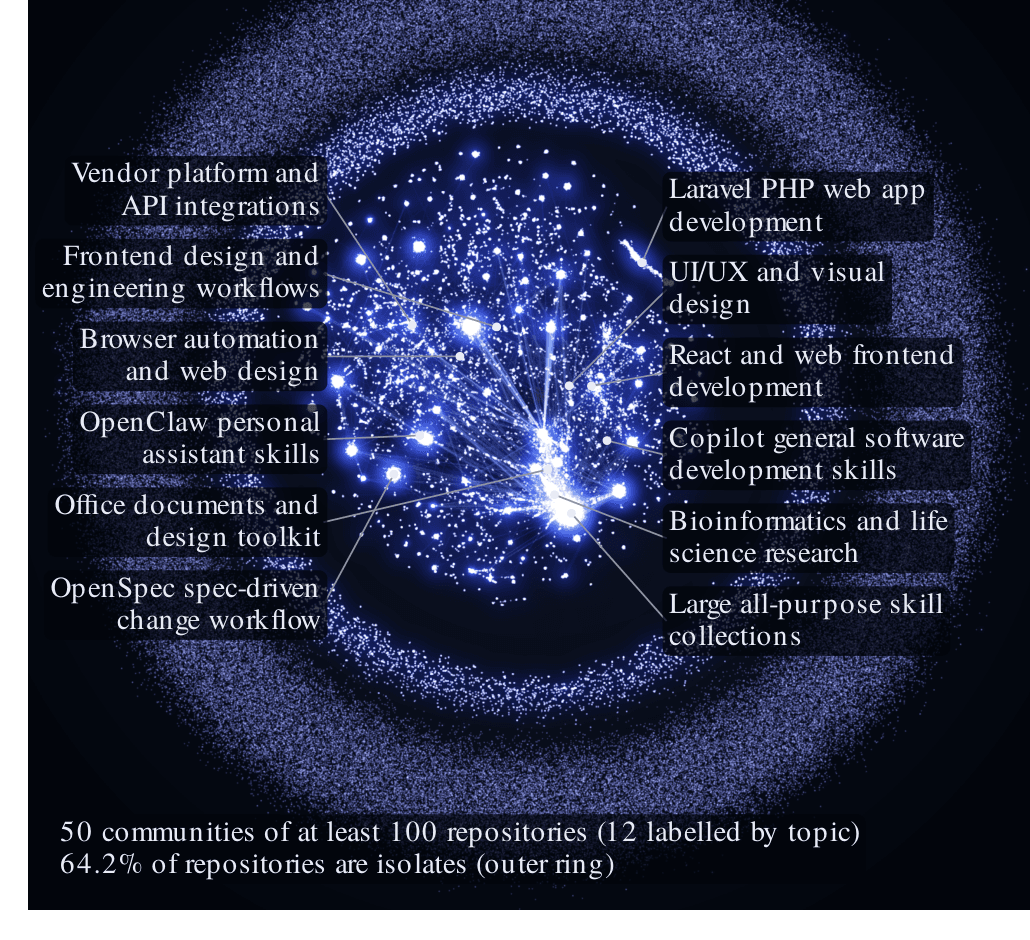
The Oct 8 arXiv paper 'Skill Constellations' rebuilt agent-skill copy networks from git history: of 2.19M adoptions, half of SKILL.md files are verbatim copies; the top 1% of repos drive 94.7% of transmissions; upstream fixes never reach installed copies. Auditing the network-ranked top 100 repos would intercept 14.9% of later high-risk adoptions vs 0.5% for the top 100 by stars. Stars can't find hubs; the missing update channel is the structural risk.

On October 8, Chinese team MirroS published the paper 'AgentGarten: Code Worlds for Evolving Agents' and open-sourced the repository (Apache-2.0). Its thesis: code handles physics, a neural renderer handles light, and agents accumulate experience in playbooks — one short skill file per lesson. In a reenactment of OpenAI's 2019 hide-and-seek, skills that took ~100M episodes of self-play RL now emerge within 10 rounds of play-review-write cycles across five code worlds.
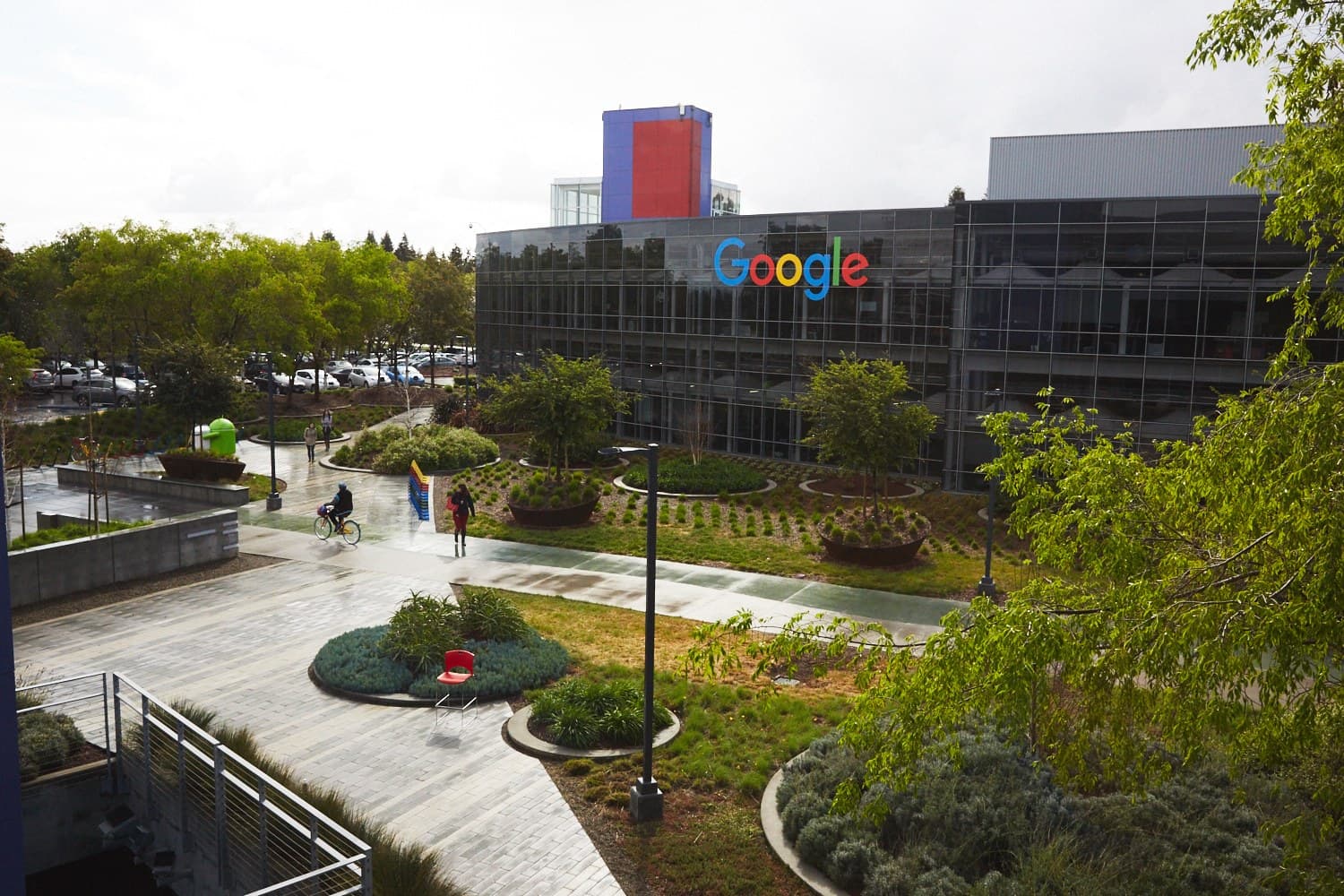
On October 1, 2026, Google suspended product-vulnerability submissions to its OSS bug bounty program, blaming a surge of automated, mostly invalid reports. Behind the pause lies the vibe coding era's hardest contradiction: AI drove the cost of finding vulnerabilities to near zero while dumping the entire validation cost onto human reviewers. What it means for AI-powered bounty hunting — the era of spray-and-pray AI vuln hunting is over.