TRAE Merges Work and Code: ByteDance Bets on a Unified Agent Workflow
On October 9, ByteDance merged TraeWork and TraeCode into a unified TRAE: one entry point for continuous tasks, one-click switching between Agent mode and IDE mode. Agent mode is a global workbench where multiple agents split coding, testing and fixing; IDE mode keeps full editing for detail work. All deliverables settle into a Project Artifacts hub instead of chat history. The real story: 'work' and 'code' in one agent workflow, plus a labor-division playbook for one-person teams.
An Unusual Kind of Merger
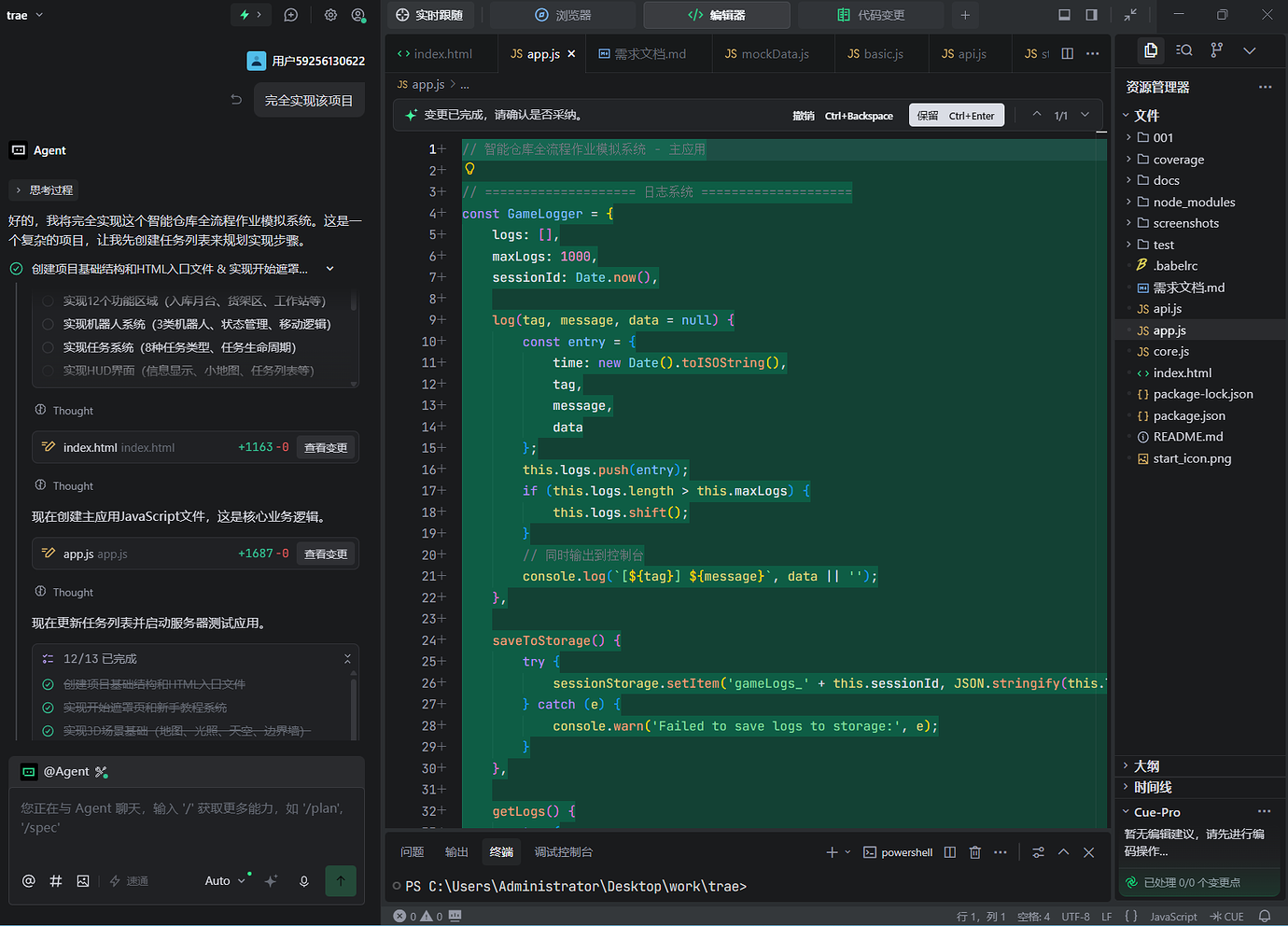
On October 9, ByteDance announced a sweeping upgrade to TRAE: TraeWork and TraeCode are being merged into a single, unified TRAE. On the surface, it looks like a routine product-line consolidation — two clients folded into one entry point. But placed in the larger arc of AI coding tools, the thing actually worth discussing is something else: ByteDance didn't turn TraeWork into yet another AI IDE plugin, nor did it repackage TraeCode as smarter autocomplete. Instead, it chose to put "work" and "code" inside the same agent workflow.
The old division of labor was clear-cut. TraeWork leaned toward office work, task management, and content generation — for people writing docs, building decks, and sorting out requirements. TraeCode was aimed at professional developers' coding needs, an IDE-shaped intelligent development environment. One handled "work," the other handled "code." After the merger, the new TRAE carries continuous tasks through one unified entry point, with one-click switching between Agent mode and IDE mode in the top-right corner — the former taking an idea all the way from breakdown to delivered result, the latter keeping the full intelligent dev environment for deep, single-project code editing and fine-grained debugging.
This isn't simple feature stacking; it's a change in product philosophy. A developer's workflow — from requirement breakdown and solution design through coding, testing, and deliverable packaging — was always continuous. Tools splitting that chain into "office software" and "IDE" was the compromise of the past.
Agent Mode: One Window, Many Agents
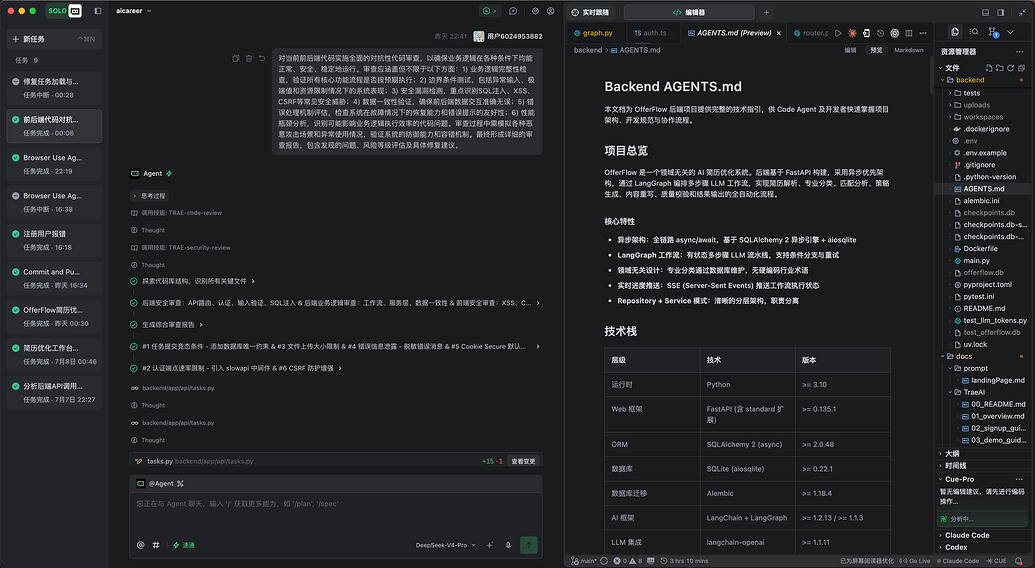
The weightiest change in the upgrade is the shape of Agent mode. It's no longer "a chat window plus code generation" — it's a global workbench: manage multiple projects in one window and hand different jobs to multiple agents running in parallel — one writing code, one writing docs, one preparing delivery materials, each owning its tasks.
That sounds like marketing copy, but the hands-on cases reported by Chinese tech media make the division of labor concrete. In one test, a 3D "pelican riding a bicycle" demo ran as a three-agent relay: Agent 1 wrote the code and built the scene; Agent 2 took screenshots, tested, and listed the problems it found; Agent 3 fixed them one by one. Development, testing, fixing, delivery — the full loop, with the human stepping in only at key decision points.
The other case is even more telling: building a map editor for a 3D dungeon game, a planning agent and a design agent worked in parallel and produced a spec conflict — one said the grid should be 20×20, the other said 32×32; one picked the E key as the shortcut, the other picked X. The dev agent's job wasn't to "pick a side" but to adjudicate each item against the principle of "ship a playable simple version first," writing the reasoning for every call into the delivery notes. That's already very much like a real small team's standup: PM and designer argue it out, the dev makes the call, ship first, iterate later.
For vibe coders, the value of these two cases isn't the demos themselves — it's that they make a "division-of-labor methodology" tangible: one person plus multiple agents is, in essence, a micro-team; and a micro-team runs on role boundaries and delivery conventions, not prompt tricks — who writes, who verifies, who fixes, where the acceptance criteria live, how disputes get settled. The new TRAE productizes exactly that: the workbench handles the division of labor, the artifacts handle the conventions.
What Was Buried in Chat Logs Finally Gets Salvaged
The most underrated part of this upgrade is actually centralized "Project Artifacts" management. Code changes, HTML, PPTs, Word docs, images, videos, test reports, fix logs, delivery notes — all of it used to scatter across chat histories, burned after reading, unfindable when you needed it.
The new TRAE settles all of it in one place: reviewable, shareable, iterable. The significance only lands if you've actually built a complete project with AI: the biggest hidden cost of vibe coding isn't writing code, it's "context loss" — the plan the AI made last week, the reasons behind a decision, all gone when you want to pick it back up this week. Chat is a stream; artifacts are assets. Turning streams into assets is the essential difference between a workbench and a chatbot.
This is also why I call this upgrade a "workbench OS" rather than a "stronger IDE": an IDE solves "how to write code," a workbench solves "how to take an idea from start to finish." Code is just one link in the chain; docs, decks, and test reports are deliverables too. By elevating "artifacts" to the same standing as "code," TRAE is conceding that the real battlefield of AI coding isn't inside the editor — it's across the entire delivery chain.
Automated Tasks, Template Library, My Assistant: Outsourcing Repetition to Agents
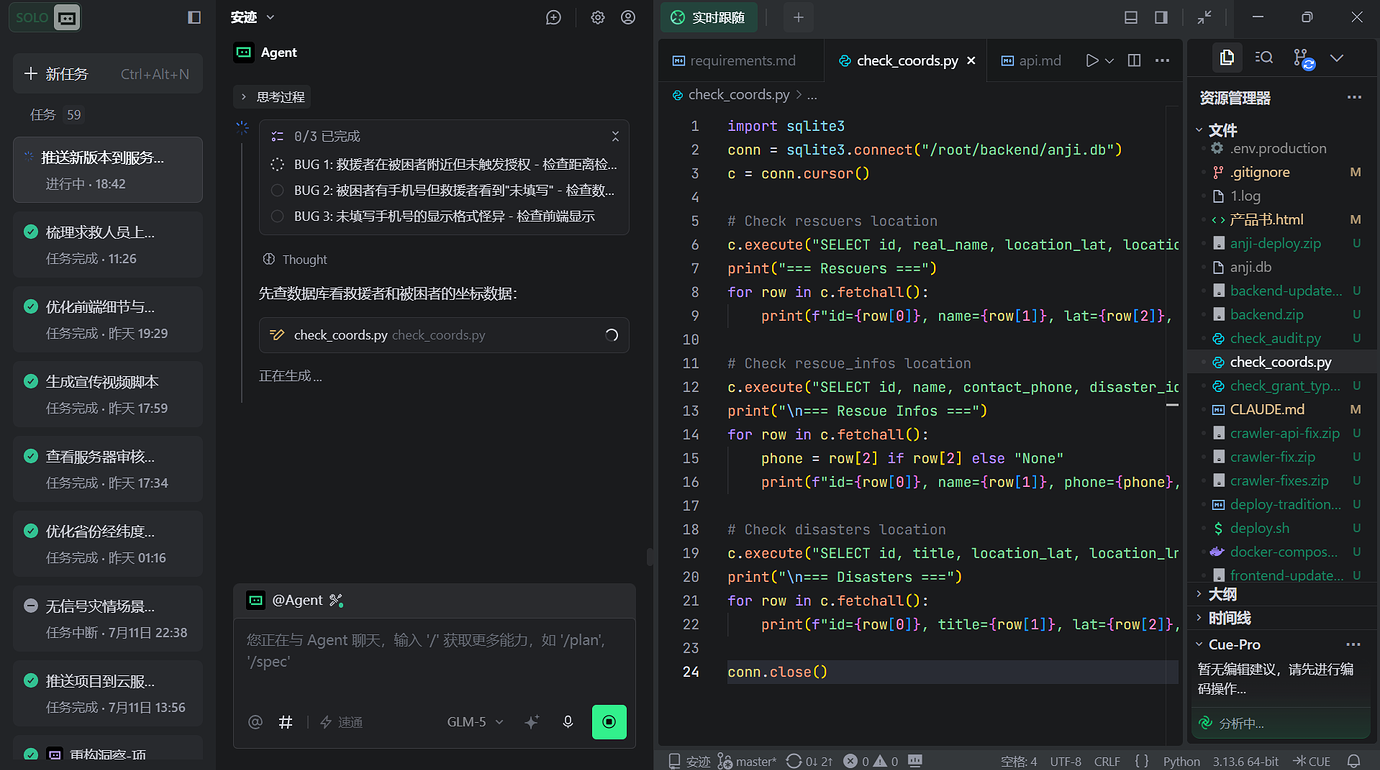
Beyond the dual modes and artifact management, the new TRAE adds three modules, all following the same logic: turning human repetition into ongoing agent work.
- Automated tasks: recurring progress summaries, scheduled checks, test-result aggregation, report generation — the "do it again every week" stuff gets handed to agents to run continuously; humans just read the results.
- Template library: high-frequency scenarios like product proposals, page building, data analysis, and technical docs start from templates instead of a blank chat every time.
- My Assistant: non-coding work — docs, reporting, collaboration — joins the same task chain. For the first time, writing code and writing the weekly report can be scheduled in one workflow.
Together, they point at one judgment: the competition in AI tools is shifting from "quality of a single task" to "the capacity to take over long-running tasks." Whoever lets users hand something off with confidence, without babysitting, holds the ticket to the next phase. The automated-tasks module is precisely aimed at the "confidence" problem — recurring, fixed, predictable is where trust starts.
Three-Device Relay, and a Farewell on October 23
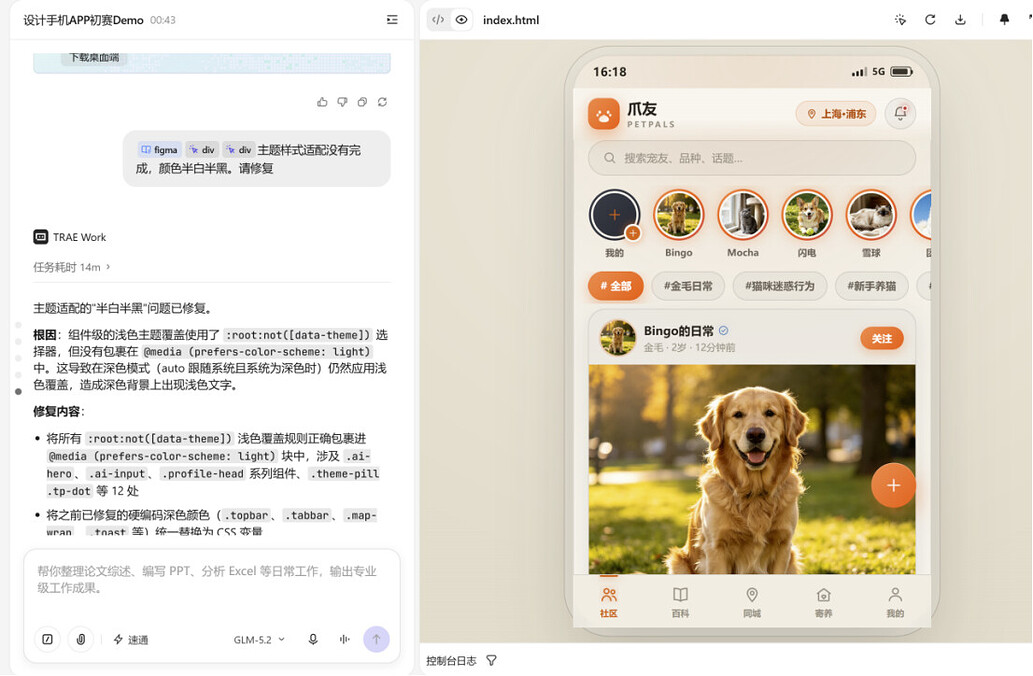
The new TRAE spans desktop, web, and mobile: start a task on the computer, check progress and add requirements from the phone, return to the desktop to keep building — projects, tasks, and artifacts advancing around one workflow, uninterrupted by device switches. The description is restrained, but it addresses a real pain point of the agent era: agent tasks are long-running, and nobody can sit at a desk all day. Tasks "parked" in the cloud with progress "glanceable" at any time are the precondition for long tasks being usable at all.
One heads-up for existing users: the standalone TraeWork shuts down on October 23. Users can migrate through the in-app upgrade, bringing chat history, account info, and local data along. The shutdown is no surprise — after the merger, the standalone app is pure redundancy — but the migration window is only two weeks, so don't leave it to the last day.
A word on the strategic meaning of the three-device relay: ByteDance didn't ship desktop-only; web and mobile came together. That says the new TRAE's task execution lives in the cloud, not on the local machine — only then does "glance at progress from your phone" work. It also suggests the next competition may move from "model capability" to "task-hosting infrastructure": whose tasks run reliably, whose resume-from-checkpoint works, whose cross-device state sync never drops — that's who looks most like a real OS. And that's exactly the weak spot of traditional IDE vendors, and the hand a company with cloud and mobile DNA like ByteDance wants to play.
The Call: AI Coding Tools Are Becoming "Workbench OSes"
Zoom out, and a trend is unmistakable: AI coding tools are morphing from "plugins inside the IDE" into "workbench operating systems."
Generation one was Copilot-style autocomplete: the AI lived in the editor and finished your next line. Generation two was agent-style pair programming: the AI edits files, runs tests, and fixes bugs on its own while the human reviews. Generation three is what TRAE is reaching for: the AI no longer just handles code — it handles "getting something done" — requirements, docs, code, tests, deliverables, decks, end to end. The editor is just one app on this OS; Agent mode is the desktop.
There's a telling piece of evidence for this read: ByteDance merged not two IDEs, but an "office agent" and a "coding IDE." If the future were only "better-written code," merging Work would be pointless. It only makes sense if you believe "the developer's job" itself is being restructured by agents — writing code and writing docs, building demos and building decks, all becoming tasks you hand to agents. That's a product decision carrying a worldview.
Of course, worldview isn't delivery. Whether the new TRAE's Agent mode can truly orchestrate multiple agents, whether artifact management becomes yet another dumping-ground drive, whether automated tasks are reliable enough to "hand off with confidence" — all of that awaits large-scale real-world use. Demos on launch day are always the prettiest version.
One more detail worth savoring: the timing of this merger lands exactly as AI coding tools collectively pivot to long-running tasks. Cursor and Windsurf have spent this year backfilling agents' sustained-execution abilities, while Anthropic pushes agents toward "working independently." TRAE's move is to fuse "office" and "coding" first — the subtext being that half of a long task's value lives in code, and half in the deliverables around it. IDE-only vendors will eventually have to answer "where do the test reports and the decks live"; TRAE chose to answer early.
But the direction itself deserves to be taken seriously. Just last month, JetBrains was refactoring its IDE toward an agentic system (our JetBrains AIR coverage), and OpenAI is experimenting with always-on agents (our OpenAI Dots coverage). The giants are all answering the same question: once AI can do things, what should a person's workbench look like? TRAE's homegrown answer: one entry point, two modes, full link.
What Vibe Coders Can Take Away: A One-Person Team's Playbook
For vibe coding practitioners, the most nutritious part of this upgrade isn't the features — it's a methodology you can steal: how to manage a "team of one."
The pelican-riding-a-bicycle case is, at heart, a minimal viable agent org chart: a three-agent relay of code / test / fix, plus a coordinator. The coordinator writes no code; it does three things: break down tasks, set acceptance criteria, settle disputes. The dungeon-editor case fills in the last two: acceptance criteria come first ("ship a playable simple version first"), and dispute rulings get recorded (the reasoning written into delivery notes).
This playbook ports to any agent tool, not just TRAE: next time you have the AI build a complete feature, try opening three sessions — one writes, one tests, one fixes — and you play the person who only reads the delivery notes. You'll discover the bottleneck of vibe coding was never how fast the AI writes code, but whether you can articulate clear roles and acceptance criteria. The tools are just productizing that discipline.
Another stealable habit is "artifact settling": after every collaboration with AI, whatever tool you use, leave a delivery note — what was done, why it was decided this way, what's next. TRAE does it for you with Project Artifacts; without that feature, you can maintain it by hand. The most common multi-agent pileups (our multi-agent pitfalls guide) trace back to lost context and fuzzy acceptance criteria, not to weak models.
One honest closing note: don't file this upgrade under "yet another AI IDE launch." The real signal is that the competitive dimension of AI coding has changed — from "whose code is better" to "who helps you take something from start to finish." For indie developers, that's good news: the more the tool resembles a workbench, the bigger one person's leverage. But bigger leverage demands more of the "manager." Learning to manage your agents like a team may be the most important lesson for vibe coders next.
Comments (0)
Sources
Related articles

Stack Overflow's engineering blog (Oct 7) argues the agent is the model plus its harness - and the model is maybe a tenth. Evidence: LangChain's agent jumped 52.8% to 66.5% on Terminal-Bench 2.0, from outside the top 30 to the top 5, changing only the harness. The essay prescribes six artifacts - constitution, autonomy boundary, tiered CONTEXT.md, durable memory, a multi-lens review panel, a PostToolUse hook - plus multi-agent coordination via shared state and an append-only decision log.
Cognition gave Devin Memory and Dreaming — and open-sourced Agent Memory Repo, a standard that treats agent memory as a git repo of interlinked Markdown notes. Clone, search, update, push: every session follows the same loop. The community split 45/40/15 on daily.dev, and the release lands as the affirmative answer to the 'memory plugins vs. documentation' debate.
In the AI coding era, secrets leak because AI actively writes keys into code, comments, and commits — and pushes them. This guide gives vibe coders a five-state credential framework: generate, store, use, rotate, and incident response. Copy-paste ready: layered .env files, pre-commit hooks, production secrets-hosting picks, three AGENTS.md red lines, least-privilege third-party keys, a 30-minute leak SOP, and a monthly 5-minute inspection checklist.