On-Device, Free, and Ad-Free: A 20-Year-Old's Underdog Aims to Be the Most Private AI Assistant
Sigil Wen, 20, self-taught, once ran GPT-2 on an Apple Watch. On October 6 he launched Underdog, a personal AI assistant with a 27B model running fully on-device — free, ad-free, monetized via Stripe payment fees. A breakdown of the tech, the business model, and pricing lessons for indie AI builders.
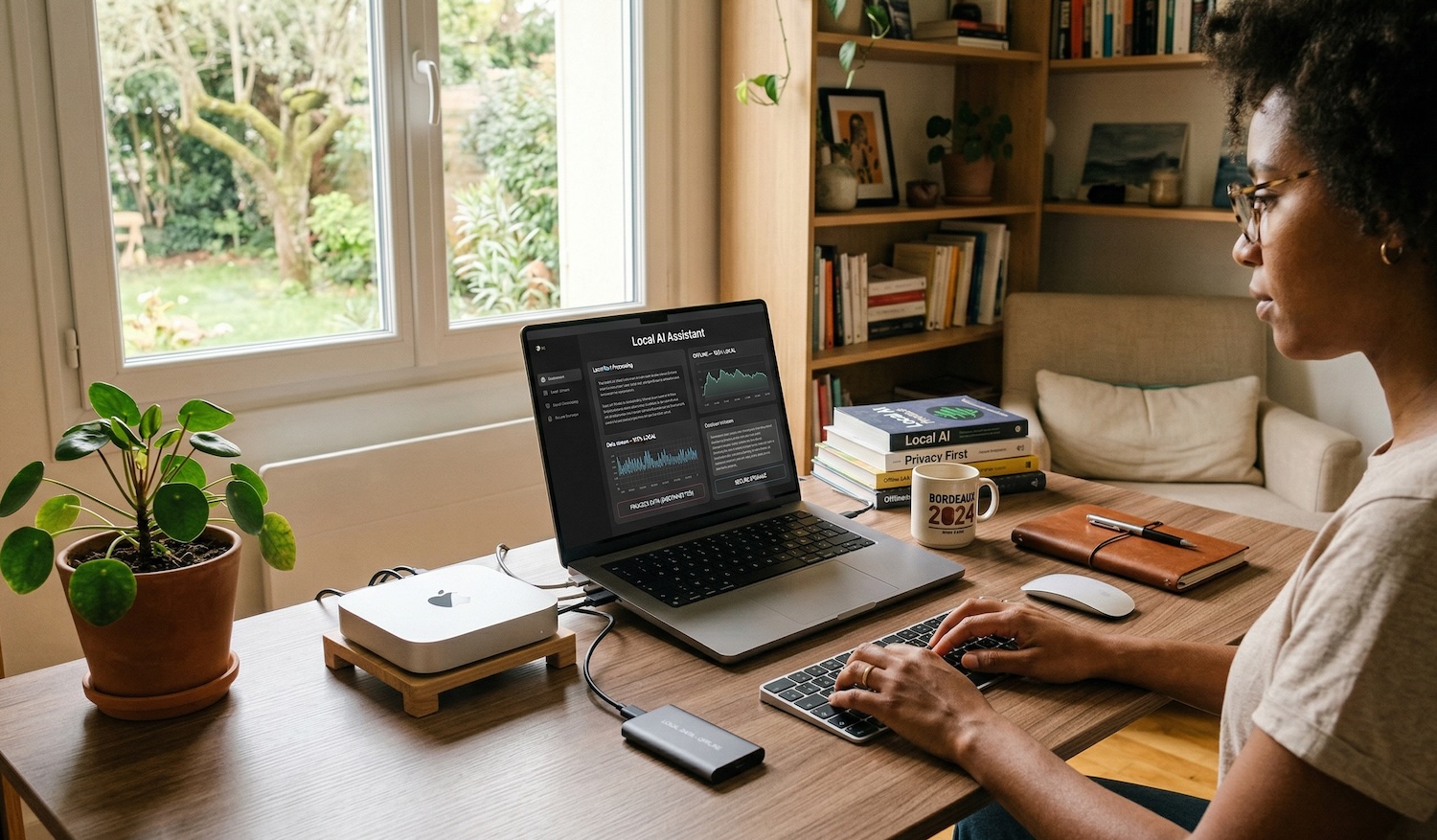
On Monday, October 6, TechCrunch ran a story with an unusual protagonist: Sigil Wen, a 20-year-old self-taught programmer. He launched Underdog, an invite-only personal AI assistant billed as "Silicon Valley's most private AI assistant." The model runs entirely on the user's own device — your data never leaves. The app is free to start, with a promise of never adding ads.
The investor list is stacked: a16z (Chris Dixon personally), Khosla Ventures, Hummingbird, SV Angel, and the Anthology Fund (the joint fund from Menlo Ventures and Anthropic). Angels include Stripe co-founder Patrick Collison, Vercel founder Guillermo Rauch, and OpenAI researcher Noam Brown. The company is called Conway Research.
This piece covers four things: why Wen's story is worth a look; what Underdog's product and tech actually amount to; its business model — "no subscriptions, monetized through payment fees" — which may be the most interesting part of the whole story; and what indie developers building AI products can take away from it.
The person first: moved to Silicon Valley at 17, crashed Karpathy's hacker house
Sigil Wen's résumé reads unconventionally, but every line hits a nerve in the AI world. A self-taught programmer, he moved to Silicon Valley at 17 and lived in Andrej Karpathy's AI hacker house — one of those legendary places where people write code by day and talk models by night. He later worked at Naval Ravikant's Airchat and picked up a Thiel Fellowship (Peter Thiel's "drop out and build something" grant).
He also pulled off a stunt that made the rounds: running GPT-2 on an Apple Watch. It sounds like performance art, but anyone technical knows what it takes — squeezing a model into brutally constrained hardware and actually getting it to run tests your chops in inference engines, quantization, and memory management. It was essentially a dress rehearsal for Underdog.
Why lead with the person? Because in the personal AI assistant race, Meta's Muse and OpenAI's Dots — the "instinct" assistants — already dominate the conversation. Why should anyone take a 20-year-old indie founder seriously? Because of a track record like this: he doesn't talk about privacy in slide decks; he's someone who actually got a model running on an Apple Watch. That "prove it by building" ethos is exactly what the vibe coding community respects most — degrees don't matter, Big Tech titles don't matter, what matters is whether you can ship something that runs.
The product: a 27B-parameter model running entirely on your machine
Underdog is positioned as a personal AI assistant, going head-to-head with always-on assistants like Meta's Muse and OpenAI's Dots. Its core selling point is singular but solid: the model runs entirely on the user's own device. Launch platforms are Mac and Windows PC, with Linux, iPhone, and Android on the way.
There are two technical layers. The first is Husky, a homegrown inference engine. According to Wen, Husky moves less data between CPU and GPU than competing on-device engines — and data movement is one of the biggest performance killers in on-device inference. Memory bandwidth decides token generation speed; keeping data movement down is what makes a 27B-class model practical on consumer hardware. The second layer is the model itself: currently a 27B-parameter reasoning model fine-tuned from Qwen3.8-27B.
Wen's performance claim: on select benchmarks, this 27B local model matches Claude Opus 4.6 — roughly the top-tier level of about half a year ago. He says that's "enough for everyday tasks like shopping research and math homework." One more detail: account credentials users grant the assistant, like email access, are stored with encryption, locally.
A reality check is in order. Benchmark numbers always deserve a discount, especially cherry-picked "select benchmarks" from a startup. Opus 4.6 was top-tier half a year ago, and half a year in AI is half an era — a local 27B matching it today isn't shocking. But that doesn't invalidate Underdog's value. The real question was never "can a local 27B beat a cloud flagship" — it's "is the local 27B experience good enough to make users switch." Token speed, memory footprint, heat, battery life — those are the metrics that decide the fate of an on-device assistant, and Husky's real-world performance won't be known until beta users get their hands on it.
One more point worth scrutinizing: "your data never leaves your device" sounds great, but where's the boundary? The endgame of a personal AI assistant is doing things for you: reading email, booking flights, placing orders. The moment it places an order or sends an email on your behalf, data has to leave the device — Wen concedes this himself, which is exactly why credentials get encrypted local storage. In other words, "never leaves" means model inference and your private data processing happen locally, not that the app never touches the network. That's an honest design. But between the marketing slogan and a real moat lies the question of whether users actually care about the distinction. My take: those who care will care intensely; those who don't won't be swayed by any slogan. Privacy is a strong filter, not a mass-market selling point.
The most interesting part: free, ad-free, monetized through payment fees
Underdog's business model may be the most thought-provoking part of the whole story. The app starts free, with a promise to never add ads. Wen's logic is blunt: because inference runs on the user's own machine, the marginal cost of serving each user is near zero, so "there's no need to charge a subscription." That sentence carries weight — it's a public admission that AI assistant subscriptions largely pay for cloud inference costs, not for intelligence itself.
So where does the money come from? Fintech, basically. Stripe co-founder Patrick Collison being an angel investor is no coincidence. Here's the model: when Underdog completes a payment for you — say it researched options and placed the order — the transaction goes through Stripe's secure rails, and Underdog takes a cut, like a credit card swipe fee. Chatting, asking questions, doing research: all free. It only makes money when you spend money through it.
Wen has a great line for this: "An AI assistant should never need to mine your data — it should be aligned with you the way your bank is." That welds the business model to the privacy narrative: banks don't make money selling your transaction history; they make it on fees when you transact. Underdog doesn't make money selling your data either; it takes a cut when you transact. Aligned incentives make the privacy promise believable — far more convincing than just saying "we take privacy seriously."
Line up the three models and the picture gets clear. One: subscriptions (the OpenAI/Anthropic route). Users pay monthly — simple and direct, but once local inference crushes costs, subscriptions start looking expensive. Users will ask: it's running on my machine, why am I paying every month? Two: ads or data monetization. Free, but the price is privacy — especially dangerous for an AI assistant that "knows everything about you." Three: payment fees. Free day-to-day, monetized only when a transaction happens. Its ceiling hinges on a very practical question: how many real spending scenarios can an AI assistant actually close the loop on? If users just chat and do homework, placing a handful of orders a year, fees won't sustain a team. If it genuinely becomes the "ask the assistant before buying" entry point, the upside is enormous.
Risks deserve equal airtime. Payments are a heavily regulated, trust-intensive arena, and Underdog is placing a key bet on Stripe's rails: Stripe is both the endorsement and a single point of dependence. And the fee model requires the assistant to sit deep inside the transaction flow, which in turn demands enormous user trust — and trust is precisely what the "data never leaves your device" pitch is meant to build. See the loop? The more private it is, the more users dare let it touch their money; the more it touches their money, the better the fee model works. Wen has clearly thought this through.
Take: is the privacy play a real moat or marketing?
In the personal assistant race, Meta's Muse and OpenAI's Dots have already established the "always-on, proactive, with memory" paradigm. Underdog chose a different lane: not the biggest model, but "your data never leaves your device." Both the opportunity and the ceiling of this lane deserve a closer look.
The opportunity is real. First, regulatory and enterprise demand for data residency keeps tightening, and a local-by-default assistant has a natural compliance edge. Second, there's a genuine cohort of users — journalists, lawyers, researchers, anyone with trade secrets — who have real concerns about cloud assistants and would pay or switch for "never leaves the device." Third, on-device models have improved dramatically in two years; 27B runs on a laptop today, 70B might tomorrow. The experience ceiling is rising fast.
But the ceiling is real too. First, the capability gap: cloud flagships climb a rung every six months, and local models are forever chasing — "matching Opus from half a year ago" is itself an admission of the gap. Second, the ecosystem: an assistant's value comes largely from connections — calendar, email, shopping, payments. The more connected it is, the more data inevitably flows, and "purely local" gets compromised in real use. Third, and most important: most ordinary users' privacy concern is lip service. Everyone says they care in surveys; at checkout they pick the one that works better. Privacy-lane winners usually win on "privacy plus something else" — privacy alone rarely punches through to the mass market.
So here's my verdict: Underdog's privacy narrative is half real moat (the architecture genuinely differs — Husky plus local inference is serious engineering) and half marketing (take "most private" with a grain of salt). Its real cleverness isn't privacy per se, but threading privacy, cost structure, and business model through one logic: local inference → near-zero cost → can be free → free needs new revenue → payment fees → fees need trust → privacy builds trust. Each link is unremarkable on its own; together they form an elegant flywheel.
Four takeaways for vibe developers
Finally, the most directly useful part for indie developers and vibe coding folks. Underdog is essentially a case study of a 20-year-old repricing a product around a new cost structure, with a few ideas worth stealing.
One: the inference cost structure changed, so pricing assumptions must change too. Building an AI product used to default to "API calls cost money, therefore charge a subscription." But on-device inference, small models, and distillation are driving the marginal cost of "intelligence" toward zero. Clinging to subscription pricing after the cost structure shifts is navigating with an outdated map. Before pricing your next AI product, ask: does my inference really have to run in the cloud? If the answer is no, "free plus monetize elsewhere" becomes a real option.
Two: find a monetization point aligned with your users' interests. The genius of the payment-fee design isn't the fee — it's "I only charge you at the exact moment I create value for you." Users enjoy the free tier all they want, and one day spend money through you; every cent you earn maps to a real benefit for them, and nobody feels harvested. Vibe developers building AI tools can ask the same question: is there a "transaction moment" in your product? At what instant are users happiest to pay? Nail your pricing to that moment instead of charging admission at the door.
Three: privacy can be a differentiator, but it has to be real — and be honest about the experience trade-off. Underdog can claim "most private" because 27B local inference is real, the Husky engine is real, encrypted credential storage is real. But it's also honest about the cost: the benchmark target is a flagship from half a year ago. If you're building on the privacy lane, get to "actually local" first, then figure out how much intelligence users give up for it, and lay that trade-off out in the open. Users don't fear trade-offs; they fear being misled.
Four: back to Wen himself. Moved to Silicon Valley at 17, crashed Karpathy's hacker house, squeezed GPT-2 onto an Apple Watch — not a single step of that path follows the standard "get credentialed, join Big Tech, then go found something" script. The biggest shift of the vibe coding era is that building things is itself the best résumé. The big names on that investor list aren't betting on his degree; they're betting on the fact that he has actually shipped things that run. Next time someone asks "can you build AI products without a pedigree," hand them Sigil Wen's story.
Source: TechCrunch, October 6, 2026, "Silicon Valley's AI wunderkind launches Underdog, the most private Meta Muse competitor yet," https://techcrunch.com/2026/10/06/silicon-valleys-ai-wunderkind-launches-underdog-the-most-private-instinct-muse-competitor-yet/
Sources
Related articles

ARTEX — an open-source AI pentesting agent by a Chinese developer — was used to breach 9 Korean banks and steal nearly 68,000 customer records. Its author has now shut it down and gone closed-source. We reconstruct the timeline, break down the AI attack chain, and ask the hard question: how responsible is a tool's author for what the tool does?
On September 30, 2026, Bitdefender launched AI Guardian in public beta: a security layer for autonomous AI agents that verdicts every tool call, file access, and credential use as allowed, flagged, or blocked. First on macOS, free during beta, supporting Claude Code and OpenClaw. Why this 'agent behavior firewall' arrives right on time for vibe coders.
On October 8, 2026, Google Cloud launched the Gemini agent at Gemini at Work 2026: a universal agent for work that takes objectives, plans by itself, auto-selects between Gemini and Claude models per task, and introduces 'coworker agents' with their own email, calendar, and directory seat. Four judgments on why the second half of the agent race is about 'agents that feel like colleagues.'