Wrong Stack? Don't Tough It Out: A Minimum-Cost Playbook for Migrating a Live Vibe-Coded Project
AI picks your stack for speed, not for year three. This guide gives solo developers a third path between toughing it out and rewriting from scratch: a six-step migration playbook where the old system stays live and every step rolls back.

Picking the Wrong Stack Is a Vibe-Coding Rite of Passage
The first three months of building with AI feel magical. You tell the chat window "build me a SaaS with user accounts," and it scaffolds Next.js + Supabase + Stripe, deploys to Vercel, and you're live in a day. Then users arrive, data grows, and so does the bill — Supabase's row-level security ties you in knots, an edge-case query times out; or the BaaS you picked for convenience turns out to make data export nearly impossible; or the frontend setup the AI chose starts fighting you on the third page you customize.
This isn't you being careless. It's a structural cost of vibe coding: when AI picks your stack, it optimizes for "running as fast as possible," not "right for who you'll be in three years." It doesn't know your users will grow from 100 to 10,000, doesn't know your sensitivity to bills, doesn't know you don't actually write SQL. The "good enough to ship" choice eventually becomes the sigh in every late-night bug fix.
The good news: picking the wrong stack isn't terminal — but "toughing it out" and "rewriting from scratch" are both slow suicides. This guide gives you a third path: a minimum-cost stack-migration playbook designed for a team of one. The old system stays live the whole time, every step is rollback-able, and the new stack has to prove itself in the shadows before it touches real traffic.
This guide is not about "how you should have chosen" (that's a selection guide's job) — it's about "you already chose wrong, now what." It also doesn't cover small database schema surgeries (a separate guide owns that). This is about wholesale replacement: swapping the BaaS, the framework, auth, or payments — changing the engine mid-flight.
Step Zero Isn't Action, It's Diagnosis: Is This Pain Worth Switching For?
The biggest migration pitfall isn't technical — it's the decision. A solo developer's scarcest resource is time, and a migration costs weeks. Migrate wrongly and you've just burned a month that could have gone to acquiring users. So before touching anything, run an honest diagnosis.
Five "true signals": any two mean you should seriously consider switching
- The bill signal: infra cost is growing faster than revenue. Not "expensive" — "unreasonably expensive." For example, 70% of your BaaS bill pays for features you never use, or a per-row-priced database loses money on every new user. Do the math: total cost of staying on the old stack for 12 months (including your time) vs. one-time migration cost + 12 months on the new stack. Only switch when the latter is clearly lower.
- The ceiling signal: a core requirement is "impossible," not "hard," on the old stack. "Hard" you can live with; "impossible" you can't. For instance, you need self-hosted data compliance but the BaaS offers no export; you need long-lived WebSocket connections but the serverless platform kills them with timeouts. Watch your wording: much "impossible" is really "you haven't learned it yet" — spend two days confirming it's a genuine platform limit, not an unread doc page.
- The dread signal: you're afraid to touch a certain part of the codebase. This is the most underrated signal. When some abstraction the AI generated (an ORM magic you don't understand, a black-box auth flow) makes you pray before every change, the stack has exceeded your radius of control. A solo developer's stack must be one you'd dare to edit alone at 3 AM.
- The lock-in signal: the cost of leaving grows every month. Data, users, files, webhooks — all tied to a single vendor with no decent export tooling. If you don't switch today, triple the data in six months means triple the switching cost. Lock-in's cruelty isn't "it hurts now," it's "it'll hurt more later."
- The maintenance signal: a core dependency is effectively abandoned. Not "slow releases" — issues unanswered for half a year, PRs piling up, 404s in the official docs. Vibe projects often get saddled by the AI with libraries that were "hot at the time." The hype died; the坑 (pitfalls) remain.
Three "false signals": don't switch even if you feel them
- "Everyone's using X." The most expensive illusion in tech. Their X solves their problem. Translate "I want to switch" into "which specific requirement does my current stack fail" — if you can't translate it, don't switch.
- "The new framework is cool." Cool doesn't pay rent. In the migration ROI formula, the numerator is "solves a real problem" and the denominator is "your weeks." Shiny new tech has a huge denominator and usually a zero numerator.
- "The code is ugly, I want a rewrite." Ugly and wrong are different things. Most AI-generated code is ugly, but if it runs stable and you can change it, ugliness is an aesthetic issue. Rewrites feel great and end in funerals — the rewritten code will be just as ugly in three months.
Diagnosis deliverable: one page stating three things — (1) the specific quantified pain triggering the switch (how much slower, how much pricier, which incident); (2) the cost of not switching (next 6 months); (3) the target stack and "what gets better after switching." If you can't write it down, you haven't thought it through — don't move yet.
Three Strategies, No Silver Bullet: Pick the Strategy Before the Steps
Diagnosis passed — now choose how to switch. The industry has three classic strategies; they differ not in technical sophistication but in the risk-vs-duration trade-off. A team of one has no luxury of a "two-hour maintenance window," so the first is the default.

Strategy 1: Strangler pattern — the default
Named after the strangler fig: the new system wraps around the old like a vine, replacing it module by module until the old system is "strangled" into retirement. In practice: put a routing/gateway layer between old and new, and shift traffic module by module to the new implementation.
Why it fits a team of one: every step is small, the system is alive after each deploy, and any failed step rolls back by pointing the route back. Your users never know you're swapping the engine. The price is duration — a medium project can take 4–8 weeks, and for a while you maintain two codebases, doubling the mental load.
Use when: you have real users, can't afford downtime, and the old system is a monolith. That's most vibe projects' reality.
Strategy 2: Big-bang rewrite — limited use only
Start a fresh repo/branch, build the whole new system in one go, flip DNS/traffic one late night, retire the old system.
Why it's usually a bad idea: all risk concentrates in one moment. At cutover, every unknown bug goes live at once, and you're alone with no on-call team to catch you. Ninety percent of "the rewrite felt great until launch day" stories are this pattern. Its only legitimate scenario: the project is small (rewritable in two weeks), has no paying users, and the old code is unreadable anyway. Rewriting an early vibe-coded demo is cheap — the code was AI-generated in one evening, so have the AI generate it again in one evening. But once real users and data exist, this path's expected value turns negative.
Strategy 3: Parallel run — the data layer's dedicated answer
Old and new systems run side by side; writes go to both, reads stay on the old system; after a reconciliation period confirms consistency, read traffic flips to the new system.
Why it's the standard for data migration: lost data is irreversible; code bugs are rollback-able. The reconciliation logs from the dual-write period are the source of your confidence. The price is doubled write cost plus the reconciliation logic — but the AI can write the reconciliation scripts for you; that's a vibe team's advantage.
The selection logic in one line: have users → strangler; no users → big bang is allowed; touching data → parallel run, always. They can be mixed: use the strangler overall, with parallel run for the data-layer step.
The Six-Step Playbook: Old System Stays Alive, Every Step Rolls Back
Strategy set — now execute. Below is the strangler pattern adapted for a team of one. Six steps, old stack retired at the end. One core principle: at any moment, you have a working system and a way home.

Step 1: Diagnose (1–3 days) — produce a one-page migration ROI
Build on the earlier diagnosis, but go finer: list every touchpoint of the old stack to be replaced. Vibe projects most often miss invisible dependencies: cron jobs, webhook callback URLs, OAuth redirect URIs, links inside email templates, hardcoded API addresses in mobile clients. Have the AI grep the whole repo for "old service domains / old SDK references" and generate a migration touchpoint checklist. Miss one and it's an incident on launch day.
Also define your rollback triggers up front, in writing: under what conditions you roll back (e.g., error rate above X%, core-funnel conversion down Y%, a P0 unfixed for Z minutes). Write it on paper, not "we'll see" — because when the moment comes you'll be flooded with adrenaline and your judgment will be zero.
Step 2: Anti-corruption layer (2–5 days) — wrap the old implementation in a new interface
This is the most critical and most counterintuitive step: before writing any new-stack code, dress the old stack in a clean coat. Between your code and the old service, abstract a clean interface (repository pattern, adapter pattern — call it what you like) so business code depends only on the interface, never calling the old SDK directly.
Why this step pays: first, it forces you to list the "10 operations the business actually needs" — you'll often discover you used 8 of the old SDK's 100 APIs, and the migration shrinks from "a mountain" to "a molehill." Second, during migration you only write one new implementation of the interface; business code stays untouched. Third, if the new stack turns out wrong too (don't laugh, it happens), the second switch costs a fraction of the first with this layer in place.
Vibe-team trick: have the AI generate the interface definition in reverse from the old SDK call sites; you only review whether the interface matches business semantics. That's mechanical work AI excels at — don't hand-write it.
Step 3: Shadow dual-run (3–7 days) — the new stack proves itself in the dark
Once the first new-stack implementation is done, don't give it traffic. Run it in shadow mode: duplicate real requests (or replay production logs) to both implementations, diff the responses, log differences, affect no real users.
The shadow period's goal isn't "zero diffs" — that's unrealistic. The goal is to classify every diff: which are expected (e.g., cleaner response format from the new stack), which are bugs, which are the old stack's undocumented quirks (AI-generated code is full of these, like depending on an undocumented side effect). Every diff class needs a disposition (accept / fix / record) — no "ship it and see" diffs.
How long? Depends on scale: a small solo project — 3 days of shadowing covering core flows is enough; with paying users, shadow for at least one full business cycle (e.g., covering a billing day).
Step 4: Gradual cutover (module by module) — split the big bang into firecrackers
Cut over using the touchpoint checklist, one module at a time. Order matters: edge modules before core modules; reads before writes. Cut the "user profile page" (read-heavy, low blast radius) before "checkout and payments" (the lifeline).
Use the simplest possible gradual rollout per module: 1% traffic for an hour, then 10%, 50%, 100%, observing at least one business peak per stage. Skip the fancy feature-flag platform — an env var plus reverse-proxy weights is enough. A solo team's rollout can be rough around the edges; what matters is that every stage has an explicit "proceed / roll back" decision, not "felt fine, ship it all."
Step 5: Verify (runs alongside step 4) — metrics, plans, drills
During cutover watch three metric groups: correctness (error rate, shadow reconciliation diff rate), performance (P95 latency, old-vs-new comparison), business (core conversion rate, payment success rate). Business metrics matter most — green tech metrics with a dropped conversion rate means the new stack is "correct but worse," and you still roll back.
Also: drill the rollback, don't just write it down. Before cutting the first module, walk the full rollback once: point traffic back at the old stack and confirm it still serves. Thirty minutes of work buys you sleep on cutover night. Many teams' rollback plans die on "I assumed the old environment still existed" — only to find the old database already deleted. The drill exists to catch exactly that.
Step 6: Clean up (within 1–2 weeks, don't delay) — retire the old stack, pay the debt
After all traffic is cut over and stable for two weeks, clean up: delete the old SDK, remove the old implementation behind the anti-corruption layer, shut down old service accounts/subscriptions (don't forget to cancel the old service's paid billing — that's real money).
Cleanup's classic failure is delay. Since the system already runs on the new stack, the old code "isn't hurting anyone" — until three months later, when a future AI assistant (or future you) stares at two implementations in confusion. Put cleanup on the calendar with a deadline; treat it as part of step 4, not "when I get around to it."
Four High-Frequency Scenarios: Real Vibe-Developer Battlefields
Theory done — here are the concrete scenarios solo vibe developers hit most, each with "why it's common + how to play it."
Scenario 1: Swapping the BaaS / database (e.g., Supabase → self-hosted Postgres)
Why it's common: AI-generated projects default to a BaaS because it's "zero config." But when you need complex queries, your data must enter your own warehouse, or per-row pricing starts to hurt, it's time to leave. Note the distinction from "database schema changes" — that's minor surgery (covered by another guide on this site); this is moving the entire data foundation.
How to play it: parallel run with dual-write and reconciliation is mandatory. Stand up the new database, dual-write to old and new for 1–2 weeks (via DB triggers or application-layer dual-write; application layer is more controllable), run daily reconciliation comparing row counts and checksums; flip read traffic first once consistent, then writes, then stop dual-writing. The thing vibe teams most often miss: don't forget cron jobs and edge functions with hardcoded connections to the old database — those connection strings hiding in corners are the #1 source of launch-day incidents.
Scenario 2: Swapping the frontend / full-stack framework
Why it's common: the AI may have picked a "trendy at the time" option whose ecosystem is now withering, or you discover SSR/SEO needs are painful under the current framework.
How to play it: the textbook strangler scenario. Split traffic by route at the reverse proxy: /app/* goes to the new framework, old pages keep serving from the old one — users notice nothing. Migrate static-heavy pages first (marketing, docs — low risk, good practice), core interactive pages last. Keep visual and interaction consistency — users should never feel "this page and that page are two different stacks." Align design tokens (colors, spacing, fonts) before you start.
Scenario 3: Swapping auth (hand-rolled / one auth service → another)
Why it's common: early vibe projects either hand-roll "works for now" auth with AI (security hazard) or pick an auth service whose free tier turns eye-watering.
How to play it: auth is the untouchable core, so go dual-track: new users go through new auth, existing users' sessions/tokens stay valid on the old system, with "silent migration" — when an old user next logs in, auto-provision them on the new system and link the accounts. Never do "everyone must re-login / reset passwords" — that's a public execution of your users, and churn will teach you the lesson. If password hashes use incompatible algorithms, the standard flow is "verify old password → write new hash" at migration time.
Scenario 4: Swapping AI model providers
This scenario already has a 14,000-word deep guide on this site (the model-retirement survival handbook) covering the three-layer abstraction, eval baselines, and four-step gradual rollout. One vibe-specific addendum: if you wrote your code from day one treating the model as a replaceable part (prompts decoupled from calls, outputs schema-validated), switching models is a config change; if you hardcoded a particular model's "personality" (its idiosyncratic output format, its hallucination patterns) into business logic, every model switch is a mini-rewrite. The anti-corruption-layer mindset applies to the AI layer too.
Six Anti-Patterns: Where Stack Migrations Go to Die
- Anti-pattern 1: "While we're at it" scope creep. "Since we're switching databases, might as well rewrite the frontend too." — Stop. Freeze all other refactors during migration; switch one thing at a time. Scope creep is migration's #1 killer: it turns a "controlled minor surgery" into an "uncontrolled major one," and your step-1 ROI math instantly becomes void.
- Anti-pattern 2: No deadline for the parallel period. "We'll retire the old one when it's stable" becomes six months of parallel running — two bills, two sets of bugs, one broken spirit. Set the parallel period's end date in step 1 and put it on the calendar.
- Anti-pattern 3: Skipping shadow mode, "just rolling out gradually." Gradual rollout limits blast radius but can't discover bugs in advance. Shadow mode is free (affects no users); gradual rollout is paid (affects real users). Discover bugs the free way whenever you can.
- Anti-pattern 4: The rollback plan lives only in your head. Covered above — drill it. One addition: a solo team's rollback plan must be "executable by one person." If rollback needs three people coordinating, for you it effectively doesn't exist.
- Anti-pattern 5: Taking new feature requests mid-migration. Don't add passengers while swapping the engine. Tell users/customers plainly: "bug fixes only for two weeks, no new features." That's professionalism, not slacking. Queue all new requests until after the migration, or you'll implement the same feature twice in two codebases.
- Anti-pattern 6: Switching for "technical correctness." "The new stack's architecture is more elegant" is not a migration reason; "the old stack costs me $300 more a month / 5 more hours a week" is. Elegance is an engineer's vanity; bills and time are a solo developer's reality.
One-Page Checklist: Tape It to Your Monitor
- ☐ Diagnosis: pain quantified? Cost of not switching calculated? Three false signals ruled out?
- ☐ Touchpoint checklist: AI-grep the whole repo for every old-stack reference — miss none
- ☐ Rollback triggers: written down, with concrete numbers for error rate / conversion / P0 duration
- ☐ Strategy: have users = strangler; no users = big bang allowed; touching data = parallel run, always
- ☐ Anti-corruption layer: business code no longer calls the old SDK directly; interface first
- ☐ Shadow dual-run: every diff classified; no "ship it and see" diffs
- ☐ Cutover order: edge → core, reads → writes, with a decision at every stage
- ☐ Rollback drill: full dry-run before cutting the first module
- ☐ Parallel-period deadline: on the calendar; old stack must retire on time
- ☐ Cleanup: delete code, delete dependencies, cancel old billing — all three, miss none
One last honest word: the best stack migration is the one you never need. Next time you have the AI scaffold a project, spend 10 extra minutes on two things: keep the data layer "exportable" (regularly verify backups restore locally), and funnel external service calls through one thin wrapper layer. Those 10 minutes are insurance for future you — when switch day comes, you'll thank the past self who didn't cut corners.
And if you've already picked wrong: don't tough it out, and don't burn it down. Walk these six steps. The old system stays alive — and so do you. That's enough.
Comments (0)
Related articles

AI tools default to cloud-first: no signal, white screen. This playbook shows indie developers how to convert a vibe-coded project to local-first — a 4-question decision flow, sync-engine matrix, six rollout steps, five anti-patterns, and an offline test checklist.

OpenAI's October 19 research post turns COBOL, Fortran and Visual Basic into measurable capabilities for the first time: the open-source MultiLangBench (reimplement SQLite 3.40.1 from docs alone, across 20 languages) plus a COBOL migration test demanding byte-for-byte parity. GPT-6.1 Sol's migration accuracy jumps from 5.4% to 97.9%. Every number is vendor-reported — this piece discounts each claim and offers three practical takeaways for legacy-system maintainers.
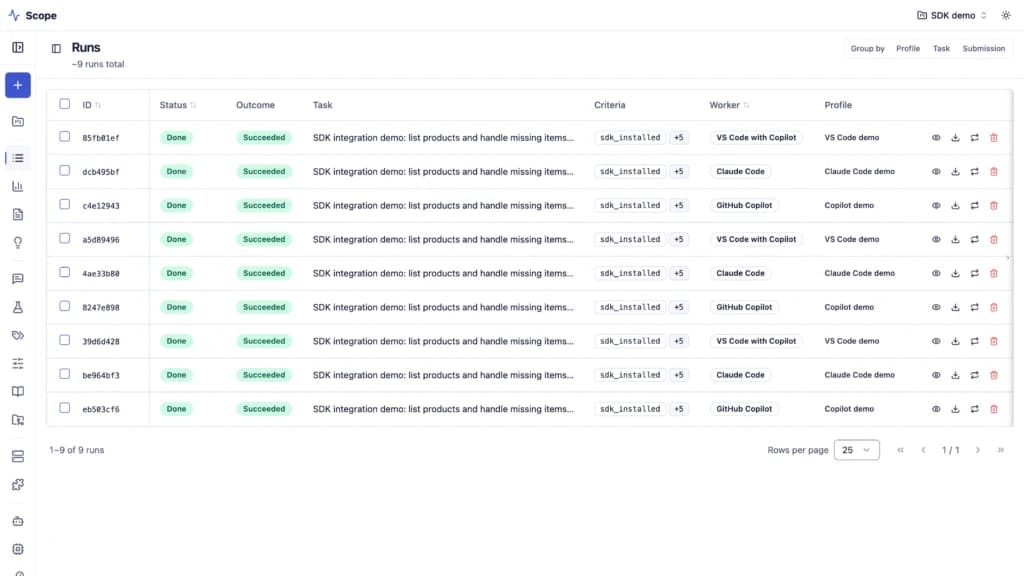
Microsoft's DevRel team open-sourced Scope (MIT), its year-plus-old agent evaluation platform. It doesn't benchmark models — it exams your product: the same task across Copilot, Claude Code and more, scored against DAG criteria by an LLM Judge, with full logs and workspace snapshots. Cosmos DB fixed 20 Agent Kit issues and 27 doc issues with it. Our take: as agents become software's users, DevEx must grow into DevAx — diagnosis before prescription.