One Model for Cars, Robots, and Drones: XPENG's WorldGPT Takes 12 Benchmark Firsts — Mostly by a Whisker
On November 24, 2026, XPENG unveiled WorldGPT, one world model commanding cars, boats, drones, and three kinds of robot, with 12 first places on public benchmarks. But the technical report is still unpublished and most leads are under a point — a roadmap to physical AI, not a product you can use yet.
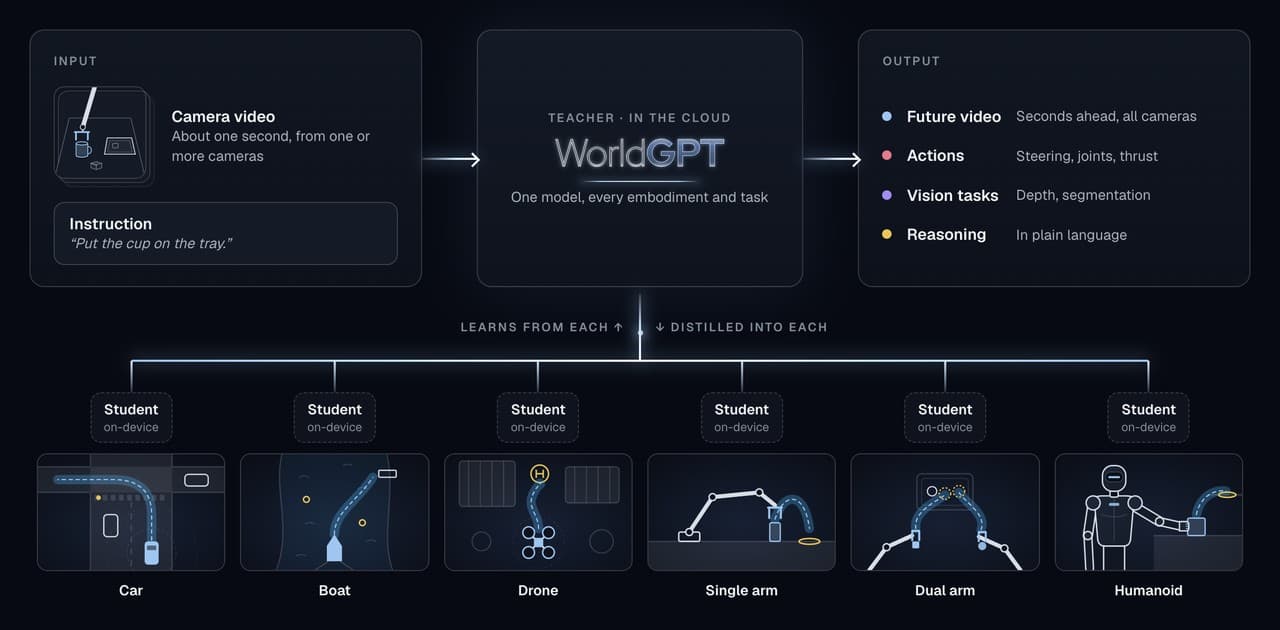
On November 24, 2026, XPENG unveiled WorldGPT in Guangzhou: one world model meant to run six kinds of machines — cars, boats, drones, single-arm robots, dual-arm robots, and humanoid robots. It joins the company's Turing World Model family, and XPENG describes it as the first world model to demonstrate prediction and action planning across all six embodiments. A project website went live the same day with 32 demo videos. One thing to say up front: this is not a model you can download or call. The release consists of a press release and a project site; the technical report is marked "coming soon" and has not been published.
The idea fits in one sentence: one model that first understands the physical world, then decides what different machines should do. Give it about a second of camera footage and a simple instruction — "turn left in 40 meters" or "put the cup on the tray" — and it generates several seconds of video showing how the scene will evolve, plans the actions needed to complete the task, and explains its reasoning in plain language. The same weights plan a steering trajectory for a car, a grasping motion for a robot arm, and a flight path for a drone. Perception, reasoning, imagination, and action are usually four separate pipelines, one set per machine; WorldGPT tries to cover all of it with one model across six embodiments.
Why one model instead of six? XPENG's answer is pixels. A steering angle means nothing to a robot arm, and a joint angle means nothing to a drone — the action languages of different machines are mutually unintelligible. But every machine sees the world through a camera, and pixels are the language they share. WorldGPT learns from all six embodiments together in that shared pixel space, so data from one machine also teaches the others. What it learns is not an operating manual for a particular machine, but the shared rules of the physical world: how to judge distance, how objects will move, what a scene becomes after an action. The project site puts it plainly: what is learned on the road, in the air, and on the water carries over to the rest.
Training runs in two steps. A large "teacher model" in the cloud absorbs knowledge from all six machines; that knowledge is then distilled into smaller "student models" that run on each machine's own hardware. Adding a new kind of machine does not mean building a new stack from scratch — its data goes into the teacher, and a new student is distilled out. XPENG says this cuts development costs, improves data efficiency, and makes it easier to extend physical AI to new machines. That is the most practical sentence in the whole announcement for developers: if it holds, giving AI to a new piece of hardware becomes a matter of adapting a student model rather than starting over. But it is, for now, an architectural promise: the release says nothing about the teacher's size, the distillation loss, or the compute a student needs on device.
The scorecard is the hardest part of the release. As of November 12, 2026, WorldGPT holds 12 first places on public benchmarks across autonomous driving, robot manipulation, visual understanding, and video generation. In driving it took four firsts, including NAVSIM v2, leading in both standard and challenging scenarios. In manipulation it averaged a 95.2% success rate across 50 single-arm tasks, the highest among published models evaluated, and also led tests of adapting to unfamiliar tasks and changing environments. In visual understanding it ranked first on CV-Bench and two BLINK subtasks. In video generation it took the top overall score on VBench 2.0 and tied for first on WorldOlympiad's long-horizon simulation. The project site also hosts 32 demos: each starts from about a second of real footage, and everything after that is the model's own imagined future, played side by side with the real recording; change the instruction, and the predicted future changes with it.
But the scorecard needs a discount. First, these are all the vendor's own numbers, the technical report is unpublished, and no third party can verify them yet; the benchmark cutoff is November 12, twelve days before the announcement, which is not a problem for freshness but means the "first places" still await independent replication. Second, the margins are thin: in the official benchmark chart, NAVSIM v2's EPDMS score is 93.57 against 93.0 for the runner-up; VBench 2.0 totals 67.56 against 67.10; CV-Bench is 91.01 against 90.0; only manipulation, 95.2% against 91.0%, opens a real gap. Twelve first places is real, but most are narrow wins, not blowouts. Third, the "first across six embodiments" claim is phrased in the original as "to our knowledge" — the vendor's own positioning, not third-party certification.

The official press release also includes a benchmark table worth a closer look. It shows 10 of the 12 first places, each mini-table ranking WorldGPT against other models in the field, with scores to two decimal places. Read across, a pattern emerges: the lead is broad but thin — most gaps are under a point, with only the Meta-World manipulation result opening up by more than four percentage points. That distribution is normal at the top: when models are this close, a different evaluation set or a different random seed can shuffle the ranking. So the table is best read not as "XPENG has pulled away from everyone" but as "XPENG has joined the leading group, and holds its place in four directions at once." The second reading is more credible — and more important.
There is also XPENG's motive to consider. This is not a carmaker's side project: the press release now describes XPENG as a "global Physical AI company," with lines stretching from smart EVs to robotaxis and humanoid robots, built on its own Turing AI chips. WorldGPT is the software base for that stack — one shared physical understanding across cars, robots, and drones, so the model does not need rewriting when the hardware changes. That is also what sets it apart from the year's other world models: Google's Genie 4 turns world models into real-time playable worlds for games and interactive media, and ByteDance's October demo was about generating a world you can wander through and look at. WorldGPT generates future video not for you to watch, but so a real machine can decide what to do next. Worlds to look at and worlds to work in are two different kinds of world model.
For ordinary readers, WorldGPT is out of reach for now: no open weights, no API, no timeline for deployment in cars or robots. It reads more like a roadmap for moving AI from "can chat" to "can act." XPENG has given no date for the technical report and no deployment timeline, so the roadmap's milestones are still blank — readers will have to wait for the company to fill in the next stop. What is worth watching comes down to three things: when the technical report appears, whether third parties can reproduce the benchmark numbers, and when the distilled on-device student models actually ship inside production cars and humanoid robots. Until then, note the 12 first places, but hold the verdict.
One detail deserves credit: XPENG is unusually honest about its demos. All 32 clips label which second is real footage and which part is imagined, with the real recording playing alongside so viewers can drag a divider and compare. The "controllable futures" set does not cherry-pick a single smooth take either — it shows three different futures from the same starting moment. That is rarer than it should be in AI launches, where demos often show only results and hide the comparison. Honest demos prove the company is not hiding the seams; they do not prove the model is reliable in arbitrary scenes, and the 32 clips are still the company's own selection — the failure cases are not in the reel.
The open questions are a long list the release does not answer. Model size is undisclosed, training data sources and scale are undisclosed, inference cost and latency are undisclosed, and there is no safety evaluation. For a model that will command real cars, drones, and robot arms, the cost of an error is nothing like a chatbot's: a wrong sentence can be retracted, a wrong grasp can be an accident. Whether WorldGPT has safety guardrails, what it does when it is uncertain — stop, or push ahead — and who is responsible when it errs are nowhere in the press release or the project site. Until the technical report lands, any judgment about reliability is guesswork.
Zoom out, and WorldGPT sits at a visible turn in the field. World models spent two years competing on video quality — how realistic the frames look, how smooth the camera moves, whether the physics holds. In the second half of 2026 the wind changed: Genie 4 made world models into interactive worlds, and WorldGPT makes them into action planners for real machines. One technical base is splitting into two roads — one toward content and entertainment, one toward controlling machines in the real world. For a company like XPENG, the second road is almost forced: it has the cars, the robots, and the chips, and what it lacked was the shared "physical understanding layer" to tie them together. WorldGPT is the attempt to fill that gap.
For readers who build with AI, the signal matters more than anything immediately usable. If world models can plan actions for real machines, the change reaches beyond carmakers and robotics firms — warehousing, logistics, home services, any software that touches the physical world changes how it is built. But the other side is also true: benchmark scores get prettier every year while the number of models actually running in production hardware stays small. Between a score and a deployment sit integration, cost, safety, and regulation, and nobody can yet say how many of those WorldGPT will clear.
A boundary to draw: this site covered Google's Genie 4 world model in October, and followed ByteDance's world-model demo the same month. Those were about generating a world to see and play in; WorldGPT is about understanding the real world and commanding real machines. Different use cases, different benchmarks, different ways of verifying. This article is only about the latter and does not repeat the earlier two.
Comments (0)
Sources
Related articles

On November 24, 2026, Tencent open-sourced Hy-MT3: 102 languages (up from 38), three sizes from 1.8B to 30B-A3B, and a 1.8B GGUF build of about 1.35 GB that runs on a laptop. The 30B model claims flagship-beating quality at under 1 TFLOP per sample — vendor-tested, with its own TransRubric as the ruler.

On November 24, 2026, SenseTime open-sourced SenseNova U1.6, an 8B unified visual model that proofreads its own pictures: UltraTextBench dense infographics rise from 86.04 to 92.28 with self-correction on. Apache 2.0 weights, ComfyUI support on day one — but 35 GB of weights, 24 GB of VRAM, and vendor-only numbers so far.

On November 24, 2026, Anthropic published full results for Siren, a honeypot test that puts Claude in deliberately weakened sandboxes with a credential or file sitting just outside. Recent models reach outside in 21–32% of scenarios but misuse what they find in only 0.6–1.6% — and a few lines of sandbox rules in the system prompt cut reaching to about 2% or less.