Agent37 (YC F26): AI Agent Sandboxes at $0.37/Month — and Free-Tier Infra That Costs Pennies
YC F26 startup Agent37 disclosed on Launch HN (Oct 12) that its customers spend an average of $0.37/month per agent sandbox — under 10% of mainstream providers — while free-tier users cost it just $0.05–0.10/month in infra. Founder Vishnu (ex-Amazon) opened up the four-part cost playbook: pulse-based CPU/RAM scheduling, Hetzner/OVH bare metal, gVisor with shared memory, and memory-dense hosts. The agent runtime layer is becoming infrastructure — and this race is about cost structure.
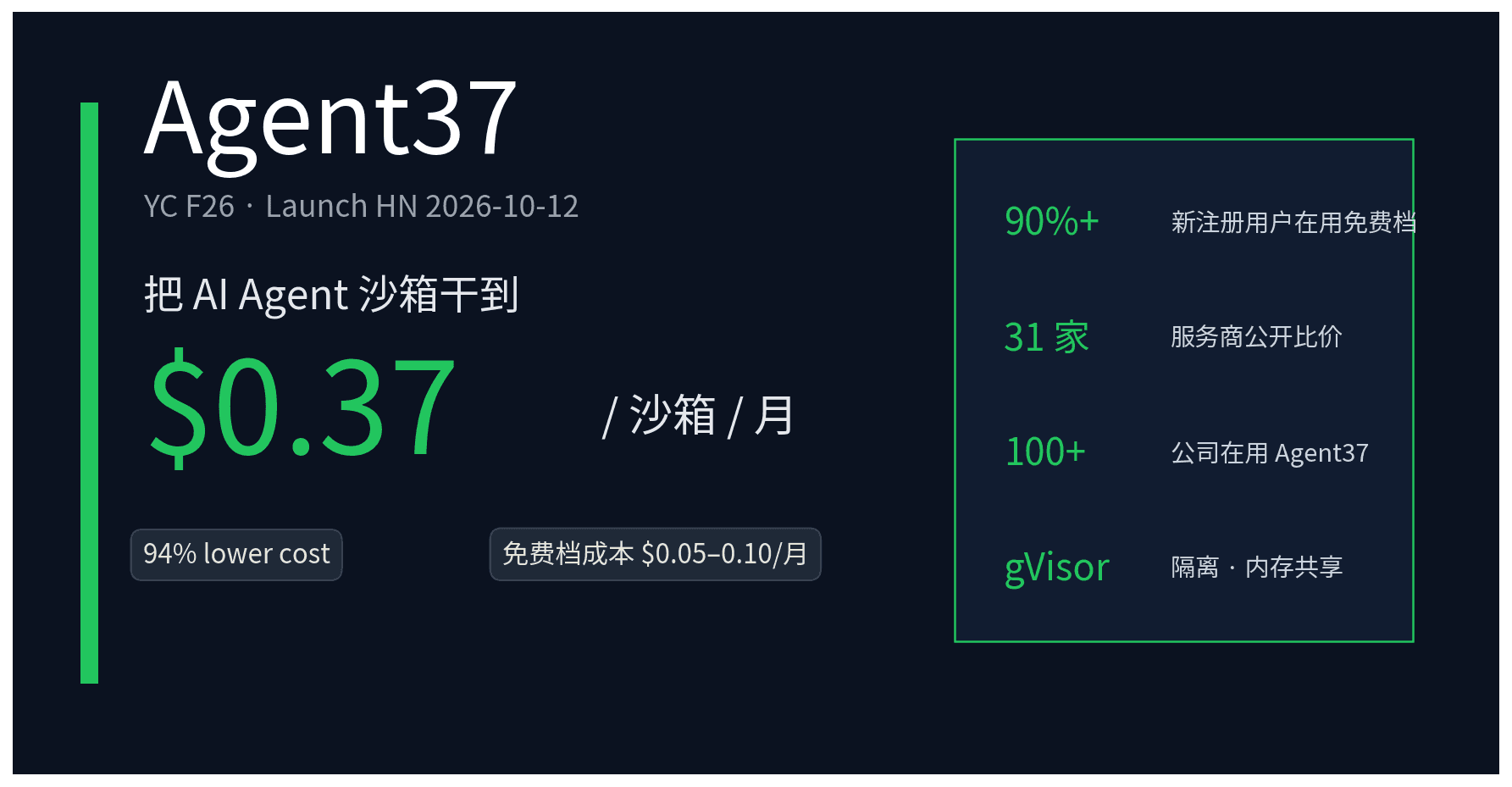
How much should an AI agent sandbox cost you per month? If you've used mainstream sandbox providers, the answer is probably somewhere between a few dollars and tens of dollars. But on October 12, a YC F26 startup stopped every scroller on the Hacker News front page with a single number: their customers spend an average of just $0.37 per sandbox per month.
The company is called Agent37, and founder Vishnu posted the number himself in a Launch HN thread — along with an even more startling one: over 90% of the company's new signups are on the free plan, and Agent37's infrastructure cost for those free users averages only $0.05 to $0.10 per user per month. Pennies.
This isn't simple price dumping. In the post, Vishnu laid out every cost-cutting move in the open: from the CPU/RAM pulse patterns of agent workloads, to "skipping the hyperscalers," to gVisor and bare-metal machine selection. For solo developers moving agents to the cloud, the post reads as both a cost teardown and an infrastructure selection guide.
Agent37 YC F26 cover: AI agent sandboxes at $0.37 per sandbox per month, 94% lower cost than mainstream providers" alt="Agent37 cover: the YC F26 startup running AI agent sandboxes at $0.37 per month" />What Agent37 is: persistent cloud sandboxes for running AI agents
What Agent37 does can be said in one sentence: cloud sandboxes for AI agents. You deploy an agent harness — OpenClaw, Hermes, Claude Code, and the like — into one, and it runs there around the clock inside an isolated sandbox with its own filesystem, network egress, and disk. Disconnect, come back later, and everything is still there.
The company's origin story is refreshingly honest. Vishnu doesn't dodge it in the post: back in February, Agent37 started as "one of those OpenClaw wrapper companies." But over the months they kept adding harnesses, and the site now lists ready-made options including Hermes, OpenClaw, Claude Code, Codex, OpenCode, Grok, and Pi — plus bring-your-own-harness. In other words, it grew from "cloud hosting for one particular agent" into a harness-agnostic agent runtime layer.
The founder's résumé adds credibility to the story: Vishnu was a Senior Software Engineer at Amazon and an Engineering Manager at Quantcast, where he built Amazon's internal AI chatbot Diya and its internal coding harness Ziya. He is, in short, someone who came out of a cloud giant having done the math himself — which explains why the post's centerpiece isn't a feature tour but a cost breakdown.
Unpacking the numbers: what "$0.37" actually means
Let's lay out every number from the post and the website at once, because the devil is entirely in the definitions:
- $0.37/month per sandbox on average: verbatim from the Launch HN post — "Our customers spend an average of $0.37/month per sandbox" — alongside the claim of running "at under 10% of the cost of most sandbox providers."
- $0.05–$0.10/month in infra cost per free-tier user: with 90%+ of new signups on the free plan, hosting their personal Hermes/OpenClaw/Claude Code instances on Agent37's cloud costs the company only pennies per user per month.
- "94% lower cost than most sandbox providers": the headline on agent37.com, consistent with the HN post's "under 10%" framing (94% lower ≈ 6% of the competitor's price).
- A public 31-provider price comparison page ("Compare all 31 providers, rates and sources") with a "find it cheaper and we'll refund the difference" promise. Turning the price comparison into a public page signals they take the number seriously.
One number deserves to be pulled out separately: the FAQ states that a 2 vCPU / 4 GB sandbox left running every minute of the month costs $4.76. Does that contradict $0.37? No — the key is auto-sleep. A sandbox with no activity automatically sleeps, and while asleep you're charged for disk only ($0.36/month for 4 GB); waking happens automatically on request. The $0.37 figure is the average across all customer sandboxes, and the reality is that most personal agents only do real work in scattered bursts throughout the day — they spend most of their time asleep.
That definitional detail is precisely the first lesson in understanding this business: the cost of an agent sandbox isn't decided by the unit price, but by how idle time is handled. An always-on personal assistant in the cloud — say an OpenClaw instance collecting your mail and running scheduled tasks — billed per minute with auto-sleep, naturally lands in pocket-change territory.
Agent37 YC F26 cover: AI agent sandboxes at $0.37 per sandbox per month, 94% lower cost than mainstream providers" alt="Bar chart comparing monthly per-sandbox cost: Agent37 vs mainstream sandbox providers" />Figure 1: Monthly per-sandbox cost comparison. Agent37 customers average $0.37/month — roughly 10% of mainstream sandbox providers (source: Agent37 founder's Launch HN post, 2026-10-12).The four cost-cutting moves: how the cost structure got compressed
The most informative part of the post is Vishnu's item-by-item teardown of the four techniques. None of them is mysterious on its own; together they form a complete methodology of "infrastructure purpose-built for agent workloads":
Move 1: Schedule CPU/RAM around the pulse patterns of agent loads
This is the key insight of the whole methodology. Vishnu notes that agent harnesses consume resources in distinct patterns: CPU spikes in bursts during initialization and certain tasks, but rarely stays pegged; RAM demand concentrates in browser and computer-use tasks, then falls back once the task is done.
Traditional cloud VMs are sold on peak reservation: you pay for a whole VM to cover those few minutes of CPU spikes. Agent37's approach is to schedule actual CPU/RAM utilization around these pulse patterns instead of reserving a full VM's resources per sandbox. In essence, they're treating "agent workloads" as a new workload class for bin-packing optimization — just as cloud vendors once invented auto-scaling for web services, someone is now inventing dedicated scheduling strategies for agents.
Move 2: Skip the hyperscalers; buy Hetzner/OVH bare metal
This one has the unmistakable flavor of an ex-Amazonian. Vishnu writes: "I worked at Amazon before and they have 80-90% margins on VMs. So it was an obvious choice once I looked at the prices to go one layer down to vendors like Hetzner and OVH." He adds that this alone was probably the single biggest cost lever.
That's a loaded statement. It implies a large chunk of an agent sandbox's cost is "cloud brand tax" — you're paying not for compute but for the hyperscaler's channel, compliance, and brand premium. For agent workloads, which are relatively undemanding on compliance (a sandbox is isolated by design) and extremely price-sensitive, buying bare metal directly is rational. The unmentioned cost, of course, is that you now own hardware failures, networking, and ops yourself — the post doesn't expand on that labor cost.
Move 3: gVisor for isolation, memory shared across sandboxes, fast cold starts
On the tech stack, Agent37 uses gVisor for sandbox isolation. gVisor brings two benefits: available host memory can be shared across sandboxes instead of reserving a full VM's memory for each one, and boot times are fast. Both map directly onto the scheduling strategy of move one — without lightweight isolation like gVisor, pulse-based scheduling wouldn't be possible.
Vishnu is honest about the trade-offs: gVisor sandboxes don't support workloads like Docker-in-Docker or Android emulators. For scenarios needing a full VM (e.g., running Docker inside the sandbox), they also offer full-VM sandboxes at a slightly higher price — but "still pretty low cost given the rest of the techniques." This "light by default, heavy on demand" tiering is a classic cost-control pattern.
Move 4: Buy for the RAM bottleneck — pack more memory per host
The final move is a procurement strategy: "the size and shape of the hosts you buy makes a big difference. RAM is typically the bottleneck when it comes to cost and not the CPU — this is specifically true for agent harness workloads. So when buying servers, we optimize for packing more RAM into a given host."
Read the four moves as a chain and the logic is airtight: first understand the workload's character (bursty CPU, memory-hungry), then buy the cheap substrate (bare metal), then pick the matching isolation technology (gVisor with shared memory), and finally procure hardware against the bottleneck (memory-dense hosts). Every step is purpose-built for agent loads; none of them is generic-cloud best practice.
Agent37 YC F26 cover: AI agent sandboxes at $0.37 per sandbox per month, 94% lower cost than mainstream providers" alt="Flow diagram of Agent37's four cost-cutting moves: pulse scheduling, bare metal, gVisor, memory-dense hosts" />Figure 2: Agent37's four cost-cutting moves — compressing the cost structure layer by layer, starting from workload characteristics (adapted from the Launch HN post).What the product looks like: more than just cheap
Beyond price, the product shape disclosed on the website is worth a look, because it defines what an "agent runtime layer" category should look like:
- Billing: metered by the minute — compute while the sandbox runs, disk while you keep it. No subscription, no minimum; new accounts get a $5 starter credit, and startups can get up to $10,000 in credits.
- Persistence: "Keep files across sessions, sleep, and restarts," with automatic backups to restore from. The FAQ puts it more bluntly: what your agent writes to disk "is still there on the next call, weeks later." For long-running agents, that's a hard requirement — memory and state must not be lost.
- Networking: each sandbox can get an authenticated HTTPS URL, expose public ports, or connect a custom domain — suitable for turning an agent into a customer-facing product.
- Observability: CPU, memory, and disk usage are trackable, and logs show what ran inside the sandbox — essential for vibe coders debugging agents.
- Security: every sandbox isolated by gVisor with its own filesystem and hard disk quota; hosts have no public hostname, with all requests entering through Cloudflare's edge over TLS; egress firewalled to the public internet only; disk, backups, and metadata encrypted at rest; SOC 2 Type I; and an explicit promise — "we do not collect your prompts, files, or terminal sessions, and your data is never used to train AI models."
Notably, Vishnu closes the post by saying they're "particularly looking for developers building messaging agents to try their workloads" and to "challenge the limits and economics of our platform." That reveals the go-to-market thinking: get the most cost-sensitive, heaviest-load developers to stress-test first — if even high-frequency messaging-agent workloads hold up and stay cheap, the word of mouth writes itself.
The trend: the agent runtime layer is becoming a new infrastructure category
Zoom out and Agent37 lands on a forming category. Not long ago AWS open-sourced Strands Box — a sandbox for AI agents whose policies can even remember what the agent did (we covered it here: read the story). On one side, a cloud giant open-sourcing sandboxes to build an ecosystem; on the other, a YC startup driving sandbox cost down to pennies a month. "Where agents run" is graduating from a developer's afterthought into a standalone infrastructure category.
The competitive logic of this category resembles last generation's cloud — with one key difference: it's not won on feature richness but on cost structure. Everybody can ship the same feature checklist (isolation, persistence, networking, observability); the real moat is who can make "one agent online 24/7" cheap enough that developers spin up a hundred without thinking.
Agent37's answer is vertical integration: serve exactly one workload — agents — and customize every layer from procurement to scheduling for it. It's the same logic AWS once used to purpose-build infrastructure for web workloads. Only this time the protagonist is the agent.
What it means for solo developers
For vibe coders and solo developers, the implication is concrete: keeping a resident agent online in the cloud around the clock is now pocket-change cheap.
Picture the typical setup: a personal OpenClaw or Hermes assistant in the cloud, summarizing your mail on schedule, watching a website for changes, generating your morning briefing. Under Agent37's model it auto-sleeps 95% of the day, wakes only when called, and the monthly bill is spare change. With free-tier users costing $0.05–$0.10/month in infra, providers can offer this service free indefinitely — sustained by an extreme cost structure, not venture subsidies.
Compare with renting your own VPS: the cheapest VPS still costs a few dollars a month, plus you own reconnects, system updates, and reverse proxies. A sandbox service outsources "keeping the agent alive," and Agent37 just proved that can be cheap enough to not bother calculating.
A cooler head: three questions worth asking
The numbers are seductive, but three things deserve a cooler look before drawing conclusions:
First, $0.37 is an average, not a price. There is no "$0.37 plan" on the website; billing is per-minute with auto-sleep. If your agent is a high-frequency workload — a messaging agent processing messages all day — the bill will land well above the average. Vishnu's open invitation for messaging-agent developers to "challenge the limits" is, in a sense, also data collection on real high-load scenarios. The right question for the number is "what's my workload's idle ratio," not "is it $0.37 flat?"
Second, gVisor's trade-offs are real. No Docker-in-Docker means that if your agent needs to spin up containers inside the sandbox — a dependency of many coding-agent workflows — you'll need the pricier full-VM tier. Confirm whether your harness needs that before letting the headline number decide for you.
Third, this cost playbook has no patent wall. Anyone can buy Hetzner bare metal, gVisor is open source, and the pulse-scheduling idea is now public in the post. Agent37's moat isn't any single technique but the operational detail of bolting all four together plus first-mover scale — which also means more people will copy the playbook and the price war may continue. Good for users; pressure for Agent37 to keep proving itself.
One more small note: the company was founded in February, and the "100+ companies" claim comes from its own site with little independent verification yet. Before migrating production agents, run the free tier for a few weeks and check whether sleep/wake latency and persistence hold up as advertised.
Closing: this race is about cost structure
The reason Agent37's Launch HN post deserves a close read isn't that another dev tool launched — it's that it open-sourced the cost ledger of a brand-new business. In the emerging "agent runtime layer" category, features will converge, prices will compress, and what remains is whose cost structure is most extreme.
For developers, the best news is this: whoever wins, a personal agent online 24/7 is becoming a utility that costs pennies a month. And when a capability gets cheap enough to stop calculating, that's when imagination about how to use it truly begins.
Primary sources: Launch HN: Agent37 (YC F26) – Low-cost agent sandboxes for running agents (Hacker News, 2026-10-12, posted by founder Vishnu); agent37.com (visited 2026-10-16). Related reading: AWS open-sources Strands Box: a sandbox for AI agents.
Comments (0)
Sources
Related articles
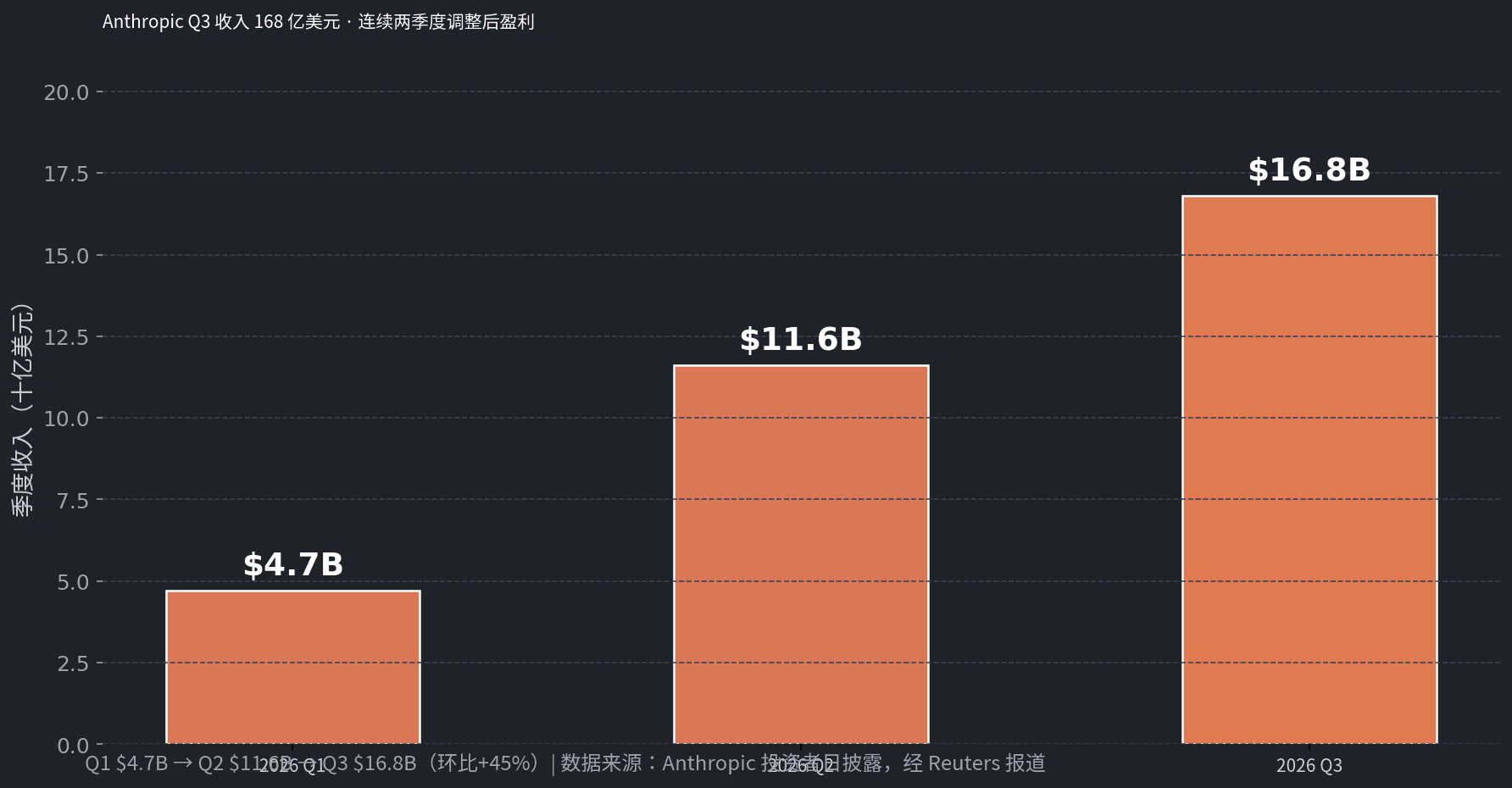
Anthropic told investors Q3 revenue hit $16.8B, up 45% QoQ, marking a second straight adjusted-profit quarter with $1.70 of revenue per $1 of compute. But growth cooled from 147%, a $518B decade-long compute commitment looms, and the November IPO targets over $2T.

On Oct 13, Shopify opened its billion-plus product catalog to any personal AI agent: the agent finds and compares, the human approves every order, and checkout always runs through Shop Pay. 65% of shoppers use AI for shopping tasks, yet only a third trust it to buy — the data behind the per-order approval design, and a new craft for vibe coders: legibility, product copy written for machines.

TV4's fully edited The Challenge Sverige season was wiped: hundreds of days of work gone, the Nov 22 premiere pushed to next spring. Aftonbladet blames an AI agent; TV4 denies an independent AI agent did it, citing backup failure. HN erupted the same day, both camps really arguing about permissions and missing backups.