Anthropic Q3 Revenue Hits $16.8B: Second Straight Adjusted-Profit Quarter as November IPO Eyes $2T
Anthropic told investors Q3 revenue hit $16.8B, up 45% QoQ, marking a second straight adjusted-profit quarter with $1.70 of revenue per $1 of compute. But growth cooled from 147%, a $518B decade-long compute commitment looms, and the November IPO targets over $2T.
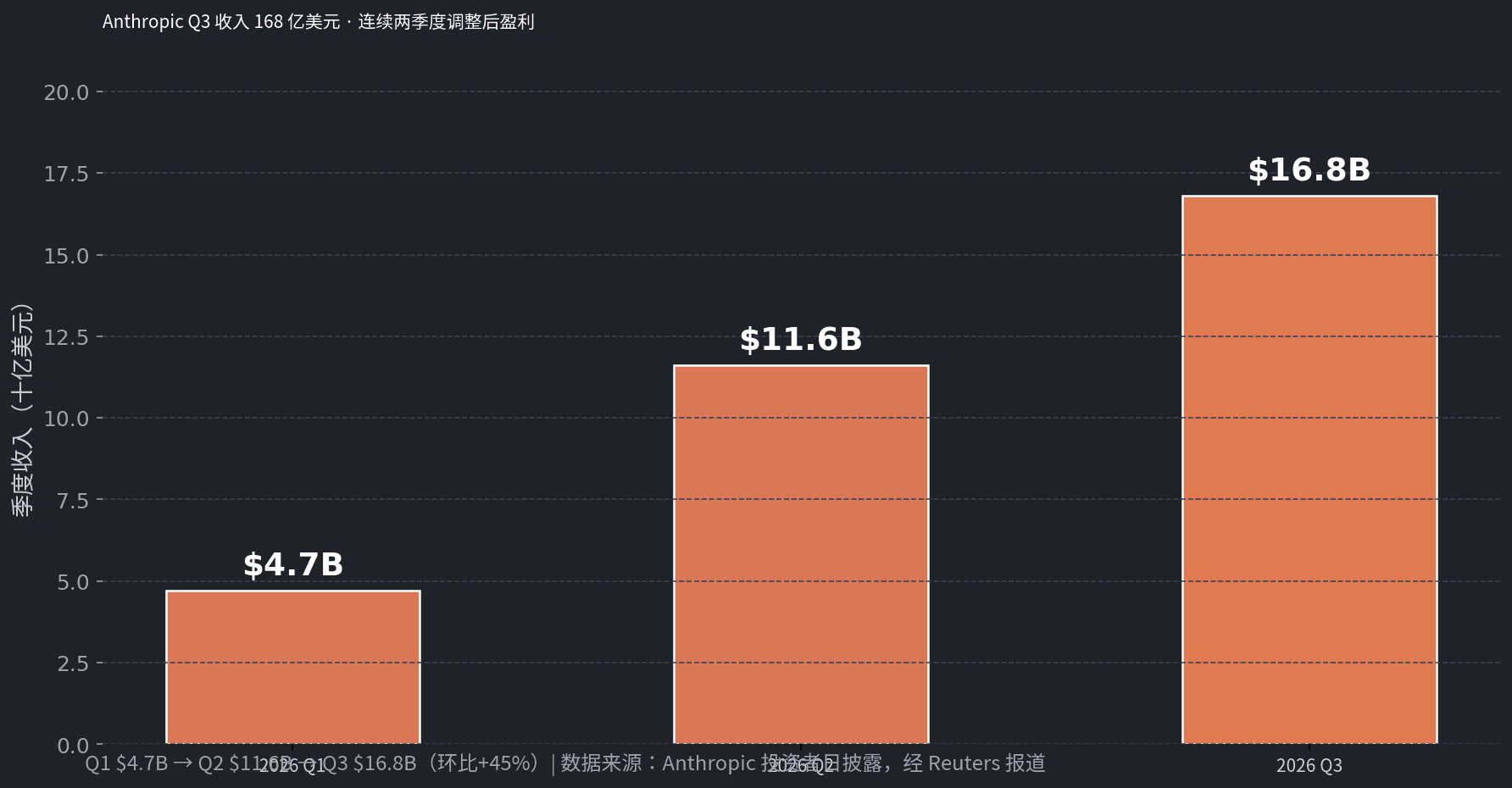
On October 14, San Francisco time, Anthropic held a pre-IPO investor day at its headquarters. CEO Dario Amodei and CFO Krishna Rao took the stage in person and gave a room full of prospective investors a set of numbers: third-quarter revenue of $16.8 billion, up 45% quarter over quarter, profitable for a second straight quarter on an adjusted basis, with positive operating cash flow. According to multiple US media outlets citing attendees, this may be the first time the question "does AI actually make money?" has received a financial-statement-grade affirmative answer — not a third-party run-rate estimate, but numbers the company itself spoke aloud to investors.
 Bar chart of Anthropic quarterly revenue Q1-Q3 2026: $4.7B, $11.6B, $16.8B climbing quarter by quarter
But the other side of those numbers deserves equal attention: growth has slowed from nearly 147% in Q2 to 45%; annualized revenue is estimated at roughly $74 billion, below the "over $100 billion by year-end" hopes some investors held this summer; and the company is carrying at least $518 billion in decade-long compute commitments. The IPO is slated for after the November US midterm elections, targeting a valuation north of $2 trillion — Anthropic wants to list before OpenAI and become the first public-market test of whether an AI lab can be profitable.
The numbers: $16.8B in Q3, three quarters of climbing
Line the three quarters up and the steepness of the climb is unmistakable:
- Q1: $4.7 billion — the starting quarter;
- Q2: $11.6 billion — up nearly 147% quarter over quarter, a dollar gain of about $6.9 billion;
- Q3: $16.8 billion — up another 45%, a dollar gain of about $5.2 billion.
For scale: Anthropic's full-year 2025 revenue was roughly $4.6 billion — meaning a single quarter in Q3 2026 brought in more than 3.6 times all of last year's revenue. The first three quarters total roughly $33.1 billion, over seven times full-year 2025. Claude's commercialization has clearly entered a new stage of scale, with enterprise APIs, Claude Code, and model services distributed via cloud platforms forming a three-legged stool.
The profitability side is showing a presentable signal for the first time: the company says Q3 was its second consecutive quarter of adjusted profitability, with positive operating cash flow. Per Bloomberg citing attendees, adjusted gross margin hit 85% and adjusted operating margin exceeded 11%; the FT's reporting added the more specific detail: in Q3, every $1 of compute spend generated roughly $1.70 of revenue. The unit economics of inference have been put on the table for the first time — and they're profitable.
For the industry, that 1.70 may matter as much as the $16.8 billion itself. For two years, skepticism about AI labs has boiled down to one sentence: "for every dollar of compute you burn, can you earn it back?" Anthropic has now handed in an answer with a formula attached: yes, at an 85% gross margin. After all the price wars, inference can apparently make money after all.
But the curve has already bent: from 147% to 45%
Still, hold half the applause. The change in the slope is more honest than the absolute number:
- Q1→Q2: revenue from $4.7B to $11.6B, quarter-over-quarter growth of nearly 147%;
- Q2→Q3: from $11.6B to $16.8B, growth of 45%;
- the dollar gain itself narrowed from about $6.9B to about $5.2B.
The market offers several explanations for the slowdown, none fully convincing but all worth hearing. Seasonality is one: people work less over the summer and burn fewer tokens, so Q3 was never going to be AI usage's strong quarter. Competition is another: OpenAI reportedly launched a strong competitor, Astra, in September, and Anthropic didn't answer until late in the month with Opus 5.5 — it spent most of Q3 in a rival's product shadow.
More important is the expectations gap. Research firm SemiAnalysis currently estimates Anthropic's annualized revenue at roughly $74 billion (up from about $65 billion in late July), while some investors this summer were expecting "over $100 billion by year-end." Between $74B and $100B lies a gap the size of an entire Fortune 500 company. Separately, analysts who met with management reportedly expect the year-end annualized run rate to touch $110 billion — but that's the analysts' model, not the company's commitment. Notably, Anthropic reportedly did not discuss its September annualized revenue rate or give a full-year outlook at the investor day, leading some bankers who had hoped for raised valuation expectations to instead consider cutting them to below $1.5 trillion.
In one sentence: the numbers are still enormous, but the "exponential forever" narrative no longer holds. Q2's 147% quarterly surge was most likely a one-time pulse from the Claude Code breakout, not the new normal.
 Bar chart of Anthropic quarterly revenue Q1-Q3 2026: $4.7B, $11.6B, $16.8B climbing quarter by quarter
Caption: Anthropic's quarterly revenue climb, Q1→Q3 2026. Q1→Q2 growth was nearly 147%; Q2→Q3 fell back to 45%, with the dollar gain narrowing in tandem. Source: Anthropic's Oct 14 investor day disclosures, via Reuters/Bloomberg reporting.
"Adjusted" is the most important word in the whole story
Every pretty profitability number comes with the qualifier "adjusted." Reuters' original copy is blunt: profitable "on an adjusted basis," cash flow as "operating cash flow." The problem: these figures are unaudited, and the company hasn't said clearly what "adjusted" adjusts away.
Known exclusions include big-ticket items like stock-based compensation — which happens to be one of an AI lab's largest people costs. The company's draft IPO prospectus reportedly showed a net loss of about $42 billion for 2025 under standard accounting; and per a Reuters exclusive last month, the company lost more than $8 billion on an operating basis in 2025 even after excluding writedowns of various liabilities tied to previous fundraising. In other words: an 11% adjusted operating margin and a massive GAAP loss can both be true at once — it all depends on what you count.
None of this means the numbers are fabricated — "adjusted profitability" is standard roadshow practice; nearly every SaaS company talks this way before an IPO. But for a company seeking a $2 trillion-plus valuation, investors should be asking: beyond SBC, how much of the adjustment is capitalized training cost? In the 85% inference gross margin, how are depreciation and compute leases allocated? The public reporting from the investor day answers none of these. Until the prospectus is published, $16.8B and 11% should be read as "the company's word" — and a carefully scoped one at that.
One more accounting footnote worth pulling out: Anthropic reportedly books certain transactions flowing through AWS and Google Cloud on a higher gross basis in its revenue, while OpenAI uses a different methodology. That means the two companies' revenue figures can't be directly compared to judge whose business is bigger. Only after both are public and filing under GAAP will a real apples-to-apples comparison be possible.
An early investor told Fortune: "Anthropic can afford to slow down and still have huge value." The subtext: the market is already pricing in slower growth, and the valuation story is shifting from "growth" to "quality of earnings."
The sword overhead: $518 billion in decade-long compute commitments
No matter how good the revenue side looks, there's no going around the mountain on the other side of the balance sheet: Anthropic has committed at least $518 billion over a decade for cloud services, compute, and infrastructure. Do the simple division: $518B over ten years averages about $51.8 billion a year — roughly 70% of SemiAnalysis's estimated current annualized revenue of $74 billion.
That is the AI lab business model in its truest form: the slope of the revenue curve must forever outrun the payment schedule of the compute commitments. Right now $1 of compute buys $1.70 of revenue, which looks like a win; but $518B is a hard commitment while $74B annualized is an "estimate" — one is a contract, the other is a model. If Q4 or next year's growth keeps normalizing toward 30% or 20%, that ten-year deal flips from growth ammunition into a fixed-cost noose.
To be fair, a commitment isn't cash out the door this year, and a ten-year structure has real flexibility built in. But the investor-day audience does big-picture math: they see $16.8B and they also do the $518B. It's also why Anthropic is rushing to list while the revenue story is at its prettiest — lock in the valuation while the curve still points up.
 Bar chart of Anthropic quarterly revenue Q1-Q3 2026: $4.7B, $11.6B, $16.8B climbing quarter by quarter
Caption: The decade-long compute commitment ($518B, disclosed by Anthropic) is roughly 7x the current annualized revenue estimate (~$74B, SemiAnalysis). Revenue is an "estimate"; the commitment is a "contract" — that is what the sword overhead means. All figures per reported disclosures.
The IPO timeline: after the midterms, ahead of OpenAI
The listing cadence is now fairly clear: per Reuters, Anthropic's public-market debut will likely be pushed until after the November 3 US midterm elections, with marketing starting as early as the week of November 9 and trading targeted before Thanksgiving on November 26. The valuation target exceeds $2 trillion — which would make it one of the largest tech IPOs in history.
Two things about the timing. First, beating OpenAI to market. Anthropic's listing is expected to precede rival OpenAI's public listing, making it the first public test of investor appetite for heavily unprofitable AI developers pursuing massive scale. Whoever lists first sets the valuation anchor for whoever lists second — Anthropic clearly wants to be the one setting it. Second, striking while the iron is hot. The May round raised $65 billion at a $965 billion post-money valuation; less than half a year later, the target valuation is supposed to more than double. That kind of leap only works inside the window where the revenue story looks its best — wait until next year, with growth further normalized, and the $2 trillion number gets harder and harder to defend.
A telling detail on the atmosphere: per Reuters, attendees left the meeting with Amodei and Rao "optimistic about the company's rapid revenue growth and path to profitability"; Amodei reiterated the company's focus on AI safety but avoided any mention of human-extinction threats — even though the draft prospectus had warned of "catastrophic or existential risks to humanity." Everyone got a hat reading "thinking." A company chasing a $2 trillion valuation pulled off its signature brand move with a piece of headwear: smart, restrained, unthreatening.
Estimated vs. reported: how this differs from the run-rate stories
This site previously covered DeepSeek and Cognition run-rate stories. Those were third-party estimates at their core: working backward from observable API pricing, usage signals, and financing materials to infer a company's revenue scale. Estimates have the virtue of "a number to look at"; the price is a methodology that never quite lines up.
This story is entirely different: $16.8B, $4.7B, $11.6B are numbers Anthropic's CFO spoke aloud to prospective investors. That puts them a credibility tier higher — a company is accountable for what it tells investors, especially on the eve of an IPO quiet period. But the flip side: these are the seller's numbers — the methodology (adjusted, gross basis), the audit status (unaudited), and the disclosure choices (reporting the flattering quarterly figures, skipping the full-year outlook) all serve the single goal of selling a $2 trillion valuation. Read this piece as "the seller's numbers, confirmed" — not "the truth, confirmed."
For readers tracking AI commercialization long-term, read the three stories together: the DeepSeek piece showed the Chinese playbook of "low price, high volume"; the Cognition piece showed the vertical playbook of "high-ACV agentic coding"; and this Anthropic piece shows the full-stack model company's scaled-up answer. Three paths, three ways of doing the math — the AI business world of 2026 has never been more worth taking apart line by line.
The vibe coder's view: Anthropic's money is your toolchain's stability forecast
Back to the question we care about most: what does this have to do with someone who writes code with Claude Code every day? Everything, directly — Anthropic's revenue is the financial foundation for the Claude toolchain "not going down, not jacking up prices, not rotting" over the next few years.
First, not going down. Q2's near-147% revenue surge was reportedly driven largely by demand for Claude Code. Developer tooling is already Anthropic's number-one growth engine, which means resource allocation will keep tilting toward Claude Code: model optimization, quota policy, new features will all serve the most profitable line first. For vibe coders, that's good news — the tool you depend on daily is the business your patron cares about most.
Second, not jacking up prices. $1 of compute returning $1.70 of revenue at an 85% adjusted gross margin means the unit economics of inference work. As long as that formula holds, Anthropic has no incentive to hike API or subscription prices aggressively. The thing to watch for, conversely: if that ratio ever slips to 1.2 or 1.1, price hikes and "quiet downgrades" (swapping in cheaper models) will follow. Watching that number beats watching launch events.
Finally, not rotting. Two straight quarters of adjusted profitability plus positive operating cash flow means Claude is backed by a self-funding company, not a cash furnace living round to round. A toolchain's long-term stability is ultimately a financial question: only a model company that can make its own money dares to make you long-term promises. From that angle, $16.8B is a number every heavy Claude user should breathe easier at — granted, with the "adjusted" qualifier attached.
To close: Anthropic used $16.8B to prove that "AI can really make money" — but the word "adjusted" reminds us it has only proven the first half. The second half to watch: when 147% growth becomes 45% and then 20%, can the $518B commitment and the $2 trillion valuation each still stand? After the IPO, every quarter hands in a report card — and we'll grade them line by line.
Comments (0)
Sources
Related articles

On October 14, Anthropic announced its fifth Asia-Pacific office in Singapore and an MOU with the Ministry of Digital Development and Information. Over 1,500 GovTech engineers already use Claude Code to modernize government systems, and Singapore ranks 2nd of 121 countries in per-capita Claude.ai usage.
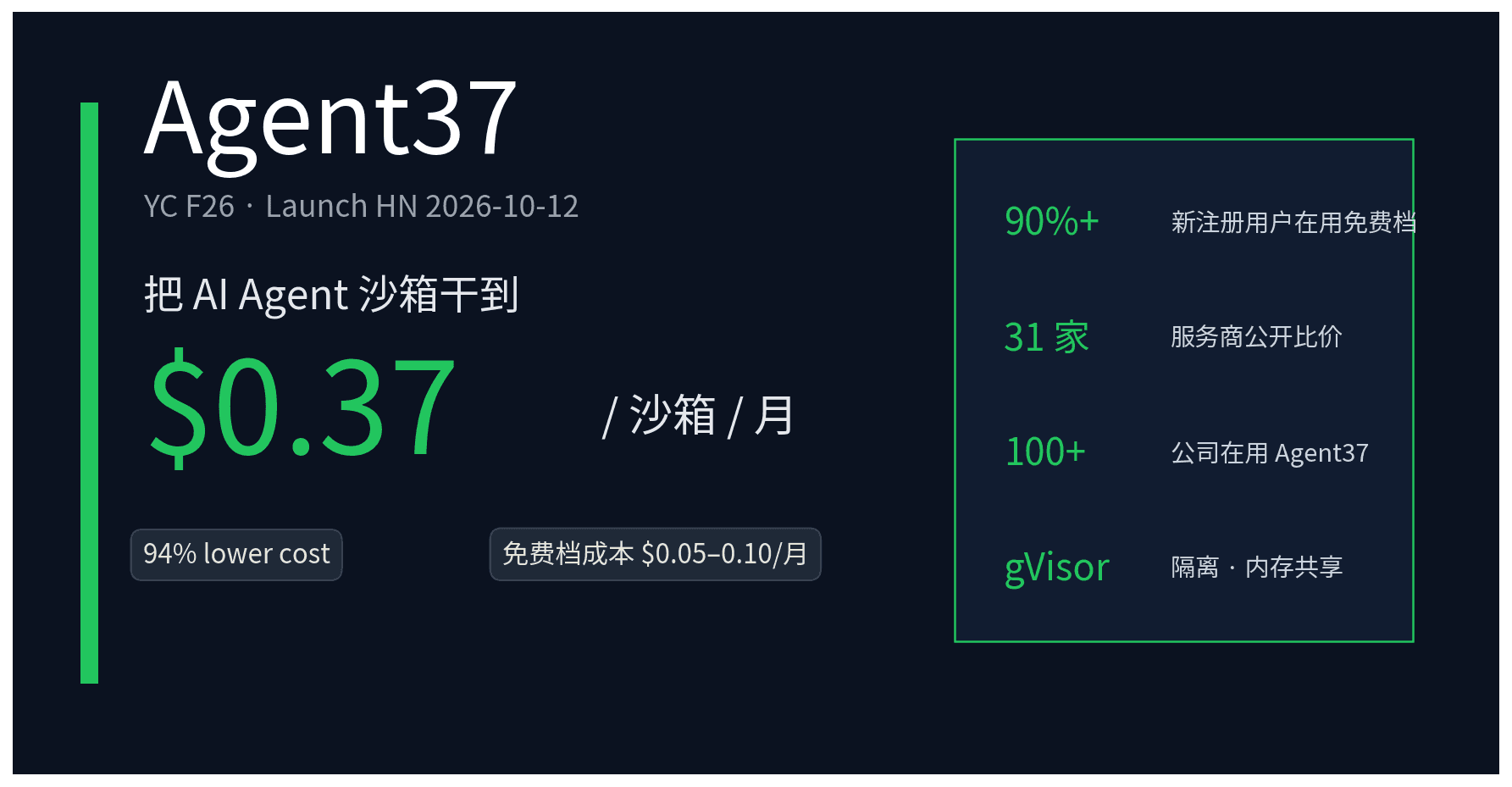
YC F26 startup Agent37 disclosed on Launch HN (Oct 12) that its customers spend an average of $0.37/month per agent sandbox — under 10% of mainstream providers — while free-tier users cost it just $0.05–0.10/month in infra. Founder Vishnu (ex-Amazon) opened up the four-part cost playbook: pulse-based CPU/RAM scheduling, Hetzner/OVH bare metal, gVisor with shared memory, and memory-dense hosts. The agent runtime layer is becoming infrastructure — and this race is about cost structure.

TV4's fully edited The Challenge Sverige season was wiped: hundreds of days of work gone, the Nov 22 premiere pushed to next spring. Aftonbladet blames an AI agent; TV4 denies an independent AI agent did it, citing backup failure. HN erupted the same day, both camps really arguing about permissions and missing backups.