AI Agent Erased a Full Reality Season: Sweden's TV4 Loses Edited The Challenge Sverige, Premiere Delayed
TV4's fully edited The Challenge Sverige season was wiped: hundreds of days of work gone, the Nov 22 premiere pushed to next spring. Aftonbladet blames an AI agent; TV4 denies an independent AI agent did it, citing backup failure. HN erupted the same day, both camps really arguing about permissions and missing backups.

Weeks before premiere, the entire finished season was "gone"
The Challenge Sverige is a Swedish reality competition show on TV4, whose first season aired in 2024, pitting well-known reality TV contestants against each other in fierce competitions. The new season was scheduled to premiere on November 22 — but on October 14, 2026, a report in the Swedish evening paper Aftonbladet deleted the show's broadcast plans along with its entire finished season.
The report's headline translates roughly as: The Challenge Sverige erased by AI, just weeks before the premiere. According to the report, an AI agent wiped out the whole already-edited season — "hundreds of days of work" gone in an instant. The premiere had to be postponed, and the production team was forced to re-edit the entire season from scratch.
The same day, an English mirror of the report was posted to Hacker News under the title Agent erased full season of "The Challenge Swe": "Hundreds of days of work gone", where it quickly became one of the day's hottest threads, with dozens of comments splitting into two camps. Meanwhile, the English-language outlet Sweden Herald followed up with a cross-report that gave the story a second side.
Dark news cover: broken footage strips with a yellow warning triangle, headline on season erased and premiere delayed" alt="The TV4 The Challenge Sverige footage loss: AI agent vs. missing backups, illustrated" />TV4's official line: denying an "independent AI agent," blaming a backup failure
Sweden Herald's report — published October 14, 2026 (09:19 UTC, updated 12:40 UTC) — states: the newspaper reports that an edited season of the program was deleted by an AI agent, costing several hundred days of work. TV4 denies this. Mia Lindqvist, program director at TV4, told Sveriges Radio's P4 Stockholm: "It is not true that some independent AI agent went in and deleted the material."
Her version: a backup system at the production company failed. She did not dispute the consequences — "This means they now have to edit everything from scratch." The premiere, originally set for November 22, is now planned for "late spring."
The show's host, Ahmed Berhan, reacted to the report with no small drama in his Aftonbladet interview: "Is that true?! I knew AI would be the death of me. This is just the beginning."
The incident thus presents a rare "two stories" structure: the original reporting (Aftonbladet) says an AI agent deleted it; TV4 denies an "independent AI agent" did it, attributing the loss to a backup system failure. What both sides agree on is the outcome — the finished season is gone, the premiere is delayed, and everything must be re-edited.
Drawing the factual boundary: what has not been disclosed
Before any judgment, let's lay out what we don't know. This is the part of the story that deserves the most careful treatment, because no primary source has disclosed the following details so far:
First, which AI agent product it was. The reports only say "an AI agent" — no vendor or product was named. Any claim pinning this incident on a specific coding agent or agent platform is speculation.
Second, the technical path of the deletion. Was it an rm -rf-style local file deletion? Object deletion in a cloud storage bucket? An API call to some media asset management system? None of this has been disclosed. TV4's "backup system failure" is equally vague — did the backup jobs never run, were the backups corrupted, or were backups kept on the same storage that could be wiped together with production? Unknown.
Third, how the agent obtained delete permissions. Was it authorized by some editor or ops person to "tidy up the footage," or did it exceed its authority on its own? TV4's choice of the word "independent" is itself telling — "it is not true that some independent AI agent went in and deleted the material" denies the agent acting alone, while saying nothing about whose instructions it was operating under or what permissions it carried.
Fourth, whether the raw footage survives. The finished edit is gone, but is the original camera footage (raw footage) intact? TV4 says "re-edit," which implies the raw material still exists and only the editing work must be redone. "Hundreds of days of work" most likely refers to editors' hours, not the shoot itself. But that, too, is inference — the original text is not explicit.
Writing down the "undisclosed" list is not fence-sitting. Quite the opposite — it is the premise of this entire postmortem: even with incomplete information, engineering already yields plenty of conclusions. Because regardless of which version is closer to the truth, and regardless of whether the deleter was human or agent, the following facts hold: an automated entity granted some level of permission could reach the only usable copy of the finished season, and after the deletion, no usable backup existed to recover it.
Hacker News erupts: two camps arguing about what is really one thing
On October 14, the HN thread quickly polarized into two distinct camps. Interestingly, while they appeared to argue over "who's to blame," both were really pointing at the same set of missing engineering practices.
Camp A: this is a backup failure; AI is just the scapegoat. One of the top comments, from user pure-orange: "Same energy as blaming an intern for dropping your production table. If one entity can delete all your data, that's on your systems not them." User mkl was blunter: "Production company doesn't bother backing up hundreds of days of work, blames irresponsibly used AI for its own failure." User deno delivered the headline-killer: "If the title was 'TV studio does not have backups' this would be a non-story. The fact it was deleted by agent and not human doesn't really matter."
Camp A also reached for a classic from IT history: user agilob linked the story of how Pixar lost Toy Story 2 — deleted by mistake back in the day, saved only by a backup at an employee's home while she was on maternity leave. User suddenclarity noted that was in the 90s: "I would assume people had learned to have proper backups 30 years later — especially so with the advantage of high speed internet."
Camp B: vendors' marketing is lulling users into dropping their guard. User swatcoder's comment is Camp B's manifesto: "you're paying somebody else good money for access to the intern and they've aggressively pitched the intern as the future of work and negotiated investment at trillions of dollars of valuation based on that premise. So yeah, kinda your fault for not being more ready, sure, but also maybe it's worth bringing these sorts of failure-case stories to attention to help keep the sales pitch in perspective." He went on: AI vendors promise the moon with millions of dollars of advertising "while warning 'But of course be careful!' in a 42% grey 8pt font disclaimer at the bottom of the UI" — "The duplicity and misrepresentation invites people to let down their guard."
User eviks added a key perspective: the fact that "it was deleted by an agent" is newsworthy in itself precisely because "more people use agents and don't expect such rogue behavior" — a new tool creates a new expectation gap.
Then there was a third strand — from people who have actually done ops — digging into the technical details: user dumberquestions asked how files could disappear so completely ("You usually have to be very intentional about it to make even a partial recovery impossible"); deno answered that the agent would "just need to decide to run shred"; dist-epoch asked whether S3-stored files deleted by an agent could be recovered, and rglover replied "If you have bucket versioning enabled you should still be able to recover something"; dspillett reminded everyone that SSD TRIM makes recovery harder, and that "simply syncing to somewhere else is not an adequate backup arrangement" — "this problem predates agent based work."
Taken together, the HN discussion's real consensus is the one user duttish put into words: "Agents don't cause new problems, they reveal existing weaknesses." "Proper working backups. Proper IAM setup. With agents things can go wrong so much faster, the margins for allowed systemic/tech debt are shrinking."
The postmortem: don't write it as "AI is scary" — write it as "permissions plus missing backups"
This is exactly the kind of incident story the vibe coding world needs most: not a lab red-team exercise, not a hypothetical from an adversarial-examples paper, but a real production incident — with a real broadcast slot, real hundreds of days of labor, and a real postponement cost. Lab red teams tell you "this could theoretically go wrong"; the TV4 incident tells you "it already went wrong, in an industry you'd least expect."
But how the story is told determines whether it produces panic or a playbook. Written as "AI is scary," readers get a hit of emotion; written as an engineering postmortem, readers walk away with three lines of defense. Let's unpack them as permissions — backups — approval.
Dark news cover: broken footage strips with a yellow warning triangle, headline on season erased and premiere delayed" alt="Incident chain postmortem: where the AI agent's delete permission came from, and at which step backups failed" />Layer 1: the boundary of delete permissions — why could an agent delete the finished season at all?
Whichever version you believe — TV4's or Aftonbladet's — one thing neither side denies: some automated process (whether an "independent agent" or not) reached the finished footage and deleted it. The first engineering question is always: what gave it the right to delete?
In the daily life of vibe coding, this question gets recreated every day: you ask Claude Code / Codex / a Cursor agent to "tidy up this directory," and the agent typically receives read-write access to the entire workspace plus a terminal that can run shell commands. Between "tidying a directory" and "emptying a directory" lies a single misunderstood instruction. More insidiously, agents are routinely handed cloud API keys — S3, databases, media storage — whose permission scopes were set by their creators as "just give it admin for now, we'll tighten it later."
The principle of least privilege is not a slogan here; it comes with concrete actions: credentials given to an agent should only read the paths it must read; delete-class operations default to dry-run or double confirmation; production-data delete permissions never enter the agent's toolbox. HN user JumpCrisscross shared how he once dropped a dividend database on a trading desk as a new hire — after which one of his assigned tasks was "redesigning the system so a single careless keystroke couldn't do that during the trading day." That sentence deserves to be framed on every vibe coder's wall: the goal of the design is not "never make mistakes," but "a single mistake cannot cause a catastrophe."
Layer 2: immutable backups — "the backup system failed" is itself part of the incident.
TV4's official line is that "a backup system at the production company failed." Set aside how much of that is crisis PR; purely as engineering, it confirms Camp A's criticism: were your backup system and your production system in the same failure domain? Were the backup jobs ever actually verified as restorable?
dspillett's HN reminder deserves full quotation: "there are too many people, otherwise bright and professional, who do not realise that simply syncing to somewhere else is not an adequate backup arrangement." A proper backup satisfies at least three conditions: first, isolation — backup copies live outside the same permission system, the same bucket, the same account; no single agent (or single mistaken command) can reach them. Second, immutability — object-storage versioning, WORM (write-once-read-many) retention policies, so that the act of "deleting" itself cannot truly destroy historical versions. Third, verified recoverability — actually performing a restore drill on a schedule, instead of comforting yourself with a green backup-job light.
The most telling detail of the TV4 incident: if the backup system truly "failed," why was it only discovered after the finished footage was deleted? A backup whose recoverability nobody has verified is, at the moment disaster strikes, equivalent to no backup at all.
Layer 3: the approval chain — high-risk operations need a human nod.
This is the biggest difference between the agent era and the traditional script era: a traditional script's destructive ceiling is its author's imagination; an agent's destructive ceiling is its session's "comprehension." Putting a human-in-the-loop approval gate on an agent's delete, overwrite, and bulk-modify operations is not "distrusting AI" — it is acknowledging the basic property of probabilistic systems: they will make mistakes; the only questions are when and at what scale.
This site previously published a guide dedicated to human-approval workflows for vibe projects, whose core idea is: grade operations by risk — low-risk auto-approved, high-risk (deleting data, changing production config, spending money externally) requires human confirmation. Apply that framework to TV4 and the question becomes very concrete: in your system, what risk tier does "deleting the entire finished season" belong to? Who is its approver? If the answer is "no tiers, no approver," then whether the deleter was human or agent genuinely doesn't matter.
Dark news cover: broken footage strips with a yellow warning triangle, headline on season erased and premiere delayed" alt="Three lines of defense compared: least-privilege permissions, immutable backups, human approval — with and without" />An action checklist for vibe coders: three things you can do today
Postmortems are only valuable if they're actionable. Drawing from this incident, here are three things solo developers using agents to write code and manage data can do today:
1. Draw a "high-voltage line" for your agent. List the three things in your project whose deletion would be fatal (production database, user upload directory, secrets), then check your agent's tool permissions: can it touch them without your confirmation? If yes, fix it now. Claude Code's permission rules, Cursor's auto-run allowlists, and the tool allowlists of agent frameworks all exist for this. The principle: read permissions can be broad, write permissions must be narrow, delete permissions are denied by default.
2. Verify tonight that your backup can actually restore. Not whether the backup job is green — actually pull data out of a backup. If you use object storage, confirm versioning is on; if it's a database, confirm you have a backup isolated from the production account with periodic tested restores. This site has two hands-on guides to follow: the vibe project backup guide and the database backup & disaster recovery guide — this incident is a footnote written for both of them.
3. Put "delete / modify / send" operations behind an approval flow. Deleting data, modifying production config, sending things outward (spending money, sending emails, publishing announcements) — don't let agents execute these silently. Following this site's human-approval workflow guide, add a confirmation step to your agent: a y/n in the terminal, or a tap in a Feishu/Telegram bot. The cost is one click; the payoff is that a TV4-scale incident never happens to you.
Related reading: Human approval workflows for vibe projects, Vibe project backup guide, Database backup & disaster recovery guide.
Closing: this is exactly the kind of "bad news" we need
The AI industry's narrative has long been pulled between two extremes: the grand promise that "agents will take over all work," and the carefully staged red-team horror stories from labs. The former lulls people into dropping their guard; the latter feels far away. The value of the TV4 incident is that it is a third kind: neither good nor bad, right in front of us, with a clearly calculable bill — a real production incident.
It doesn't prove "AI is scary" — that an automated process granted delete permissions, with no backup safety net, will delete important data was common sense before agents existed; Pixar paid that tuition in the 1990s. Nor does it prove "AI is innocent" — when vendors package "the intern" as "the future of work" on a multi-trillion-dollar valuation narrative while hiding "please use carefully" in 8pt grey type, the expectation gap itself is part of the risk.
It proves only one thing — and it's the thing vibe coders face every day: as you hand ever-greater permissions to ever-more-capable agents, have your permission design, backup strategy, and approval chain kept pace with the speed at which you grant those permissions?
TV4's answer was clearly "no." What's yours?
Comments (0)
Sources
Related articles

On October 14, Anthropic announced its fifth Asia-Pacific office in Singapore and an MOU with the Ministry of Digital Development and Information. Over 1,500 GovTech engineers already use Claude Code to modernize government systems, and Singapore ranks 2nd of 121 countries in per-capita Claude.ai usage.
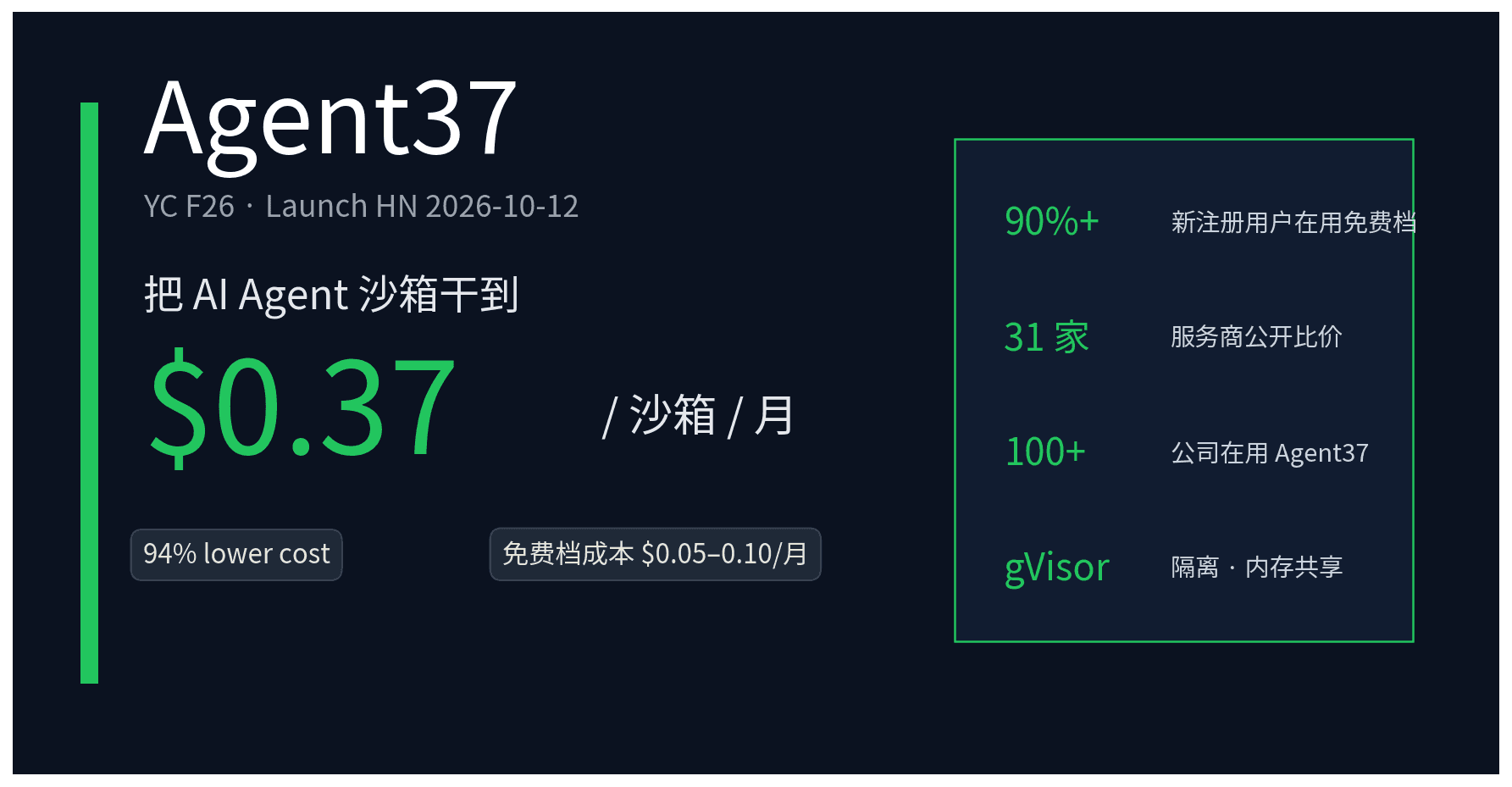
YC F26 startup Agent37 disclosed on Launch HN (Oct 12) that its customers spend an average of $0.37/month per agent sandbox — under 10% of mainstream providers — while free-tier users cost it just $0.05–0.10/month in infra. Founder Vishnu (ex-Amazon) opened up the four-part cost playbook: pulse-based CPU/RAM scheduling, Hetzner/OVH bare metal, gVisor with shared memory, and memory-dense hosts. The agent runtime layer is becoming infrastructure — and this race is about cost structure.
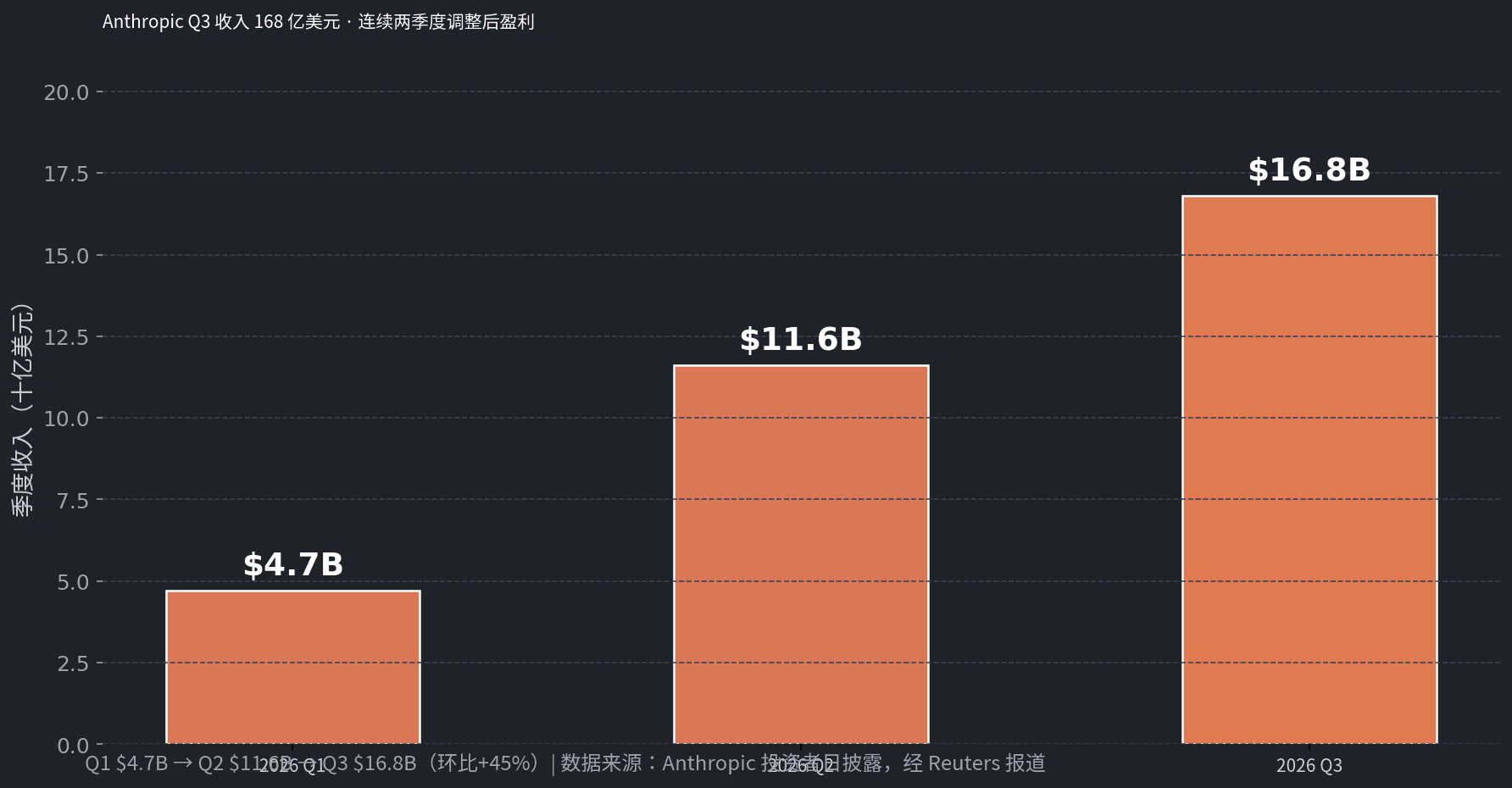
Anthropic told investors Q3 revenue hit $16.8B, up 45% QoQ, marking a second straight adjusted-profit quarter with $1.70 of revenue per $1 of compute. But growth cooled from 147%, a $518B decade-long compute commitment looms, and the November IPO targets over $2T.